Retargeting
Retargeting
Retargeting
Retargeting shows ads to people who already know your brand. Learn how it works, which audiences to target, and why creative is the key to making it convert.
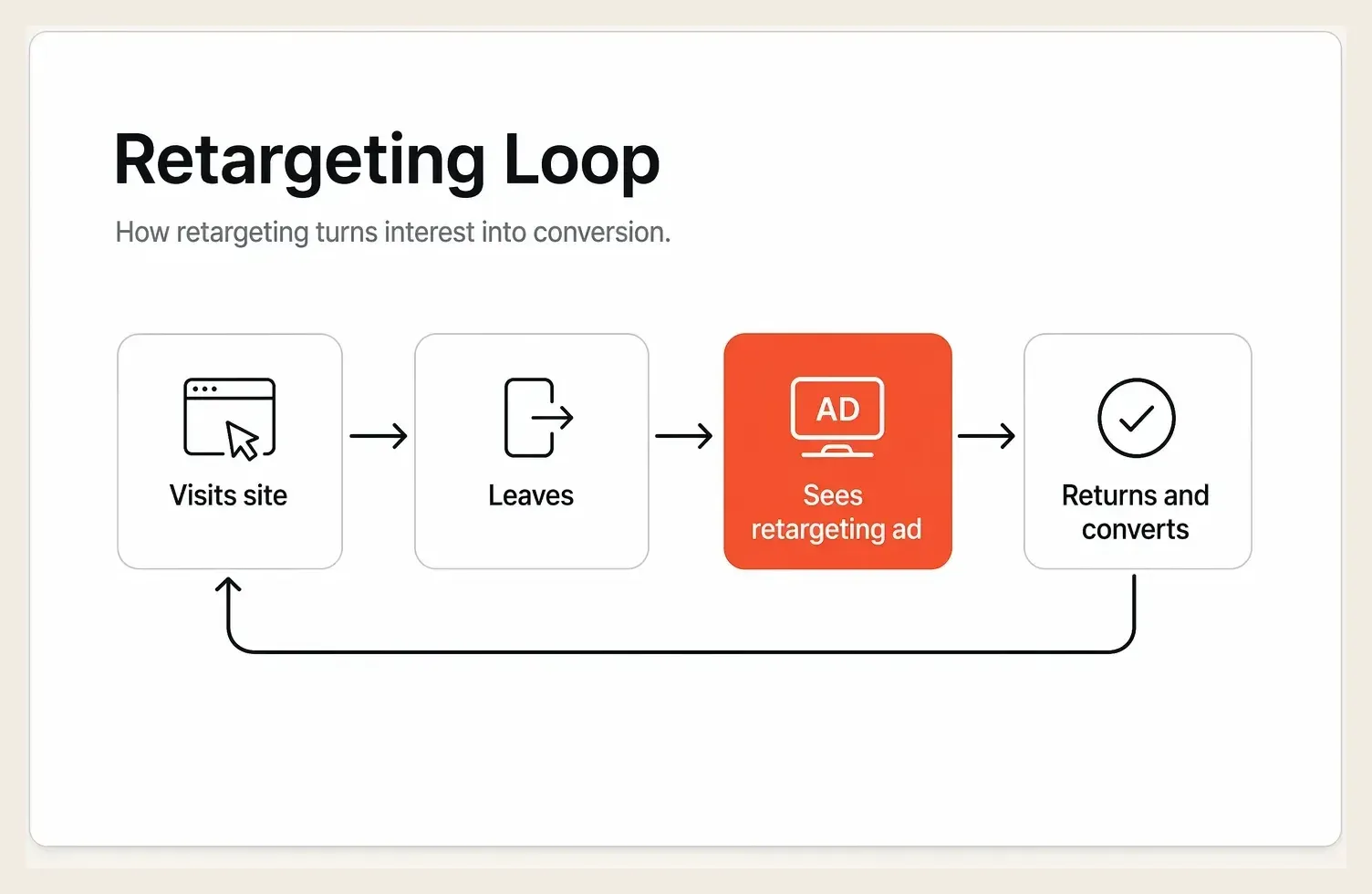
Retargeting (also called remarketing) is a paid advertising strategy that shows ads specifically to people who have already interacted with your brand — visited your website, watched your video, added something to their cart, or clicked your ad - but didn't take the action you wanted. Instead of starting from zero with strangers, you're picking up the conversation where it left off.
Think of it this way: if someone walks into your store, browses for 10 minutes, and leaves without buying, you wouldn't send them the exact same promotional flyer you mail to people who've never heard of you. You'd tailor the message - maybe highlight a review they might have missed, or offer free shipping to close the deal. Retargeting is that tailored follow-up, at scale, in paid ads.
Why It Matters
Retargeting audiences convert at 2–5x higher rates than cold traffic because they already know who you are - the trust barrier is lower, and the intent signal is stronger. But here's what most marketers get wrong: they run the exact same creative to warm audiences as they do to cold ones. That's not retargeting. That's just paying twice for the same message that already didn't work.
The real power of retargeting comes from creative that speaks to where the person is in the funnel and that requires understanding what's actually driving (or blocking) conversions at each stage.
How It Works
You install a tracking pixel - Meta Pixel or Google Tag fires on your website and records visitor events: which pages they visited, what they added to cart, whether they started checkout. These events build the audience pools your ads will target.
You create Custom Audiences based on behaviour - cart abandoners, product page viewers, video watchers, past purchasers. Each segment has different intent levels, and each deserves different creative.
Your ads are served back to these audiences - across Facebook, Instagram, Google Display, YouTube, and more. The platform matches the tracked users (via cookies or device IDs) and shows your ads in their feeds.
You optimize by segment and creative — a cart abandoner needs urgency and friction-removal ("Still thinking it over? Free returns, always."). A product page visitor might need social proof. A past customer needs a reason to come back. Each segment = a different message.
Real-World Example
A D2C apparel brand is running prospecting campaigns at a ₹420 CPA. They notice their cart abandonment rate is 68% - meaning nearly 7 out of 10 shoppers are leaving without buying.
They set up three retargeting segments:
Cart abandoners → shown a UGC video testimonial with a "Free shipping for the next 24 hours" CTA → ₹185 CPA
Product page viewers (no add to cart) → shown a static ad with a size guide and a 4.8-star rating badge → ₹240 CPA
Past purchasers → shown a cross-sell carousel featuring complementary products → ₹160 CPA (repeat purchase)
By matching creative to audience intent - rather than running one generic ad - they reduced blended CPA by 38% and recovered an estimated ₹4.2L in revenue that would have otherwise been lost to abandonment.
Common Mistakes
❌ Mistake | ✅ What to Do Instead |
|---|---|
Running the same prospecting creative to retargeting audiences (warm audiences need different messaging) | Create funnel-specific creative: objection-handling, social proof, and urgency for warm audiences — not the same awareness-stage hook |
Retargeting your entire website audience as one segment (too broad, dilutes relevance) | Segment by behavior and intent: cart abandoners, product page viewers, and checkout dropoffs each need different ads |
Ignoring frequency - bombarding a small retargeting audience with the same ad until creative fatigue kills performance | Cap frequency (3–4 impressions per week for most retargeting audiences), rotate creative regularly, and monitor CTR trends for early fatigue signals |
How Hawky Helps
Retargeting is where creative intelligence matters most - because small creative differences create massive CPA gaps across warm audiences. Hawky's element-level analysis breaks down which hooks, CTAs, visual formats, and messaging angles are actually converting at each funnel stage, so you can build retargeting creative backed by data, not guesswork.
Learn More
Creative Performance Analysis: How to Find Your Winning Creative
How to Master Meta's Attribution Model: A Deep Dive into First-Party Data
Quick Takeaway
Retargeting gives you a second chance with warm audiences - but only if your creative is tailored to where they dropped off, not a repeat of the ad that didn't convert them the first time.
Retargeting (also called remarketing) is a paid advertising strategy that shows ads specifically to people who have already interacted with your brand — visited your website, watched your video, added something to their cart, or clicked your ad - but didn't take the action you wanted. Instead of starting from zero with strangers, you're picking up the conversation where it left off.
Think of it this way: if someone walks into your store, browses for 10 minutes, and leaves without buying, you wouldn't send them the exact same promotional flyer you mail to people who've never heard of you. You'd tailor the message - maybe highlight a review they might have missed, or offer free shipping to close the deal. Retargeting is that tailored follow-up, at scale, in paid ads.
Why It Matters
Retargeting audiences convert at 2–5x higher rates than cold traffic because they already know who you are - the trust barrier is lower, and the intent signal is stronger. But here's what most marketers get wrong: they run the exact same creative to warm audiences as they do to cold ones. That's not retargeting. That's just paying twice for the same message that already didn't work.
The real power of retargeting comes from creative that speaks to where the person is in the funnel and that requires understanding what's actually driving (or blocking) conversions at each stage.
How It Works
You install a tracking pixel - Meta Pixel or Google Tag fires on your website and records visitor events: which pages they visited, what they added to cart, whether they started checkout. These events build the audience pools your ads will target.
You create Custom Audiences based on behaviour - cart abandoners, product page viewers, video watchers, past purchasers. Each segment has different intent levels, and each deserves different creative.
Your ads are served back to these audiences - across Facebook, Instagram, Google Display, YouTube, and more. The platform matches the tracked users (via cookies or device IDs) and shows your ads in their feeds.
You optimize by segment and creative — a cart abandoner needs urgency and friction-removal ("Still thinking it over? Free returns, always."). A product page visitor might need social proof. A past customer needs a reason to come back. Each segment = a different message.
Real-World Example
A D2C apparel brand is running prospecting campaigns at a ₹420 CPA. They notice their cart abandonment rate is 68% - meaning nearly 7 out of 10 shoppers are leaving without buying.
They set up three retargeting segments:
Cart abandoners → shown a UGC video testimonial with a "Free shipping for the next 24 hours" CTA → ₹185 CPA
Product page viewers (no add to cart) → shown a static ad with a size guide and a 4.8-star rating badge → ₹240 CPA
Past purchasers → shown a cross-sell carousel featuring complementary products → ₹160 CPA (repeat purchase)
By matching creative to audience intent - rather than running one generic ad - they reduced blended CPA by 38% and recovered an estimated ₹4.2L in revenue that would have otherwise been lost to abandonment.
Common Mistakes
❌ Mistake | ✅ What to Do Instead |
|---|---|
Running the same prospecting creative to retargeting audiences (warm audiences need different messaging) | Create funnel-specific creative: objection-handling, social proof, and urgency for warm audiences — not the same awareness-stage hook |
Retargeting your entire website audience as one segment (too broad, dilutes relevance) | Segment by behavior and intent: cart abandoners, product page viewers, and checkout dropoffs each need different ads |
Ignoring frequency - bombarding a small retargeting audience with the same ad until creative fatigue kills performance | Cap frequency (3–4 impressions per week for most retargeting audiences), rotate creative regularly, and monitor CTR trends for early fatigue signals |
How Hawky Helps
Retargeting is where creative intelligence matters most - because small creative differences create massive CPA gaps across warm audiences. Hawky's element-level analysis breaks down which hooks, CTAs, visual formats, and messaging angles are actually converting at each funnel stage, so you can build retargeting creative backed by data, not guesswork.
Learn More
Creative Performance Analysis: How to Find Your Winning Creative
How to Master Meta's Attribution Model: A Deep Dive into First-Party Data
Quick Takeaway
Retargeting gives you a second chance with warm audiences - but only if your creative is tailored to where they dropped off, not a repeat of the ad that didn't convert them the first time.
Retargeting (also called remarketing) is a paid advertising strategy that shows ads specifically to people who have already interacted with your brand — visited your website, watched your video, added something to their cart, or clicked your ad - but didn't take the action you wanted. Instead of starting from zero with strangers, you're picking up the conversation where it left off.
Think of it this way: if someone walks into your store, browses for 10 minutes, and leaves without buying, you wouldn't send them the exact same promotional flyer you mail to people who've never heard of you. You'd tailor the message - maybe highlight a review they might have missed, or offer free shipping to close the deal. Retargeting is that tailored follow-up, at scale, in paid ads.
Why It Matters
Retargeting audiences convert at 2–5x higher rates than cold traffic because they already know who you are - the trust barrier is lower, and the intent signal is stronger. But here's what most marketers get wrong: they run the exact same creative to warm audiences as they do to cold ones. That's not retargeting. That's just paying twice for the same message that already didn't work.
The real power of retargeting comes from creative that speaks to where the person is in the funnel and that requires understanding what's actually driving (or blocking) conversions at each stage.
How It Works
You install a tracking pixel - Meta Pixel or Google Tag fires on your website and records visitor events: which pages they visited, what they added to cart, whether they started checkout. These events build the audience pools your ads will target.
You create Custom Audiences based on behaviour - cart abandoners, product page viewers, video watchers, past purchasers. Each segment has different intent levels, and each deserves different creative.
Your ads are served back to these audiences - across Facebook, Instagram, Google Display, YouTube, and more. The platform matches the tracked users (via cookies or device IDs) and shows your ads in their feeds.
You optimize by segment and creative — a cart abandoner needs urgency and friction-removal ("Still thinking it over? Free returns, always."). A product page visitor might need social proof. A past customer needs a reason to come back. Each segment = a different message.
Real-World Example
A D2C apparel brand is running prospecting campaigns at a ₹420 CPA. They notice their cart abandonment rate is 68% - meaning nearly 7 out of 10 shoppers are leaving without buying.
They set up three retargeting segments:
Cart abandoners → shown a UGC video testimonial with a "Free shipping for the next 24 hours" CTA → ₹185 CPA
Product page viewers (no add to cart) → shown a static ad with a size guide and a 4.8-star rating badge → ₹240 CPA
Past purchasers → shown a cross-sell carousel featuring complementary products → ₹160 CPA (repeat purchase)
By matching creative to audience intent - rather than running one generic ad - they reduced blended CPA by 38% and recovered an estimated ₹4.2L in revenue that would have otherwise been lost to abandonment.
Common Mistakes
❌ Mistake | ✅ What to Do Instead |
|---|---|
Running the same prospecting creative to retargeting audiences (warm audiences need different messaging) | Create funnel-specific creative: objection-handling, social proof, and urgency for warm audiences — not the same awareness-stage hook |
Retargeting your entire website audience as one segment (too broad, dilutes relevance) | Segment by behavior and intent: cart abandoners, product page viewers, and checkout dropoffs each need different ads |
Ignoring frequency - bombarding a small retargeting audience with the same ad until creative fatigue kills performance | Cap frequency (3–4 impressions per week for most retargeting audiences), rotate creative regularly, and monitor CTR trends for early fatigue signals |
How Hawky Helps
Retargeting is where creative intelligence matters most - because small creative differences create massive CPA gaps across warm audiences. Hawky's element-level analysis breaks down which hooks, CTAs, visual formats, and messaging angles are actually converting at each funnel stage, so you can build retargeting creative backed by data, not guesswork.
Learn More
Creative Performance Analysis: How to Find Your Winning Creative
How to Master Meta's Attribution Model: A Deep Dive into First-Party Data
Quick Takeaway
Retargeting gives you a second chance with warm audiences - but only if your creative is tailored to where they dropped off, not a repeat of the ad that didn't convert them the first time.
Make Every Ad a Winner
Hooks, CTAs, visuals - decode every detail.
Ready to Stop Guessing and Start Winning with Creative Intelligence?
Company
Ready to Stop Guessing and Start Winning with Creative Intelligence?
Company
Ready to Stop Guessing and Start Winning with Creative Intelligence?
Company