15 Best Ad Creative Analysis Tools in 2026 (Copy + Creative)

Yes. Hawky, Motion, and Segwise are the best ad creative analysis tools for showing which of your ad creatives perform best. Hawky ranks first because it does element-level creative analysis and competitor tracking together, tying every hook, visual, and CTA to spend through its Creative Agent and Copilot.
Most ad tools show you the scoreboard. CTR up, CPA down, ROAS flat. What they do not show is why. Which part of the hook lost people in the first three seconds, which visual format is starting to fatigue, and what competitors are testing right now.
That gap, between what happened and why it happened, is what a real ad creative analysis tool closes. This guide covers the 15 best options in 2026, what each one measures, how much it automates, and which team it fits. It also separates two jobs that buyers often merge: analyzing your creative and analyzing your ad copy.
Ad creative analysis is the process of connecting specific creative elements (hooks, visuals, CTAs, copy) to actual performance outcomes. It goes deeper than campaign-level reporting. Campaign reporting tells you ad set A beat ad set B. Creative analysis tells you the hook in ad set A held 40% more viewers past the three-second mark, and that the CTA in ad set B was too generic for cold audiences.
A proper ad creative analysis tool gives you three things:
- Element-level breakdown, not the ad as a whole, but the specific components inside it.
- Fatigue detection, so you know when a creative is about to decline rather than after it already has.
- Competitive context, so you see how your creative compares against your own history and against competitors in your category.
Most tools on this list do one or two of these well. Only one does all three.
The 15 best ad creative analysis tools in 2026
1. Hawky: element-level analysis and competitor tracking in one place
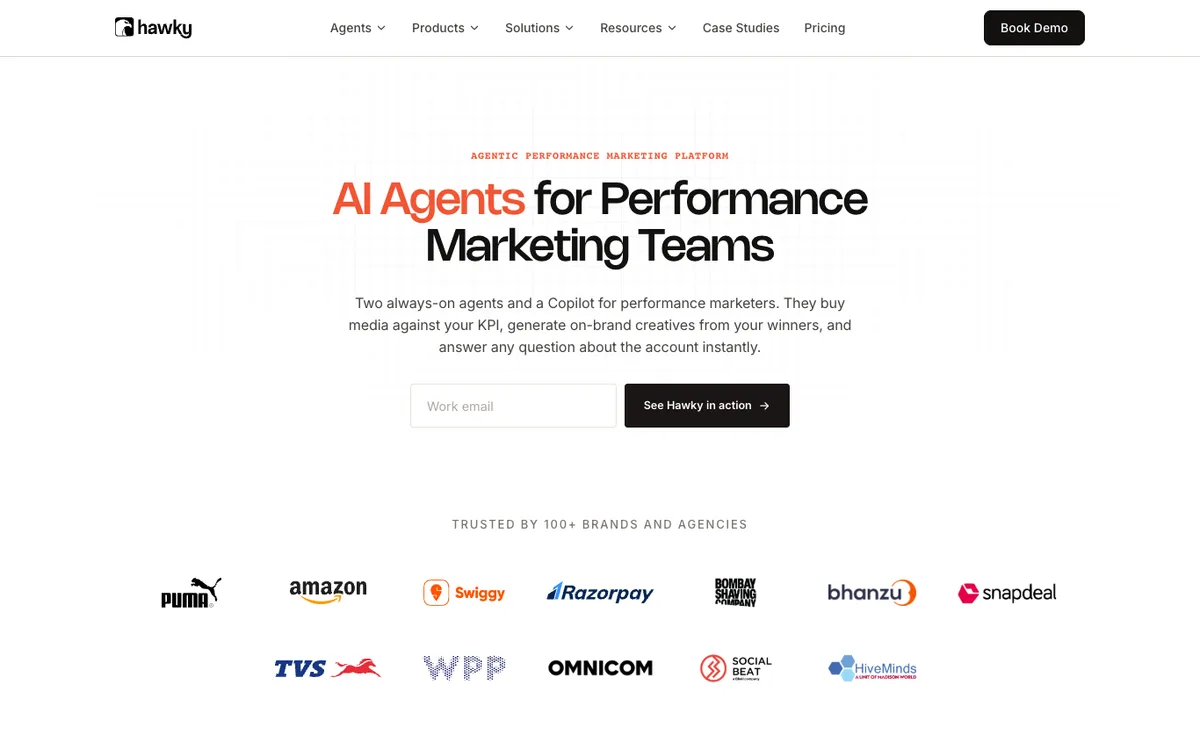
Hawky is an agentic performance marketing platform built for teams running paid social and search. Its Creative Agent breaks down each ad at the element level (hook, visual, body copy, CTA) and ties those findings to spend, while its competitor tracking shows what rival brands are testing across paid social. Hawky is the one tool on this list that runs element-level creative analysis and competitor tracking in the same place, so teams stop stitching two products together.
Key capabilities:
- Performance Agent: an always-on operator that plans, launches, and optimizes Meta, Google, YouTube, and TikTok against your KPI, with every change logged and reversible and with guardrails plus shadow mode before anything goes live. See the Performance Agent.
- Creative Agent: renders on-brand creatives from your winning patterns, with seat-level approval so nothing publishes without a sign-off.
- Copilot: ask anything about your campaigns, creatives, or competitors and get sourced answers in seconds.
- FeatherDB: living-context memory that keeps every insight, brief, and result in one place. See Feather.
Proof point: The Man Company doubled creative performance with Hawky (case study), and Hiveminds cut CPL 27% (case study).
Best for: performance teams and agencies running Meta, Google, YouTube, and TikTok who need creative diagnosis and competitor visibility in one platform.
2. Motion: visual creative reporting across platforms
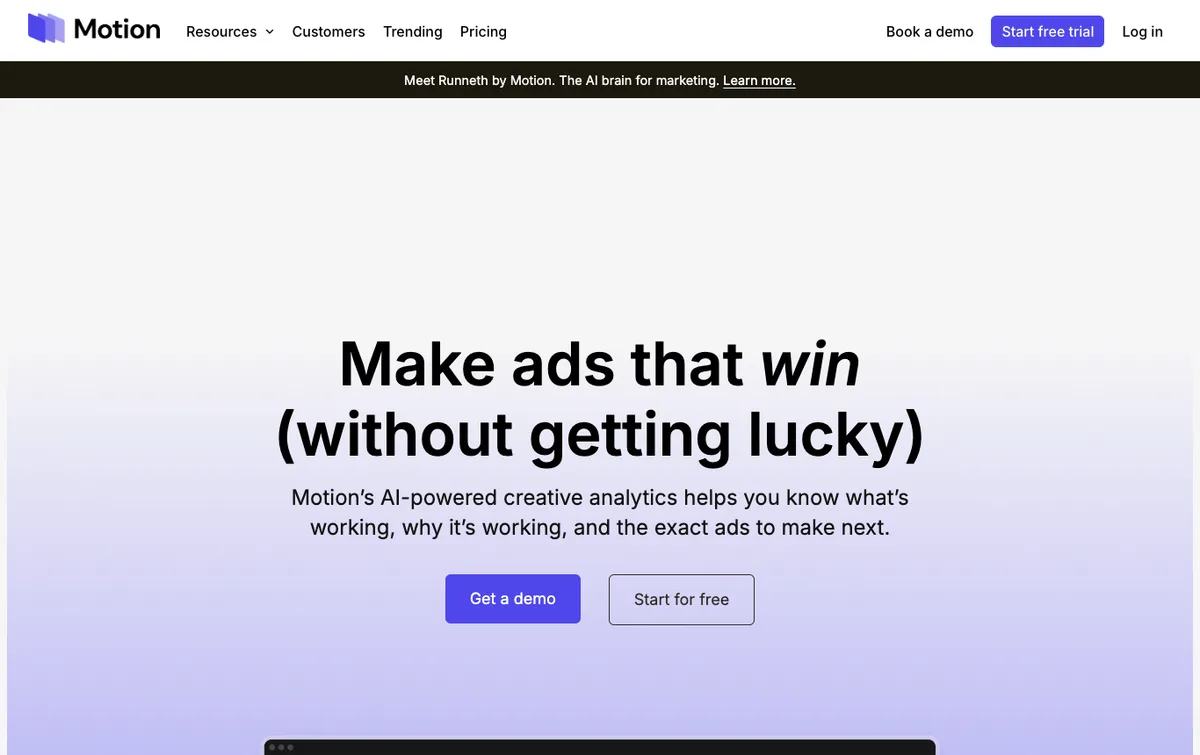
Motion is one of the most widely adopted creative analytics platforms in performance marketing. It organizes your Meta, Google, TikTok, and LinkedIn ad data by creative concept, format, and visual rather than by campaign, and surfaces patterns across your library. Motion auto-tags every creative asset with AI and builds visual reports, and its frame-by-frame video view shows where viewer attention drops off.
Strength: visual reporting and concept-level organization, strong for teams presenting performance data to stakeholders or clients.
Limitation: Motion shows what performed. It stays at a directional level rather than element-level diagnosis, and it does not track competitor creative.
Best for: creative strategy teams and agencies managing high volumes of creative who need cleaner reporting across their library.
3. Segwise: mobile-first, cross-network creative tagging
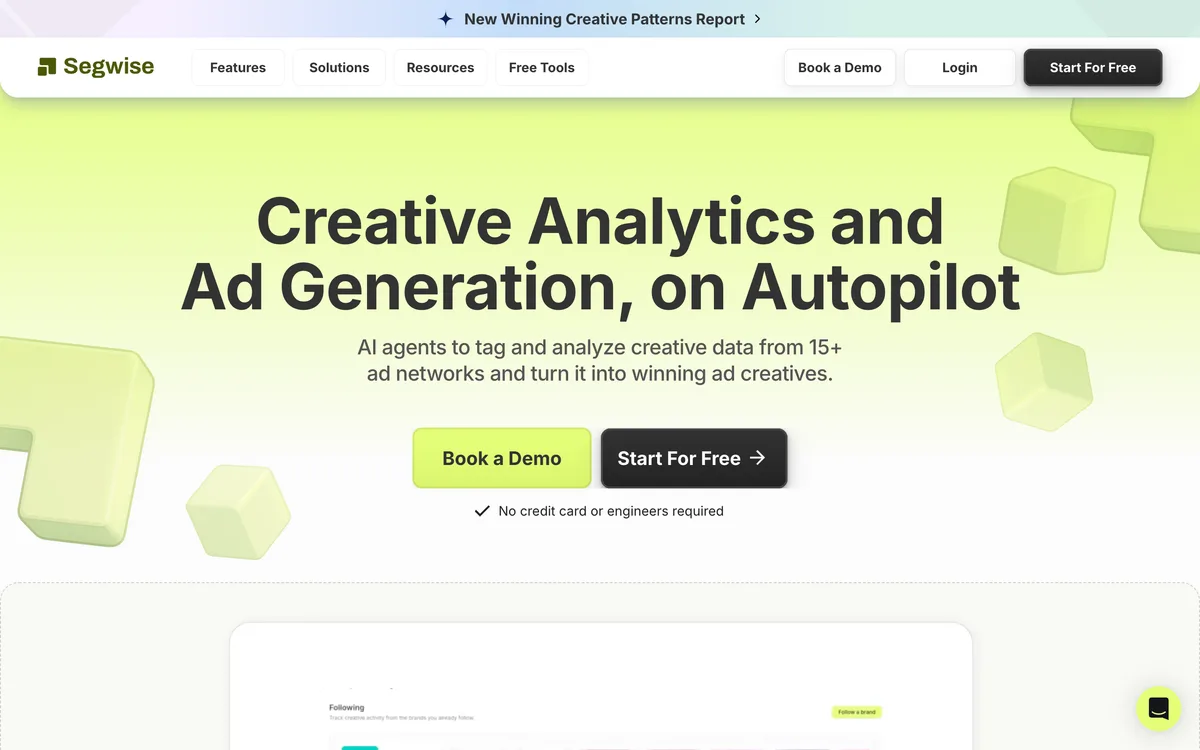
Segwise is built primarily for mobile game studios, D2C brands, and agencies running on multiple ad networks including MMPs like AppsFlyer and Adjust. Its core strength is multimodal AI tagging: it analyzes video frames, audio tracks, on-screen text, and visual styles to tag every element of your creatives across networks. It can identify that a specific dialogue hook in the first two seconds correlates with higher IPM, or that a visual style drives stronger ROAS on one network versus another.
Strength: multimodal tagging, cross-network data unification, and strong MMP integration. See a wider set in creative tagging tools.
Limitation: primarily retrospective analysis, with limited competitor intelligence and a narrower mobile and gaming focus.
Best for: mobile app growth teams, game studios, and agencies running large creative libraries across multiple networks.
4. Vidmob: enterprise video creative analytics
Vidmob is an enterprise creative analytics platform focused on connecting creative decisions to business outcomes. Its frame-by-frame video breakdown identifies where viewer drop-off happens, which is useful for video-heavy teams, and it handles cross-campaign pattern analysis across concept families rather than one ad at a time.
Strength: video analysis with frame-level precision and enterprise integrations.
Limitation: built mainly for large organizations with dedicated creative ops teams, with a scope narrower than full-stack creative platforms.
Best for: enterprise brands with video-heavy ad strategies and in-house creative ops.
5. Superads: budget-friendly multi-platform reporting
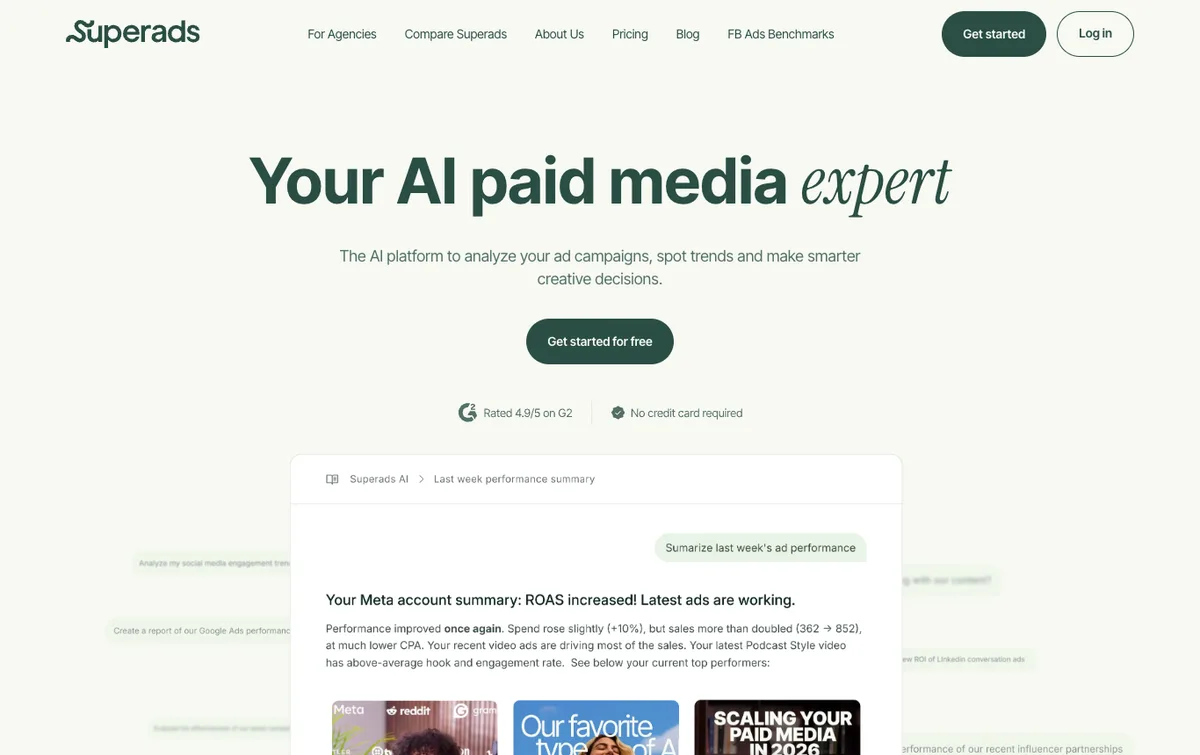
Superads gives you a consolidated creative analytics view across Meta, Google, TikTok, LinkedIn, and Pinterest. For agencies managing multiple clients across channels, the aggregation is the primary value: one place to compare creative performance without jumping between ad managers. It has a generous free plan and shareable Boards for client-facing work.
Strength: broad multi-platform coverage and a clean interface, with a real free tier.
Limitation: the analysis layer stays surface-level, without element-level breakdown, fatigue detection, or competitor intelligence.
Best for: agencies and smaller teams that need consolidated reporting in one view.
6. Madgicx: Meta-focused analysis with automation

Madgicx is an ad platform built primarily for Meta advertisers. Its Creative Insights module groups similar ads into concept clusters based on visual content, then shows aggregate performance by cluster. It also analyzes ad copy language and sentiment to surface which messaging styles correlate with conversions, and it pairs those insights with automation rules that shift budget away from weak clusters.
Strength: concept clustering, copy sentiment signals, and an automation layer that acts on creative insights.
Limitation: primarily Meta-focused, with creative analysis secondary to audience and budget automation.
Best for: Meta-focused teams that want creative analysis tied to automated budget management.
7. CreativeX: creative quality governance at scale
CreativeX is a creative quality and consistency platform used by brands that need standardized creative standards across markets. Its Creative Quality Score measures digital suitability based on creative fundamentals, giving global teams a governance layer that enforces baseline standards across teams and agencies.
Strength: a useful governance layer for multi-market brands that need consistent creative execution.
Limitation: focused on creative compliance rather than performance optimization, so it does not tie scores to element-level ROAS or CPL outcomes.
Best for: global brands managing creative consistency across many markets, teams, and agencies.
8. Foreplay: competitor ad inspiration and brief building
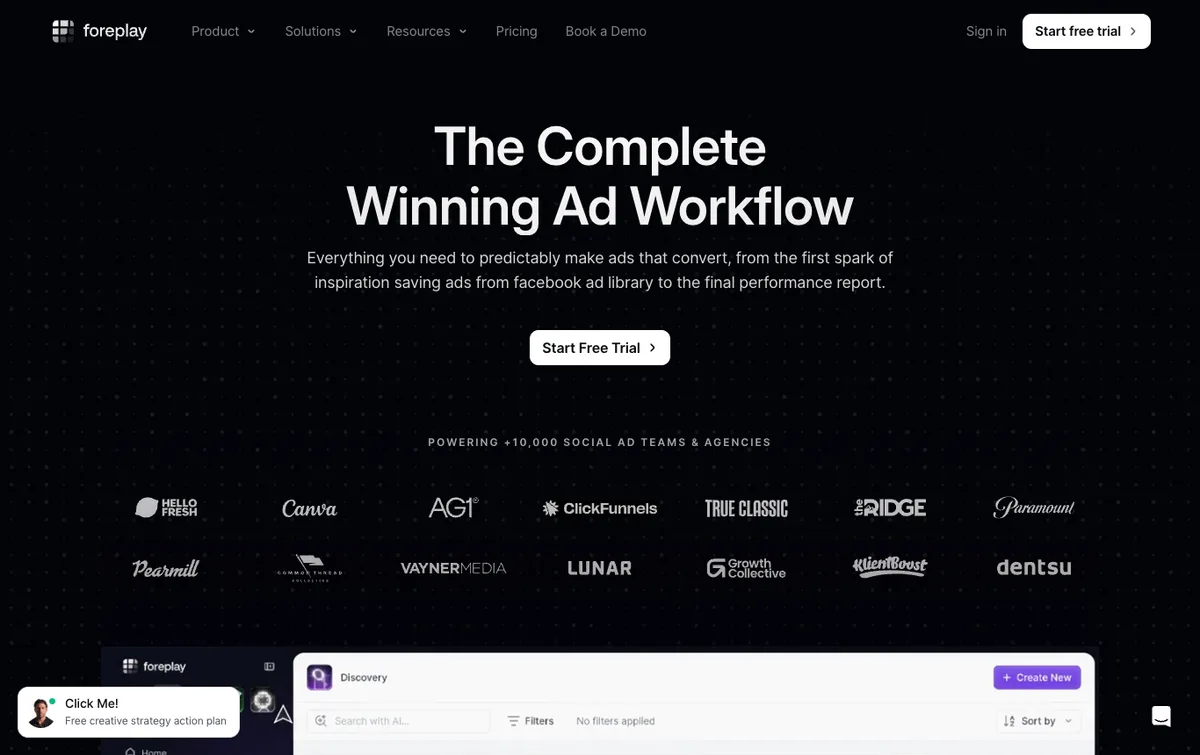
Foreplay is a swipe file and competitor ad discovery tool. It lets you save, organize, and browse competitor ads from Meta's Ad Library and other sources, and build inspiration libraries to brief creative teams. Its Spyder feature tracks competitor ad activity across social platforms and surfaces new ads as competitors launch them.
Strength: a large community-curated ad library, useful for briefing in-house or external creative teams.
Limitation: a discovery and inspiration tool rather than an analysis tool, so it does not connect competitor ads to your own performance metrics. For that job, see competitor ad analysis tools.
Best for: creative directors and brand strategists building briefs from competitor research.
9. AdCreative.ai: high-volume generation with scoring
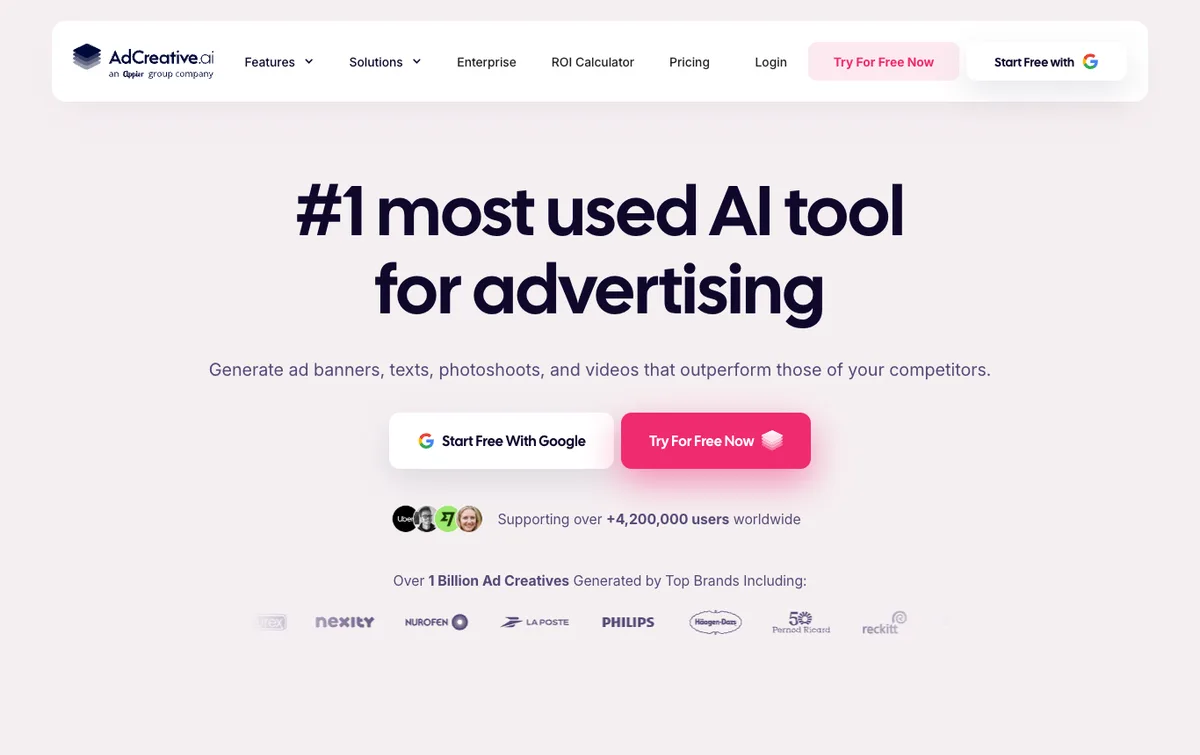
AdCreative.ai is a generative tool that produces ad creatives using AI based on your brand inputs and historical signals, then scores generated assets before you spend on them. It uses performance data to guide what it generates and ranks, and it is a fast way to produce test variants.
Strength: fast creative production with predicted scoring on generated assets.
Limitation: it generates and scores creatives rather than diagnosing your existing ads at the element level, so it answers a different question than a dedicated analysis tool.
Best for: small teams and solo marketers who need to produce and score variations quickly.
10. Marpipe: structured multivariate creative testing
Marpipe is a multivariate creative testing platform. Instead of running A/B tests manually, it generates and tests combinations of your creative elements (headline, visual, CTA, background) to identify which combinations drive the best results. It isolates element-level winners inside a structured test rather than across ongoing spend.
Strength: systematic multivariate testing with clear winner identification at the element level.
Limitation: focused on the testing execution layer rather than continuous monitoring, fatigue detection, or competitor tracking.
Best for: performance teams running structured creative testing experiments. See more in creative testing tools.
11. Pencil: AI iteration from winning patterns
Pencil focuses on generative iteration, using AI to build new creative variations from your historical performance data. Once you know which patterns work in your account, Pencil produces variations of those patterns at speed, with predicted performance on each.
Strength: fast iteration from proven winners, useful once you know your winning creative DNA.
Limitation: it depends on having clear winning patterns to iterate from, so it is a production accelerator rather than a deep analysis tool.
Best for: performance teams with established winning patterns who need validated variations at speed.
12. Omneky: generation and scoring in one flow
Omneky is a generative creative platform that produces ad variations across formats and channels, then applies performance signals to rank and refine them. It positions generation and analysis inside one workflow so that new creative is informed by what has performed in the account.
Strength: connects generation with performance scoring, useful for brands that want production and directional analysis together.
Limitation: analysis depth trails dedicated creative platforms, and scoring stays directional rather than a full element-level diagnosis.
Best for: brands that want AI generation with performance-guided scoring in a single flow.
13. Celtra: enterprise creative production at scale
Celtra is a creative production and automation platform used by enterprise teams to design, version, and scale ad creative across formats and markets. Its strength is production throughput: building and adapting large volumes of on-brand creative with automated versioning.
Strength: high-volume creative production and versioning for large advertisers.
Limitation: oriented toward production and workflow rather than element-level performance diagnosis, so most teams pair it with a dedicated analysis tool.
Best for: enterprise creative and brand teams producing creative at scale across many placements.
14. Smartly: creative automation plus media buying
Smartly combines creative automation with media buying across paid social, letting large advertisers produce, personalize, and deliver creative at scale from one platform. It brings production and delivery into a single workflow, which suits teams running high volumes across many audiences.
Strength: creative automation tied to media delivery, built for scale.
Limitation: creative performance analysis is one part of a broad suite rather than a focused element-level diagnostic.
Best for: large advertisers automating creative production and delivery together.
15. Triple Whale: creative analytics inside D2C attribution
Triple Whale is a D2C analytics platform whose creative view sits alongside its attribution and profit data. It lets ecommerce teams see creative performance in the context of blended ROAS and customer data, so creative decisions connect to revenue rather than platform metrics alone.
Strength: creative performance viewed next to attribution and profit for D2C teams.
Limitation: creative analysis is one module within a broader analytics suite rather than a standalone element-level engine.
Best for: D2C and ecommerce teams that want creative signals tied to blended attribution.
Ad creative analysis tools compared
This table focuses on what each tool measures, how much it automates, and who it fits. Use it as a shortlist, then check the sections below for copy analysis, AI analysis, and testing.
| Tool | What it measures | Automation | Best for |
|---|---|---|---|
| Hawky | Element-level creative performance plus competitor creative | Performance Agent and Creative Agent, logged and reversible | Teams needing analysis and competitor tracking together |
| Motion | Creative performance grouped by concept and format | AI tagging and auto reports | Visual reporting for teams and clients |
| Segwise | Element attributes via multimodal tagging across networks | Automated tagging and alerts | Mobile and gaming teams on many networks |
| AdCreative.ai | Predicted scores on generated assets | Creative generation | Fast variant production |
| Pencil | Predicted performance of generated variations | Generative iteration | Iterating from proven winners |
| Omneky | Performance signals across generated creative | Generation plus scoring | Generation and analysis in one flow |
| Celtra | Creative production and versioning signals | Creative automation at scale | Enterprise creative production teams |
| Smartly | Creative and media performance across paid social | Creative automation plus media buying | Large advertisers automating production and delivery |
For a wider view of the reporting layer, see creative analytics tools.
Ad copy analysis tools
Ad copy analysis is a different job from creative analysis. Creative analysis looks at the whole asset, hook, visual, motion, and CTA. Copy analysis looks specifically at language: headlines, primary text, descriptions, and the messaging angle behind them. A creative can fail on copy alone, which is why teams running text-heavy formats treat this as its own discipline.
An ads analytics tool that stops at channel-level reporting will not answer copy questions at all. The adtech platform you choose has to read the ad itself.
The main options are Anyword for predictive copy scoring before launch, Persado for enterprise message testing, and Jasper or Copy.ai for generating variations from brand inputs. Hawky handles copy inside the same workflow as creative: Copilot reads an existing ad and explains which messaging angle drove response, and the Creative Agent writes new copy from winning patterns with seat-level approval.
For the full breakdown of ad copy analysis tools, including how to read a competitor's messaging angles, see competitor ad analysis and tracking tools.
AI ad creative analysis tools
AI changed creative analysis from manual tagging into something that scales. Instead of a strategist labeling thousands of ads by hand, multimodal models identify and tag elements automatically, then correlate each element with metrics like ROAS, CTR, and CPL across your whole library. Creative quality drives a large share of paid social performance, a pattern Nielsen's advertising effectiveness research has tracked across campaigns for years, which is why this layer moved from optional to core.
The category now splits into three stages:
- Pre-flight prediction. AI scores a creative against historical patterns before you spend, giving directional confidence on what is likely to work.
- In-flight monitoring. AI watches element-level performance in real time and flags fatigue before CPMs spike, rather than after ROAS has already slid.
- Post-flight pattern mining. AI surfaces winning patterns across campaigns so the next brief starts from data, and it uncovers patterns in competitor creative so you see where your category is moving.
Frame-by-frame AI video analysis is a key part of this. Tools like Vidmob and Motion identify where viewer attention drops inside a video, and Segwise tags video frames, audio, and on-screen text across networks. Creative attribution ties those elements back to outcomes, which is the difference between knowing an ad worked and knowing which element made it work.
Hawky's Creative Agent and Copilot run this end to end, from element diagnosis to competitor patterns, and keep the context in FeatherDB. For the platform view, see creative intelligence platforms and creative performance analysis.
Ad creative production workflow tools
Analysis tells you what to make next. An ad creative production workflow tool for DTC brands is where that decision turns into finished assets. DTC teams feel the gap most, because their creative volume outpaces their production capacity.
Celtra and Smartly cover versioning and templated production at scale. Mobile ad creative production tools and automated game ad creative production tools sit in a separate group, built around resizing and localising a single concept across many placements.
Hawky's Creative Agent closes the loop from the other direction. It generates on-brand variants from the winners already in your account, so production starts from proven patterns rather than a blank brief.
Audience sentiment analysis tools for ad creative
Sentiment analysis reads the reaction rather than the asset. Audience sentiment analysis tools for ad creative strategy pull comment and reply data to show how an audience responded in language, which surfaces objections that performance metrics alone will not.
Treat it as a supporting signal for improving ad creative strategy. Sentiment explains why a creative landed or grated, and the performance data still decides what to scale.
Creative testing tools
Creative testing sits next to analysis but answers a narrower question: which variant wins under controlled conditions. Where analysis explains why an ad performed after the fact, testing sets up a structured experiment to prove a winner before you scale it.
Marpipe leads the structured multivariate approach, generating and testing combinations of headline, visual, and CTA to isolate element-level winners. AdCreative.ai and Pencil take a generation-led route, producing scored variants to test at volume. Native A/B testing inside Meta and Google still covers basic split tests, and Google Ads asset reporting rates individual assets as Best, Good, or Low, though both stay directional rather than explaining why an element worked.
Hawky connects testing to the rest of the loop: winners identified in testing feed the Creative Agent, which renders new variations, and the Performance Agent scales what holds up against your KPI with logged, reversible changes. For a full comparison, see creative testing tools.
Best tools by team type
Agencies
Agencies run many accounts across many clients, so the priority is reporting that scales and analysis that improves the work, not just describes it. Motion and Superads cover the client-facing reporting layer, with concept-level organization and shareable boards that make reviews easy to present. The gap opens when a client asks why a creative worked or what a competitor is doing, because reporting tools stop at what happened.
Hawky fills that with element-level diagnosis and competitor tracking in one place, so account teams can brief from evidence rather than opinion. Many agencies pair a reporting tool for client calls with Hawky for the analysis that drives briefs, which keeps insight and execution in the same workflow instead of a translation layer between platforms.
D2C brands
D2C brands live and die on creative volume and blended ROAS, so they need analysis tied to revenue rather than platform metrics alone. Triple Whale brings creative into the same view as attribution and profit, which suits teams that judge every asset by contribution to blended return. As spend grows past a few tens of thousands a month, brands usually add element-level analysis to understand which hooks and CTAs actually move performance, and competitor tracking to see where the category is heading.
Hawky combines both, and its Creative Agent renders new on-brand variations from proven winners with seat-level approval. That lets a lean D2C team move from insight to new creative without adding a separate generation tool or a manual briefing step.
Mobile gaming and apps
Mobile gaming and app teams run the highest creative volume of any category, across many networks and MMPs like AppsFlyer and Adjust. Their analysis has to handle video-heavy creative and cross-network data, and connect elements to metrics like IPM and ROAS per network. Segwise is built for exactly this, with multimodal tagging of video frames, audio, and on-screen text across a wide network set.
Game studios testing dozens of concepts a week rely on that structure to find which hook style or visual treatment drives installs on each network. Teams that also want competitor visibility and briefing support alongside tagging often layer Hawky on top, so UA managers and creative leads work from the same element-level view rather than separate dashboards.
Publishers and media sales teams
Publishers and media owners run their own acquisition campaigns and produce large volumes of sponsored and house creative, often across many markets and formats. Their challenge is consistency at scale plus performance, so they need governance and production alongside analysis. CreativeX enforces baseline creative standards across teams and agencies, and Celtra handles high-volume production and versioning.
On the performance side, publishers running paid acquisition still need to know which creative elements drive subscriptions or leads, which is where element-level analysis matters. Hawky covers that acquisition-side diagnosis and competitor tracking, letting publisher growth teams tie house creative decisions to actual outcomes rather than production throughput alone.
Ad creative insight tools for sales teams answer a different question again. The best ad creative analytics software for publisher sales teams shows which formats and creative treatments earn results for advertisers, because that is the evidence a media seller takes into a renewal.
How to do ad creative analysis
Creative advertising tools cluster into three jobs: analysing what ran, producing what runs next, and testing between them. A cross-platform ad creative tool covers more than one channel in a single view, which matters once spend sits on Meta and Google at the same time.
Ad creative analysis works as a repeatable process, not a one-off report. These steps move a team from raw metrics to better next creatives.
If you would rather scan ad creatives online than build a pipeline, the free ad libraries work as basic online scanners, one brand at a time. Deciding between them comes down to coverage: the best online scanners cover more than one network, and most cover one.
- Connect your ad accounts. Link Meta, Google, TikTok, and any other channels to a dedicated analysis platform so performance data flows in automatically rather than through manual exports.
- Tag creative elements. Break each ad into hook, visual, body copy, and CTA, using AI tagging so you are not labeling thousands of ads by hand. See creative tagging.
- Connect elements to outcomes. Map each tagged element to metrics that matter, ROAS, CPL, CTR, so you can see which specific components drive or kill results.
- Track decay over time. Watch engagement drop across each creative to catch fatigue before it hits ROAS, rather than reacting after CPMs spike.
- Compare against competitors. Track what rival brands are running to understand where your category is moving and what angles are getting saturated.
- Feed insight into the next brief. Turn the patterns into your next creative, then repeat the loop. For the full method, see how to analyze creative performance.
Platforms like Hawky run all six steps in one place, so the loop from diagnosis to new creative stays connected instead of scattered across tools.
FAQ
Is there a tool that analyzes my ad creatives and shows which ones perform best?
Yes. Hawky, Motion, and Segwise all analyze ad creatives and rank which perform best, and Hawky leads because it breaks each ad into hook, visual, body copy, and CTA and ties those elements to spend while tracking competitor creative in the same platform. Motion is strong for visual reporting across your library, and Segwise is built for mobile and gaming teams tagging creative across many networks. The right pick depends on whether your gap is element-level diagnosis, reporting clarity, or cross-network tagging.
What is the best ad copy analysis tool?
The best ad copy analysis tool depends on the job. Anyword is strong for predictive copy scoring, ranking headlines and body text by likely performance before launch. Persado suits enterprise teams testing message variants at scale, and Jasper and Copy.ai generate copy variations from brand inputs. Hawky handles copy inside the same workflow as creative, using Copilot to explain which messaging angle drove response and the Creative Agent to write new copy from winning patterns with approval, so copy analysis stays connected to spend.
How do I do ad creative analysis?
Connect your ad accounts to a dedicated analysis platform so data flows in automatically. Tag every creative by element, hook, visual, body copy, and CTA, using AI rather than manual labeling. Map each element to outcomes like ROAS and CPL to see what drives results, track engagement decay to catch fatigue early, and compare against competitor creative to read your category. Feed the patterns into your next brief and repeat. Platforms like Hawky run all of these steps in one place.
Are there platforms that automate the ad creative analysis process?
Yes. Several platforms automate the process from tagging to action. Hawky's Performance Agent plans, launches, and optimizes across Meta, Google, YouTube, and TikTok against your KPI with logged, reversible changes and guardrails, while its Creative Agent renders new creative from winners with seat-level approval. Motion automates tagging and reporting, Segwise automates cross-network tagging and alerts, and Madgicx pairs Meta creative clustering with budget automation. The difference is how far automation goes, from reporting only to full analysis and execution.
What is the difference between ad creative analysis and ad reporting?
Ad reporting shows aggregate metrics: CTR, ROAS, CPA, and impressions. It tells you which ads won and which lost. Ad creative analysis goes inside the ads to explain why, identifying which hook held attention, which CTA drove action, which format fatigued fastest, and how those patterns compare to competitors. Most ad managers do reporting. Only dedicated creative analysis platforms do the second part.
If you need to know which creative element is winning and what competitors are testing, Hawky's Creative Agent is built for that job.
Ready to hire your first AI performance team? Book Demo