Hook Rate: What It Is, How to Calculate It, and How to Improve It
Hook Rate: What It Is, How to Calculate It, and How to Improve It

Hook Rate: What It Is, How to Calculate It, and How to Improve It

Sudarshan Baskar

Sudarshan Baskar

Sudarshan Baskar

Mar 24, 2026

Mar 24, 2026

Mar 24, 2026

8 Mins Read

8 Mins Read

8 Mins Read

  • What is hook rate?

  • How to calculate hook rate Hook rate benchmarks by platform (2026)

  • Why hook rate matters more than CTR for diagnosing creative problems

  • What drives a low hook rate

  • How to improve hook rate: a testing framework

  • Hook rate as part of a creative testing

  • framework Frequently asked questions

Hook rate is the percentage of people who watch past the first 3 seconds of a video ad, calculated as 3-second video views divided by total impressions. It is the clearest leading indicator of video ad performance because no amount of compelling storytelling, strong offers, or sharp CTAs matters if viewers scroll past before any of it plays.

On Meta, a hook rate above 25% is table stakes. Above 30% is good. Above 40% is elite - the point where the algorithm starts treating your creative as genuinely relevant and rewards it with lower CPMs and broader distribution.

What is hook rate?

Hook rate measures what happens in the first three seconds of a video ad. Specifically, it tells you what percentage of people who saw your ad chose to keep watching past that initial threshold rather than scrolling past.

The metric goes by a few names - hook rate, thumb-stop rate, and video hook rate are used interchangeably across the industry. The underlying calculation is the same.

It matters disproportionately because platforms like Meta and TikTok use early engagement signals to determine how broadly to distribute your ad. A creative that loses most viewers in the first three seconds signals low relevance to the algorithm, resulting in reduced delivery, higher CPMs, and worse overall campaign efficiency. A creative that holds attention earns the opposite: more distribution at a lower cost.

The first three seconds are not just the hook for the viewer. They are also the primary signal the platform uses to decide whether your ad deserves to be shown to more people.

How to calculate hook rate

Hook rate formula:

Hook rate = (3-second video views / total impressions) x 100

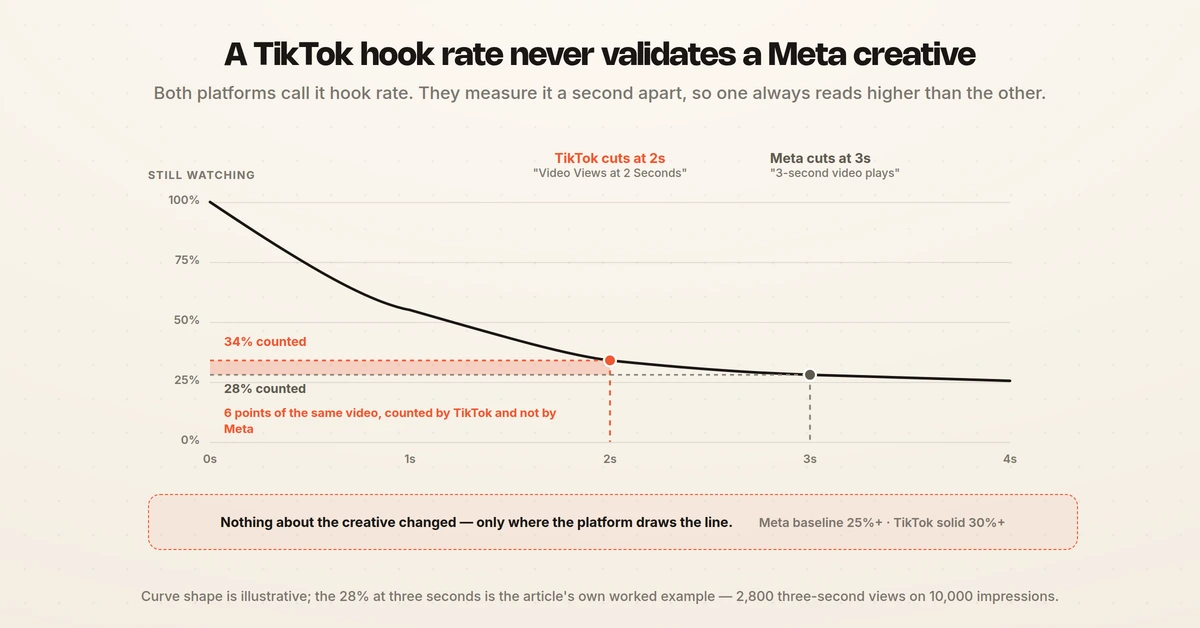
Example: if your video ad receives 10,000 impressions and 2,800 people watch past the 3-second mark, your hook rate is 28%.

How to find this in each platform

Meta Ads Manager: The metric is labeled "3-second video plays." Divide that by impressions and multiply by 100. Meta does not surface hook rate as a default column - you need to create a custom metric. Go to Columns → Customize Columns → create a custom metric using the formula above. Meta's official documentation on video ad metrics covers all available video play columns in full.

TikTok Ads Manager: Look for "Video Views at 2 Seconds" (TikTok uses a 2-second threshold rather than Meta's 3-second threshold). Divide by impressions for your hook rate. TikTok's Ads Manager glossary lists all available video engagement columns.

Google/YouTube: Hook rate is less directly applicable to YouTube's skippable formats, where the relevant metric is view-through rate at 5 seconds. For Shorts, use views past 3 seconds vs. impressions.

One important note on TikTok vs. Meta benchmarks: because TikTok uses a 2-second threshold and Meta uses 3 seconds, the numbers are not directly comparable. TikTok hook rates will naturally appear higher. Always compare against benchmarks from the same platform.

Hook rate benchmarks by platform (2026)

These benchmarks are based on aggregated data from multiple performance marketing accounts published in 2025 and 2026, including studies by Vaizle and MHI Growth Engine. Use them as orientation, not absolute targets - your account's historical median is often the most useful benchmark because it accounts for your specific audience, category, and creative style.

Meta (Facebook and Instagram)

Hook rate

What it means

Below 15%

Significant problem with the opening frame or visual. The first second is not stopping the scroll.

15-24%

Below average. The hook needs work before optimising anything else in the funnel.

25-30%

Baseline. Adequate, but the majority of your audience is still scrolling past.

30-39%

Good. Room for improvement, but the creative is holding its own.

40%+

Elite. The algorithm treats this as high-relevance content and rewards it with stronger delivery.

Note: Reels placements typically run 5-10 percentage points lower than Feed placements because users scroll faster. Adjust expectations accordingly.

TikTok

Hook rate

What it means

Below 20%

Opening visual or audio is too slow or generic.

20-29%

Below average for the platform.

30-35%

Solid for most accounts.

35-40%

Top quartile.

40%+

Top 10% of advertisers.

Why hook rate matters more than CTR for diagnosing creative problems

Most teams look at CTR first when a creative underperforms. That's the wrong starting point.

CTR tells you what percentage of people who saw your ad clicked on it. Hook rate tells you what percentage actually watched it. If your hook rate is low, the people who never watched past 3 seconds are being counted in the denominator of your CTR calculation - dragging the number down regardless of how compelling your offer or landing page is.

The diagnostic sequence should be: hook rate first, then hold rate, then CTR.

If hook rate is low: the first frame is not stopping the scroll. Nothing after it matters until you fix this.

If hook rate is fine but hold rate is low: the opening grabbed attention but didn't earn it - the body of the ad failed to deliver on the promise the hook made.

If both are fine but CTR is low: the creative is holding viewers but not converting them to action. The issue is the offer, the CTA, or the audience fit.

Treating these as a sequence means you're fixing the actual problem rather than optimising downstream metrics while the real issue sits upstream.

What drives a low hook rate

Low hook rates typically come from one of four places:

A slow opening. Starting with a logo, a brand name, a scene-setting intro, or any framing that delays the core message. The algorithm and the viewer make their decision in the first second, not the first five. Anything that delays getting to the point is costing you.

Generic visuals. Stock footage, clean white backgrounds, and polished corporate aesthetics blend into the feed rather than interrupting it. Feeds are algorithmically filled with content the viewer is already interested in - your ad has to be visually distinct enough to break that pattern.

No immediate relevance signal. If your ad is for a specific audience - D2C brand buyers, marketing teams, first-time pet owners - and that specificity is not clear from the first frame, the relevant viewers have no reason to stop. The hook should tell the right person this is for them within the first second.

No audio hook. A large percentage of mobile users watch with sound on, and sound-off viewing is handled by text overlays. If the first second of audio is music intro or silence, you're wasting a channel that could be stopping the scroll.

How to improve hook rate: a testing framework

Hook testing is the highest-return creative test you can run. Changing the first 3 seconds of an existing video costs almost nothing compared to producing a new creative from scratch - and a single hook variant can double or halve your hook rate without touching any other element of the ad.
Step 1: Isolate the hook from the body

Take a video ad where the body content converts well (strong hold rate, good CTR, reasonable CPA) but hook rate is below target. Strip the first 3 seconds and replace them with new hook variants while keeping everything after identical. This gives you clean data on hook effectiveness without confounding variables from the body.

Step 2: Test these four hook types

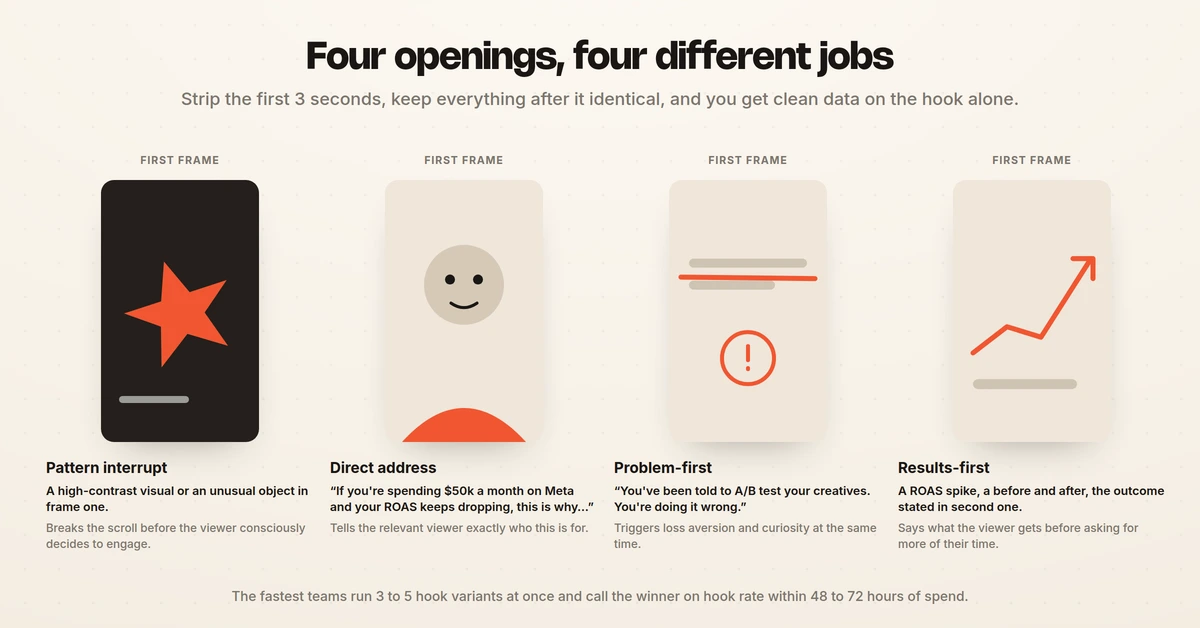
Pattern interrupt. Something unexpected in the first frame - a high-contrast visual, an unusual object, movement that contrasts with polished feed content. Breaks the automatic scrolling pattern before the viewer consciously decides to engage.

Direct address. Speaking to camera, making eye contact, starting mid-sentence. Creates immediate personal connection. "If you're spending $50k a month on Meta and your ROAS keeps dropping, this is why..." tells the relevant viewer exactly who this is for.

Problem-first. Open with the pain point rather than the solution. "You've been told to A/B test your creatives. You're doing it wrong." Triggers loss aversion and curiosity simultaneously.

Results-first. Lead with the outcome. A screenshot of a ROAS spike, a before/after, a result stated in the first second. Tells the viewer what they're going to get before asking them to invest more viewing time.
Step 3: Score and iterate using creative performance data

The fastest teams in 2026 test 3-5 hook variants simultaneously, identify the winner by hook rate within the first 48-72 hours of spend, and then apply the winning hook pattern to other creatives in the same account.

This is where having element-level creative analysis matters. Rather than manually comparing hook variants by scrolling through ads manager, Hawky's creative analysis tracks hook performance at the element level - identifying which specific visual styles, opening lines, and structural patterns consistently produce the highest hook rates in your account. When you know your winning hook pattern, every new brief starts from a data-confirmed starting point rather than a guess.

Hook rate as part of a creative testing framework

Hook rate is the entry metric in a three-stage creative diagnostic. Here is how it fits into a full testing framework:
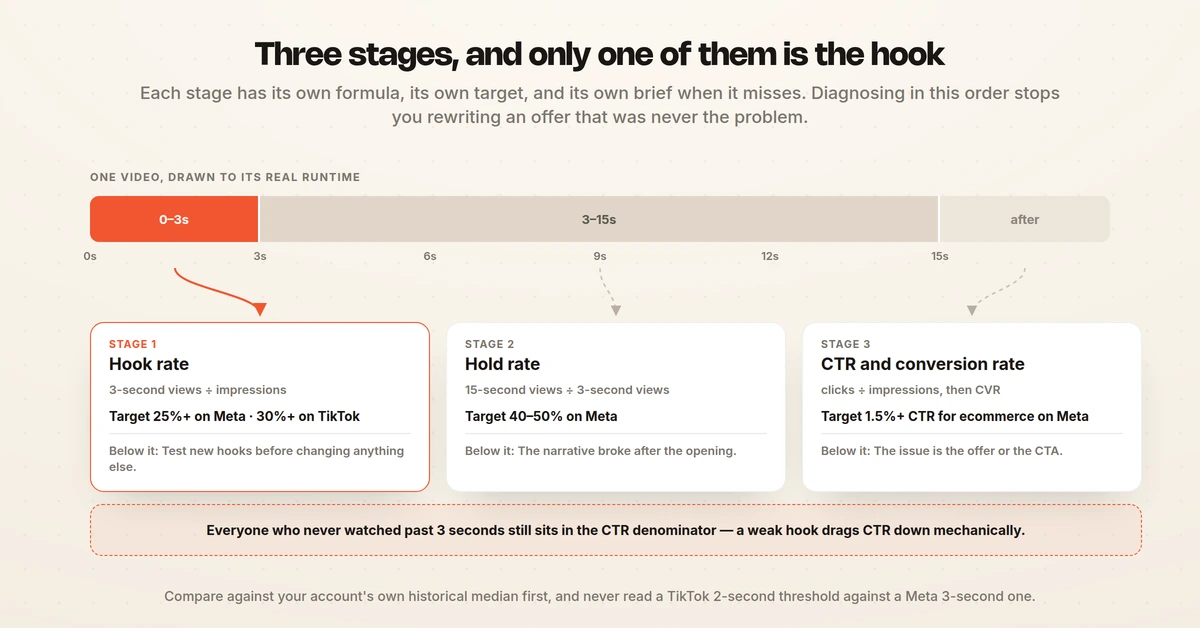
Stage 1 - Hook rate (0-3 seconds). Are you stopping the scroll? Target: 25%+ on Meta, 30%+ on TikTok. If below target, test new hooks before changing anything else.

Stage 2 - Hold rate (3-15 seconds). Of the people you hooked, did the body deliver on the promise? Formula: 15-second views / 3-second views x 100. Target: 40-50% on Meta. If hook rate is fine but hold rate is low, the narrative broke down after the opening.

Stage 3 - CTR and conversion rate. Did the people who watched through take action? Target: 1.5%+ CTR for e-commerce on Meta. If hold rate is fine but CTR is low, the issue is the offer or the CTA.

Running this sequence as a weekly review across your active creatives gives you a systematic way to identify exactly which creative element is the bottleneck - rather than making broad changes to ads and attributing results to the wrong variable.

The teams that build this framework into their creative workflow consistently outperform those who evaluate creative performance at the campaign level. When you know that your hook rate is 28% and your target is 30%, you have a specific brief: test 3 new hooks this week. When you only know that ROAS dropped, you have no brief at all.

Frequently asked questions

What is hook rate?

Hook rate is the percentage of people who watch past the first 3 seconds of a video ad, calculated by dividing 3-second video views by total impressions and multiplying by 100. It measures how effectively the opening of your ad stops viewers from scrolling past, and is used as a leading indicator of creative performance on platforms like Meta and TikTok.

What is a good hook rate?

On Meta, a hook rate of 25-30% is considered solid for most accounts, while 30-40% is good and 40%+ is elite. On TikTok, which uses a 2-second threshold, aim for 30-35% as a baseline and 40%+ for top-quartile performance. The most useful benchmark is your own account median - because it accounts for your specific audience, creative style, and category - rather than a universal number.

How do you calculate hook rate?

Hook rate = (3-second video views / total impressions) x 100. In Meta Ads Manager, create a custom metric using the "3-second video plays" column divided by impressions. In TikTok Ads Manager, use "Video Views at 2 Seconds" divided by impressions. Neither platform surfaces hook rate as a default column - it requires a custom metric setup.

How do you improve hook rate?

The highest-return approach is hook testing: take a video with a strong body but weak hook rate, strip the first 3 seconds, and test 3-5 new opening variants against the same body. Test pattern interrupts, direct address, problem-first, and results-first hooks. Identify the winner by hook rate within 48-72 hours of spend, then apply that winning pattern across other creatives in the account. Structural fixes - leading with product rather than branding, adding bold text overlay in the first second, ensuring the relevance signal for your target audience is clear immediately - typically move the needle faster than wholesale creative rebuilds.

Track hook rate automatically

Manually pulling custom metrics from Meta Ads Manager each week and comparing them across dozens of creatives takes time and misses patterns that only appear at scale.

If you're running multiple campaigns across Meta and Google, tracking which hook styles, visual formats, and opening lines consistently produce the best hook rates - and flagging creatives before their hook rate starts to decline - is the kind of analysis that compounds over time. Hawky's creative performance tracking surfaces hook rate patterns at the element level across your account, so your next brief starts from what the data shows works rather than what felt good last week.


Hook rate is the percentage of people who watch past the first 3 seconds of a video ad, calculated as 3-second video views divided by total impressions. It is the clearest leading indicator of video ad performance because no amount of compelling storytelling, strong offers, or sharp CTAs matters if viewers scroll past before any of it plays.

On Meta, a hook rate above 25% is table stakes. Above 30% is good. Above 40% is elite - the point where the algorithm starts treating your creative as genuinely relevant and rewards it with lower CPMs and broader distribution.

What is hook rate?

Hook rate measures what happens in the first three seconds of a video ad. Specifically, it tells you what percentage of people who saw your ad chose to keep watching past that initial threshold rather than scrolling past.

The metric goes by a few names - hook rate, thumb-stop rate, and video hook rate are used interchangeably across the industry. The underlying calculation is the same.

It matters disproportionately because platforms like Meta and TikTok use early engagement signals to determine how broadly to distribute your ad. A creative that loses most viewers in the first three seconds signals low relevance to the algorithm, resulting in reduced delivery, higher CPMs, and worse overall campaign efficiency. A creative that holds attention earns the opposite: more distribution at a lower cost.

The first three seconds are not just the hook for the viewer. They are also the primary signal the platform uses to decide whether your ad deserves to be shown to more people.

How to calculate hook rate

Hook rate formula:

Hook rate = (3-second video views / total impressions) x 100

Example: if your video ad receives 10,000 impressions and 2,800 people watch past the 3-second mark, your hook rate is 28%.

How to find this in each platform

Meta Ads Manager: The metric is labeled "3-second video plays." Divide that by impressions and multiply by 100. Meta does not surface hook rate as a default column - you need to create a custom metric. Go to Columns → Customize Columns → create a custom metric using the formula above. Meta's official documentation on video ad metrics covers all available video play columns in full.

TikTok Ads Manager: Look for "Video Views at 2 Seconds" (TikTok uses a 2-second threshold rather than Meta's 3-second threshold). Divide by impressions for your hook rate. TikTok's Ads Manager glossary lists all available video engagement columns.

Google/YouTube: Hook rate is less directly applicable to YouTube's skippable formats, where the relevant metric is view-through rate at 5 seconds. For Shorts, use views past 3 seconds vs. impressions.

One important note on TikTok vs. Meta benchmarks: because TikTok uses a 2-second threshold and Meta uses 3 seconds, the numbers are not directly comparable. TikTok hook rates will naturally appear higher. Always compare against benchmarks from the same platform.

Hook rate benchmarks by platform (2026)

These benchmarks are based on aggregated data from multiple performance marketing accounts published in 2025 and 2026, including studies by Vaizle and MHI Growth Engine. Use them as orientation, not absolute targets - your account's historical median is often the most useful benchmark because it accounts for your specific audience, category, and creative style.

Meta (Facebook and Instagram)

Hook rate

What it means

Below 15%

Significant problem with the opening frame or visual. The first second is not stopping the scroll.

15-24%

Below average. The hook needs work before optimising anything else in the funnel.

25-30%

Baseline. Adequate, but the majority of your audience is still scrolling past.

30-39%

Good. Room for improvement, but the creative is holding its own.

40%+

Elite. The algorithm treats this as high-relevance content and rewards it with stronger delivery.

Note: Reels placements typically run 5-10 percentage points lower than Feed placements because users scroll faster. Adjust expectations accordingly.

TikTok

Hook rate

What it means

Below 20%

Opening visual or audio is too slow or generic.

20-29%

Below average for the platform.

30-35%

Solid for most accounts.

35-40%

Top quartile.

40%+

Top 10% of advertisers.

Why hook rate matters more than CTR for diagnosing creative problems

Most teams look at CTR first when a creative underperforms. That's the wrong starting point.

CTR tells you what percentage of people who saw your ad clicked on it. Hook rate tells you what percentage actually watched it. If your hook rate is low, the people who never watched past 3 seconds are being counted in the denominator of your CTR calculation - dragging the number down regardless of how compelling your offer or landing page is.

The diagnostic sequence should be: hook rate first, then hold rate, then CTR.

If hook rate is low: the first frame is not stopping the scroll. Nothing after it matters until you fix this.

If hook rate is fine but hold rate is low: the opening grabbed attention but didn't earn it - the body of the ad failed to deliver on the promise the hook made.

If both are fine but CTR is low: the creative is holding viewers but not converting them to action. The issue is the offer, the CTA, or the audience fit.

Treating these as a sequence means you're fixing the actual problem rather than optimising downstream metrics while the real issue sits upstream.

What drives a low hook rate

Low hook rates typically come from one of four places:

A slow opening. Starting with a logo, a brand name, a scene-setting intro, or any framing that delays the core message. The algorithm and the viewer make their decision in the first second, not the first five. Anything that delays getting to the point is costing you.

Generic visuals. Stock footage, clean white backgrounds, and polished corporate aesthetics blend into the feed rather than interrupting it. Feeds are algorithmically filled with content the viewer is already interested in - your ad has to be visually distinct enough to break that pattern.

No immediate relevance signal. If your ad is for a specific audience - D2C brand buyers, marketing teams, first-time pet owners - and that specificity is not clear from the first frame, the relevant viewers have no reason to stop. The hook should tell the right person this is for them within the first second.

No audio hook. A large percentage of mobile users watch with sound on, and sound-off viewing is handled by text overlays. If the first second of audio is music intro or silence, you're wasting a channel that could be stopping the scroll.

How to improve hook rate: a testing framework

Hook testing is the highest-return creative test you can run. Changing the first 3 seconds of an existing video costs almost nothing compared to producing a new creative from scratch - and a single hook variant can double or halve your hook rate without touching any other element of the ad.

Step 1: Isolate the hook from the body

Take a video ad where the body content converts well (strong hold rate, good CTR, reasonable CPA) but hook rate is below target. Strip the first 3 seconds and replace them with new hook variants while keeping everything after identical. This gives you clean data on hook effectiveness without confounding variables from the body.

Step 2: Test these four hook types

Pattern interrupt. Something unexpected in the first frame - a high-contrast visual, an unusual object, movement that contrasts with polished feed content. Breaks the automatic scrolling pattern before the viewer consciously decides to engage.

Direct address. Speaking to camera, making eye contact, starting mid-sentence. Creates immediate personal connection. "If you're spending $50k a month on Meta and your ROAS keeps dropping, this is why..." tells the relevant viewer exactly who this is for.

Problem-first. Open with the pain point rather than the solution. "You've been told to A/B test your creatives. You're doing it wrong." Triggers loss aversion and curiosity simultaneously.

Results-first. Lead with the outcome. A screenshot of a ROAS spike, a before/after, a result stated in the first second. Tells the viewer what they're going to get before asking them to invest more viewing time.

Step 3: Score and iterate using creative performance data

The fastest teams in 2026 test 3-5 hook variants simultaneously, identify the winner by hook rate within the first 48-72 hours of spend, and then apply the winning hook pattern to other creatives in the same account.

This is where having element-level creative analysis matters. Rather than manually comparing hook variants by scrolling through ads manager, Hawky's creative analysis tracks hook performance at the element level - identifying which specific visual styles, opening lines, and structural patterns consistently produce the highest hook rates in your account. When you know your winning hook pattern, every new brief starts from a data-confirmed starting point rather than a guess.

Hook rate as part of a creative testing framework

Hook rate is the entry metric in a three-stage creative diagnostic. Here is how it fits into a full testing framework:

Stage 1 - Hook rate (0-3 seconds). Are you stopping the scroll? Target: 25%+ on Meta, 30%+ on TikTok. If below target, test new hooks before changing anything else.

Stage 2 - Hold rate (3-15 seconds). Of the people you hooked, did the body deliver on the promise? Formula: 15-second views / 3-second views x 100. Target: 40-50% on Meta. If hook rate is fine but hold rate is low, the narrative broke down after the opening.

Stage 3 - CTR and conversion rate. Did the people who watched through take action? Target: 1.5%+ CTR for e-commerce on Meta. If hold rate is fine but CTR is low, the issue is the offer or the CTA.

Running this sequence as a weekly review across your active creatives gives you a systematic way to identify exactly which creative element is the bottleneck - rather than making broad changes to ads and attributing results to the wrong variable.

The teams that build this framework into their creative workflow consistently outperform those who evaluate creative performance at the campaign level. When you know that your hook rate is 28% and your target is 30%, you have a specific brief: test 3 new hooks this week. When you only know that ROAS dropped, you have no brief at all.

Frequently asked questions

What is hook rate?

Hook rate is the percentage of people who watch past the first 3 seconds of a video ad, calculated by dividing 3-second video views by total impressions and multiplying by 100. It measures how effectively the opening of your ad stops viewers from scrolling past, and is used as a leading indicator of creative performance on platforms like Meta and TikTok.

What is a good hook rate?

On Meta, a hook rate of 25-30% is considered solid for most accounts, while 30-40% is good and 40%+ is elite. On TikTok, which uses a 2-second threshold, aim for 30-35% as a baseline and 40%+ for top-quartile performance. The most useful benchmark is your own account median - because it accounts for your specific audience, creative style, and category - rather than a universal number.

How do you calculate hook rate?

Hook rate = (3-second video views / total impressions) x 100. In Meta Ads Manager, create a custom metric using the "3-second video plays" column divided by impressions. In TikTok Ads Manager, use "Video Views at 2 Seconds" divided by impressions. Neither platform surfaces hook rate as a default column - it requires a custom metric setup.

How do you improve hook rate?

The highest-return approach is hook testing: take a video with a strong body but weak hook rate, strip the first 3 seconds, and test 3-5 new opening variants against the same body. Test pattern interrupts, direct address, problem-first, and results-first hooks. Identify the winner by hook rate within 48-72 hours of spend, then apply that winning pattern across other creatives in the account. Structural fixes - leading with product rather than branding, adding bold text overlay in the first second, ensuring the relevance signal for your target audience is clear immediately - typically move the needle faster than wholesale creative rebuilds.

Track hook rate automatically

Manually pulling custom metrics from Meta Ads Manager each week and comparing them across dozens of creatives takes time and misses patterns that only appear at scale.

If you're running multiple campaigns across Meta and Google, tracking which hook styles, visual formats, and opening lines consistently produce the best hook rates - and flagging creatives before their hook rate starts to decline - is the kind of analysis that compounds over time. Hawky's creative performance tracking surfaces hook rate patterns at the element level across your account, so your next brief starts from what the data shows works rather than what felt good last week.
Hook rate is the percentage of people who watch past the first 3 seconds of a video ad, calculated as 3-second video views divided by total impressions. It is the clearest leading indicator of video ad performance because no amount of compelling storytelling, strong offers, or sharp CTAs matters if viewers scroll past before any of it plays.

On Meta, a hook rate above 25% is table stakes. Above 30% is good. Above 40% is elite - the point where the algorithm starts treating your creative as genuinely relevant and rewards it with lower CPMs and broader distribution.

What is hook rate?

Hook rate measures what happens in the first three seconds of a video ad. Specifically, it tells you what percentage of people who saw your ad chose to keep watching past that initial threshold rather than scrolling past.

The metric goes by a few names - hook rate, thumb-stop rate, and video hook rate are used interchangeably across the industry. The underlying calculation is the same.

It matters disproportionately because platforms like Meta and TikTok use early engagement signals to determine how broadly to distribute your ad. A creative that loses most viewers in the first three seconds signals low relevance to the algorithm, resulting in reduced delivery, higher CPMs, and worse overall campaign efficiency. A creative that holds attention earns the opposite: more distribution at a lower cost.

The first three seconds are not just the hook for the viewer. They are also the primary signal the platform uses to decide whether your ad deserves to be shown to more people.

How to calculate hook rate

Hook rate formula:

Hook rate = (3-second video views / total impressions) x 100

Example: if your video ad receives 10,000 impressions and 2,800 people watch past the 3-second mark, your hook rate is 28%.

How to find this in each platform

Meta Ads Manager: The metric is labeled "3-second video plays." Divide that by impressions and multiply by 100. Meta does not surface hook rate as a default column - you need to create a custom metric. Go to Columns → Customize Columns → create a custom metric using the formula above. Meta's official documentation on video ad metrics covers all available video play columns in full.

TikTok Ads Manager: Look for "Video Views at 2 Seconds" (TikTok uses a 2-second threshold rather than Meta's 3-second threshold). Divide by impressions for your hook rate. TikTok's Ads Manager glossary lists all available video engagement columns.

Google/YouTube: Hook rate is less directly applicable to YouTube's skippable formats, where the relevant metric is view-through rate at 5 seconds. For Shorts, use views past 3 seconds vs. impressions.

One important note on TikTok vs. Meta benchmarks: because TikTok uses a 2-second threshold and Meta uses 3 seconds, the numbers are not directly comparable. TikTok hook rates will naturally appear higher. Always compare against benchmarks from the same platform.

Hook rate benchmarks by platform (2026)

These benchmarks are based on aggregated data from multiple performance marketing accounts published in 2025 and 2026, including studies by Vaizle and MHI Growth Engine. Use them as orientation, not absolute targets - your account's historical median is often the most useful benchmark because it accounts for your specific audience, category, and creative style.

Meta (Facebook and Instagram)

Hook rate

What it means

Below 15%

Significant problem with the opening frame or visual. The first second is not stopping the scroll.

15-24%

Below average. The hook needs work before optimising anything else in the funnel.

25-30%

Baseline. Adequate, but the majority of your audience is still scrolling past.

30-39%

Good. Room for improvement, but the creative is holding its own.

40%+

Elite. The algorithm treats this as high-relevance content and rewards it with stronger delivery.

Note: Reels placements typically run 5-10 percentage points lower than Feed placements because users scroll faster. Adjust expectations accordingly.

TikTok

Hook rate

What it means

Below 20%

Opening visual or audio is too slow or generic.

20-29%

Below average for the platform.

30-35%

Solid for most accounts.

35-40%

Top quartile.

40%+

Top 10% of advertisers.

Why hook rate matters more than CTR for diagnosing creative problems

Most teams look at CTR first when a creative underperforms. That's the wrong starting point.

CTR tells you what percentage of people who saw your ad clicked on it. Hook rate tells you what percentage actually watched it. If your hook rate is low, the people who never watched past 3 seconds are being counted in the denominator of your CTR calculation - dragging the number down regardless of how compelling your offer or landing page is.

The diagnostic sequence should be: hook rate first, then hold rate, then CTR.

If hook rate is low: the first frame is not stopping the scroll. Nothing after it matters until you fix this.

If hook rate is fine but hold rate is low: the opening grabbed attention but didn't earn it - the body of the ad failed to deliver on the promise the hook made.

If both are fine but CTR is low: the creative is holding viewers but not converting them to action. The issue is the offer, the CTA, or the audience fit.

Treating these as a sequence means you're fixing the actual problem rather than optimising downstream metrics while the real issue sits upstream.

What drives a low hook rate

Low hook rates typically come from one of four places:

A slow opening. Starting with a logo, a brand name, a scene-setting intro, or any framing that delays the core message. The algorithm and the viewer make their decision in the first second, not the first five. Anything that delays getting to the point is costing you.

Generic visuals. Stock footage, clean white backgrounds, and polished corporate aesthetics blend into the feed rather than interrupting it. Feeds are algorithmically filled with content the viewer is already interested in - your ad has to be visually distinct enough to break that pattern.

No immediate relevance signal. If your ad is for a specific audience - D2C brand buyers, marketing teams, first-time pet owners - and that specificity is not clear from the first frame, the relevant viewers have no reason to stop. The hook should tell the right person this is for them within the first second.

No audio hook. A large percentage of mobile users watch with sound on, and sound-off viewing is handled by text overlays. If the first second of audio is music intro or silence, you're wasting a channel that could be stopping the scroll.

How to improve hook rate: a testing framework

Hook testing is the highest-return creative test you can run. Changing the first 3 seconds of an existing video costs almost nothing compared to producing a new creative from scratch - and a single hook variant can double or halve your hook rate without touching any other element of the ad.

Step 1: Isolate the hook from the body

Take a video ad where the body content converts well (strong hold rate, good CTR, reasonable CPA) but hook rate is below target. Strip the first 3 seconds and replace them with new hook variants while keeping everything after identical. This gives you clean data on hook effectiveness without confounding variables from the body.

Step 2: Test these four hook types

Pattern interrupt. Something unexpected in the first frame - a high-contrast visual, an unusual object, movement that contrasts with polished feed content. Breaks the automatic scrolling pattern before the viewer consciously decides to engage.

Direct address. Speaking to camera, making eye contact, starting mid-sentence. Creates immediate personal connection. "If you're spending $50k a month on Meta and your ROAS keeps dropping, this is why..." tells the relevant viewer exactly who this is for.

Problem-first. Open with the pain point rather than the solution. "You've been told to A/B test your creatives. You're doing it wrong." Triggers loss aversion and curiosity simultaneously.

Results-first. Lead with the outcome. A screenshot of a ROAS spike, a before/after, a result stated in the first second. Tells the viewer what they're going to get before asking them to invest more viewing time.

Step 3: Score and iterate using creative performance data

The fastest teams in 2026 test 3-5 hook variants simultaneously, identify the winner by hook rate within the first 48-72 hours of spend, and then apply the winning hook pattern to other creatives in the same account.

This is where having element-level creative analysis matters. Rather than manually comparing hook variants by scrolling through ads manager, Hawky's creative analysis tracks hook performance at the element level - identifying which specific visual styles, opening lines, and structural patterns consistently produce the highest hook rates in your account. When you know your winning hook pattern, every new brief starts from a data-confirmed starting point rather than a guess.

Hook rate as part of a creative testing framework

Hook rate is the entry metric in a three-stage creative diagnostic. Here is how it fits into a full testing framework:

Stage 1 - Hook rate (0-3 seconds). Are you stopping the scroll? Target: 25%+ on Meta, 30%+ on TikTok. If below target, test new hooks before changing anything else.

Stage 2 - Hold rate (3-15 seconds). Of the people you hooked, did the body deliver on the promise? Formula: 15-second views / 3-second views x 100. Target: 40-50% on Meta. If hook rate is fine but hold rate is low, the narrative broke down after the opening.

Stage 3 - CTR and conversion rate. Did the people who watched through take action? Target: 1.5%+ CTR for e-commerce on Meta. If hold rate is fine but CTR is low, the issue is the offer or the CTA.

Running this sequence as a weekly review across your active creatives gives you a systematic way to identify exactly which creative element is the bottleneck - rather than making broad changes to ads and attributing results to the wrong variable.

The teams that build this framework into their creative workflow consistently outperform those who evaluate creative performance at the campaign level. When you know that your hook rate is 28% and your target is 30%, you have a specific brief: test 3 new hooks this week. When you only know that ROAS dropped, you have no brief at all.

Frequently asked questions

What is hook rate?

Hook rate is the percentage of people who watch past the first 3 seconds of a video ad, calculated by dividing 3-second video views by total impressions and multiplying by 100. It measures how effectively the opening of your ad stops viewers from scrolling past, and is used as a leading indicator of creative performance on platforms like Meta and TikTok.

What is a good hook rate?

On Meta, a hook rate of 25-30% is considered solid for most accounts, while 30-40% is good and 40%+ is elite. On TikTok, which uses a 2-second threshold, aim for 30-35% as a baseline and 40%+ for top-quartile performance. The most useful benchmark is your own account median - because it accounts for your specific audience, creative style, and category - rather than a universal number.

How do you calculate hook rate?

Hook rate = (3-second video views / total impressions) x 100. In Meta Ads Manager, create a custom metric using the "3-second video plays" column divided by impressions. In TikTok Ads Manager, use "Video Views at 2 Seconds" divided by impressions. Neither platform surfaces hook rate as a default column - it requires a custom metric setup.

How do you improve hook rate?

The highest-return approach is hook testing: take a video with a strong body but weak hook rate, strip the first 3 seconds, and test 3-5 new opening variants against the same body. Test pattern interrupts, direct address, problem-first, and results-first hooks. Identify the winner by hook rate within 48-72 hours of spend, then apply that winning pattern across other creatives in the account. Structural fixes - leading with product rather than branding, adding bold text overlay in the first second, ensuring the relevance signal for your target audience is clear immediately - typically move the needle faster than wholesale creative rebuilds.

Track hook rate automatically

Manually pulling custom metrics from Meta Ads Manager each week and comparing them across dozens of creatives takes time and misses patterns that only appear at scale.

If you're running multiple campaigns across Meta and Google, tracking which hook styles, visual formats, and opening lines consistently produce the best hook rates - and flagging creatives before their hook rate starts to decline - is the kind of analysis that compounds over time. Hawky's creative performance tracking surfaces hook rate patterns at the element level across your account, so your next brief starts from what the data shows works rather than what felt good last week.

Ready to Stop Guessing and Start Winning with Creative Intelligence?

Creative Intelligence for Performance Marketing

© 2025 Hawky AI, All rights reserved

Ready to Stop Guessing and Start Winning with Creative Intelligence?

Creative Intelligence for Performance Marketing

© 2025 Hawky AI, All rights reserved

Ready to Stop Guessing and Start Winning with Creative Intelligence?

Creative Intelligence for Performance Marketing

© 2025 Hawky AI, All rights reserved