Creative Automation
Last updated
Technology that streamlines ad creation and testing by automating repetitive tasks while maintaining creative quality and brand consistency.
Creative Automation
Creative automation uses AI to produce, adapt, and optimize ad creative at scale. Learn how it works, why it beats manual production, and how to do it right.
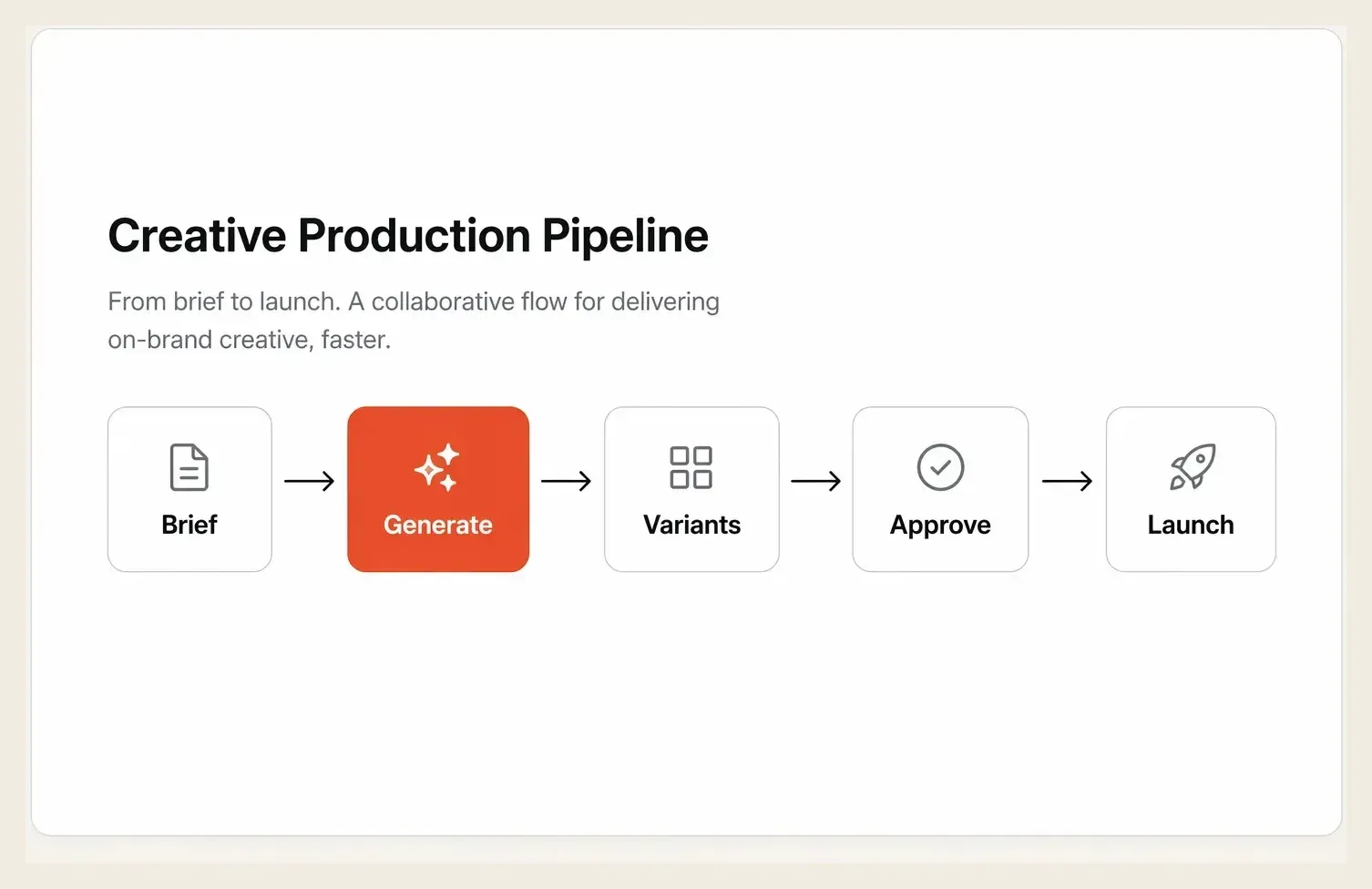
Creative automation is the use of AI and technology to produce, adapt, and optimise ad creative at scale, turning what used to take a design team days or weeks into a process that takes seconds, without sacrificing brand consistency or performance quality. Instead of briefing one designer to make one ad, software generates dozens of on-brand, platform-ready variants in the time it takes to write the brief. The goal is not volume for its own sake. It is matching the pace platforms demand with creative that is informed by what already performs.
Why It Matters
Performance marketing platforms are demanding more creative than ever. Meta recommends testing 3 to 5 new ad variations per week per ad set. Google PMax wants 15 headlines and 5 or more images per Asset Group. TikTok's fast-scroll environment means creatives can fatigue in as little as 5 to 7 days. Meanwhile, the average design-to-approval cycle still takes 3 to 7 days per asset.
That gap between what platforms need and what teams can produce manually is where campaigns lose performance, and where creative automation wins it back. Creative is the single biggest lever in paid media. Nielsen and Meta studies attribute roughly 56% of campaign sales lift to the creative itself, more than targeting, bidding, or placement combined. A team that can only ship five assets a week is leaving most of that lever untouched. Automation lifts the ceiling so the highest-impact variable in the account is also the one moving fastest.
How It Works
Creative automation runs across four connected layers. Production generates the raw variants, personalisation assembles them per viewer, performance data decides what gets made next, and brand governance keeps every output on-spec.
- Production automation generates new variants instantly. AI produces fresh headlines, visuals, and CTAs, or creates new combinations from existing assets, adapting them automatically to the right specs for every platform (Meta, Google, TikTok, LinkedIn) in a single pass.
- Personalisation automation assembles ads in real time. Instead of one static ad shown to everyone, creative components (hook, image, offer, CTA) are dynamically combined based on who is watching: their behavior, location, device, or funnel stage.
- Performance data closes the loop. The best creative automation is not just about volume. It feeds creative intelligence back into production, analysing which elements drove conversions and generating the next round of variants built on those winning patterns.
- Brand governance runs at generation time. Color palettes, typography, approved messaging, and CTA language are encoded once and enforced automatically across every asset, so scaling production does not mean losing brand control.
A Real Example
A DTC skincare brand was producing 4 to 5 ad creatives per week using a two-person design team. Their testing velocity was too slow to keep up with creative fatigue. By the time a new variant was approved and live, the old one had already burned out and CPA had climbed 30%.
After implementing creative automation, the picture changed inside a single quarter:
- They went from 5 to 30 or more new variants per week without adding headcount.
- Each new batch was automatically adapted across Meta (1:1, 4:5, 9:16), TikTok, and Google Display specs.
- AI-driven production incorporated their top-performing hooks and CTAs from the previous month's data.
- CPA stabilized within 2 weeks, and creative fatigue incidents dropped by over 60% the following quarter.
Same team, same budget, better creative throughput, and better results.
Common Mistakes
| Mistake | ❌ Wrong Approach | ✅ Right Approach |
|---|---|---|
| Automating without intelligence | Using automation to produce high volumes of variants with no data on what is working, generating noise instead of winners | Connect automation to performance data. Let your best-performing hooks, visuals, and CTAs inform what gets generated next, not random variation |
| Treating automation as set-and-forget | Launching automated workflows and assuming they self-optimize forever without human creative direction | Review performance patterns regularly. Automation handles volume and speed; strategists handle creative direction, messaging, and brand storytelling |
| Skipping brand governance setup | Rushing to generate volume before encoding brand guidelines, resulting in off-brand assets that erode trust | Invest time upfront encoding brand DNA (colors, fonts, voice, approved CTAs) so every automated output is consistent from the start |
How Hawky Helps
Hawky treats creative automation as an action its agents take on the account, not a feature you operate by hand. The Creative Agent reads past winners and competitor patterns from FeatherDB, then renders new on-brand variants built on the exact hooks, visuals, and CTAs that drove the account's best CPA and ROAS. It does not generate at random. Every asset is grounded in a proven signal.
The Performance Agent watches live delivery and tells the Creative Agent when to fire, so production is triggered by a real fatigue or performance signal rather than a calendar guess. The result is a creative operation that scales volume and intelligence together, with strategists kept in the loop for direction and brand storytelling.
Frequently Asked Questions
What is creative automation in advertising?
Creative automation is the use of AI and software to produce, adapt, and optimise ad creative at scale. It generates platform-ready variants, resizes them for every placement automatically, and uses performance data to decide what to make next. The aim is to match the creative volume that platforms like Meta, Google, and TikTok demand without overloading a design team.
Does creative automation replace designers?
No. Creative automation removes the mechanical bottleneck, the resizing, reformatting, and high-volume variant production, so designers spend their time on concept, messaging strategy, and brand storytelling. Automation handles speed and scale, while humans handle creative direction. Teams that combine both ship more and ship smarter.
How is creative automation different from dynamic creative optimization?
Creative automation is the broad discipline of producing and adapting creative at scale, while dynamic creative optimization (DCO) is the personalisation branch that assembles ads in real time per viewer. DCO is one layer inside a full automation stack. Production, performance feedback, and brand governance are the other layers.
How many ad variants should I produce each week?
Most platforms reward high creative velocity. Meta recommends 3 to 5 fresh variations per ad set per week, and TikTok creatives can fatigue in under a week. Automation makes 20 to 30 or more weekly variants achievable for a small team, which keeps fatigue from setting in before a replacement is ready.
Quick Takeaway
Creative automation is not about replacing your creative team. It removes the production bottleneck so the highest-impact lever in your account, the creative, moves at the speed platforms reward.
Your design team is buried in resizing while your CPA climbs from fatigue. Ready to hire your first AI performance team? Book Demo