Attribution Model
Last updated
A framework for determining which touchpoints in a customer journey get credit for a conversion. Choosing the right model directly impacts how you allocate your ad budget.
Attribution Model
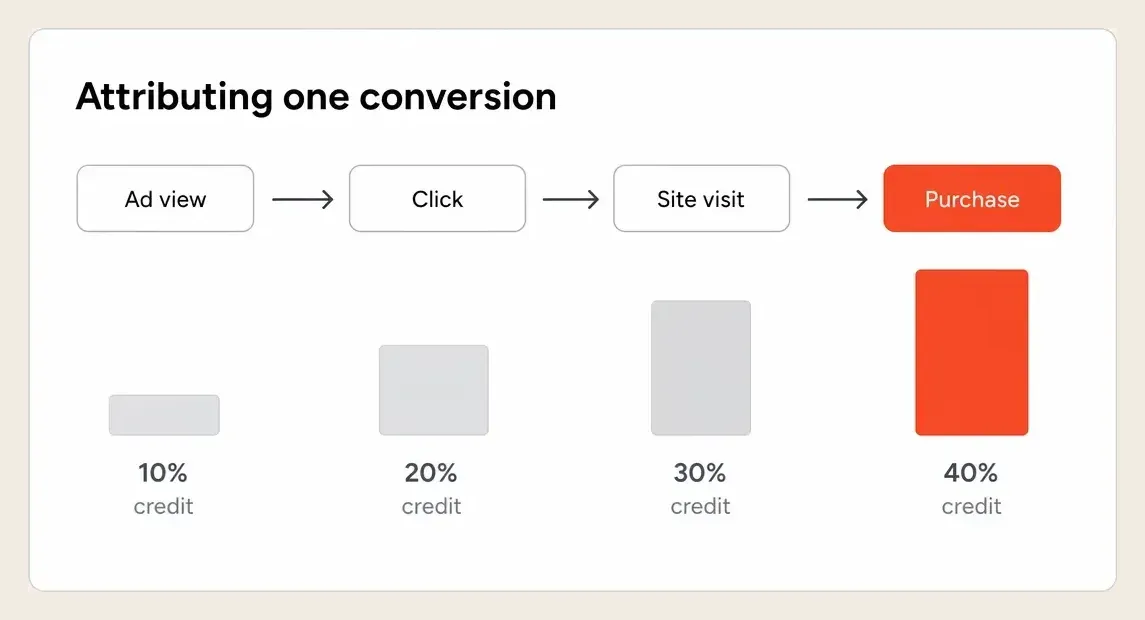
An attribution model is the rule set that determines how credit for conversions is assigned to marketing touchpoints in a customer's journey. When someone interacts with multiple ads before converting (seeing your Facebook ad, clicking a Google search ad, then purchasing via email), the attribution model decides which channel gets credit. This fundamental choice shapes how you measure ROAS, allocate budget, and evaluate channel performance.
Why It Matters
Your attribution model directly determines which campaigns look successful and which get cut. Last-click attribution, the most common default, gives 100% of the credit to the final touchpoint, making retargeting and branded search look incredibly profitable while systematically undervaluing top-of-funnel awareness campaigns. If you optimize CPA on last-click data, you are likely starving the channels that introduce customers to your brand in the first place.
The model you choose shapes your entire strategy, often invisibly. Two teams with identical data and identical spend can reach opposite conclusions about which channel to scale purely because they read the journey through different attribution rules. Since 2021, signal loss from iOS privacy changes has made this worse, because last-click windows now miss many of the view-based touchpoints that actually drove the sale. Getting attribution wrong does not just mislead a report, it sends real budget to the wrong place.
How It Works
- Customer journey: A user sees a Facebook ad on Day 1, clicks a Google ad on Day 3, opens an email on Day 7, then purchases.
- Last-click model: Email gets 100% of the credit, and most platforms default to this.
- First-click model: Facebook gets 100% of the credit for starting the journey.
- Linear model: Each of the three touchpoints gets an equal 33.3% share.
- Platform impact: Facebook reports one ROAS, Google reports another, and the email platform reports a third, all using different attribution models on the same sale.
The headache is that every platform claims credit using its own rules and its own window. Add up the conversions each tool reports and you will often exceed your real order count, because the same purchase is being counted three times. Understanding which model and window each platform uses is the first step to making numbers comparable across channels.
Types of Attribution Models
- Last-click: All credit to the final touchpoint. Simple, but overcredits bottom-funnel channels.
- First-click: All credit to the first touchpoint. Useful for measuring awareness, but ignores what closed the sale.
- Linear: Equal credit to every touchpoint. Fair but blunt.
- Time-decay: More credit to touchpoints closer to conversion. A reasonable middle ground.
- Position-based (U-shaped): Heavy credit to the first and last touches, less to the middle.
- Data-driven: Uses your actual conversion paths to assign fractional credit based on real influence, generally the most accurate when you have enough volume.
A Real Example
A skincare brand runs ads on Facebook and Google and sends email campaigns.
Using last-click attribution (the default):
- Email: $50,000 spend, 500 conversions, $100 CPA, looks like the winner.
- Facebook: $50,000 spend, 100 conversions, $500 CPA, looks like a budget to cut.
- Google Search: $50,000 spend, 200 conversions, $250 CPA, looks worth maintaining.
Using data-driven attribution (actual impact):
- Email: 500 conversions, but 80% came from users who first saw Facebook ads.
- Facebook: Credited with 320 conversions, a $156 CPA, actually profitable.
- Google: Credited with 180 conversions, a $278 CPA.
The brand nearly killed Facebook, their main customer acquisition channel, because they measured success with the wrong model. Switching to data-driven attribution revealed Facebook was driving most of those email conversions in the first place.
Common Mistakes
| ❌ Mistake | ✅ Better Approach |
|---|---|
| Using whatever model the platform defaults to (usually last-click). | Audit your attribution settings, since most platforms default to models that favor bottom-funnel channels. |
| Comparing ROAS across platforms with different windows (Facebook 7-day vs. Google 30-day). | Standardize attribution windows across platforms for an apples-to-apples comparison. |
| Expecting one model to be the single correct answer. | Use multiple models together: last-click for immediate ROI, data-driven for true influence. |
How Hawky Helps
Hawky's Performance Agent reads performance through more than the platform default, so budget decisions are not hostage to last-click bias. Instead of trusting that email "won" because it touched the sale last, the agent weighs the full path and reallocates spend toward the channels actually creating demand, including the upper-funnel campaigns last-click quietly buries.
Because FeatherDB retains the full history of touchpoints and outcomes across your account, Hawky builds a durable picture of how channels really work together rather than re-deriving it from a single window each week. That living memory is what lets the Performance Agent defend a channel like prospecting Facebook that a naive ROAS read would cut.
Frequently Asked Questions
What is the best attribution model?
There is no single best model, because each reveals a different truth. Data-driven attribution is generally the most accurate when you have enough conversion volume, since it assigns credit based on real influence rather than a fixed rule. For most advertisers, the strongest approach is to read last-click for immediate ROI and data-driven for true channel impact, then make budget calls on the fuller picture.
What is the difference between first-click and last-click attribution?
First-click attribution gives all the credit to the touchpoint that started the journey, which highlights awareness channels. Last-click gives all the credit to the final touchpoint before conversion, which highlights closing channels like retargeting and branded search. Each overcredits one end of the funnel, so relying on only one systematically misvalues the other.
Why do Facebook and Google report different conversion numbers?
Each platform uses its own attribution model and its own window, and each counts conversions it had any hand in. Facebook might use a 7-day click window while Google uses 30 days, so the same purchase gets claimed by both. This is why summing platform-reported conversions usually overstates your real order count, and why standardizing windows matters.
How did iOS privacy changes affect attribution?
Apple's App Tracking Transparency, introduced in 2021, limited the signals platforms can use to connect ad views to conversions. This shrank the visibility of view-through and cross-app touchpoints, making last-click reports even more biased toward easily tracked bottom-funnel actions. As a result, blended and data-driven measurement have become more important than trusting any single platform's in-app numbers.
Quick Takeaway
Attribution models decide which touchpoints get credit for conversions. Most platforms default to last-click, which undervalues awareness campaigns, so audit your settings and read multiple models to measure true channel impact.
When the wrong attribution model is about to make you cut your best channel, you need a team that reads the full journey. Ready to hire your first AI performance team? Book Demo