ROAS (Return on Ad Spend)
Last updated
Revenue generated for every dollar spent on advertising. The north-star metric for performance marketing teams measuring campaign profitability.
ROAS (Return on Ad Spend)
ROAS (Return on Ad Spend) measures revenue per ad dollar spent. Learn how to calculate, optimize, and improve ROAS with creative intelligence. Real examples plus benchmarks.
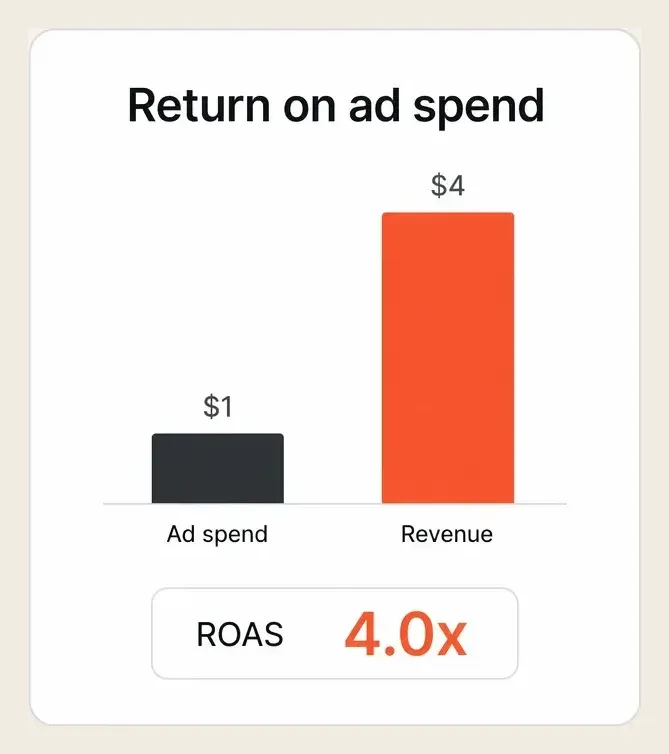
Return on Ad Spend (ROAS) is the revenue you generate for every dollar spent on advertising. It is the most direct measure of campaign profitability. A 4:1 ROAS means you earn $4 for every $1 spent on ads, simple as that.
Why It Matters
ROAS tells you whether your ads are actually making money or just generating vanity metrics. You can have a 5% conversion rate, but if your ROAS sits below breakeven, you lose money on every conversion. It is the metric that decides whether you scale a campaign, optimize it, or shut it off.
It also governs how aggressively you can grow. A campaign holding a strong ROAS as spend increases is a green light to scale, while one whose ROAS collapses the moment you raise the budget signals a ceiling. Most performance teams treat ROAS, alongside CPA, as the primary gate for every budget decision they make.
Formula
ROAS = Revenue from Ads ÷ Ad Spend
If a campaign generates $20,000 in revenue from $5,000 in ad spend, the ROAS is 4.0 (or 4:1). Express it as a ratio or a multiple; both say the same thing.
Typical benchmark ranges vary by business model:
- E-commerce and D2C: 3:1 to 5:1 is a common target, with 4:1 often treated as the baseline for healthy paid acquisition.
- Subscription and SaaS: 2:1 can be acceptable because high lifetime value justifies a longer payback period.
- High-margin or luxury goods: brands sometimes thrive below 3:1 because each sale carries more profit.
Breakeven ROAS is the point where ad-driven revenue exactly covers cost. The shortcut is breakeven ROAS = 1 ÷ profit margin (our break-even ROAS calculator does the fuller version, including shipping, fees and returns). A product with a 25% margin needs a 4:1 ROAS just to break even, which is why a "good" headline ROAS can still be unprofitable once margins are factored in. Always target a ROAS comfortably above your breakeven, not just above 1:1.
How It Works
- Track revenue at the ad level: connect ads directly to revenue, not just clicks or conversions, so you know which creative actually pays.
- Factor in profit margins: a 3:1 ROAS can lose money if your margins are thin, so compare against your breakeven, not zero.
- Consider attribution windows: longer windows capture more revenue but make optimization slower and harder to compare.
- Compare against benchmarks: use your model's target range and your own breakeven rather than a generic number pulled from a blog.
A Real Example
An athletic wear brand runs Facebook ads at a 2.8:1 ROAS. Analyzing creative performance with element-level analysis, the team discovers that ads featuring product-in-action clips deliver a 4.2:1 ROAS while studio shots drag the average down.
They shift budget toward action footage, and within 30 days blended ROAS climbs from 2.8:1 to 3.9:1. On the same monthly ad budget, that lift generates an additional $47,000 in profit, all from reallocating spend toward the creative the data already flagged as the winner.
Common Mistakes
| ❌ Mistake | ✅ Better Approach |
|---|---|
| Celebrating high ROAS on tiny budgets ($50/day at 10:1 isn't scalable) | Test whether performance holds when you 3 to 5x the budget |
| Not standardizing attribution windows across campaigns | Standardize the attribution window so comparisons are fair |
| Optimizing for ROAS without tracking creative fatigue | Treat a steady ROAS drop as a creative burnout signal, not audience exhaustion |
How Hawky Helps
Hawky's Performance Agent operates the account against your ROAS target directly. It shifts budget toward the creative and audiences clearing your breakeven, pulls spend from campaigns sliding below it, and scales winners while the numbers still hold, rather than waiting for a weekly report to surface the problem.
The agent reads which hooks, visuals, and formats correlate with top-performing ROAS using patterns drawn from millions of ads in FeatherDB, so decisions are grounded in evidence instead of guesswork. Pairing that with a Creative Performance Score lets the system flag likely ROAS-drivers before budget is committed to testing them.
Frequently Asked Questions
What is a good ROAS?
For most e-commerce brands, a 4:1 ROAS is a healthy baseline, meaning $4 of revenue for every $1 spent. But "good" is relative to your margins. A 4:1 ROAS on a thin-margin product can be breakeven, while a high-margin business may profit at 2:1. Always measure against your own breakeven ROAS rather than a universal number.
How is ROAS different from ROI?
ROAS measures revenue against ad spend only, while ROI measures total profit against total cost. ROAS ignores product costs, fulfillment, and overhead, so a strong ROAS can still mean a losing business if those costs are high. Use ROAS to compare campaigns and ROI to judge overall profitability.
What is breakeven ROAS?
Breakeven ROAS is the return at which ad-driven revenue exactly covers cost, calculated as 1 divided by your profit margin. A product with a 20% margin needs a 5:1 ROAS to break even. Anything above breakeven is profit; anything below it loses money even if the campaign looks busy.
How can I improve my ROAS?
The fastest lever is usually creative, not bidding. Reallocate budget toward the ads and audiences already clearing your target, refresh creative before fatigue sets in, and tighten targeting around your highest-intent segments such as retargeting pools. Element-level analysis helps pinpoint which specific creative choices drive the return.
Quick Takeaway
ROAS measures revenue per ad dollar spent, but creative-level ROAS reveals which specific ad elements make campaigns profitable, turning optimization from guesswork into systematic improvement against your breakeven.
Stop reading ROAS reports after the budget is already spent and let an agent act on the number in real time. Ready to hire your first AI performance team? Book Demo