Creative Testing Framework
Learn how to build a creative testing framework that turns random A/B tests into systematic learning. Includes 12 week example and common mistakes to avoid.
A Creative Testing Framework is a structured, systematic approach to testing ad creative variations that defines what elements to test, how to isolate variables, and how to document learnings for continuous improvement. Unlike ad hoc A/B testing where you randomly try different ads, a framework ensures each test builds on previous insights turning creative testing from guesswork into a strategic advantage that compounds over time.
Why It Matters
Without a testing framework, you waste budget on redundant tests and fail to build institutional knowledge about what works. When one campaign manager tests hooks while another tests offers, you never develop clear answers. A structured framework transforms creative testing from a cost center into your competitive moat according to Invesp research, companies with structured testing programs see 30 40% higher ROI on ad spend compared to those testing randomly.
Frameworks also prevent "false positive" syndrome where you scale a winning ad without understanding why it won, then fail when trying to replicate success. By systematically isolating variables, you know exactly which creative elements drive performance.
How It Works
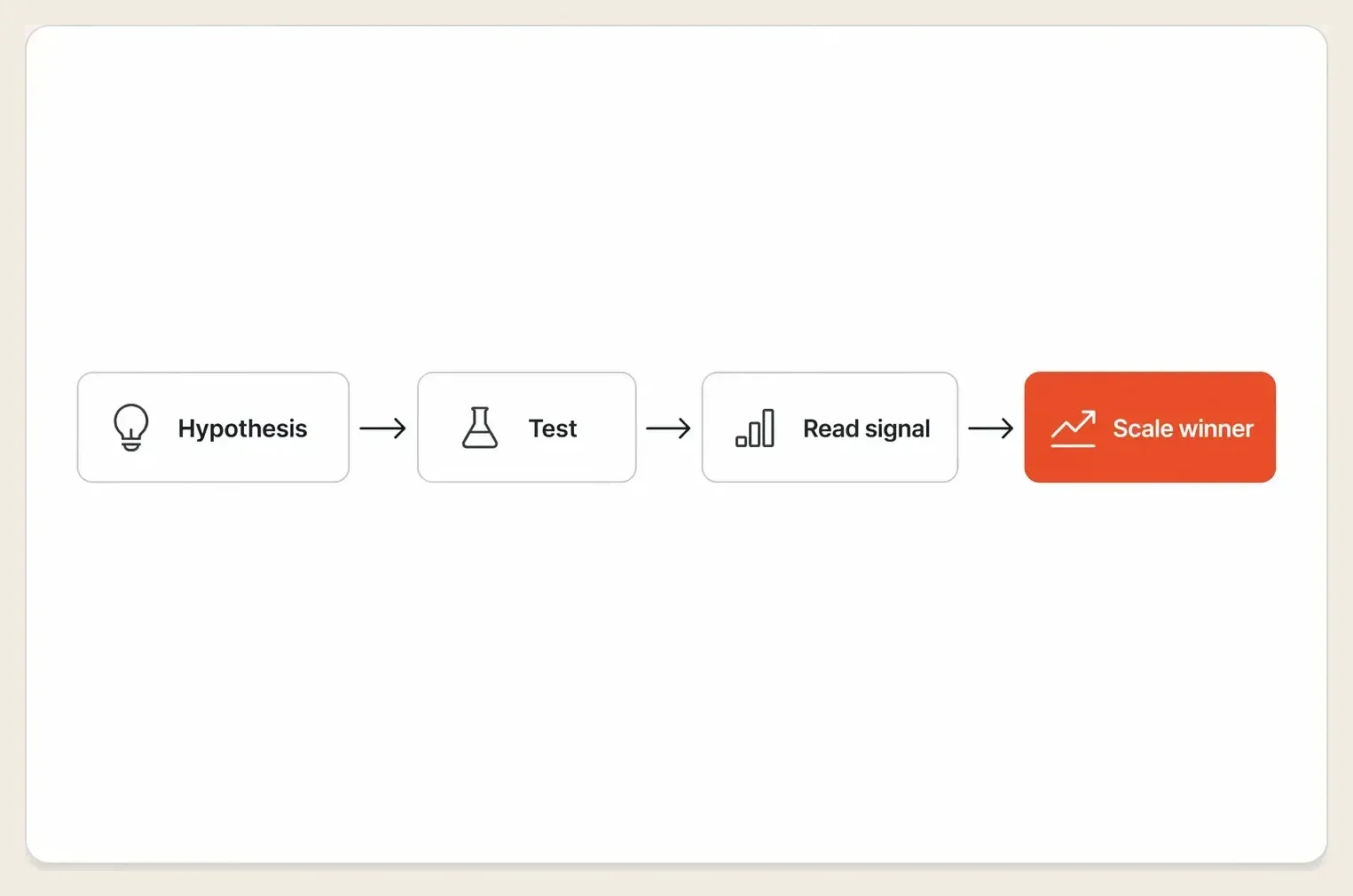
Effective creative testing frameworks follow a structured approach:
Define Testing Hierarchy: Prioritize what to test based on impact potential typically starting with high impact elements like hooks and core messaging before testing lower impact elements like button colors or minor visual tweaks
Isolate Variables: Test one element at a time (hook style, visual format, offer structure) so you can confidently attribute performance differences to specific creative decisions rather than confounding factors
Set Success Metrics: Establish clear, stage appropriate KPIs for each test awareness campaigns might optimize for 3 second video views, while conversion campaigns focus on CPA or ROAS as outlined in Google's measurement framework
Document and Scale Learnings: Create a testing library that captures what you've learned "Problem focused hooks outperform benefit focused by 34%" becomes institutional knowledge that informs all future creative, not just one campaign
Real-World Example
An activewear brand was spending $50K/month on Facebook ads but couldn't explain why some ads worked and others flopped. They implemented a testing framework over 12 weeks:
Weeks 1 4: Tested hook types (problem focused vs. transformation focused vs. social proof). Learned problem focused hooks delivered 41% lower CPA.
Weeks 5 8: Fixed problem focused hooks, tested visual styles (UGC vs. studio vs. hybrid). Found UGC style with studio product shots beat pure UGC by 28%.
Weeks 9 12: Fixed winning hook + visual combo, tested offer structures (discount vs. bundle vs. time limited). Time limited offers won with 2.9x ROAS vs. 2.1x for straight discounts.
Result: They now have a proven formula (problem hook + UGC/studio hybrid + urgency offer) that consistently delivers 2.5x+ ROAS. More importantly, they have a systematic approach to keep testing and improving rather than starting from scratch each campaign.
Common Mistakes
❌ Mistake | ✅ Better approach |
|---|---|
Testing multiple variables simultaneously (changing the hook AND visual format AND offer in one test means you can't identify which element drove results) | Use controlled experiments where you isolate one variable at a time, keeping all other elements constant so you can confidently attribute performance differences |
Stopping after finding a winner (many marketers find an ad that works and ride it until performance drops, missing opportunities for incremental improvements) | Build continuous testing into your workflow. Even winning ads can be improved by testing new elements, and what works today may not work tomorrow due to creative fatigue |
Testing without sufficient sample size (declaring a winner after 100 impressions leads to false conclusions that don't hold at scale) | Follow statistical significance guidelines. As Optimizely's testing resources explain, most tests need 250 350 conversions per variant minimum for reliable results, though this varies by conversion rate and effect size |
How Hawky Helps
Hawky analyzes your ads to show you which creative elements are actually worth testing in your category. Instead of guessing what to test next, you see data backed recommendations: "Brands in athletic apparel see 34% better performance with problem focused hooks" or "UGC style creative is trending up 67% in your vertical." This means your testing framework is informed by patterns across millions of ads, not just your limited test history.
Learn More
Element-Level Analysis - Breaking down creative into testable components
Creative Intelligence - Using AI to inform what and how to test
A/B Testing - The fundamental methodology for comparing creative variants
Creative Fatigue - Why continuous testing matters for sustained performance
Performance Metrics - Choosing the right success metrics for your tests
Quick Takeaway
A creative testing framework transforms ad testing from random experimentation into a systematic approach that builds compounding knowledge over time. By isolating variables, documenting learnings, and testing strategically, you develop institutional knowledge about what drives performance turning creative into your most defensible competitive advantage.
A Creative Testing Framework is a structured, systematic approach to testing ad creative variations that defines what elements to test, how to isolate variables, and how to document learnings for continuous improvement. Unlike ad hoc A/B testing where you randomly try different ads, a framework ensures each test builds on previous insights turning creative testing from guesswork into a strategic advantage that compounds over time.
Why It Matters
Without a testing framework, you waste budget on redundant tests and fail to build institutional knowledge about what works. When one campaign manager tests hooks while another tests offers, you never develop clear answers. A structured framework transforms creative testing from a cost center into your competitive moat according to Invesp research, companies with structured testing programs see 30 40% higher ROI on ad spend compared to those testing randomly.
Frameworks also prevent "false positive" syndrome where you scale a winning ad without understanding why it won, then fail when trying to replicate success. By systematically isolating variables, you know exactly which creative elements drive performance.
How It Works
Effective creative testing frameworks follow a structured approach:
Define Testing Hierarchy: Prioritize what to test based on impact potential typically starting with high impact elements like hooks and core messaging before testing lower impact elements like button colors or minor visual tweaks
Isolate Variables: Test one element at a time (hook style, visual format, offer structure) so you can confidently attribute performance differences to specific creative decisions rather than confounding factors
Set Success Metrics: Establish clear, stage appropriate KPIs for each test awareness campaigns might optimize for 3 second video views, while conversion campaigns focus on CPA or ROAS as outlined in Google's measurement framework
Document and Scale Learnings: Create a testing library that captures what you've learned "Problem focused hooks outperform benefit focused by 34%" becomes institutional knowledge that informs all future creative, not just one campaign
Real-World Example
An activewear brand was spending $50K/month on Facebook ads but couldn't explain why some ads worked and others flopped. They implemented a testing framework over 12 weeks:
Weeks 1 4: Tested hook types (problem focused vs. transformation focused vs. social proof). Learned problem focused hooks delivered 41% lower CPA.
Weeks 5 8: Fixed problem focused hooks, tested visual styles (UGC vs. studio vs. hybrid). Found UGC style with studio product shots beat pure UGC by 28%.
Weeks 9 12: Fixed winning hook + visual combo, tested offer structures (discount vs. bundle vs. time limited). Time limited offers won with 2.9x ROAS vs. 2.1x for straight discounts.
Result: They now have a proven formula (problem hook + UGC/studio hybrid + urgency offer) that consistently delivers 2.5x+ ROAS. More importantly, they have a systematic approach to keep testing and improving rather than starting from scratch each campaign.
Common Mistakes
❌ Mistake | ✅ Better approach |
|---|---|
Testing multiple variables simultaneously (changing the hook AND visual format AND offer in one test means you can't identify which element drove results) | Use controlled experiments where you isolate one variable at a time, keeping all other elements constant so you can confidently attribute performance differences |
Stopping after finding a winner (many marketers find an ad that works and ride it until performance drops, missing opportunities for incremental improvements) | Build continuous testing into your workflow. Even winning ads can be improved by testing new elements, and what works today may not work tomorrow due to creative fatigue |
Testing without sufficient sample size (declaring a winner after 100 impressions leads to false conclusions that don't hold at scale) | Follow statistical significance guidelines. As Optimizely's testing resources explain, most tests need 250 350 conversions per variant minimum for reliable results, though this varies by conversion rate and effect size |
How Hawky Helps
Hawky analyzes your ads to show you which creative elements are actually worth testing in your category. Instead of guessing what to test next, you see data backed recommendations: "Brands in athletic apparel see 34% better performance with problem focused hooks" or "UGC style creative is trending up 67% in your vertical." This means your testing framework is informed by patterns across millions of ads, not just your limited test history.
Learn More
Element-Level Analysis - Breaking down creative into testable components
Creative Intelligence - Using AI to inform what and how to test
A/B Testing - The fundamental methodology for comparing creative variants
Creative Fatigue - Why continuous testing matters for sustained performance
Performance Metrics - Choosing the right success metrics for your tests
Quick Takeaway
A creative testing framework transforms ad testing from random experimentation into a systematic approach that builds compounding knowledge over time. By isolating variables, documenting learnings, and testing strategically, you develop institutional knowledge about what drives performance turning creative into your most defensible competitive advantage.
A Creative Testing Framework is a structured, systematic approach to testing ad creative variations that defines what elements to test, how to isolate variables, and how to document learnings for continuous improvement. Unlike ad hoc A/B testing where you randomly try different ads, a framework ensures each test builds on previous insights turning creative testing from guesswork into a strategic advantage that compounds over time.
Why It Matters
Without a testing framework, you waste budget on redundant tests and fail to build institutional knowledge about what works. When one campaign manager tests hooks while another tests offers, you never develop clear answers. A structured framework transforms creative testing from a cost center into your competitive moat according to Invesp research, companies with structured testing programs see 30 40% higher ROI on ad spend compared to those testing randomly.
Frameworks also prevent "false positive" syndrome where you scale a winning ad without understanding why it won, then fail when trying to replicate success. By systematically isolating variables, you know exactly which creative elements drive performance.
How It Works
Effective creative testing frameworks follow a structured approach:
Define Testing Hierarchy: Prioritize what to test based on impact potential typically starting with high impact elements like hooks and core messaging before testing lower impact elements like button colors or minor visual tweaks
Isolate Variables: Test one element at a time (hook style, visual format, offer structure) so you can confidently attribute performance differences to specific creative decisions rather than confounding factors
Set Success Metrics: Establish clear, stage appropriate KPIs for each test awareness campaigns might optimize for 3 second video views, while conversion campaigns focus on CPA or ROAS as outlined in Google's measurement framework
Document and Scale Learnings: Create a testing library that captures what you've learned "Problem focused hooks outperform benefit focused by 34%" becomes institutional knowledge that informs all future creative, not just one campaign
Real-World Example
An activewear brand was spending $50K/month on Facebook ads but couldn't explain why some ads worked and others flopped. They implemented a testing framework over 12 weeks:
Weeks 1 4: Tested hook types (problem focused vs. transformation focused vs. social proof). Learned problem focused hooks delivered 41% lower CPA.
Weeks 5 8: Fixed problem focused hooks, tested visual styles (UGC vs. studio vs. hybrid). Found UGC style with studio product shots beat pure UGC by 28%.
Weeks 9 12: Fixed winning hook + visual combo, tested offer structures (discount vs. bundle vs. time limited). Time limited offers won with 2.9x ROAS vs. 2.1x for straight discounts.
Result: They now have a proven formula (problem hook + UGC/studio hybrid + urgency offer) that consistently delivers 2.5x+ ROAS. More importantly, they have a systematic approach to keep testing and improving rather than starting from scratch each campaign.
Common Mistakes
❌ Mistake | ✅ Better approach |
|---|---|
Testing multiple variables simultaneously (changing the hook AND visual format AND offer in one test means you can't identify which element drove results) | Use controlled experiments where you isolate one variable at a time, keeping all other elements constant so you can confidently attribute performance differences |
Stopping after finding a winner (many marketers find an ad that works and ride it until performance drops, missing opportunities for incremental improvements) | Build continuous testing into your workflow. Even winning ads can be improved by testing new elements, and what works today may not work tomorrow due to creative fatigue |
Testing without sufficient sample size (declaring a winner after 100 impressions leads to false conclusions that don't hold at scale) | Follow statistical significance guidelines. As Optimizely's testing resources explain, most tests need 250 350 conversions per variant minimum for reliable results, though this varies by conversion rate and effect size |
How Hawky Helps
Hawky analyzes your ads to show you which creative elements are actually worth testing in your category. Instead of guessing what to test next, you see data backed recommendations: "Brands in athletic apparel see 34% better performance with problem focused hooks" or "UGC style creative is trending up 67% in your vertical." This means your testing framework is informed by patterns across millions of ads, not just your limited test history.
Learn More
Element-Level Analysis - Breaking down creative into testable components
Creative Intelligence - Using AI to inform what and how to test
A/B Testing - The fundamental methodology for comparing creative variants
Creative Fatigue - Why continuous testing matters for sustained performance
Performance Metrics - Choosing the right success metrics for your tests
Quick Takeaway
A creative testing framework transforms ad testing from random experimentation into a systematic approach that builds compounding knowledge over time. By isolating variables, documenting learnings, and testing strategically, you develop institutional knowledge about what drives performance turning creative into your most defensible competitive advantage.
Make Every Ad a Winner
Hooks, CTAs, visuals - decode every detail.
Ready to Stop Guessing and Start Winning with Creative Intelligence?
Company
Ready to Stop Guessing and Start Winning with Creative Intelligence?
Company
Ready to Stop Guessing and Start Winning with Creative Intelligence?
Company