CPA (Cost Per Acquisition)
Last updated
The total cost to acquire one customer or conversion through your ad campaigns. Lowering CPA while maintaining volume is the core goal of performance marketing.
CPA (Cost Per Acquisition)
CPA (Cost Per Acquisition) is what you pay per customer. Learn how to calculate, optimize, and reduce CPA across Meta, Google, and TikTok with real examples and benchmarks.
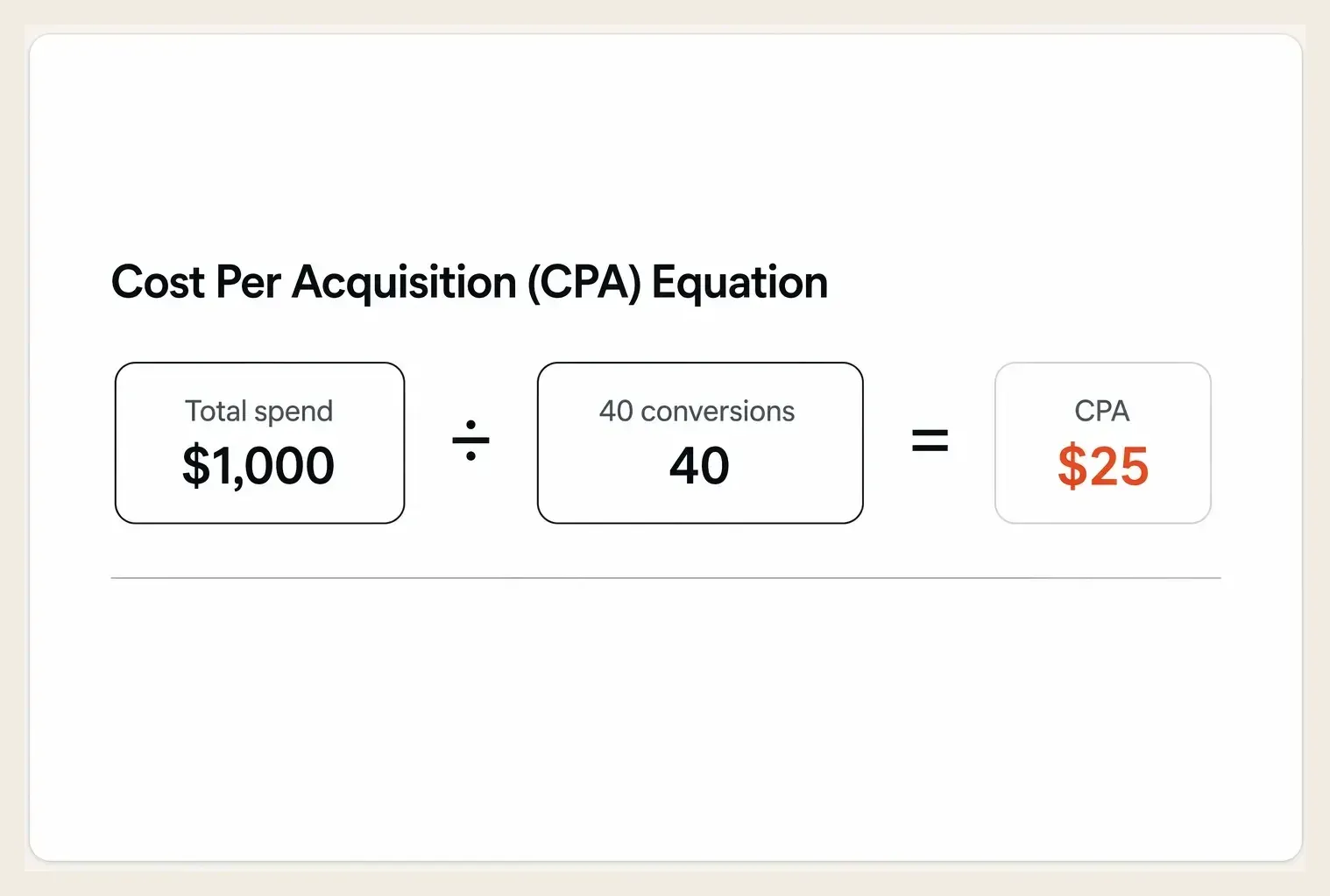
Cost Per Acquisition (CPA) is how much you pay to acquire one customer or conversion through your ads. It is your total ad spend divided by the number of conversions you get. If you spend $500 and get 25 customers, your CPA is $20 per customer. CPA is the metric that decides whether a campaign is building the business or quietly draining it.
Why It Matters
CPA determines whether your campaigns are profitable at scale. You might have a high conversion rate, but if each customer costs more than they are worth, the account loses money on every sale. CPA is the reality check that separates campaigns that feel good from campaigns that actually make money.
The stakes compound as you spend more. A $5 gap between your CPA and your target looks small at $1,000 a day, but across a $50,000 monthly budget that gap becomes real margin. Most accounts that fail to scale do not fail because of targeting. They fail because CPA climbs faster than revenue as budget increases, and nobody catches the creative-level cause in time. Tracking ROAS alongside CPA keeps both the cost and the return side of the equation honest.
How It Works
CPA is calculated at the campaign level, but the real signal lives at the creative level. Two ads in the same ad set can post wildly different CPAs, and the blended number hides that.
- Define what acquisition means. First purchase, lead submission, or trial signup. Be specific about the conversion event you are paying for.
- Track CPA by creative, not just by campaign. The winners and losers usually sit inside the same ad set.
- Compare against LTV or margin. A $50 CPA is excellent if your lifetime value is $200 and poor if it is $80.
- Monitor CPA trends over time. Rising CPA usually signals creative fatigue before it signals audience saturation.
Formula
The formula is simple, and the benchmark ranges are where the judgment lives.
Total Ad Spend / Number of Conversions = CPA
Typical CPA benchmarks vary by platform and funnel stage:
- Meta (ecommerce purchase): $15 to $45 for impulse-priced products, $40 to $120 for considered purchases.
- Google Search (high intent): often 20 to 40 percent lower than Meta for the same product because intent is already present.
- TikTok (top of funnel): CPAs can run higher on direct purchase but lower on lead and app-install goals.
Benchmarks are a starting reference, not a target. Your real ceiling is your maximum allowable CPA, set by lifetime value and margin, not by an industry average.
A Real Example
A DTC skincare brand runs Meta ads at a $42 CPA, above their $35 target. Analyzing performance at the creative level, they discover that UGC style ads deliver a $28 CPA while polished product shots deliver $58. They shift 70 percent of budget to UGC-style creative and run a structured creative testing framework for new variations.
Within 45 days, blended CPA drops from $42 to $31. That headroom lets them scale spend 2.5x while staying profitable, because the constraint was never the audience. It was the creative mix feeding the audience.
Common Mistakes
| ❌ Mistakes | ✅ Better Approach |
|---|---|
| Celebrate low CPA without checking if those customers convert to revenue | Track CPA alongside ROAS and customer quality metrics |
| Blame rising CPA on audience exhaustion without checking creative | Use element-level analysis to find which creative elements drive CPA inflation |
| Launch without a maximum CPA threshold | Calculate your max allowable CPA from LTV and margin before spending a dollar |
How Hawky Helps
Hawky runs an account with agents, not dashboards. The Performance Agent watches CPA at the creative level, shifts budget toward the variants holding the lowest cost, and pulls back on the ones inflating the blend before the daily spend is wasted. The Creative Agent detects when a rising CPA is driven by fatigue and generates fresh variations on the hooks and formats that historically convert.
Underneath both, FeatherDB holds the account's memory, so every CPA decision is informed by what already worked rather than starting from zero each week. The result is an account where CPA is actively managed hour to hour, not reviewed after the budget is gone.
Frequently Asked Questions
What is a good CPA for Facebook ads?
A good CPA on Facebook depends entirely on your margin and lifetime value, but most ecommerce brands target $15 to $45 for impulse purchases and $40 to $120 for higher-consideration products. The only CPA that matters is one below your maximum allowable cost, calculated from LTV and profit margin.
How do you reduce CPA?
The fastest way to reduce CPA is to fix the creative mix, not the targeting. Identify which specific ads and hooks deliver the lowest cost, shift budget toward them, and refresh fatigued creative before cost climbs. Targeting changes usually move CPA by single-digit percentages, while creative changes routinely cut it by 20 to 40 percent.
What is the difference between CPA and CPC?
CPC is the cost of a single click, while CPA is the cost of a completed conversion such as a purchase or lead. A campaign can have a low CPC and a terrible CPA if the clicks never convert, which is why CPA is the metric tied directly to profitability.
Why is my CPA suddenly increasing?
A sudden CPA spike is most often caused by creative fatigue, where your audience has seen the ad too many times and stops responding. Check ad frequency and creative-level performance first. Rising costs are usually a content problem before they are an audience problem.
Quick Takeaway
CPA measures what you pay per customer, and creative-level CPA reveals that the gap between profitable and unprofitable campaigns usually comes down to which ad elements you are running, not just who you are targeting.
Profitable scaling starts with knowing which creatives hold your CPA down, then putting agents on the account that act on it in real time. Ready to hire your first AI performance team? Book Demo