CTR (Click-Through Rate)
Last updated
The percentage of people who click your ad after seeing it. A key signal of how compelling your creative and messaging are to your target audience.
CTR (Click-Through Rate)
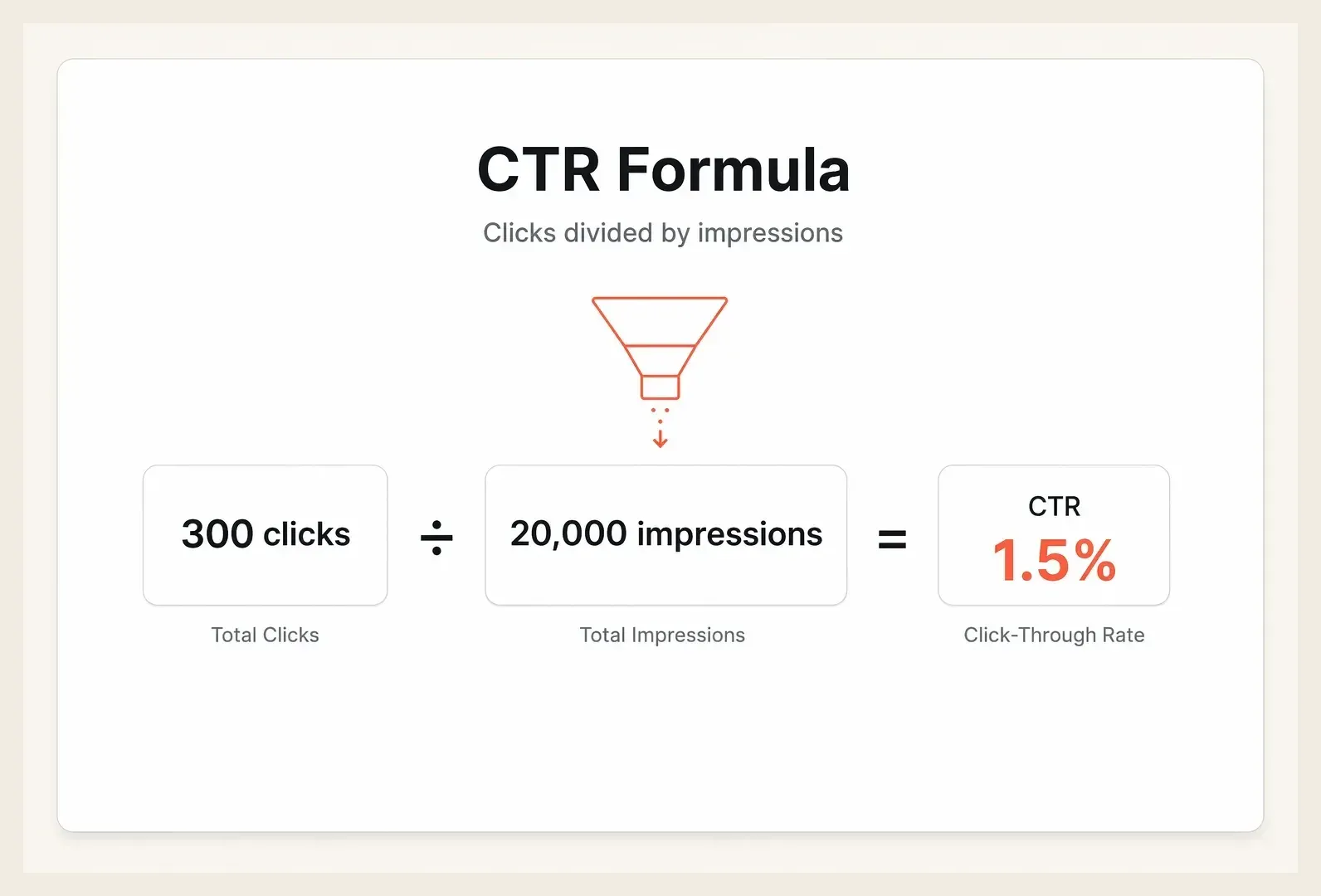
Click-Through Rate (CTR) is the percentage of people who click your ad after seeing it. It is your clicks divided by impressions, shown as a percentage. If 100 people see your ad and 3 people click it, you have a 3 percent CTR. CTR is the clearest early signal of whether your creative is compelling enough to stop the scroll.
Why It Matters
CTR is your creative's report card. It tells you whether your ad is compelling enough to stop the scroll and earn attention. Low CTR signals that your creative is not resonating, and it costs you money through higher CPCs and weaker quality scores. High CTR means your creative is working, and ad platforms reward that engagement with better placement and lower costs.
The financial stakes are direct. On Meta, a creative that lifts CTR from 0.9 percent to 1.8 percent can cut effective CPC by 30 to 50 percent because the auction rewards engaging ads with cheaper delivery. That compounding effect means CTR is not a vanity metric, it is an input to every downstream cost in the account. Declining CTR is also the first visible symptom of creative fatigue, often appearing weeks before CPA starts to rise.
How It Works
CTR is calculated per impression, but the insight lives at the creative level, not the campaign level:
- Track CTR by creative, not just campaign. Different ads in the same campaign can show 2 to 5x CTR variance, and the campaign average hides which creative is carrying the account.
- Compare against platform benchmarks. A 1.2 percent CTR is strong on Facebook feed but weak on Google Search, where intent is far higher.
- Watch CTR trends over time. A sustained decline is the earliest warning of creative fatigue, before CPA or ROAS move.
- Do not optimize CTR in isolation. High CTR with low conversions means your ad promises something the landing page does not deliver.
Formula
The formula is straightforward:
(Clicks ÷ Impressions) × 100 = CTR percent
Typical benchmark ranges vary sharply by placement. Facebook and Instagram feed ads average around 0.9 to 1.5 percent, with strong creative reaching 2 to 3 percent. Google Search sits much higher at 3 to 6 percent because users are actively searching. Display and the GDN run far lower, often 0.4 to 0.6 percent. TikTok in-feed ads commonly land between 1 and 2 percent. Always benchmark against your own placement and industry rather than a single global number.
A Real Example
A fitness app runs 15 different Instagram ads with CTRs ranging from 0.6 percent to 2.3 percent. Using element-level analysis, the team breaks down performance by creative component and finds a clear pattern: ads opening with a "transformation timeline" visual (before and after shown in the first 3 seconds) average 2.1 percent CTR, while ads starting with workout clips average 0.8 percent CTR.
They shift creative strategy to prioritize transformation hooks across new variations. Within 30 days, blended CTR rises from 1.1 percent to 1.9 percent, CPA drops from $3.50 to $2.10, and Instagram's algorithm rewards the higher engagement with 40 percent more impressions at the same budget.
Common Mistakes
| ❌ Mistake | ✅ Better Approach |
|---|---|
| Chasing high CTR with clickbait that does not match your offer | Use element-level analysis to find hooks that drive clicks AND conversions |
| Not benchmarking against platform-specific averages for your industry | Benchmark against the average for your exact placement and vertical |
| Ignoring declining CTR until ROAS drops | Refresh creative when CTR decreases 30 percent or more from initial performance |
How Hawky Helps
Hawky treats CTR as a creative problem and acts on it, not just a number to report. The Creative Agent runs element-level analysis to identify which opening hooks, thumbnail styles, and visual formats consistently drive higher CTR in your category, then rebuilds underperforming creative around those winning elements before you waste budget testing blind.
The Performance Agent watches CTR trends ad by ad and flags fatigue the moment engagement starts sliding, so refreshes happen before CPA climbs. Every winning pattern is stored in FeatherDB, so the next creative cycle starts from what already works in your account instead of guessing.
Frequently Asked Questions
What is a good CTR for Facebook ads?
A good CTR for Facebook and Instagram feed ads is around 1.5 percent or higher, with strong creative reaching 2 to 3 percent. The platform average sits closer to 0.9 percent, so anything consistently above 1.5 percent signals creative that is resonating. Benchmarks shift by industry, so compare against your own vertical rather than a single global figure.
How do you calculate click-through rate?
Click-through rate is calculated by dividing clicks by impressions and multiplying by 100. If an ad earns 200 clicks on 10,000 impressions, the CTR is 2 percent. The metric measures how often people who see your ad actually click it.
Why is my CTR dropping?
A declining CTR is almost always the first sign of creative fatigue, meaning your audience has seen the ad too many times and stopped responding. Rising frequency, a stale hook, or a saturated audience are the usual causes. Refresh the creative when CTR falls 30 percent or more from its launch performance, before CPA starts to rise.
Does a high CTR always mean a good ad?
No. A high CTR only confirms the ad is compelling enough to earn the click, not that it drives results. If clicks do not convert, the creative is likely overpromising or mismatched with the landing page, which wastes budget. Always read CTR alongside conversion rate and CPA.
Quick Takeaway
CTR measures how many people click your ad after seeing it, but creative-level CTR reveals that the gap between 0.8 percent and 2.4 percent is rarely your audience or targeting. It is which creative elements you use in the first 3 seconds.
Stuck watching CTR slide while costs creep up? Book Demo