CPM (Cost Per Mille)
Last updated
The cost per 1,000 ad impressions. CPM reflects how expensive it is to reach your target audience and is a key metric for brand awareness campaigns.
CPM (Cost Per Mille)
What is CPM and why does it affect your ROAS? Learn how to calculate Cost Per Mille, benchmark it by platform, and use Hawky's agents to lower your ad costs.
CPM stands for Cost Per Mille, where mille is Latin for thousand, and it represents the price an advertiser pays for every 1,000 impressions an ad receives. It is the standard metric used to compare the cost-efficiency of different channels and audience segments. CPM is essentially the rent you pay for attention, before anyone clicks or buys.
Why It Matters
CPM is your inventory cost. If your CPM doubles but your conversion rate stays flat, your profit margins vanish even though nothing about your product or funnel changed. Understanding CPM tells you whether a platform is too expensive for your price point or whether your creative needs to win more auctions at a lower price.
CPM also explains a large share of unexplained cost swings. When marketers see CPC or CPA rise overnight, the root cause is frequently a CPM spike driven by seasonality or competition rather than anything wrong with the funnel. Knowing your baseline CPM lets you separate auction-price problems from creative and conversion problems, so you fix the right thing.
How It Works
CPM is set in the same auction that governs every impression. Bid matters, but so does how much the platform wants to show your ad.
- The auction: Social platforms set CPM through a mix of your bid, the estimated action rate, and ad quality.
- Seasonality: Expect CPMs to spike during peak periods like Black Friday and Cyber Monday when every brand floods the auction.
- Audience specificity: Broad targeting usually yields a lower CPM than a narrow, high-value lookalike audience.
- Creative quality: Platforms reward ads people engage with. A strong hook and high thumbstop ratio can lower your CPM because the platform prefers showing content users like.
Formula
CPM is easy to compute and essential to benchmark before judging any campaign.
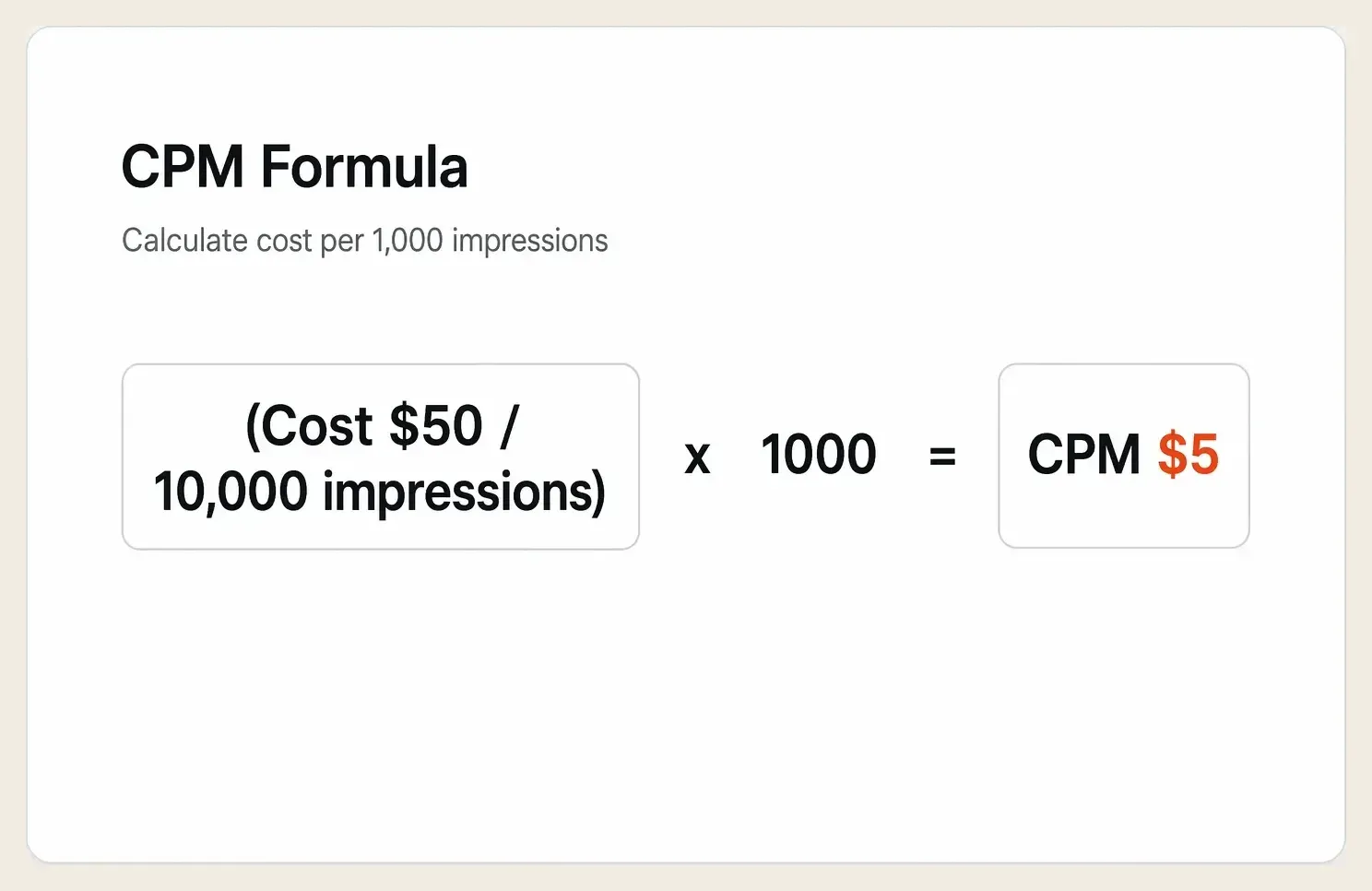
(Total Cost / Total Impressions) x 1,000 = CPM
Typical CPM benchmark ranges by platform:
- Meta (Facebook and Instagram): $8 to $18 for broad audiences, higher for narrow targeting and premium placements.
- TikTok: $6 to $12, often the lowest CPM for reach-driven campaigns.
- YouTube: $10 to $30 depending on format and targeting.
- LinkedIn: $25 to $50 plus, the most expensive impressions because of B2B audience precision.
These are reference points, not goals. A high CPM is only a problem if your conversion rate cannot carry it.
A Real Example
A lifestyle brand runs two campaigns on Meta. Campaign A targets "Professional Pilots" and posts a $45 CPM because the audience is small and heavily contested. Campaign B targets "Males 25 to 45" and posts a $12 CPM because the audience pool is enormous.
Even if Campaign A earns a higher CTR, the brand often finds Campaign B more profitable, because the cost of eyeballs is nearly 4x cheaper. The lesson is that narrow interest-based targeting carries a CPM premium that the conversion rate has to justify, and frequently it does not.
Common Mistakes
| The Mistake | ❌ The Wrong Way | ✅ The Better Way |
|---|---|---|
| Ignoring ad quality | Blaming the algorithm for high costs | Improving content quality so the platform serves it cheaper |
| Over-targeting | Layering 10 or more interests, which drives CPM up | Using broader targeting and letting strong creative find the customer |
| Comparing apples to oranges | Expecting LinkedIn CPMs to match TikTok CPMs | Benchmarking CPM against platform and industry norms |
How Hawky Helps
Hawky runs the account with agents that act on CPM instead of just reporting it. When CPMs climb because of saturation or rising competition, the Creative Agent generates fresh assets built around the visual elements winning auctions in your niche, the kind of content platforms reward with cheaper impressions. The Performance Agent reads CPM alongside conversion rate and shifts budget toward the audiences and placements delivering efficient reach.
Both agents draw on FeatherDB, the account's living memory, so they remember which creative consistently bought attention at a discount and lean into it.
Frequently Asked Questions
What is a good CPM for Facebook ads?
A good Facebook CPM for broad audiences usually falls between $8 and $18, though it rises with narrow targeting, premium placements, and seasonal competition. CPM alone never tells the full story, since a higher CPM can still be profitable if the audience converts well.
Why did my CPM suddenly increase?
A sudden CPM jump is most often caused by seasonality, increased competition in your auction, or a creative that has saturated and lost engagement. Check the calendar for peak shopping periods first, then check ad frequency and creative performance before assuming the audience is exhausted.
What is the difference between CPM and CPC?
CPM is the cost per 1,000 impressions and measures what you pay to be seen, while CPC is the cost per click and measures what you pay for engagement. A strong CTR is what converts a low CPM into a low CPC, so the two metrics are tightly linked through creative quality.
How do I lower my CPM?
The most effective way to lower CPM is to improve creative engagement, since platforms charge less to serve ads people want to watch. Broadening overly narrow targeting and avoiding the most contested audiences also helps, because scarce audiences carry an auction premium.
Quick Takeaway
CPM is the price you pay to play the advertising game, and the way to keep it low is to make ads people actually want to see. Strong creative and sensible targeting beat bid tweaks every time.
When your impressions get expensive, the answer is better creative and smarter reach, not just a lower bid. Ready to hire your first AI performance team? Book Demo