UGC (User-Generated Content)

UGC (User-Generated Content)

UGC (User-Generated Content)

UGC ads get 4x higher CTR than polished creative. Learn what user-generated content is, why it outperforms, and how to scale it systematically.

UGC ads get 4x higher CTR than polished creative. Learn what user-generated content is, why it outperforms, and how to scale it systematically.

UGC ads get 4x higher CTR than polished creative. Learn what user-generated content is, why it outperforms, and how to scale it systematically.

You've seen the ads. Someone holds up a product on camera, says "okay I need to tell you about this," and suddenly you're watching a 45-second video that doesn't feel like an ad at all(sometimes they look like ads). That's UGC and it's consistently one of the highest-performing creative formats in paid social right now.

What Is UGC?

UGC stands for User-Generated Content. In performance marketing, it refers to ad creative that looks and feels like it was made by a real person - not a polished brand studio. Think smartphone-filmed reviews, honest testimonials, casual unboxings, and before/after demos filmed in someone's actual home or office.

Originally, UGC meant content organically created by real customers. Today, most brands also use paid UGC creators - people who are briefed to produce content that captures that same authentic, real-person feel specifically for use in paid campaigns.

Why It Matters

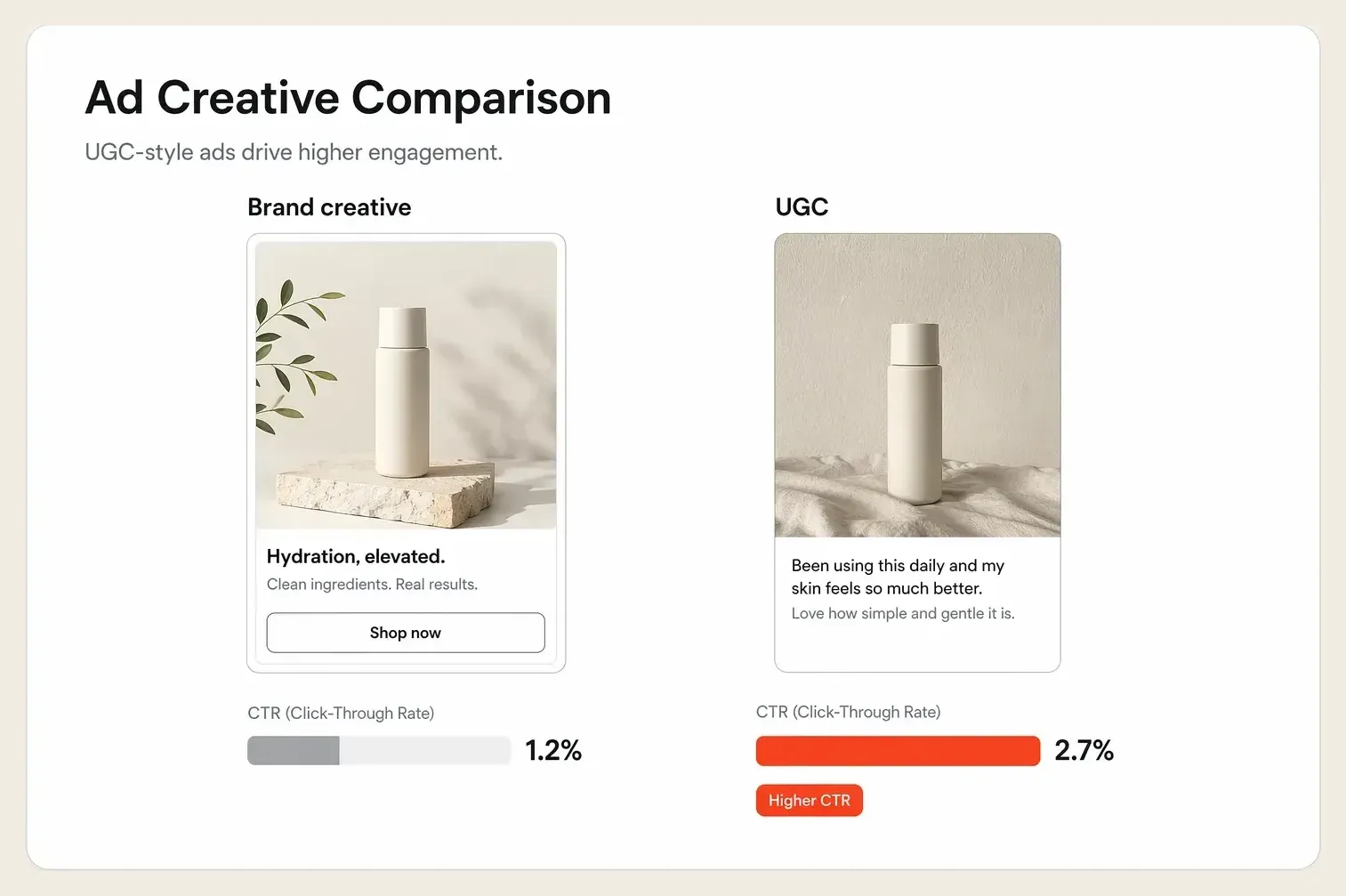
Audiences have become experts at scrolling past ads that look like ads. UGC bypasses that reflex because it reads like a peer recommendation, not a brand message. The performance gap is real: UGC-based ads receive 4x higher click-through rates than traditional polished creative, and social content featuring UGC drives 10x higher conversion rates compared to standard brand posts (Emplifi, Q3 2025). When your CTR is 4x higher on the same budget, that's the difference between a scaling campaign and a stagnant one.

How It Works

  • Authenticity triggers trust: Polished ads signal "this is advertising" - which instantly activates skepticism. UGC signals "this is a real person's experience" which activates curiosity and trust. The format change alone shifts how the brain processes the message.

  • Platform algorithms reward it: Meta, TikTok, and Instagram all favour content that feels native to the feed. UGC-style ads typically see lower CPMs because the platform's algorithm reads them as high-engagement content, not intrusive advertising - directly improving your ROAS.

  • Social proof does the heavy lifting: A real (or real-feeling) customer explaining a product's impact is more persuasive than any headline a copywriter writes. This is why UGC consistently outperforms at the middle and bottom of the funnel in retargeting and conversion campaigns especially.

  • Volume enables learning: UGC is faster and cheaper to iterate than studio content. That means you can test more hooks, creators, and angles which compresses the time it takes to find your winning creative format and feeds directly into better element-level analysis.

Real-World Example

A DTC haircare brand is running studio-shot ads across Meta with a blended 1.8x ROAS. Their CPA sits at $52. Creative refreshes take two weeks and cost $3,000+ per shoot.

They shift 40% of their creative budget toward UGC: briefing five creators to film honest before/after videos using their products at home. The briefs focus on a single hook format - "problem statement in the first 3 seconds, results revealed at the 15-second mark."

Within three weeks, two of the five creator videos outperform all existing studio ads. CTR climbs from 1.2% to 3.9% on the winning variants. CPA drops to $31. And because each new UGC video costs $200 to produce, they can now iterate 15x faster than before - feeding a continuous cycle of testing and improvement instead of waiting for the next big shoot.

Common Mistakes


Mistake

❌ What Marketers Do

✅ What to Do Instead

Assuming UGC always wins

Shift 100% of budget to UGC because "data says it converts better"

Test UGC vs. polished creative for your specific product and price point - for high-AOV items ($400+), polished content often wins on conversion quality even when UGC wins on CTR

Ignoring UGC creative fatigue

Keep running the same creator video until performance tanks

Monitor CTR and CPA trends at the individual creative level, UGC can fatigue within 7–14 days on TikTok; rotate creators and hook formats proactively before decay hits

Briefing without structure

Send creators a product and ask them to "be authentic"

Provide a clear hook framework (problem → product → proof → CTA), define the key benefit to lead with, and give examples — authentic feeling doesn't mean unguided

How Hawky Helps

When you're running 20, 40, or 80 UGC variants simultaneously, manually figuring out which hook type, creator style, or CTA format is actually driving conversions becomes impossible. Hawky's element-level analysis automatically breaks down your UGC creative - by hook structure, video length, text overlay use, creator type, and more - and connects each element to real conversion data, turning your UGC testing from intuition into a repeatable system.

Learn More

Quick Takeaway

UGC works because it feels like a recommendation, not an ad - but "authentic-looking" doesn't mean unplanned; the brands scaling fastest with UGC treat it as a systematic testing engine, not a one-off creative experiment.

You've seen the ads. Someone holds up a product on camera, says "okay I need to tell you about this," and suddenly you're watching a 45-second video that doesn't feel like an ad at all(sometimes they look like ads). That's UGC and it's consistently one of the highest-performing creative formats in paid social right now.

What Is UGC?

UGC stands for User-Generated Content. In performance marketing, it refers to ad creative that looks and feels like it was made by a real person - not a polished brand studio. Think smartphone-filmed reviews, honest testimonials, casual unboxings, and before/after demos filmed in someone's actual home or office.

Originally, UGC meant content organically created by real customers. Today, most brands also use paid UGC creators - people who are briefed to produce content that captures that same authentic, real-person feel specifically for use in paid campaigns.

Why It Matters

Audiences have become experts at scrolling past ads that look like ads. UGC bypasses that reflex because it reads like a peer recommendation, not a brand message. The performance gap is real: UGC-based ads receive 4x higher click-through rates than traditional polished creative, and social content featuring UGC drives 10x higher conversion rates compared to standard brand posts (Emplifi, Q3 2025). When your CTR is 4x higher on the same budget, that's the difference between a scaling campaign and a stagnant one.

How It Works

  • Authenticity triggers trust: Polished ads signal "this is advertising" - which instantly activates skepticism. UGC signals "this is a real person's experience" which activates curiosity and trust. The format change alone shifts how the brain processes the message.

  • Platform algorithms reward it: Meta, TikTok, and Instagram all favour content that feels native to the feed. UGC-style ads typically see lower CPMs because the platform's algorithm reads them as high-engagement content, not intrusive advertising - directly improving your ROAS.

  • Social proof does the heavy lifting: A real (or real-feeling) customer explaining a product's impact is more persuasive than any headline a copywriter writes. This is why UGC consistently outperforms at the middle and bottom of the funnel in retargeting and conversion campaigns especially.

  • Volume enables learning: UGC is faster and cheaper to iterate than studio content. That means you can test more hooks, creators, and angles which compresses the time it takes to find your winning creative format and feeds directly into better element-level analysis.

Real-World Example

A DTC haircare brand is running studio-shot ads across Meta with a blended 1.8x ROAS. Their CPA sits at $52. Creative refreshes take two weeks and cost $3,000+ per shoot.

They shift 40% of their creative budget toward UGC: briefing five creators to film honest before/after videos using their products at home. The briefs focus on a single hook format - "problem statement in the first 3 seconds, results revealed at the 15-second mark."

Within three weeks, two of the five creator videos outperform all existing studio ads. CTR climbs from 1.2% to 3.9% on the winning variants. CPA drops to $31. And because each new UGC video costs $200 to produce, they can now iterate 15x faster than before - feeding a continuous cycle of testing and improvement instead of waiting for the next big shoot.

Common Mistakes


Mistake

❌ What Marketers Do

✅ What to Do Instead

Assuming UGC always wins

Shift 100% of budget to UGC because "data says it converts better"

Test UGC vs. polished creative for your specific product and price point - for high-AOV items ($400+), polished content often wins on conversion quality even when UGC wins on CTR

Ignoring UGC creative fatigue

Keep running the same creator video until performance tanks

Monitor CTR and CPA trends at the individual creative level, UGC can fatigue within 7–14 days on TikTok; rotate creators and hook formats proactively before decay hits

Briefing without structure

Send creators a product and ask them to "be authentic"

Provide a clear hook framework (problem → product → proof → CTA), define the key benefit to lead with, and give examples — authentic feeling doesn't mean unguided

How Hawky Helps

When you're running 20, 40, or 80 UGC variants simultaneously, manually figuring out which hook type, creator style, or CTA format is actually driving conversions becomes impossible. Hawky's element-level analysis automatically breaks down your UGC creative - by hook structure, video length, text overlay use, creator type, and more - and connects each element to real conversion data, turning your UGC testing from intuition into a repeatable system.

Learn More

Quick Takeaway

UGC works because it feels like a recommendation, not an ad - but "authentic-looking" doesn't mean unplanned; the brands scaling fastest with UGC treat it as a systematic testing engine, not a one-off creative experiment.

You've seen the ads. Someone holds up a product on camera, says "okay I need to tell you about this," and suddenly you're watching a 45-second video that doesn't feel like an ad at all(sometimes they look like ads). That's UGC and it's consistently one of the highest-performing creative formats in paid social right now.

What Is UGC?

UGC stands for User-Generated Content. In performance marketing, it refers to ad creative that looks and feels like it was made by a real person - not a polished brand studio. Think smartphone-filmed reviews, honest testimonials, casual unboxings, and before/after demos filmed in someone's actual home or office.

Originally, UGC meant content organically created by real customers. Today, most brands also use paid UGC creators - people who are briefed to produce content that captures that same authentic, real-person feel specifically for use in paid campaigns.

Why It Matters

Audiences have become experts at scrolling past ads that look like ads. UGC bypasses that reflex because it reads like a peer recommendation, not a brand message. The performance gap is real: UGC-based ads receive 4x higher click-through rates than traditional polished creative, and social content featuring UGC drives 10x higher conversion rates compared to standard brand posts (Emplifi, Q3 2025). When your CTR is 4x higher on the same budget, that's the difference between a scaling campaign and a stagnant one.

How It Works

  • Authenticity triggers trust: Polished ads signal "this is advertising" - which instantly activates skepticism. UGC signals "this is a real person's experience" which activates curiosity and trust. The format change alone shifts how the brain processes the message.

  • Platform algorithms reward it: Meta, TikTok, and Instagram all favour content that feels native to the feed. UGC-style ads typically see lower CPMs because the platform's algorithm reads them as high-engagement content, not intrusive advertising - directly improving your ROAS.

  • Social proof does the heavy lifting: A real (or real-feeling) customer explaining a product's impact is more persuasive than any headline a copywriter writes. This is why UGC consistently outperforms at the middle and bottom of the funnel in retargeting and conversion campaigns especially.

  • Volume enables learning: UGC is faster and cheaper to iterate than studio content. That means you can test more hooks, creators, and angles which compresses the time it takes to find your winning creative format and feeds directly into better element-level analysis.

Real-World Example

A DTC haircare brand is running studio-shot ads across Meta with a blended 1.8x ROAS. Their CPA sits at $52. Creative refreshes take two weeks and cost $3,000+ per shoot.

They shift 40% of their creative budget toward UGC: briefing five creators to film honest before/after videos using their products at home. The briefs focus on a single hook format - "problem statement in the first 3 seconds, results revealed at the 15-second mark."

Within three weeks, two of the five creator videos outperform all existing studio ads. CTR climbs from 1.2% to 3.9% on the winning variants. CPA drops to $31. And because each new UGC video costs $200 to produce, they can now iterate 15x faster than before - feeding a continuous cycle of testing and improvement instead of waiting for the next big shoot.

Common Mistakes


Mistake

❌ What Marketers Do

✅ What to Do Instead

Assuming UGC always wins

Shift 100% of budget to UGC because "data says it converts better"

Test UGC vs. polished creative for your specific product and price point - for high-AOV items ($400+), polished content often wins on conversion quality even when UGC wins on CTR

Ignoring UGC creative fatigue

Keep running the same creator video until performance tanks

Monitor CTR and CPA trends at the individual creative level, UGC can fatigue within 7–14 days on TikTok; rotate creators and hook formats proactively before decay hits

Briefing without structure

Send creators a product and ask them to "be authentic"

Provide a clear hook framework (problem → product → proof → CTA), define the key benefit to lead with, and give examples — authentic feeling doesn't mean unguided

How Hawky Helps

When you're running 20, 40, or 80 UGC variants simultaneously, manually figuring out which hook type, creator style, or CTA format is actually driving conversions becomes impossible. Hawky's element-level analysis automatically breaks down your UGC creative - by hook structure, video length, text overlay use, creator type, and more - and connects each element to real conversion data, turning your UGC testing from intuition into a repeatable system.

Learn More

Quick Takeaway

UGC works because it feels like a recommendation, not an ad - but "authentic-looking" doesn't mean unplanned; the brands scaling fastest with UGC treat it as a systematic testing engine, not a one-off creative experiment.

Make Every Ad a Winner

Hooks, CTAs, visuals - decode every detail.

Ready to Stop Guessing and Start Winning with Creative Intelligence?

Creative Intelligence for Performance Marketing

© 2025 Hawky AI, All rights reserved

Ready to Stop Guessing and Start Winning with Creative Intelligence?

Creative Intelligence for Performance Marketing

© 2025 Hawky AI, All rights reserved

Ready to Stop Guessing and Start Winning with Creative Intelligence?

Creative Intelligence for Performance Marketing

© 2025 Hawky AI, All rights reserved