Hook
Last updated
How effectively your ad's opening 3 seconds captures attention and stops the scroll. The make-or-break moment for video ad success, because a weak hook kills your ROAS.
Discover how ad hooks can save your marketing budget. Learn the 3-second rule and how Hawky helps you generate new hooks to beat creative fatigue.
A Hook is the opening element of a creative, usually the first 3 seconds of a video or the first sentence of a caption, designed to capture a user's attention. It is the "stop-the-scroll" moment that earns you the right to tell the rest of your story, and it is the single most important determinant of whether an ad gets watched at all.
Why It Matters
In the attention economy, you are not just competing with other brands. You are competing with a user's friends, family, and favorite creators for the same three seconds. If your hook fails, your CTR drops, your CPM spikes because the algorithm reads your content as irrelevant, and the rest of your production budget is effectively wasted on an ad nobody watches.
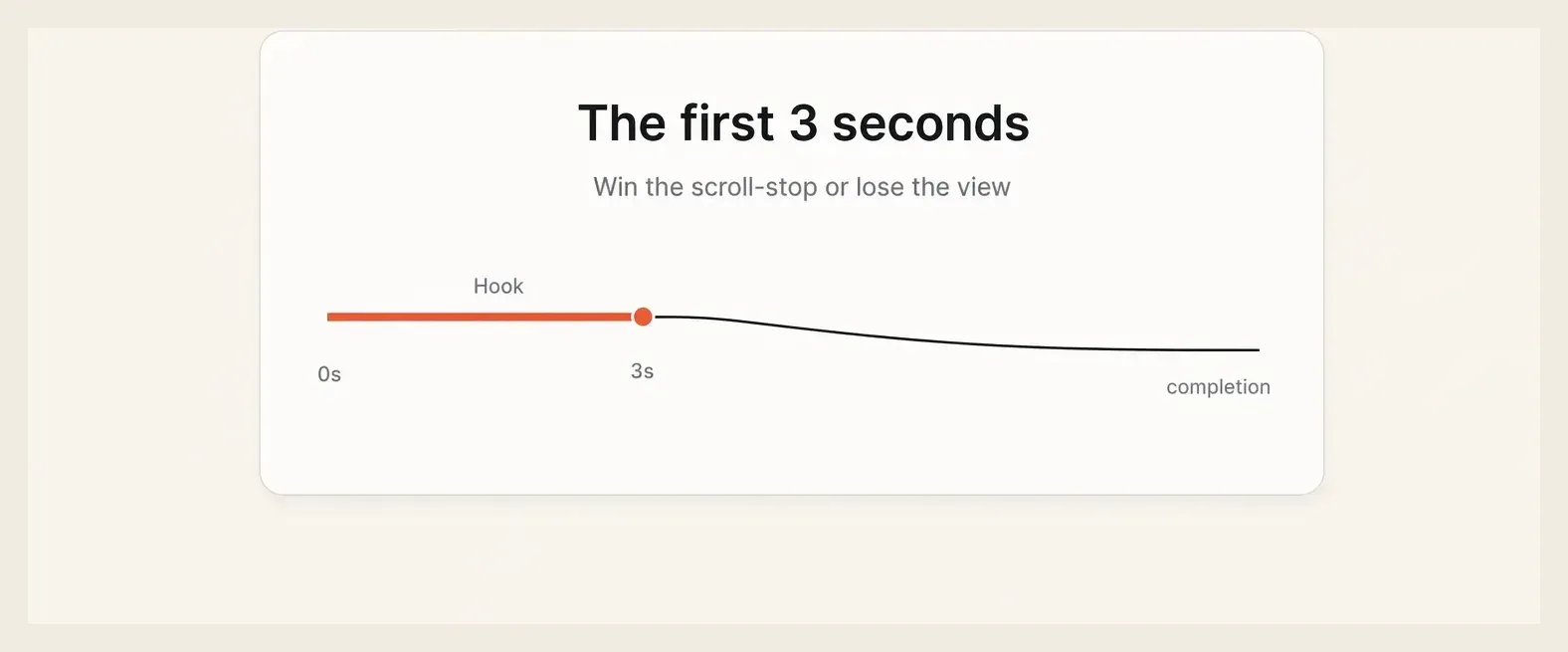
The math is unforgiving. On most platforms, the majority of viewers who drop off do so in the first three seconds, which means the hook decides the fate of the other 27 seconds of a 30-second ad. A brilliant offer behind a weak hook performs worse than an average offer behind a strong one, because the audience never reaches the offer.
How It Works
- The 3-second rule: On platforms like TikTok and Reels, if you have not delivered value or curiosity within 3 seconds, the user is already gone.
- Visual disruption: Using bright colors, unexpected movement, or native-looking UGC styles to blend into the feed while still standing out.
- The curiosity gap: Opening with a problem or a surprising statement that forces the user to keep watching for the resolution.
- Text overlay: Using bold, easy-to-read captions that summarize the value proposition immediately, even with the sound off.
The reason hooks reward testing is that what stops the scroll is rarely intuitive. Negative framing, blunt questions, and pattern interrupts often beat polished brand intros, and the only way to know which works for your audience is to run several against each other.
A Real Example
A skincare brand tests two versions of the same 30-second video ad against the same audience.
- Version A (weak hook): Starts with a logo animation and "Welcome to our brand."
- Version B (strong hook): Starts with a close-up of a breakout and the text "Stop using moisturizer until you see this."
Version B sees a 45% higher thumbstop ratio (people watching past 3 seconds) and a 2.1x increase in ROAS, despite being the exact same body content. By testing multiple openers, the brand learns that negative-framing hooks consistently outperform for their target audience, and it makes that the default starting point for the next batch.
Common Mistakes
| The Mistake | ❌ Wrong Approach | ✅ Better Approach |
|---|---|---|
| The "Logo First" Trap | Putting your brand logo in the first 2 seconds. | Starting with a relatable problem or an eye-catching visual. |
| One-and-Done | Using only one hook for a high-production video. | Testing 3 to 5 different hooks against the same body of the video. |
| Generic Openers | Using "Hey guys" or "Check this out." | Opening with a specific, data-backed insight or a clear pattern interrupt. |
How Hawky Helps
When your current hooks stop converting or you hit creative fatigue, Hawky's Creative Agent generates new openers built on what is actually stopping the scroll in your industry, then ships them as ready variants instead of leaving you to brainstorm from scratch. It treats the hook as the lever to pull, because it is the element with the most leverage over performance.
The Creative Agent draws on FeatherDB, Hawky's living memory of which hook structures have worked for your brand before, so each new round of openers starts from proven angles. Hawky's Copilot adds the competitor dimension, surfacing the hook patterns winning across your category so your tests start from evidence rather than guesswork.
Frequently Asked Questions
What is a hook in advertising?
A hook is the opening element of an ad, typically the first 3 seconds of a video or the first line of a caption, designed to capture attention and stop the scroll. It earns the viewer's decision to keep watching, which is why it carries more weight than any other single part of the creative.
What is the 3-second rule for video ads?
The 3-second rule states that you have roughly three seconds to deliver value or spark curiosity before a user scrolls past. On TikTok, Reels, and Meta feeds, most drop-off happens in this window, so the hook effectively decides whether the rest of your ad is seen at all.
How many hooks should you test per ad?
A practical standard is testing 3 to 5 different hooks against the same body content. Because what stops the scroll is hard to predict, running multiple openers lets the data reveal the winner rather than relying on instinct, and it extends the life of high-production footage you have already paid for.
What makes a good hook?
A good hook creates an immediate reason to keep watching, usually through a curiosity gap, a relatable problem, a pattern interrupt, or a bold visual in the first frames. Strong hooks tend to avoid logo-first intros and generic openers, leading instead with something specific and unexpected.
Quick Takeaway
A hook is your 3-second window to save your campaign. If you do not stop the scroll, the rest of your ad does not matter.
When your hooks stop earning attention, an agent should be generating and testing new ones for you. Ready to hire your first AI performance team? Book Demo