Video Completion Rate
Last updated
The percentage of viewers who watch your video ad to completion. A strong indicator of creative quality and audience-content fit, and higher is always better.
Video Completion Rate
Video Completion Rate (VCR) is the percentage of video ad impressions that play all the way through to the end. It is calculated by dividing the number of completed views by the total number of video starts, and it is one of the clearest signals of whether a video ad is actually holding attention.
Why It Matters
A high VCR is one of the strongest signals of a quality performance creative. When users watch an ad to the end, the platform's algorithm reads the content as highly relevant and rewards it with cheaper CPM and wider distribution. Just as important, completion is where conversions live: if the call to action sits at the end of a video and only a fraction of viewers reach it, most of the audience never even sees the offer.
The stakes show up directly in cost efficiency. On platforms like TikTok and Reels, a video that holds viewers past the halfway mark routinely earns more reach for the same budget, while a video that loses most of its audience in the first few seconds gets throttled. A few points of VCR improvement often translates into a materially lower CPA because more qualified viewers reach the CTR-driving moment at the end.
Formula
VCR is a simple ratio expressed as a percentage:
VCR = (Completed Views / Video Starts) x 100
If a video ad is started 10,000 times and played to completion 2,500 times, the VCR is 25%. Note that platforms define "completion" differently, so always check the metric definition before comparing across channels. Benchmarks vary widely by platform and video length:
| Platform | Typical VCR Range | Notes |
|---|---|---|
| TikTok | 8% to 15% | Short clips (under 15s) can run much higher |
| Instagram Reels | 10% to 20% | Native, sound-on, fast-paced creative performs best |
| YouTube (skippable) | 30% to 50% | Counted at the 30-second or full-view mark |
| Meta Feed | 15% to 25% | Strongly tied to a hook landing in the first 3 seconds |
Shorter videos almost always post higher completion rates, so a 35% VCR on a 15-second ad and a 12% VCR on a 60-second ad can represent similar absolute watch time. Read VCR alongside video length and total seconds watched, not in isolation.
How It Works
VCR is driven less by luck and more by structure, which is what makes it a controllable lever.
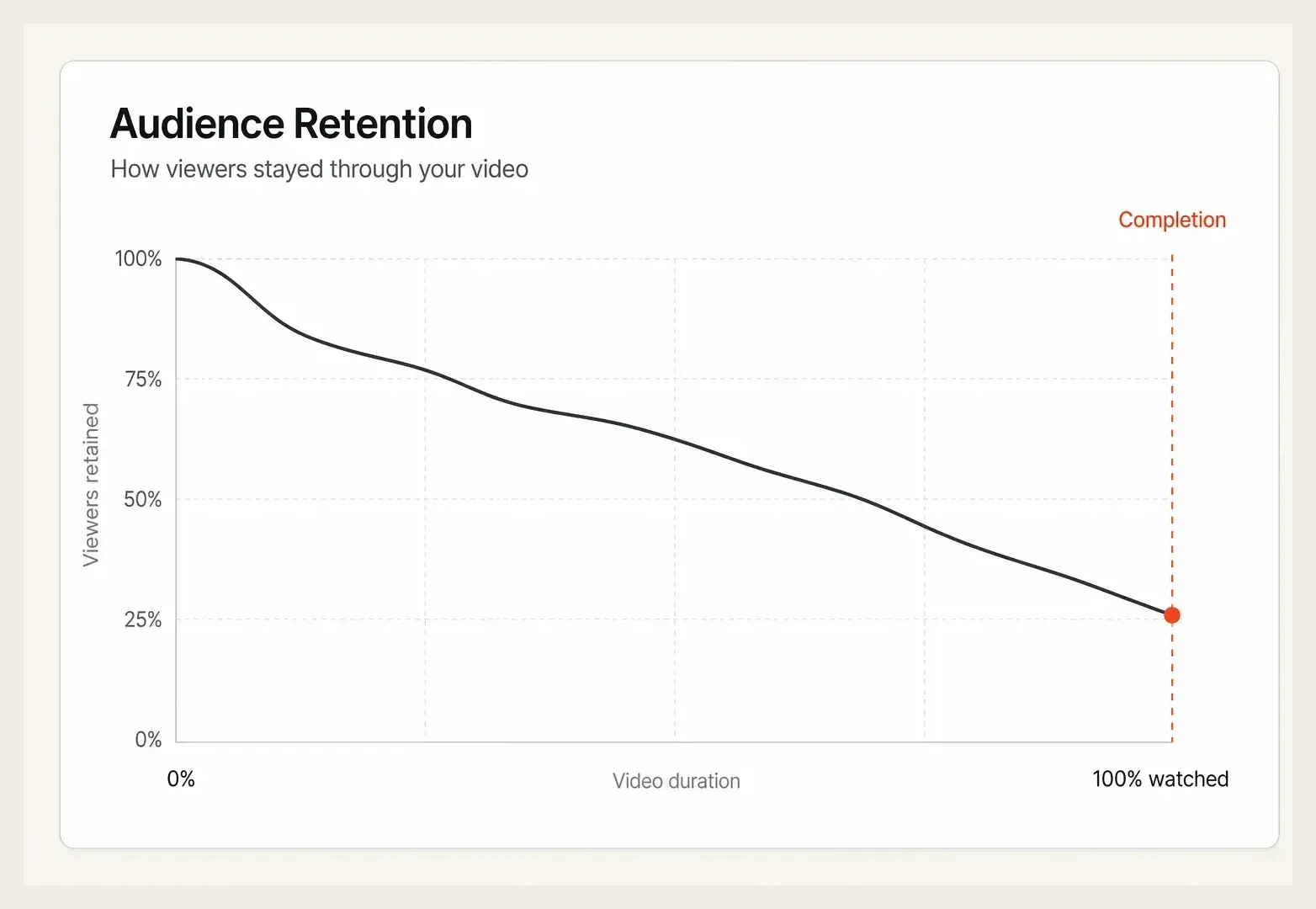
- Retention Mapping: The retention curve shows the exact second viewers swipe away, pinpointing where the creative loses momentum.
- Algorithm Reward: TikTok, Reels, and YouTube prioritize high-completion videos with cheaper, broader distribution and occasional viral momentum.
- CTA Exposure: When the offer lives at the end, VCR directly caps how many people ever see it, linking completion to conversions.
- Creative Pacing: Completion is heavily shaped by hook strength, fast cuts, music transitions, and the constant delivery of new information.
In practice, teams improve VCR by reading the retention curve, finding the drop-off point, and re-editing that exact moment. The most common fixes are a stronger opening hook, tighter pacing in the middle, and cutting any segment where nothing new happens on screen.
A Real Example
A cookware brand ran a 60-second recipe ad and was struggling to make it profitable.
In week one the VCR sat at 8% and the CPA was $45. The retention curve showed a massive drop-off at the 12-second mark, exactly where a slow talking-head introduction dragged on. The team re-cut the ad to a fast-paced 20 seconds, opening on the finished dish and moving quickly through the steps. VCR jumped to 35% and CPA fell to $22, because far more viewers now reached the final "Shop Now" frame. The only change was structural, the offer and audience stayed the same.
Common Mistakes
| The Mistake | ❌ Wrong Approach | ✅ Better Approach |
|---|---|---|
| The "Fluff" Intro | Opening with a slow logo animation or a long "Hey guys" | Landing the action within the first second using a strong hook |
| Dead Air | Leaving segments with no movement or new information | Using fast cuts and text overlays to maintain visual momentum |
| Ignoring the Middle | Perfecting the hook but letting the body of the video drag | Finding and removing retention killers from the footage |
| Comparing Across Lengths | Judging a 60s ad against a 15s ad on raw VCR | Reading VCR alongside seconds watched and video length |
How Hawky Helps
When a video hits ad saturation and its VCR starts to slide, the fix is not a report telling you completion dropped, it is new creative that holds attention. Hawky's Creative Agent generates fresh assets with optimized pacing, identifying the story structures and hook patterns that keep viewers watching to the final frame for that specific brand.
Hawky's element-level analysis connects each pacing choice, hook style, and edit point to real completion and conversion data, so the system learns which structures drive retention instead of guessing. Those learnings are stored in FeatherDB as living context for the account, and the Performance Agent scales the high-VCR variants that win. The effect is an account that continuously regenerates high-retention creative as old videos fatigue, rather than a dashboard that simply flags the decline.
Frequently Asked Questions
What is a good video completion rate?
A good VCR depends heavily on platform and video length. On TikTok and Reels, 10% to 20% is typical for short creative, while skippable YouTube ads often reach 30% to 50%. The more useful benchmark is your own trend: a VCR climbing over successive creative versions signals improving retention, regardless of the absolute number.
How is video completion rate calculated?
VCR is calculated by dividing completed views by total video starts, then multiplying by 100 to express it as a percentage. For example, 2,500 completions out of 10,000 starts equals a 25% VCR. Platforms define "completion" differently, so confirm whether a channel counts the full view or a 30-second threshold before comparing.
Why is my video completion rate so low?
Low VCR almost always traces back to the first few seconds or a mid-video drop-off. A weak opening hook, a slow intro, or a dead stretch where nothing new happens on screen all cause viewers to swipe away. Reading the retention curve pinpoints the exact second the audience leaves, which is where the re-edit should focus.
Does video completion rate affect ad cost?
Yes. Platforms treat high completion as a relevance signal and reward those videos with lower CPM and broader distribution. A higher VCR also means more viewers reach the call to action at the end, which improves conversion volume and lowers CPA on the same budget.
Quick Takeaway
Video Completion Rate is the ultimate proof of attention. If viewers are not finishing the video, they are probably not seeing the offer or buying the product, so treat VCR as a structural problem you can re-edit your way out of.
Watching your VCR slide as your best videos fatigue? Book Demo