CPC (Cost Per Click)
Last updated
The amount you pay each time someone clicks your ad. A fundamental bidding metric that reflects how competitive your audience targeting and creative are.
CPC (Cost Per Click)
What is CPC in digital marketing? Learn how to optimize Cost Per Click and use Hawky's agents to drive cheaper, higher-quality traffic across Meta, Google, and TikTok.
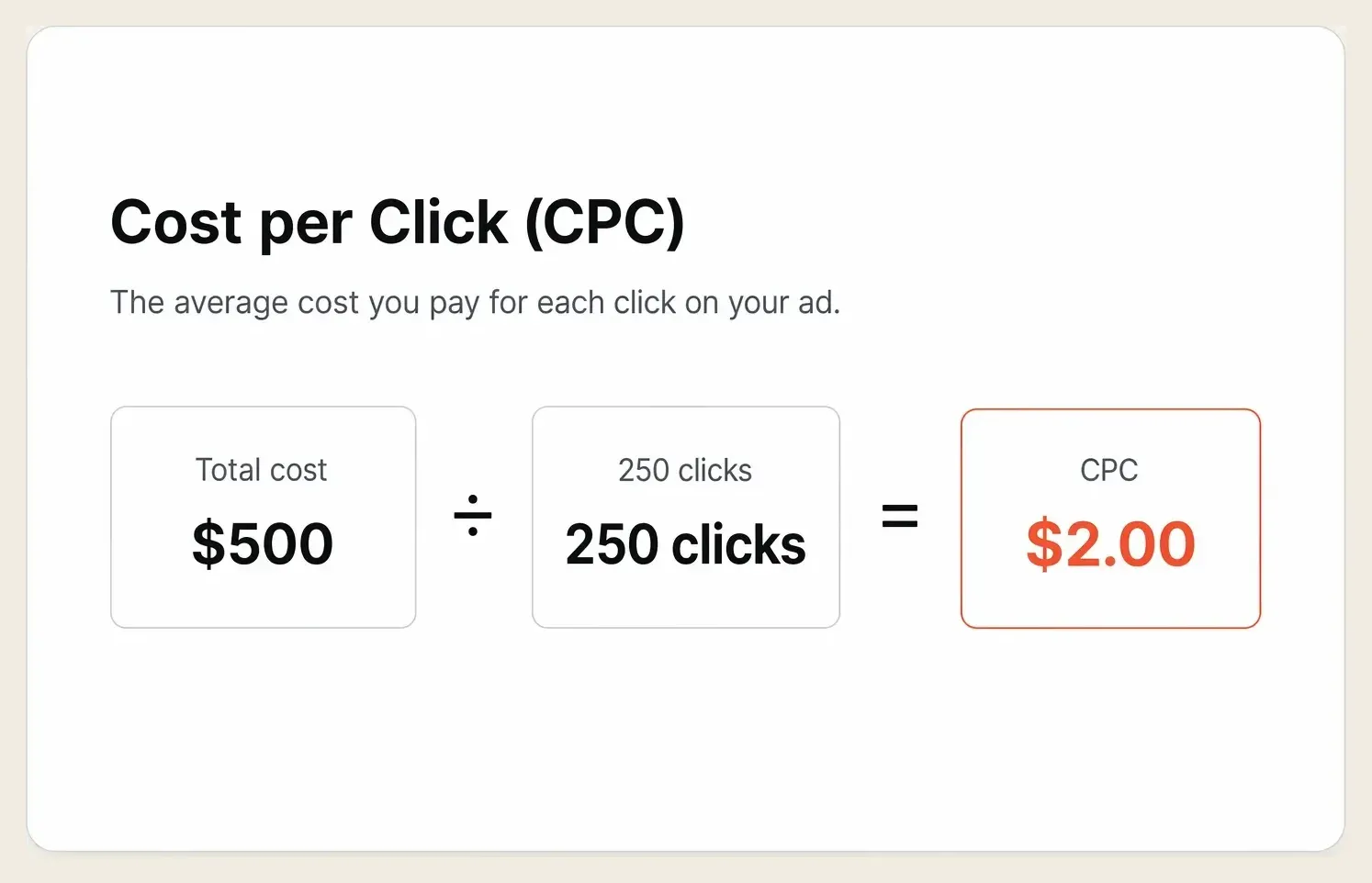
CPC, or Cost Per Click, is the amount an advertiser pays each time a user clicks on one of their ads. It represents the real cost of moving a potential customer from a platform like Meta, TikTok, or Google to your website or landing page. CPC is the toll you pay for every visitor, and it sits upstream of almost every other performance metric.
Why It Matters
CPC directly dictates your customer acquisition cost. If your CPC is too high, even a great landing page cannot deliver a profitable ROAS, because you are paying too much before the conversion math even begins. Monitoring CPC shows exactly how much you pay for traffic and whether your creative is actually engaging the audience.
CPC is also the earliest warning signal in the account. It moves before CPA does. A rising CPC usually means your CTR is falling, which means the creative is losing relevance, which means cost is about to climb across the whole funnel. Catching CPC drift early is far cheaper than reacting to a blown CPA two weeks later.
How It Works
CPC is set in a live auction every time your ad is eligible to show. Your bid is only part of it. Relevance does the rest.
- Auction dynamics: CPC is determined by your maximum bid combined with the estimated quality and relevance of your ad.
- Relevance rewards: Platforms lower the CPC of ads with strong CTR, effectively handing you a relevance discount for content people want to click.
- Market competition: During high-traffic events like Black Friday, more advertisers chase the same audience and the baseline CPC rises.
- Creative decay: As an ad hits ad saturation, the audience stops clicking and the algorithm raises your CPC to protect its revenue per impression.
Formula
CPC is straightforward to calculate and revealing to benchmark.
Total Cost / Number of Clicks = CPC
Typical CPC benchmark ranges by platform:
- Meta (Facebook and Instagram): $0.50 to $2.00 for most ecommerce and lifestyle categories, higher in finance and insurance.
- Google Search: $1.00 to $4.00 on average, with high-intent commercial keywords running well above that.
- TikTok: $0.50 to $1.50, often the cheapest clicks but with lower purchase intent.
- LinkedIn: $3.00 to $8.00, the highest CPCs because of premium B2B targeting.
These ranges shift with seasonality and competition. A CPC that is high for your category is a creative signal, not a fixed cost of doing business.
A Real Example
A skincare brand tests two hooks for the same moisturizer. Hook A ("Our Best Seller") is a standard product shot and returns a $1.85 CPC. Hook B ("3 Signs of Dehydrated Skin") is an educational UGC video and returns a $0.62 CPC.
For every $1,000 spent, Hook B generates 1,612 visitors while Hook A generates only 540. Same budget, same product, same audience. By identifying the winning hook, the brand roughly tripled its traffic without spending an extra dollar. That is the leverage hidden inside CPC.
Common Mistakes
| The Mistake | ❌ Wrong Approach | ✅ Better Approach |
|---|---|---|
| Ignoring high CPC | Continuing to spend on an ad where the click cost has doubled | Pausing the ad and using creative testing to find a cheaper alternative |
| Focusing only on cost | Buying the cheapest possible clicks even if they never convert | Balancing CPC with conversion rate to find high-intent traffic |
| Static creative | Expecting the same image to hold a low CPC for months | Refreshing creative before ad saturation drives the cost up |
How Hawky Helps
Hawky operates the account through agents instead of leaving the work to you. When CPC starts climbing because a creative is saturating, the Creative Agent generates fresh variations built around the visual cues and hooks currently driving the lowest CPCs in your niche. The Performance Agent then reallocates budget toward the ads holding their click cost and trims the ones bleeding it.
Every move is grounded in FeatherDB, the living memory that remembers which hooks earned cheap clicks before, so the account compounds what works instead of relearning it each cycle.
Frequently Asked Questions
What is a good CPC for Facebook ads?
A good Facebook CPC for most ecommerce and lifestyle brands sits between $0.50 and $2.00, though regulated categories like finance run higher. The more useful question is whether your CPC produces traffic that converts, since a $0.60 click that never buys is worse than a $1.50 click that does.
How can I lower my cost per click?
The most reliable way to lower CPC is to raise CTR with stronger creative, because platforms reward relevant ads with cheaper clicks. Refresh fatigued creative, lead with a sharper hook, and test new formats before competition or saturation pushes your cost up.
What is the difference between CPC and CPM?
CPM is the cost per 1,000 impressions, while CPC is the cost per click. CPM measures what you pay to be seen, and CPC measures what you pay to be clicked, so a high CTR is what turns a low CPM into a low CPC.
Why is my CPC increasing over time?
A steadily rising CPC almost always points to creative fatigue, where your audience has seen the ad enough times that fewer people click. Falling CTR forces the algorithm to charge more per click, so refreshing the creative is usually the fix rather than raising your bid.
Quick Takeaway
CPC is the toll bridge to your website, and fresh, engaging creative is what keeps that toll low. Manage CTR and creative freshness, and CPC takes care of itself.
When your clicks start getting expensive, the fix is rarely the bid and almost always the creative. Ready to hire your first AI performance team? Book Demo