Ad Saturation
Last updated
When your target audience has seen your ad too many times, leading to declining performance and wasted ad spend. Spot it before it kills your ROI.
Ad Saturation
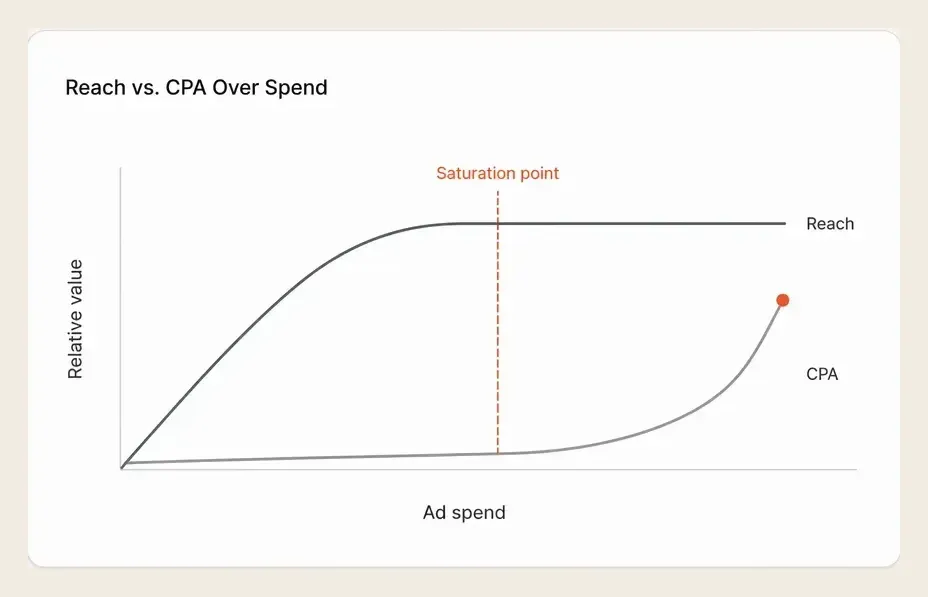
Ad saturation occurs when an advertising campaign has reached its maximum potential within a specific audience segment. It is the moment when nearly every reachable person in your target group has seen your message multiple times, and your cost per acquisition begins to rise sharply because there is no fresh audience left to convert.
Why It Matters
Pushing past the point of saturation is the fastest way to waste a marketing budget. Once you hit this ceiling, every additional dollar yields less profit, signaling that it is time to expand your audience targeting or shift your creative strategy. Ignoring the signal does not just stall growth, it actively destroys efficiency, because the platform keeps charging auction prices for impressions that no longer convert.
The cost is measurable. It is common to see CPA climb 50% or more once an ad set saturates its core audience, while ROAS slides week over week with no change in targeting. Catching saturation early, before it drags down a whole account, is the difference between a campaign you scale and a campaign that quietly burns cash. Saturation is also closely tied to ad frequency: when the audience pool empties, frequency spikes, and fatigue follows.
How It Works
- Market penetration: You have successfully served ads to the high-intent users within your niche market, and the supply of new prospects starts to thin.
- Frequency overload: Because the pool of new people is shrinking, the algorithm shows your ads to the same users again, driving up frequency.
- Efficiency drop: Your ROAS begins a steady decline that cannot be reversed by small creative tweaks.
- Platform limitation: Meta, Google, or TikTok struggles to find new auctions to enter for your brand, leading to stagnant or more expensive delivery.
Saturation is partly an audience problem and partly a creative problem, and the two compound. A small audience saturates faster, but even a large audience saturates if you run the same creative against it for too long. Recognizing which constraint you have hit, audience size or creative variety, determines whether the fix is broader targeting or fresh assets.
A Real Example
A luxury watch brand targets "Male Golf Enthusiasts" in California with a $10,000 monthly budget.
- Month 1: They reach 200,000 people and get 400 sales at a $25 CPA.
- Month 4: They double the budget to $20,000, but still reach only 280,000 people because the golf segment in that region is limited.
- The result: They get just 450 sales, but CPA has jumped to $44. The audience is saturated.
Doubling spend bought almost no incremental reach and nearly doubled the cost per sale. To scale from here, the brand must expand targeting to adjacent segments like "Luxury Travel," broaden geographically to a national audience, or introduce genuinely new creative angles, because more budget against the same exhausted segment only inflates frequency.
Common Mistakes
| Mistake | ❌ Wrong Approach | ✅ Right Approach |
|---|---|---|
| Budget Forcing | Increasing spend on a stagnant audience to "make it work." | Scaling spend only when performance data shows real audience headroom. |
| Narrow Targeting | Staying inside a tiny lookalike audience for too long. | Gradually broadening targeting as frequency passes healthy levels. |
| Ignoring the Ceiling | Assuming growth is infinite within one channel. | Diversifying across channels when a specific ad set hits saturation. |
How Hawky Helps
Hawky's Performance Agent reads the early signals of saturation, plateauing reach, rising frequency, and slipping ROAS, and acts on them before the ceiling caps your results. Rather than reporting that an ad set stalled last week, it can pull back spend on the exhausted audience and shift budget toward segments with real headroom, the way an experienced media buyer would.
When the constraint is creative rather than audience, the Creative Agent generates new concepts to break through the performance ceiling, giving a tired audience a genuinely new reason to convert. Because FeatherDB remembers which audiences and angles saturated before, Hawky avoids repeating the same dead-end push and sequences expansion intelligently.
Frequently Asked Questions
How do I know if my ads are saturated?
Watch for three signals together: reach plateauing even as spend rises, average frequency climbing past 5 to 7 on cold audiences, and ROAS declining week over week with no change in targeting or creative. When all three appear at once, the audience is saturated and adding budget will only raise your CPA.
What is the difference between ad saturation and creative fatigue?
Creative fatigue is when a specific ad stops working because people have seen it too many times, fixed by refreshing the creative. Ad saturation is broader: you have run out of fresh people to reach in a segment, so even new creative has limited room to run. Fatigue is a creative problem, saturation is often an audience-size problem, though the two frequently occur together.
How do you fix ad saturation?
You have two main levers: expand the audience or refresh the creative. Broaden targeting to adjacent interests, add lookalikes, or open new geographies to grow the addressable pool, and introduce new creative angles so existing audiences have a reason to re-engage. Diversifying onto additional channels also opens fresh auctions when one platform's segment is tapped out.
Can a bigger budget overcome ad saturation?
No. Once a segment is saturated, more budget simply buys higher frequency against the same people, which raises costs without adding conversions. The luxury watch example shows this clearly: doubling spend barely moved reach and nearly doubled CPA. Budget only scales efficiently when there is untapped audience or new creative for the algorithm to work with.
Quick Takeaway
Ad saturation is the wall you hit when you have run out of new people to show your ads to. Stop spending more into the same segment and start targeting broader or refreshing creative.
When rising CPAs mean you have hit your audience ceiling, you need a team that expands and refreshes before the budget burns. Ready to hire your first AI performance team? Book Demo