Ad Frequency
Last updated
The average number of times a single user sees your ad within a given time period. High frequency leads to ad fatigue and declining performance, so monitor it closely.
Ad Frequency
Ad frequency is the average number of times each unique person sees your ad during a campaign, calculated by dividing total impressions by total reach. It tells you whether you are building awareness through useful repetition or wasting budget by oversaturating the same people, which makes it one of the most underrated metrics in performance marketing.
Why It Matters
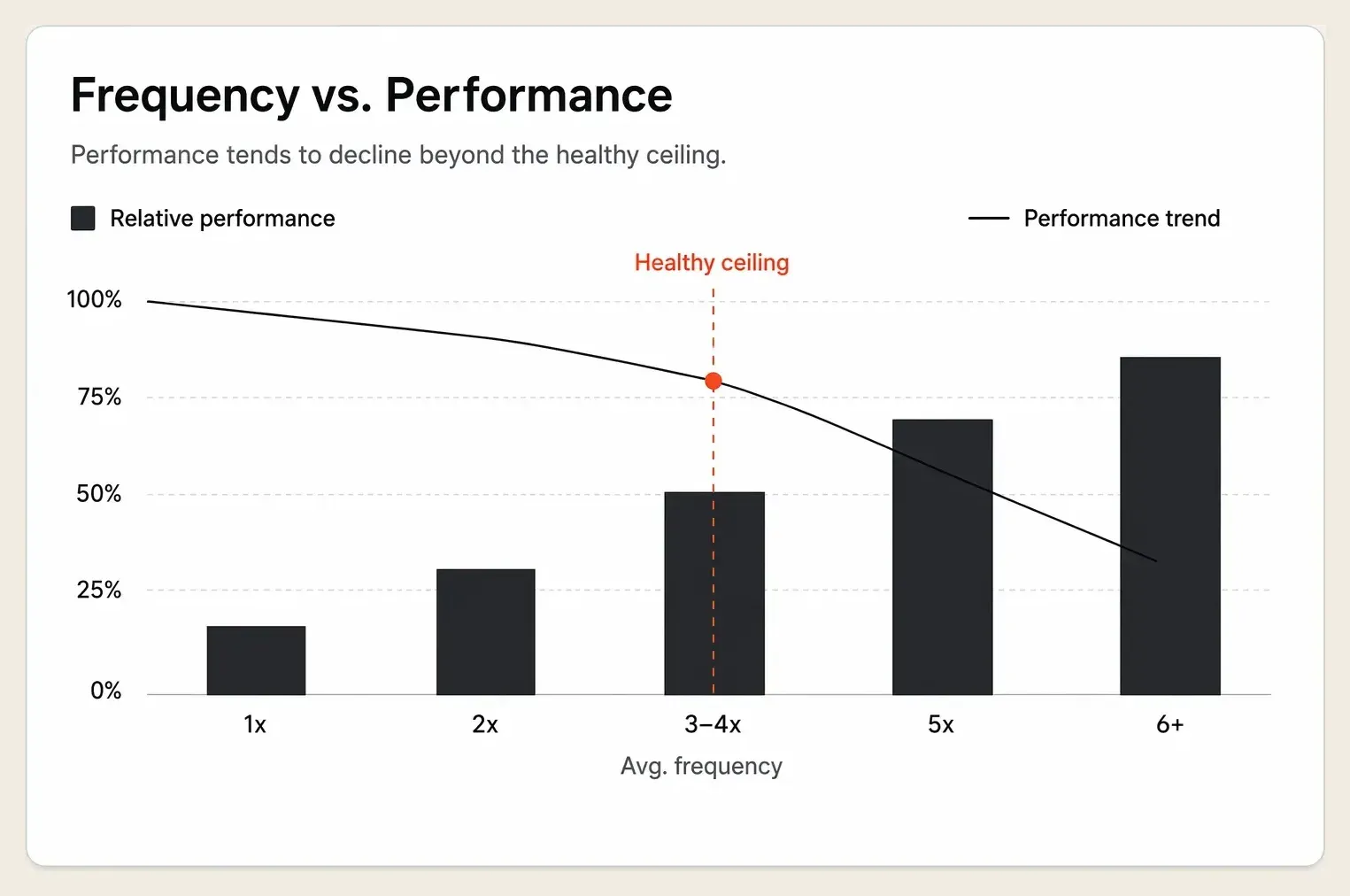
Frequency directly drives your cost per acquisition and overall campaign efficiency. Research on advertising effectiveness suggests people need to see a message between three and seven times before acting, but past that threshold performance typically collapses. High frequency above seven accelerates creative fatigue, where your CTR falls and CPM rises as people scroll past an ad they have already seen.
The stakes are concrete. When the same audience sees an ad too many times, the auction punishes you twice: response rates drop, so your effective CPA climbs, and ad fatigue signals can raise your delivery costs at the same time. Hitting the optimal frequency band without tipping into oversaturation is one of the highest-leverage adjustments a media buyer can make, and it costs nothing but attention.
How It Works
- Impression: Each time your ad appears on someone's screen, counted every time even for the same person.
- Reach: The number of unique people who see your ad at least once.
- Calculation: Total impressions divided by unique reach equals average frequency.
- Performance impact: Frequency 1 to 3 builds awareness, 3 to 5 drives action, and 5 and above typically shows diminishing returns.
Frequency rises naturally over a campaign's life because reach is finite. Once the platform has shown your ad to most of the addressable audience, additional impressions land on people who have already seen it, so frequency climbs even when your budget stays flat. That is why frequency is best read as a clock counting down the useful life of a creative, not a static setting you configure once.
Formula and Benchmarks
The formula is simple:
Frequency = Total Impressions / Unique Reach
Typical healthy ranges by placement and goal:
- Prospecting on Feed: keep average frequency around 1.5 to 3.0 over a 7-day window.
- Retargeting: a higher band of 4 to 8 is acceptable because the audience is warmer and the pool is smaller.
- Stories and Reels: tolerate slightly higher frequency than Feed because the format is faster and less fatiguing.
- Warning zone: sustained frequency above 5 to 7 on cold audiences usually signals it is time to refresh creative or expand reach.
These are starting points, not laws. The right ceiling depends on your offer, audience size, and how distinctive the creative is, which is why measuring the frequency at which your specific ads decay beats copying a generic number.
A Real Example
A DTC coffee brand runs a Facebook campaign targeting 50,000 people.
- Week 1: 150,000 impressions, 50,000 reach, frequency 3.0, CTR 2.1%, CPA $18.
- Week 2 (same creative): 200,000 impressions, 50,000 reach, frequency 7.0, CTR 0.9%, CPA $42.
- Week 3 (new creative): 150,000 impressions, 50,000 reach, frequency 3.0, CTR 2.3%, CPA $16.
By week 2 the audience had seen the same ad seven times on average and performance tanked despite identical targeting. Refreshing the creative reset effective frequency and immediately restored results, more than halving CPA. This is exactly why monitoring frequency is central to any creative rotation strategy.
Common Mistakes
| ❌ Mistake | ✅ Better Approach |
|---|---|
| Ignoring frequency until performance drops (by then budget is already wasted) | Set frequency alerts at 5.0 and refresh creative before fatigue sets in |
| Treating frequency 7 the same across all placements (Stories and Feed differ) | Monitor frequency by placement, since Stories tolerate higher frequency than Feed |
| Expanding the audience to fix high frequency (which dilutes targeting quality) | Rotate creative instead, keeping the proven audience but showing something new |
How Hawky Helps
Hawky's Performance Agent watches frequency in real time and ties it directly to outcomes, showing you the exact point where each ad starts to decay. Instead of guessing when to act, you see findings like "CTR drops 47% once frequency passes 6.2," and the agent can rotate budget toward fresher creative before performance collapses, rather than reporting the damage after the fact.
Working alongside it, the Creative Agent queues up replacement assets so a refresh is ready the moment frequency hits your ceiling. Because FeatherDB remembers the frequency at which each past creative fatigued, Hawky learns your account's specific tolerance over time and gets sharper at timing every rotation.
Frequently Asked Questions
What is a good ad frequency on Facebook?
For cold prospecting audiences, aim for an average frequency of roughly 1.5 to 3.0 over a 7-day window. Retargeting can run higher, around 4 to 8, because the audience is warmer and smaller. Sustained frequency above 5 to 7 on cold traffic usually means it is time to refresh creative or widen reach.
How do you calculate ad frequency?
Divide total impressions by unique reach. For example, 150,000 impressions delivered to 50,000 unique people equals a frequency of 3.0. The metric is an average, so some people will have seen the ad far more often than the number suggests.
Does high ad frequency hurt performance?
Yes. Once frequency climbs past the useful threshold, response rates fall while costs rise, because the audience has already seen the message and stops engaging. This shows up as declining CTR, rising CPM, and a climbing CPA, the classic signature of creative fatigue.
How is frequency different from reach?
Reach counts the unique people who saw your ad at least once, while frequency measures how many times each of those people saw it on average. Reach answers "how many," and frequency answers "how often." A campaign can have huge reach with low frequency, or small reach with punishing frequency, and the two require very different fixes.
Quick Takeaway
Frequency measures how many times each person sees your ad. Aim for 3 to 5 to drive action, and refresh creative before hitting 7 or more to avoid audience fatigue and wasted budget.
Stop letting tired creative quietly inflate your CPA. Ready to hire your first AI performance team? Book Demo