CPV (Cost Per View)
Last updated
The amount paid each time a viewer watches your video ad. Used primarily for video campaigns on YouTube and social platforms to measure video creative efficiency.
CPV (Cost Per View)
What is CPV in video marketing? Learn how to optimize Cost Per View, benchmark it by platform, and use Hawky's agents to produce video ads that capture and hold attention.
CPV, or Cost Per View, is a bidding method and metric where you pay each time a user watches your video ad. Depending on the platform, a view is counted when a user watches for a set duration (for example, 2 seconds on Meta, or 30 seconds or the full video on YouTube) or otherwise interacts with the ad. CPV is the price of buying attention at the top of the funnel.
Why It Matters
For brands leaning into video, CPV is the most direct measure of what brand awareness and top-of-funnel interest actually cost. A low CPV lets you build a large retargeting pool of people who have seen your brand, which you can later convert with lower-funnel performance creative at a much better CPA.
CPV also signals creative quality faster than almost any other metric. The platforms reward video people watch, so a falling CPV usually means your content is holding attention, and a rising CPV usually means it is not. Because video is expensive to produce, knowing your CPV early prevents pouring budget into a creative that the audience is quietly skipping.
How It Works
CPV is shaped as much by retention as by your bid. The longer people watch, the cheaper your views get.
- Platform standards: On TikTok you might optimize for 6-second focused views, while on YouTube you may only pay once a user watches past the skip button.
- Creative retention: A stronger hook keeps people watching longer, which signals quality to the platform and drives CPV down.
- Auction competition: Like CPM, CPV fluctuates with how many advertisers are bidding for the same user's attention.
- Targeting depth: Broad audiences usually yield lower CPVs, while narrow niche audiences come at a premium.
Formula
CPV is simple to calculate and best understood against platform benchmarks.
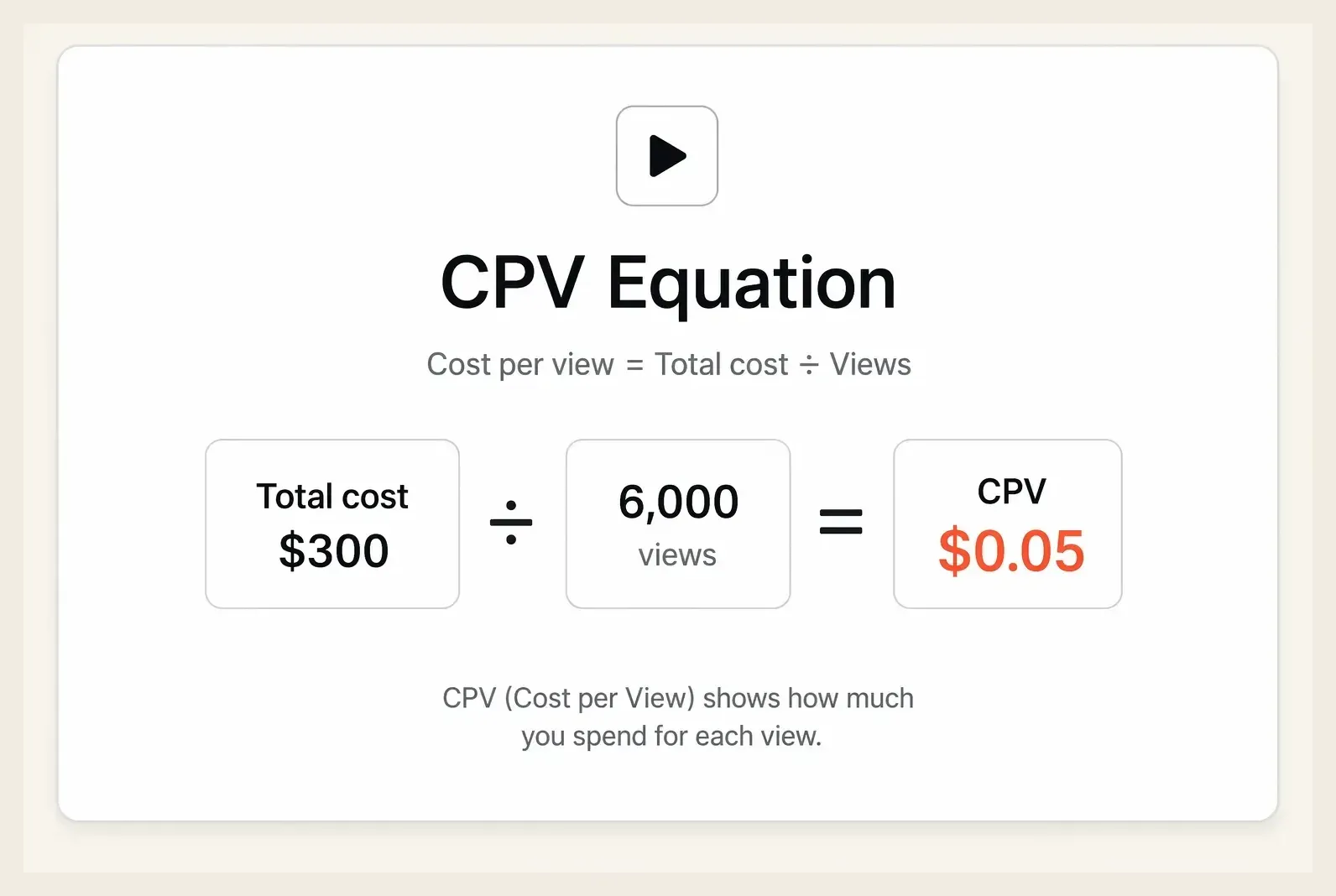
Total Video Ad Cost / Number of Views = CPV
Typical CPV benchmark ranges by platform:
- YouTube (TrueView, paid after 30 seconds or full view): $0.03 to $0.30 depending on targeting and category.
- TikTok (6-second focused view): roughly $0.02 to $0.10 for broad reach campaigns.
- Meta (2-second continuous view): often $0.01 to $0.05, though short view windows make the metric softer.
View definitions differ by platform, so always compare CPV against the same view standard before drawing conclusions.
A Real Example
An outdoor gear brand launches a new camping tent with a 15-second video. Ad A is cinematic, with beautiful mountain shots but no product for the first 10 seconds, and posts a $0.15 CPV. Ad B opens on someone struggling to set up an old tent, a clear problem-solution structure, and posts a $0.03 CPV.
Ad B is 5x more efficient. For the same $500 budget, Ad B generates 16,666 views while Ad A generates only 3,333. The difference is entirely in the first three seconds, which is why front-loading the hook is the single biggest lever on CPV.
Common Mistakes
| The Mistake | ❌ Wrong Approach | ✅ Better Approach |
|---|---|---|
| The slow burn | Saving the best part of the video for the end | Front-loading value in the first 3 seconds to maximize thumbstop ratio |
| Ignoring retention | Paying for views without checking how many watch past 50 percent | Using video completion rate to see where viewers drop off |
| Misaligned bidding | Using CPV bidding for a buy-now conversion goal | Balancing CPV for reach with CPA for actual sales |
How Hawky Helps
Hawky operates the account with agents that act on view cost directly. When video saturates and CPVs start to climb, the Creative Agent generates fresh cuts with refreshed hooks and visuals, drawing on the video structures currently winning the most watch time in your category. The Performance Agent reads CPV against retention and downstream conversions, then shifts budget toward the videos building the most valuable retargeting pool.
Both agents lean on FeatherDB, the living memory that records which hooks and pacing held attention before, so the account keeps compounding what works instead of guessing.
Frequently Asked Questions
What is a good CPV on YouTube?
A good YouTube CPV typically falls between $0.03 and $0.30, depending on your targeting, category, and how competitive your audience is. The cheaper end usually reflects strong hooks and broad targeting, while premium niche audiences push the cost higher.
What is the difference between CPV and CPM?
CPM charges you per 1,000 impressions regardless of whether anyone watches, while CPV charges only when a user actually views your video for the platform's defined duration. CPV ties cost more closely to genuine attention, which makes it the better metric for measuring video engagement.
How do I lower my cost per view?
The most effective way to lower CPV is to front-load a strong hook in the first three seconds, since higher retention signals quality and the platform rewards it with cheaper views. Refreshing fatigued video and avoiding overly narrow audiences also helps bring the cost down.
Is CPV good for conversions?
CPV is built for reach and brand awareness rather than direct conversions, so it works best at the top of the funnel to build a retargeting audience. For actual sales, pair CPV reach campaigns with conversion campaigns optimized for CPA.
Quick Takeaway
CPV is the price of a pair of eyes, and content that hooks fast and holds attention is what keeps that price low. Win the first three seconds and CPV follows.
When your video costs creep up, the answer is a sharper hook and fresher cuts, not a bigger bid. Ready to hire your first AI performance team? Book Demo