9 Best Mobile Marketing Automation Tools in 2026: Features, Use Cases & What to Look For

Lokeshwaran Magesh
Lokeshwaran Magesh
Lokeshwaran Magesh
6 Mins Read
6 Mins Read
6 Mins Read

Make Every Ad a Winner
Hooks, CTAs, visuals - decode every detail.
The best mobile marketing automation tools in 2026 are Hawky for AI-powered creative intelligence on the acquisition side, Braze for real-time multi-channel customer engagement, and CleverTap for retention analytics paired with deep segmentation. Each solves a different layer of the mobile growth stack, and the right pick depends on whether your bottleneck is acquiring users with better ad creative or retaining the ones you already have.
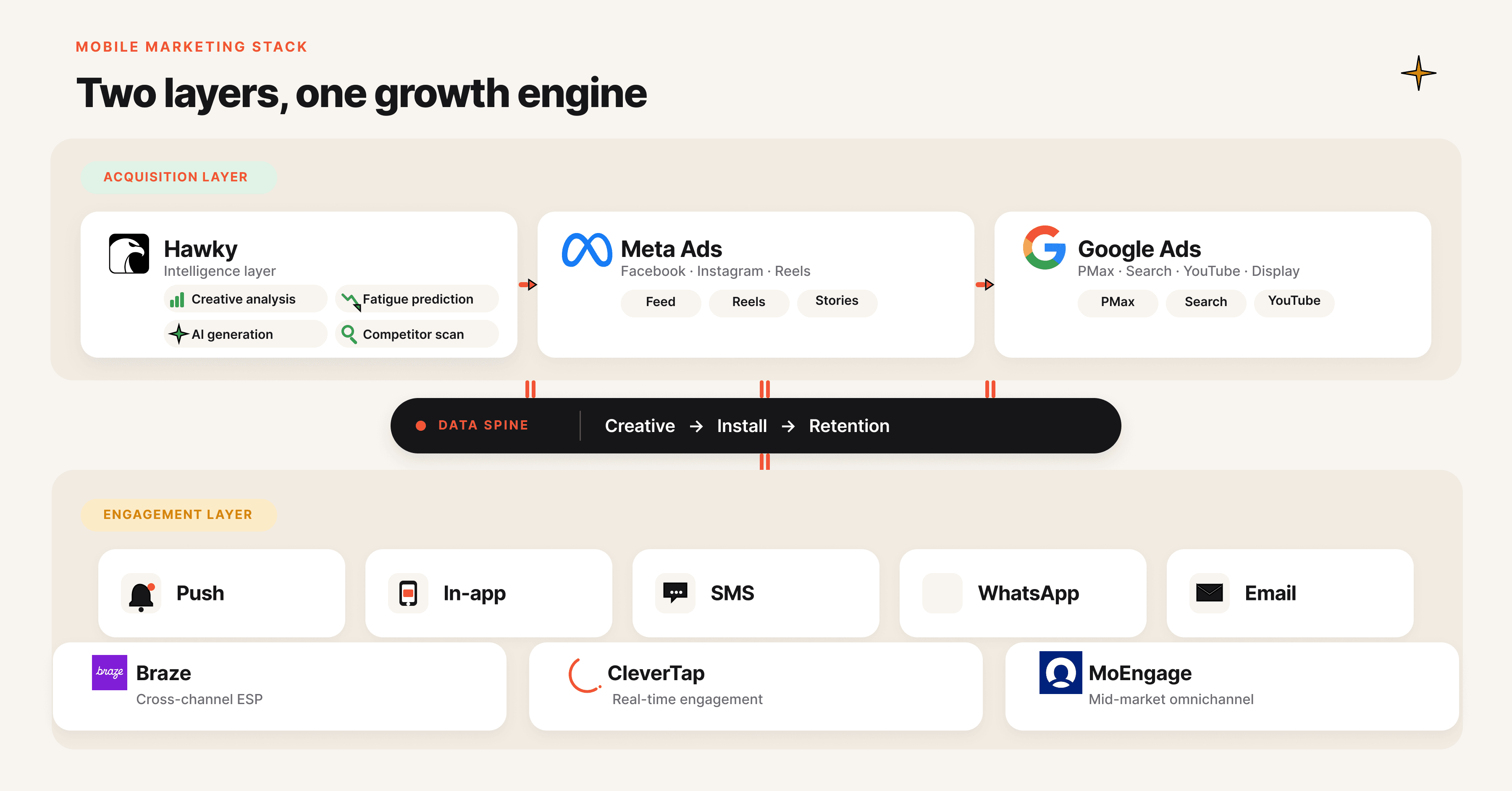
Mobile marketing in 2026 is no longer a single workflow. It splits into two distinct layers. The acquisition layer is where ad creative decides cost-per-install and ROAS on Meta and Google.
The engagement layer is where push notifications, in-app messages, SMS, and WhatsApp decide whether users come back. Most performance teams treat these as separate problems, run separate tools, and lose the connection between creative that wins and users who stay.
This guide covers 9 platforms, what each one is genuinely good at, where they fall short, and how to pick the one (or pair) that matches your team and budget.
What mobile marketing automation actually means in 2026
Mobile marketing automation is software that triggers personalized messages and ad creative across mobile channels (push notifications, in-app messages, SMS, WhatsApp, mobile ads) based on user behavior, attributes, and campaign rules. The goal is to deliver the right message to the right user at the right moment without manual intervention.
In 2026, the category has expanded beyond the classic engagement use case. Modern stacks now include the creative intelligence layer that decides what runs on the acquisition side. A tool that only handles push notifications is solving half the problem. The mobile ad creative your users see before they install matters as much as the in-app message they see after.
A good mobile marketing automation tool in 2026 has five non-negotiables. First, real-time event ingestion so segments and triggers fire when behavior happens, not on a 30-day delay. Second, channel coverage that includes push, in-app, SMS, email, and ideally WhatsApp.
Third, behavioral segmentation that updates as users move through the funnel. Fourth, AI personalization that's actually predictive, not just rule-based. Fifth, integration with your acquisition stack so creative performance and retention performance share a data spine.
The 9 best mobile marketing automation tools
1. Hawky: Best for mobile ad creative intelligence and acquisition automation
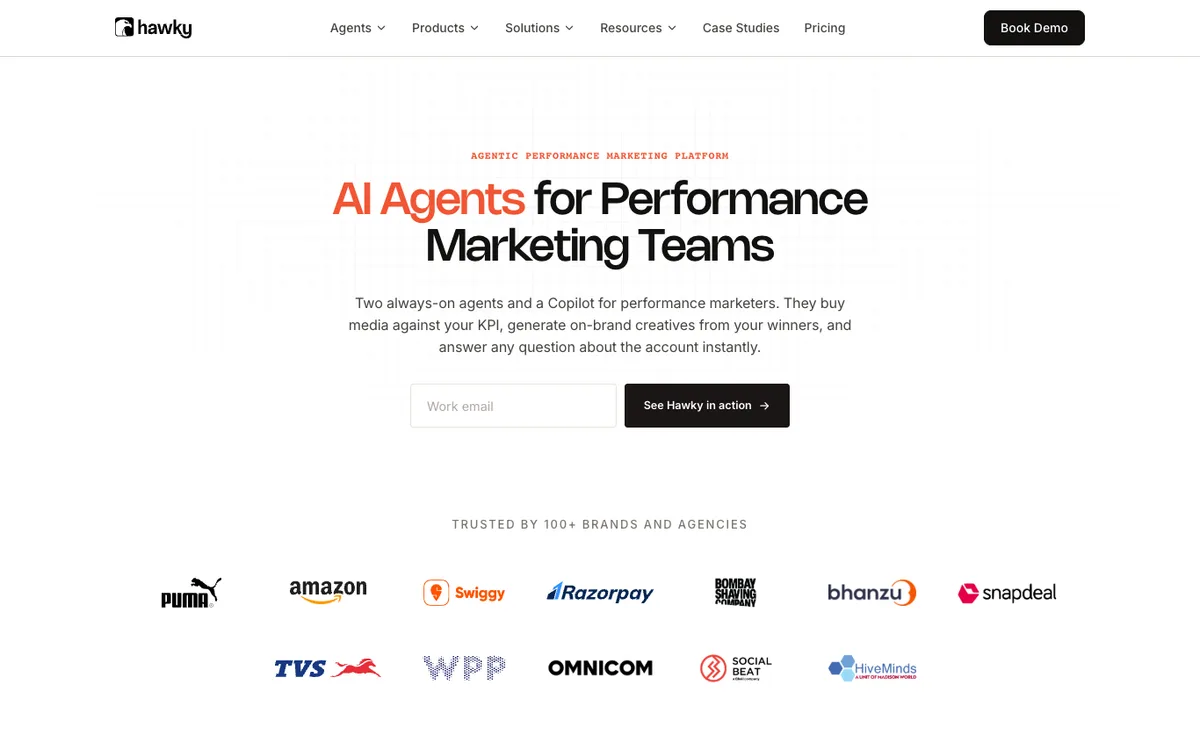
Hawky is an AI-native creative intelligence platform built for performance marketers running paid acquisition on Meta and Google. It analyzes ad creative at the element level (hook, visual, CTA, body copy), predicts creative fatigue before CPC spikes, tracks competitor creative, generates AI creatives from winning patterns, and runs an agentic Command Center that turns insights into actions inside the ad platform.
For mobile teams, Hawky solves the layer most engagement platforms ignore: the ad creative that decides whether the user installs in the first place. Tools like Braze and CleverTap optimize what users see after install. Hawky optimizes what they see before.
Hiveminds cut CPL by 27% and saved 160+ hours per brand monthly using Hawky. Univest increased CTR by 20% within 7 days by applying element-level creative intelligence.
Key capabilities:
Element-level creative analysis: Score hooks, visuals, CTAs, and body copy individually, then identify which combinations win for each audience. See Creative Analysis.
Predictive fatigue detection: Flag creatives starting to fatigue before performance drops, with regeneration suggestions ready in AI Creative Generation.
Competitor ad intelligence: Searchable repository of competitor ads on Meta and Google with weekly alerts on hook changes, new offers, and messaging shifts. Powered by Competitor Analysis.
Agentic Command Center: Auto-generated task list ranked by impact, with one-click pause and budget actions inside Meta from the Command Center.
Hawky Agents: Scheduled creative playbook, competitor tracker, and performance alert agents that run on autopilot and route tasks to the right team.
Best for: Performance marketing teams at D2C brands and agencies running $50k+/month on Meta and Google who want to fix the acquisition creative bottleneck before it shows up as bad retention.
Pricing: Tiered by ad spend and team size. See Hawky pricing for current plans.
Honest limitation: Hawky is Meta and Google focused. It's not a replacement for Braze or CleverTap on the engagement messaging side. Treat it as the creative intelligence layer that sits above whatever engagement platform you run.
2. Braze: Best for real-time multi-channel customer engagement
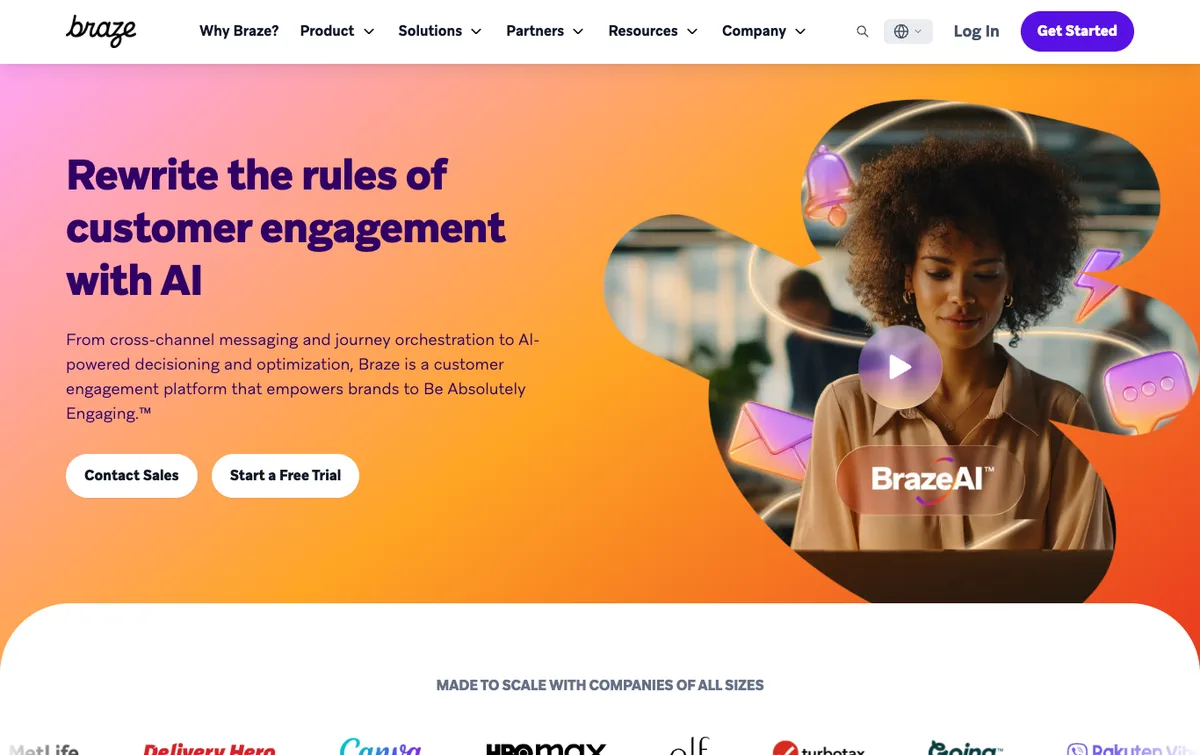
Braze is the enterprise standard for cross-channel customer engagement, with deep capabilities across push, in-app, email, SMS, and WhatsApp. Its real-time data infrastructure and Canvas journey builder make it the default pick for large mobile-first brands that need fine control over message timing and personalization.
Braze excels when the use case demands real-time triggers on streaming data and tight orchestration across many channels. The platform's strength is also its weakness.
Configuration takes time, and reviewers consistently flag a steep learning curve. According to G2 reviewers, "mastering the basics of Braze might pose a significant challenge at first."
Strength: Real-time event-driven messaging across the widest channel mix in the category, with mature personalization via Liquid templating.
Limitation: Pricing is data-consumption based and typically 2-3x MoEngage. Implementations routinely run 2-3 months. Smaller teams over-buy capability they won't use.
Best for: Enterprise mobile-first brands with dedicated lifecycle marketing teams and the engineering resources to operate the platform.
Pricing: Custom, data-volume based. Expect six figures annually at scale.
3. CleverTap: Best for retention analytics with real-time segmentation
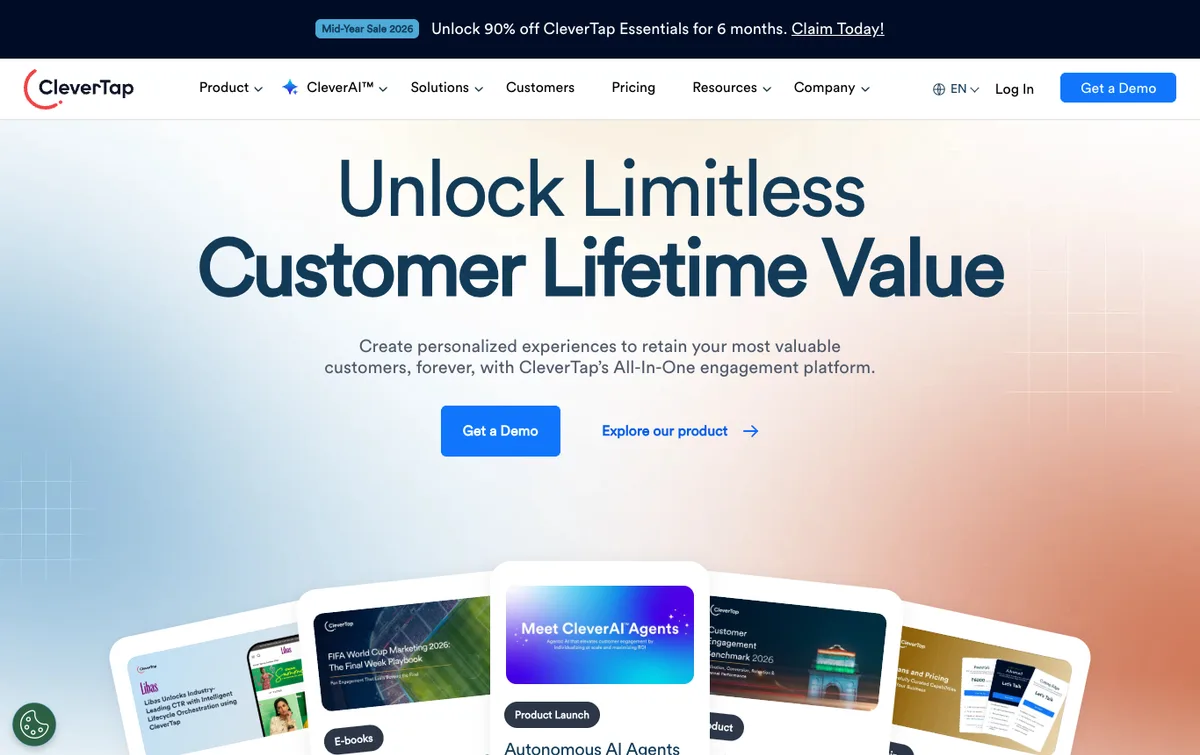
CleverTap is a retention-focused engagement platform with a real-time streaming architecture, advanced behavioral segmentation, and one of the strongest mobile analytics suites in the category. It's a Leader in the 2026 Gartner Magic Quadrant for Personalization Engines.
CleverTap leans harder on analytics than Braze does. Funnel analysis, cohort analysis, RFM segmentation, and uninstall tracking sit alongside push, in-app, email, SMS, and WhatsApp delivery. For teams whose primary problem is understanding why users churn and acting on it, CleverTap's analytics depth is hard to beat.
Strength: Real-time segmentation, mobile-first analytics, strong AI personalization (Clever.AI) without the Braze price tag.
Limitation: Reporting can feel buried under the depth. Web and email parity with mobile-first capabilities lags behind Braze and Insider.
Best for: Mid-market and enterprise mobile apps where retention is the primary growth lever and analytics depth matters more than channel breadth.
Pricing: Tiered by monthly active users. Mid-market plans typically start in the low five figures annually.
4. MoEngage: Best for ease of use and growing mid-market teams
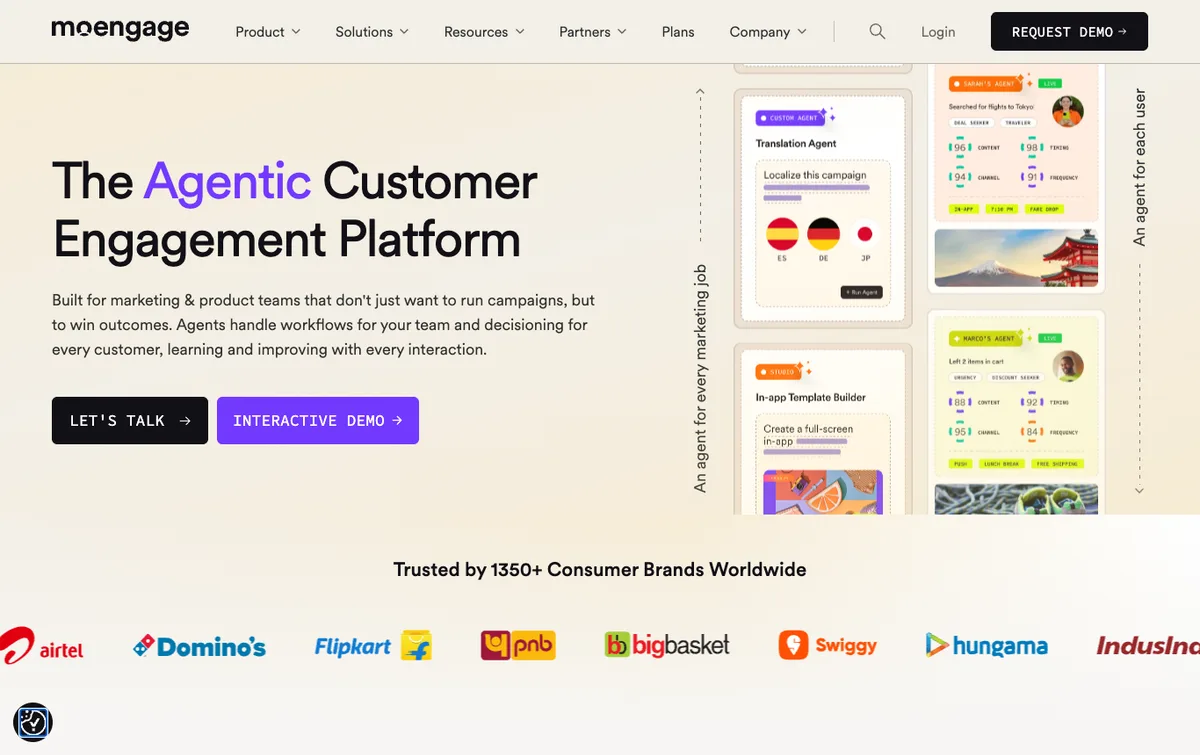
MoEngage is a customer engagement platform popular with mid-market mobile brands across Asia, the Middle East, and Latin America. It covers push, in-app, email, SMS, WhatsApp, and on-site web personalization with a friendlier learning curve than Braze.
The platform's user experience is its biggest selling point. Marketers can build flows, segments, and journeys without leaning hard on engineering. The trade-off is architectural.
MoEngage uses a query-based segmentation model rather than real-time streaming. Real-time engagement is guaranteed only for filter queries within the last 30 days and is restricted to six messaging channels.
Strength: Marketer-friendly interface, fast time-to-first-campaign, strong regional support, lower price point than Braze or CleverTap.
Limitation: 30-day segmentation window for real-time use cases. Teams scaling beyond that hit architectural walls and often migrate.
Best for: Growing mid-market mobile teams who want a platform that the marketing team can run without a full lifecycle ops function.
Pricing: Volume-based, generally lower than Braze. Custom quotes.
5. Insider: Best for omnichannel orchestration with WhatsApp at the core
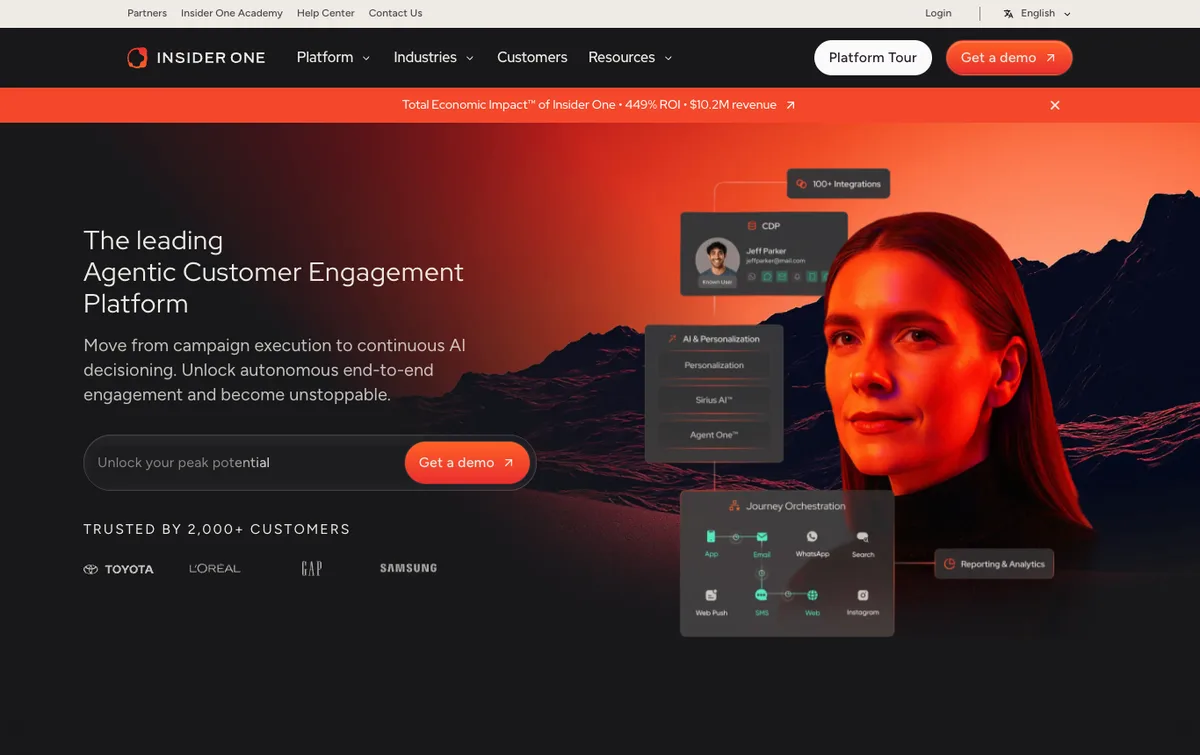
Insider is an AI-driven customer experience platform supporting 12+ channels natively, including WhatsApp, web push, app push, email, SMS, in-app, and on-site personalization. Used by 1,200+ brands including Adidas, Vodafone, and Lexus, it's built around the idea of one identity and one journey across every channel.
Insider's strength is breadth. If your stack needs WhatsApp commerce flows, web personalization, app push, and email orchestration in the same journey, Insider is one of the few platforms that handles it natively. According to G2, 96% of users say Insider meets their requirements.
Strength: Channel breadth (12+), strong WhatsApp and on-site personalization, AI predictions for next-best-action.
Limitation: Feature breadth makes pricing opaque. The sales process is heavy. Configuration of every channel takes time.
Best for: Mid-market and enterprise brands in retail, eCommerce, and travel where WhatsApp and web personalization sit alongside mobile push.
Pricing: Custom, sales-led. Typically mid five figures annually for mid-market.
6. Customer.io: Best for behavior-based journeys in product-led mobile apps
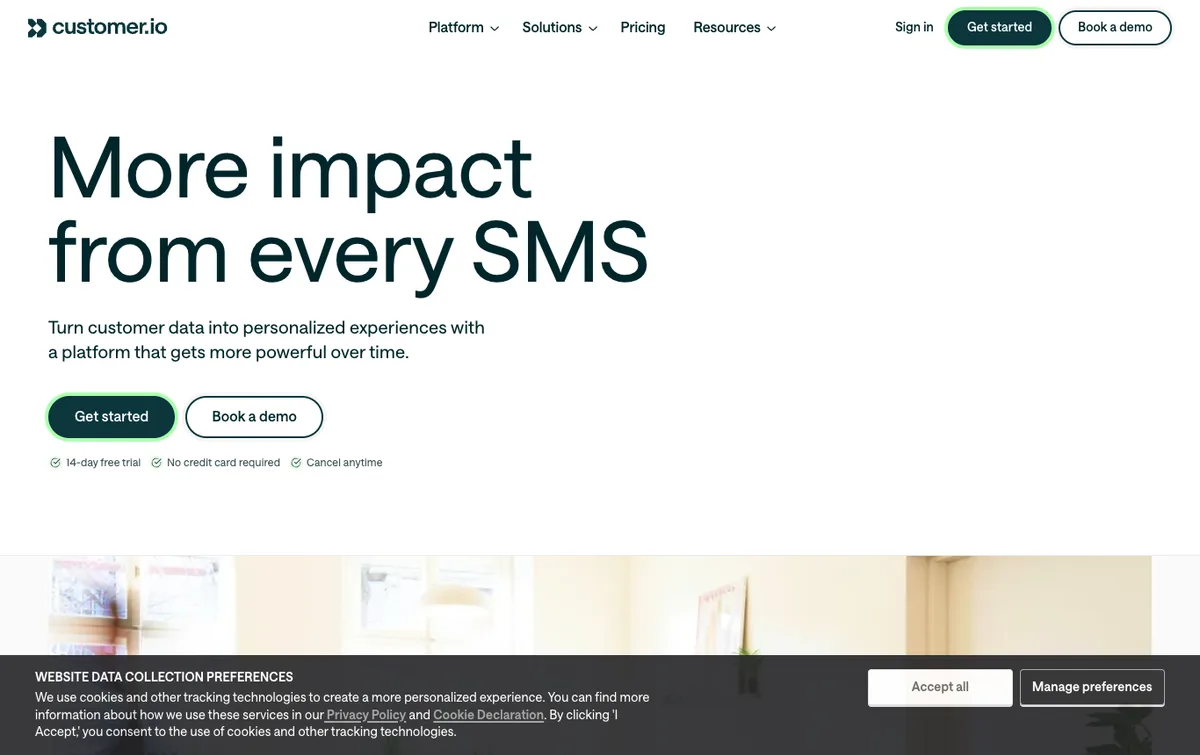
Customer.io is a behavioral messaging platform built for product-led teams who run journeys across email, push, SMS, and in-app from a single first-party data model. It's particularly popular with SaaS apps, fintech, and marketplaces where workflows need to follow precise event sequences.
The platform shines on flexibility. The journey builder, segmentation, and Liquid templating give marketing and engineering teams a lot of control. The trade-off is a setup curve. Marketers used to drag-and-drop tools sometimes find the data model and segmentation syntax demanding.
Strength: Powerful event-based segmentation, transparent pricing, developer-friendly without losing marketer usability.
Limitation: Fewer prebuilt templates than CleverTap or Braze. Less mature on analytics depth.
Best for: Product-led mobile apps and SaaS companies where journey logic is complex and tied tightly to product events.
Pricing: Public pricing starts around $100/month and scales with profiles and message volume.
7. Airship: Best for advanced push and mobile wallet
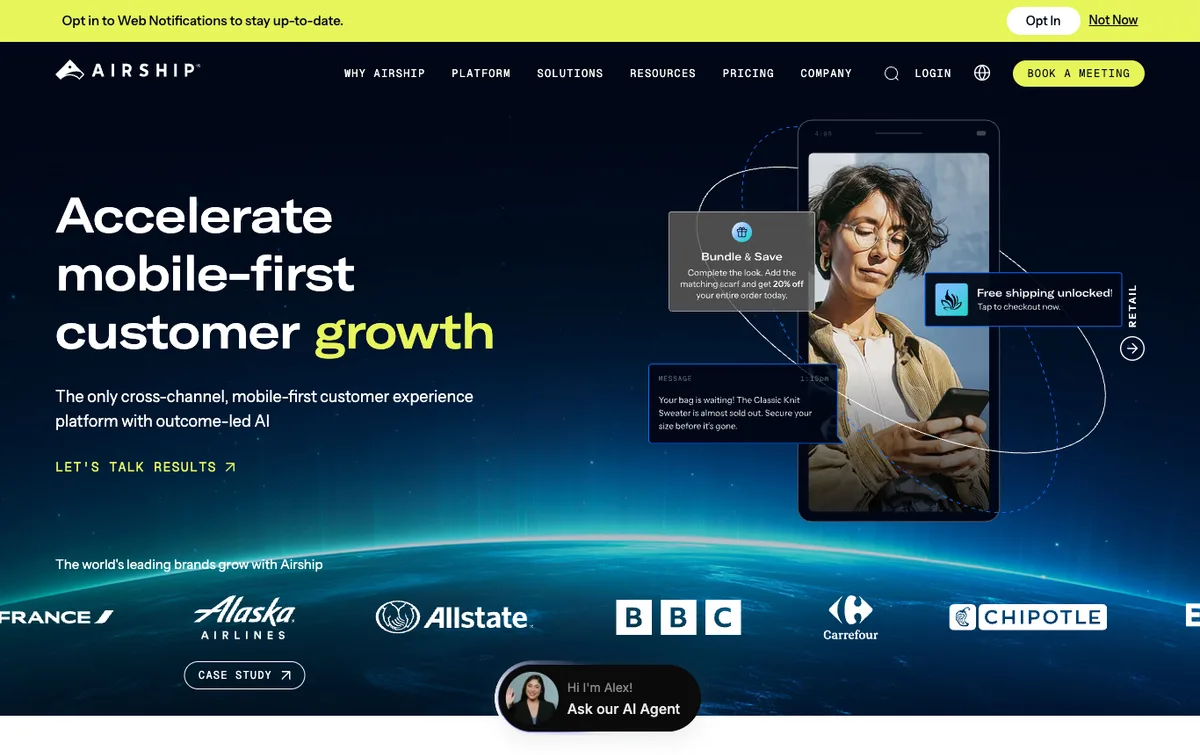
Airship is one of the longest-running mobile engagement platforms, with deep capabilities in push notifications, in-app messages, SMS/MMS, mobile wallet (Apple Wallet and Google Wallet), and AI-powered journeys. It's particularly strong in retail, airlines, and media.
Airship's mobile wallet capability is a genuine differentiator. Few platforms can issue, update, and re-engage on wallet passes at the scale Airship can. For brands where boarding passes, loyalty cards, or coupons are core, this matters.
Strength: Mobile wallet capability, mature push and in-app, strong AI journey orchestration, enterprise-grade reliability.
Limitation: Enterprise pricing. Less marketer-friendly than MoEngage or Customer.io. Email and growth-team workflows are not the strongest fit.
Best for: Enterprise retail, airline, and media brands where mobile wallet and advanced push are central to the strategy.
Pricing: Custom, enterprise-tier. Six figures annually at scale.
8. OneSignal: Best for free and low-cost push at scale
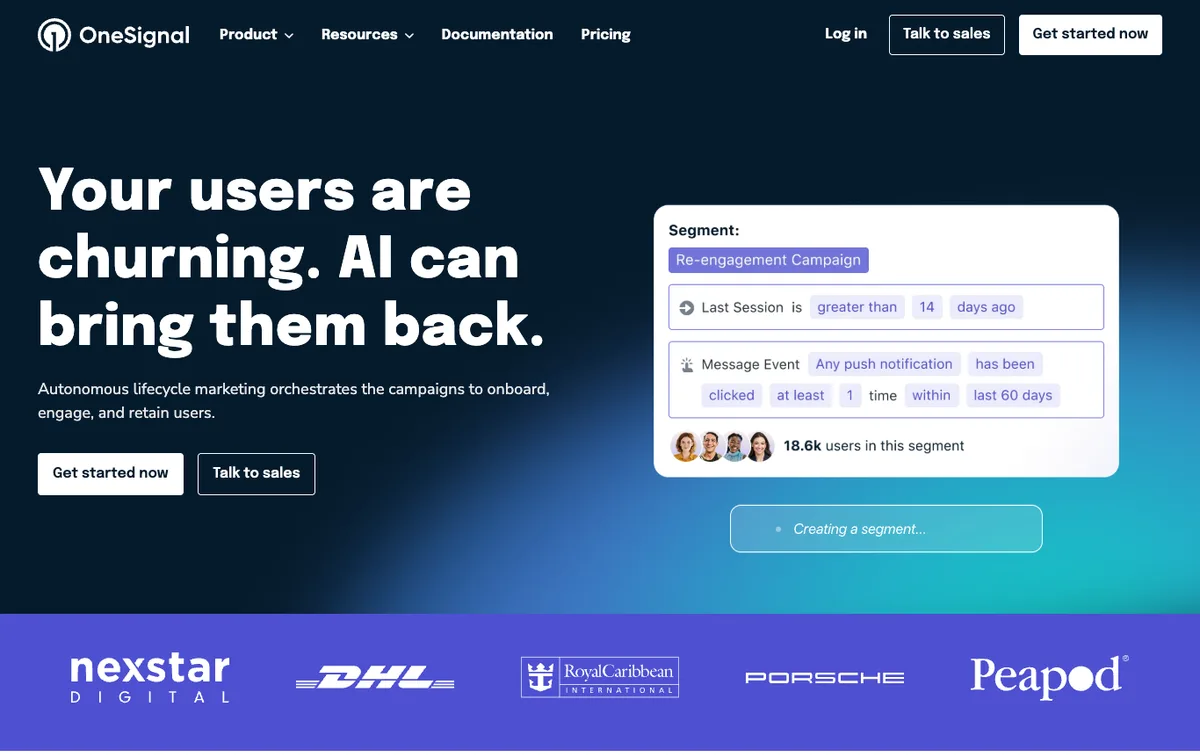
OneSignal is the most popular free push notification platform globally, used by over 2 million developers. It supports mobile push, web push, in-app messages, email, and SMS, with a free plan that covers up to 10,000 web subscribers and unlimited push notifications.
For teams that need push at scale without a six-figure platform commitment, OneSignal is the obvious starting point. The free plan is genuinely usable. Paid tiers add segmentation depth, journey builder access, and advanced analytics.
Strength: Free plan with unlimited push. Fast SDK integration. Reliable delivery at scale.
Limitation: Segmentation depth and journey logic on free and entry-paid tiers are limited compared to Braze, CleverTap, or MoEngage. Mature lifecycle teams outgrow it.
Best for: Early-stage apps, indie developers, and growth teams that need push first and will revisit the platform decision once volume justifies it.
Pricing: Free plan available. Paid plans start around $9/month and scale by features and volume.
9. Iterable: Best for cross-channel marketing teams who want workflow control
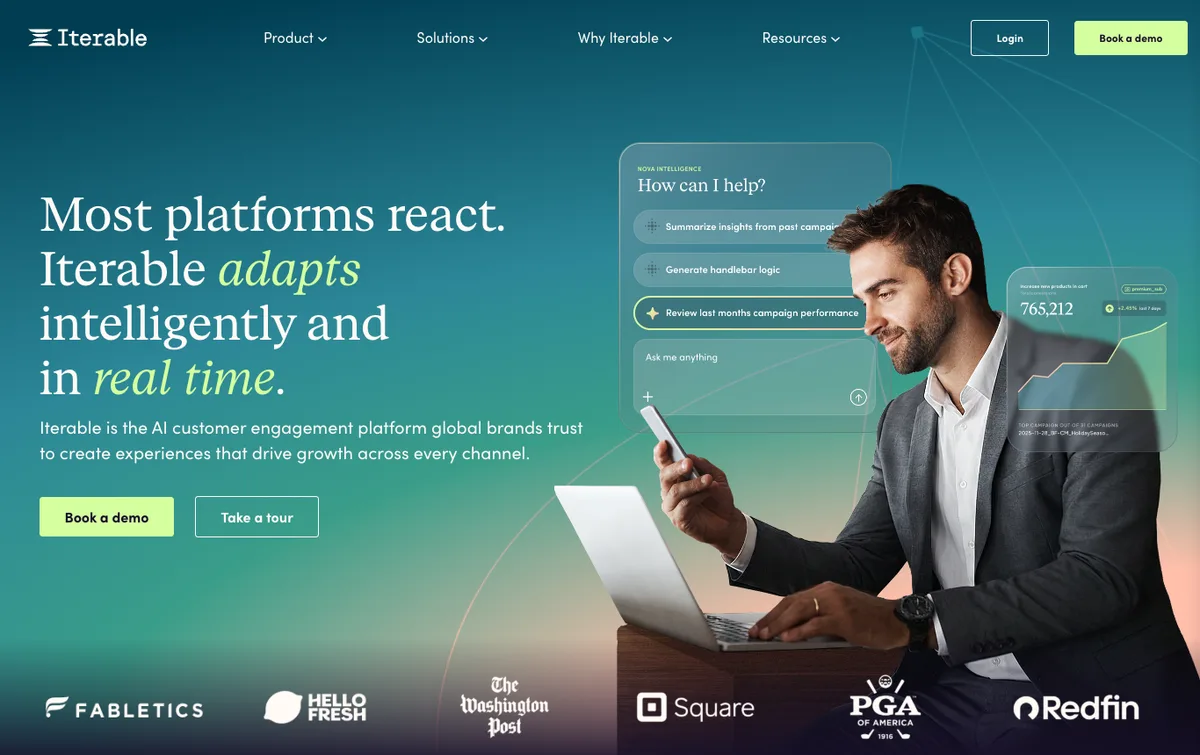
Iterable is a cross-channel marketing platform with strong workflow tooling across email, SMS, push, in-app, and embedded experiences. It's positioned for marketing teams who want a unified workspace for lifecycle programs without the configuration weight of Braze.
Iterable's strength is its Studio workflow builder. Marketers can build complex multi-channel journeys with branching logic and AI optimizations. The platform is a frequent shortlist alongside Braze and CleverTap for brands evaluating enterprise engagement.
Strength: Marketer-friendly workflow builder, strong AI optimization (send-time, channel, content), broad channel coverage.
Limitation: Data model has a learning curve. Real-time event coverage is solid but not as deep as Braze on the most demanding use cases.
Best for: Mid-market to enterprise marketing teams that want cross-channel orchestration with less engineering load than Braze.
Pricing: Custom, volume-based. Mid-market plans typically mid-five figures annually.
Feature comparison: how these tools stack up
Tool | Primary strength | Real-time architecture | Channel coverage | AI personalization | Best team size |
|---|---|---|---|---|---|
Hawky | Creative intelligence | Yes (ad data) | Meta, Google Ads | Element-level + predictive | Performance teams of all sizes |
Braze | Multi-channel engagement | Yes | Push, in-app, email, SMS, WhatsApp | Mature | Enterprise |
CleverTap | Retention analytics | Yes | Push, in-app, email, SMS, WhatsApp | Strong (Clever.AI) | Mid-market to enterprise |
MoEngage | Ease of use | Limited (30-day window) | Push, in-app, email, SMS, WhatsApp, web | Solid | Mid-market |
Insider | Channel breadth | Yes | 12+ including WhatsApp, web | AI next-best-action | Mid-market to enterprise |
Customer.io | Behavioral journeys | Yes | Email, push, SMS, in-app | Workflow-driven | Product-led teams |
Airship | Push and wallet | Yes | Push, in-app, SMS, wallet | Journey AI | Enterprise |
OneSignal | Free push | Yes | Push, in-app, email, SMS | Basic | Startup to mid-market |
Iterable | Workflow control | Yes | Email, SMS, push, in-app | Strong | Mid-market to enterprise |
The two layers of mobile marketing automation and why most stacks miss one

Most mobile marketing stacks treat acquisition and engagement as separate problems with separate tools. Meta and Google sit on one side. Braze, CleverTap, MoEngage sit on the other.
The MMP (mobile measurement partner) sits in the middle. The data flows but the intelligence doesn't.
That gap costs more than teams realize. Creative fatigue on the acquisition side drives bad-fit installs. Bad-fit installs drive lower retention.
Lower retention drives the engagement platform to work harder on users who never had a high probability of staying. The engagement layer cannot fix what the creative layer broke.
The two-layer view changes the question. Instead of "which engagement platform do I buy?" it becomes "where is my actual bottleneck?". For most performance teams running paid acquisition, the bottleneck is creative.
Hooks fatigue in 7 to 14 days on Meta. Competitors ship new angles weekly. Without an intelligence layer that identifies winning patterns, predicts fatigue, and generates replacements, the engagement platform downstream is paying interest on bad acquisition decisions.
This is the gap Hawky closes. It sits above the engagement layer and feeds it healthier acquisition. The full creative lifecycle (analyze, predict, generate, act) lives in Creative Analysis, AI Creative Generation, and the Command Center.
Then a tool like Braze or CleverTap takes over for in-app and post-install messaging. The two layers stop fighting each other.
Which tool is right for your team?
If your bottleneck is mobile ad creative on Meta or Google, pick Hawky. Element-level analysis, predictive fatigue detection, AI creative generation, and competitor intelligence pay back fastest when paid spend is over $50k/month. You'll still need an engagement platform for in-app and post-install messaging.
If you're a large mobile-first brand with a dedicated lifecycle team and demanding real-time multi-channel use cases, pick Braze. Budget for a 2-3 month implementation and a six-figure annual contract.
If retention and analytics depth matter more than channel breadth, pick CleverTap. The mobile-first DNA shows in the analytics tooling, and the price is generally below Braze for comparable scale.
If you're mid-market, growing fast, and want a platform your marketing team can actually run without engineering on call, pick MoEngage. Watch the 30-day real-time segmentation window if your use cases extend beyond it.
If WhatsApp commerce, web personalization, and app push need to live in one journey, pick Insider. It's one of the few platforms genuinely native across all three.
If you're a product-led mobile or SaaS team and your journeys follow tight product event sequences, pick Customer.io. Transparent pricing, strong segmentation, and a journey builder that respects how product teams think.
If mobile wallet (Apple Wallet, Google Wallet) is core to your loyalty or ticketing strategy, pick Airship. It's the most mature platform in that niche.
If you need push at scale tomorrow without a procurement cycle, pick OneSignal. The free plan is genuinely usable while you plan the next move.
If you want cross-channel workflow control with less engineering load than Braze, pick Iterable.
The teams that win in 2026 stop buying one tool to do everything. They run a creative intelligence layer (Hawky) above an engagement platform (Braze, CleverTap, MoEngage, or Insider) and let each do the job it's actually good at.
Frequently asked questions
What is mobile marketing automation?
Mobile marketing automation is software that triggers personalized messages and ad creative across mobile channels (push notifications, in-app messages, SMS, WhatsApp, mobile ads) based on user behavior, attributes, and campaign rules. It covers two layers: the acquisition layer where ad creative drives installs, and the engagement layer where messaging drives retention and revenue.
What features should a mobile marketing automation tool have?
Look for five non-negotiables: real-time event ingestion so segments and triggers fire as behavior happens, channel coverage spanning push, in-app, SMS, email, and ideally WhatsApp, behavioral segmentation that updates dynamically, AI personalization that's predictive rather than rule-based, and integration with your acquisition stack so creative performance and retention performance share a data spine.
How much does mobile marketing automation cost?
Pricing varies by architecture and scale. Free push tools like OneSignal cover early-stage needs. Mid-market platforms (MoEngage, Customer.io, Iterable) typically run mid-four to mid-five figures annually.
Enterprise platforms (Braze, CleverTap, Insider, Airship) are six figures annually at scale. Hawky is priced by ad spend and team size on the acquisition side. Most teams underestimate implementation cost, which often equals or exceeds first-year license cost.
What is the difference between push notifications and SMS?
Push notifications are free per message after the platform fee, support images, action buttons, and deep links into specific app screens, but reach only users who installed the app and accepted notifications. SMS costs $0.01 to $0.05 per message plus carrier fees, has no app dependency, and reaches every mobile number, but is limited to 160 characters of text. Most mature mobile stacks use both, with push as the default and SMS as the breakthrough channel for high-priority moments.
Is Braze better than CleverTap?
Both are leaders in the category and are usually the final two on enterprise shortlists. Braze edges out on real-time multi-channel orchestration depth and ecosystem maturity. CleverTap edges out on retention analytics, mobile-first DNA, and price-to-capability ratio. The decision usually comes down to channel mix (Braze if email and SMS parity matter), analytics depth (CleverTap), and budget (CleverTap is generally lower at comparable scale).
Can one tool handle both acquisition creative and engagement messaging?
Not well. The two layers solve different problems with different data and different decision cycles. Acquisition creative tools (like Hawky) work on ad-platform data, ad creative elements, and competitor signals.
Engagement platforms (like Braze and CleverTap) work on first-party event data inside your app and CRM. Teams that try to force one tool to do both end up with weak coverage on one side. The strongest stacks in 2026 run a dedicated creative intelligence layer above a dedicated engagement layer.
If creative fatigue, rising CPCs on Meta, or weak ROAS on mobile acquisition are the bottleneck, Hawky's creative intelligence platform is built for that job. Element-level analysis, predictive fatigue detection, competitor tracking, and AI creative generation, all in the Command Center and ready to feed your engagement platform healthier acquisition.
For deeper context on the concepts behind this article, see What is Creative Intelligence? and Creative Fatigue Explained.
Ready to Stop Guessing and Start Winning with Creative Intelligence?
The best mobile marketing automation tools in 2026 are Hawky for AI-powered creative intelligence on the acquisition side, Braze for real-time multi-channel customer engagement, and CleverTap for retention analytics paired with deep segmentation. Each solves a different layer of the mobile growth stack, and the right pick depends on whether your bottleneck is acquiring users with better ad creative or retaining the ones you already have.
Mobile marketing in 2026 is no longer a single workflow. It splits into two distinct layers. The acquisition layer is where ad creative decides cost-per-install and ROAS on Meta and Google.
The engagement layer is where push notifications, in-app messages, SMS, and WhatsApp decide whether users come back. Most performance teams treat these as separate problems, run separate tools, and lose the connection between creative that wins and users who stay.
This guide covers 9 platforms, what each one is genuinely good at, where they fall short, and how to pick the one (or pair) that matches your team and budget.
What mobile marketing automation actually means in 2026
Mobile marketing automation is software that triggers personalized messages and ad creative across mobile channels (push notifications, in-app messages, SMS, WhatsApp, mobile ads) based on user behavior, attributes, and campaign rules. The goal is to deliver the right message to the right user at the right moment without manual intervention.
In 2026, the category has expanded beyond the classic engagement use case. Modern stacks now include the creative intelligence layer that decides what runs on the acquisition side. A tool that only handles push notifications is solving half the problem. The mobile ad creative your users see before they install matters as much as the in-app message they see after.
A good mobile marketing automation tool in 2026 has five non-negotiables. First, real-time event ingestion so segments and triggers fire when behavior happens, not on a 30-day delay. Second, channel coverage that includes push, in-app, SMS, email, and ideally WhatsApp.
Third, behavioral segmentation that updates as users move through the funnel. Fourth, AI personalization that's actually predictive, not just rule-based. Fifth, integration with your acquisition stack so creative performance and retention performance share a data spine.
The 9 best mobile marketing automation tools
1. Hawky: Best for mobile ad creative intelligence and acquisition automation

Hawky is an AI-native creative intelligence platform built for performance marketers running paid acquisition on Meta and Google. It analyzes ad creative at the element level (hook, visual, CTA, body copy), predicts creative fatigue before CPC spikes, tracks competitor creative, generates AI creatives from winning patterns, and runs an agentic Command Center that turns insights into actions inside the ad platform.
For mobile teams, Hawky solves the layer most engagement platforms ignore: the ad creative that decides whether the user installs in the first place. Tools like Braze and CleverTap optimize what users see after install. Hawky optimizes what they see before.
Hiveminds cut CPL by 27% and saved 160+ hours per brand monthly using Hawky. Univest increased CTR by 20% within 7 days by applying element-level creative intelligence.
Key capabilities:
Element-level creative analysis: Score hooks, visuals, CTAs, and body copy individually, then identify which combinations win for each audience. See Creative Analysis.
Predictive fatigue detection: Flag creatives starting to fatigue before performance drops, with regeneration suggestions ready in AI Creative Generation.
Competitor ad intelligence: Searchable repository of competitor ads on Meta and Google with weekly alerts on hook changes, new offers, and messaging shifts. Powered by Competitor Analysis.
Agentic Command Center: Auto-generated task list ranked by impact, with one-click pause and budget actions inside Meta from the Command Center.
Hawky Agents: Scheduled creative playbook, competitor tracker, and performance alert agents that run on autopilot and route tasks to the right team.
Best for: Performance marketing teams at D2C brands and agencies running $50k+/month on Meta and Google who want to fix the acquisition creative bottleneck before it shows up as bad retention.
Pricing: Tiered by ad spend and team size. See Hawky pricing for current plans.
Honest limitation: Hawky is Meta and Google focused. It's not a replacement for Braze or CleverTap on the engagement messaging side. Treat it as the creative intelligence layer that sits above whatever engagement platform you run.
2. Braze: Best for real-time multi-channel customer engagement

Braze is the enterprise standard for cross-channel customer engagement, with deep capabilities across push, in-app, email, SMS, and WhatsApp. Its real-time data infrastructure and Canvas journey builder make it the default pick for large mobile-first brands that need fine control over message timing and personalization.
Braze excels when the use case demands real-time triggers on streaming data and tight orchestration across many channels. The platform's strength is also its weakness.
Configuration takes time, and reviewers consistently flag a steep learning curve. According to G2 reviewers, "mastering the basics of Braze might pose a significant challenge at first."
Strength: Real-time event-driven messaging across the widest channel mix in the category, with mature personalization via Liquid templating.
Limitation: Pricing is data-consumption based and typically 2-3x MoEngage. Implementations routinely run 2-3 months. Smaller teams over-buy capability they won't use.
Best for: Enterprise mobile-first brands with dedicated lifecycle marketing teams and the engineering resources to operate the platform.
Pricing: Custom, data-volume based. Expect six figures annually at scale.
3. CleverTap: Best for retention analytics with real-time segmentation

CleverTap is a retention-focused engagement platform with a real-time streaming architecture, advanced behavioral segmentation, and one of the strongest mobile analytics suites in the category. It's a Leader in the 2026 Gartner Magic Quadrant for Personalization Engines.
CleverTap leans harder on analytics than Braze does. Funnel analysis, cohort analysis, RFM segmentation, and uninstall tracking sit alongside push, in-app, email, SMS, and WhatsApp delivery. For teams whose primary problem is understanding why users churn and acting on it, CleverTap's analytics depth is hard to beat.
Strength: Real-time segmentation, mobile-first analytics, strong AI personalization (Clever.AI) without the Braze price tag.
Limitation: Reporting can feel buried under the depth. Web and email parity with mobile-first capabilities lags behind Braze and Insider.
Best for: Mid-market and enterprise mobile apps where retention is the primary growth lever and analytics depth matters more than channel breadth.
Pricing: Tiered by monthly active users. Mid-market plans typically start in the low five figures annually.
4. MoEngage: Best for ease of use and growing mid-market teams

MoEngage is a customer engagement platform popular with mid-market mobile brands across Asia, the Middle East, and Latin America. It covers push, in-app, email, SMS, WhatsApp, and on-site web personalization with a friendlier learning curve than Braze.
The platform's user experience is its biggest selling point. Marketers can build flows, segments, and journeys without leaning hard on engineering. The trade-off is architectural.
MoEngage uses a query-based segmentation model rather than real-time streaming. Real-time engagement is guaranteed only for filter queries within the last 30 days and is restricted to six messaging channels.
Strength: Marketer-friendly interface, fast time-to-first-campaign, strong regional support, lower price point than Braze or CleverTap.
Limitation: 30-day segmentation window for real-time use cases. Teams scaling beyond that hit architectural walls and often migrate.
Best for: Growing mid-market mobile teams who want a platform that the marketing team can run without a full lifecycle ops function.
Pricing: Volume-based, generally lower than Braze. Custom quotes.
5. Insider: Best for omnichannel orchestration with WhatsApp at the core

Insider is an AI-driven customer experience platform supporting 12+ channels natively, including WhatsApp, web push, app push, email, SMS, in-app, and on-site personalization. Used by 1,200+ brands including Adidas, Vodafone, and Lexus, it's built around the idea of one identity and one journey across every channel.
Insider's strength is breadth. If your stack needs WhatsApp commerce flows, web personalization, app push, and email orchestration in the same journey, Insider is one of the few platforms that handles it natively. According to G2, 96% of users say Insider meets their requirements.
Strength: Channel breadth (12+), strong WhatsApp and on-site personalization, AI predictions for next-best-action.
Limitation: Feature breadth makes pricing opaque. The sales process is heavy. Configuration of every channel takes time.
Best for: Mid-market and enterprise brands in retail, eCommerce, and travel where WhatsApp and web personalization sit alongside mobile push.
Pricing: Custom, sales-led. Typically mid five figures annually for mid-market.
6. Customer.io: Best for behavior-based journeys in product-led mobile apps

Customer.io is a behavioral messaging platform built for product-led teams who run journeys across email, push, SMS, and in-app from a single first-party data model. It's particularly popular with SaaS apps, fintech, and marketplaces where workflows need to follow precise event sequences.
The platform shines on flexibility. The journey builder, segmentation, and Liquid templating give marketing and engineering teams a lot of control. The trade-off is a setup curve. Marketers used to drag-and-drop tools sometimes find the data model and segmentation syntax demanding.
Strength: Powerful event-based segmentation, transparent pricing, developer-friendly without losing marketer usability.
Limitation: Fewer prebuilt templates than CleverTap or Braze. Less mature on analytics depth.
Best for: Product-led mobile apps and SaaS companies where journey logic is complex and tied tightly to product events.
Pricing: Public pricing starts around $100/month and scales with profiles and message volume.
7. Airship: Best for advanced push and mobile wallet

Airship is one of the longest-running mobile engagement platforms, with deep capabilities in push notifications, in-app messages, SMS/MMS, mobile wallet (Apple Wallet and Google Wallet), and AI-powered journeys. It's particularly strong in retail, airlines, and media.
Airship's mobile wallet capability is a genuine differentiator. Few platforms can issue, update, and re-engage on wallet passes at the scale Airship can. For brands where boarding passes, loyalty cards, or coupons are core, this matters.
Strength: Mobile wallet capability, mature push and in-app, strong AI journey orchestration, enterprise-grade reliability.
Limitation: Enterprise pricing. Less marketer-friendly than MoEngage or Customer.io. Email and growth-team workflows are not the strongest fit.
Best for: Enterprise retail, airline, and media brands where mobile wallet and advanced push are central to the strategy.
Pricing: Custom, enterprise-tier. Six figures annually at scale.
8. OneSignal: Best for free and low-cost push at scale

OneSignal is the most popular free push notification platform globally, used by over 2 million developers. It supports mobile push, web push, in-app messages, email, and SMS, with a free plan that covers up to 10,000 web subscribers and unlimited push notifications.
For teams that need push at scale without a six-figure platform commitment, OneSignal is the obvious starting point. The free plan is genuinely usable. Paid tiers add segmentation depth, journey builder access, and advanced analytics.
Strength: Free plan with unlimited push. Fast SDK integration. Reliable delivery at scale.
Limitation: Segmentation depth and journey logic on free and entry-paid tiers are limited compared to Braze, CleverTap, or MoEngage. Mature lifecycle teams outgrow it.
Best for: Early-stage apps, indie developers, and growth teams that need push first and will revisit the platform decision once volume justifies it.
Pricing: Free plan available. Paid plans start around $9/month and scale by features and volume.
9. Iterable: Best for cross-channel marketing teams who want workflow control

Iterable is a cross-channel marketing platform with strong workflow tooling across email, SMS, push, in-app, and embedded experiences. It's positioned for marketing teams who want a unified workspace for lifecycle programs without the configuration weight of Braze.
Iterable's strength is its Studio workflow builder. Marketers can build complex multi-channel journeys with branching logic and AI optimizations. The platform is a frequent shortlist alongside Braze and CleverTap for brands evaluating enterprise engagement.
Strength: Marketer-friendly workflow builder, strong AI optimization (send-time, channel, content), broad channel coverage.
Limitation: Data model has a learning curve. Real-time event coverage is solid but not as deep as Braze on the most demanding use cases.
Best for: Mid-market to enterprise marketing teams that want cross-channel orchestration with less engineering load than Braze.
Pricing: Custom, volume-based. Mid-market plans typically mid-five figures annually.
Feature comparison: how these tools stack up
Tool | Primary strength | Real-time architecture | Channel coverage | AI personalization | Best team size |
|---|---|---|---|---|---|
Hawky | Creative intelligence | Yes (ad data) | Meta, Google Ads | Element-level + predictive | Performance teams of all sizes |
Braze | Multi-channel engagement | Yes | Push, in-app, email, SMS, WhatsApp | Mature | Enterprise |
CleverTap | Retention analytics | Yes | Push, in-app, email, SMS, WhatsApp | Strong (Clever.AI) | Mid-market to enterprise |
MoEngage | Ease of use | Limited (30-day window) | Push, in-app, email, SMS, WhatsApp, web | Solid | Mid-market |
Insider | Channel breadth | Yes | 12+ including WhatsApp, web | AI next-best-action | Mid-market to enterprise |
Customer.io | Behavioral journeys | Yes | Email, push, SMS, in-app | Workflow-driven | Product-led teams |
Airship | Push and wallet | Yes | Push, in-app, SMS, wallet | Journey AI | Enterprise |
OneSignal | Free push | Yes | Push, in-app, email, SMS | Basic | Startup to mid-market |
Iterable | Workflow control | Yes | Email, SMS, push, in-app | Strong | Mid-market to enterprise |
The two layers of mobile marketing automation and why most stacks miss one

Most mobile marketing stacks treat acquisition and engagement as separate problems with separate tools. Meta and Google sit on one side. Braze, CleverTap, MoEngage sit on the other.
The MMP (mobile measurement partner) sits in the middle. The data flows but the intelligence doesn't.
That gap costs more than teams realize. Creative fatigue on the acquisition side drives bad-fit installs. Bad-fit installs drive lower retention.
Lower retention drives the engagement platform to work harder on users who never had a high probability of staying. The engagement layer cannot fix what the creative layer broke.
The two-layer view changes the question. Instead of "which engagement platform do I buy?" it becomes "where is my actual bottleneck?". For most performance teams running paid acquisition, the bottleneck is creative.
Hooks fatigue in 7 to 14 days on Meta. Competitors ship new angles weekly. Without an intelligence layer that identifies winning patterns, predicts fatigue, and generates replacements, the engagement platform downstream is paying interest on bad acquisition decisions.
This is the gap Hawky closes. It sits above the engagement layer and feeds it healthier acquisition. The full creative lifecycle (analyze, predict, generate, act) lives in Creative Analysis, AI Creative Generation, and the Command Center.
Then a tool like Braze or CleverTap takes over for in-app and post-install messaging. The two layers stop fighting each other.
Which tool is right for your team?
If your bottleneck is mobile ad creative on Meta or Google, pick Hawky. Element-level analysis, predictive fatigue detection, AI creative generation, and competitor intelligence pay back fastest when paid spend is over $50k/month. You'll still need an engagement platform for in-app and post-install messaging.
If you're a large mobile-first brand with a dedicated lifecycle team and demanding real-time multi-channel use cases, pick Braze. Budget for a 2-3 month implementation and a six-figure annual contract.
If retention and analytics depth matter more than channel breadth, pick CleverTap. The mobile-first DNA shows in the analytics tooling, and the price is generally below Braze for comparable scale.
If you're mid-market, growing fast, and want a platform your marketing team can actually run without engineering on call, pick MoEngage. Watch the 30-day real-time segmentation window if your use cases extend beyond it.
If WhatsApp commerce, web personalization, and app push need to live in one journey, pick Insider. It's one of the few platforms genuinely native across all three.
If you're a product-led mobile or SaaS team and your journeys follow tight product event sequences, pick Customer.io. Transparent pricing, strong segmentation, and a journey builder that respects how product teams think.
If mobile wallet (Apple Wallet, Google Wallet) is core to your loyalty or ticketing strategy, pick Airship. It's the most mature platform in that niche.
If you need push at scale tomorrow without a procurement cycle, pick OneSignal. The free plan is genuinely usable while you plan the next move.
If you want cross-channel workflow control with less engineering load than Braze, pick Iterable.
The teams that win in 2026 stop buying one tool to do everything. They run a creative intelligence layer (Hawky) above an engagement platform (Braze, CleverTap, MoEngage, or Insider) and let each do the job it's actually good at.
Frequently asked questions
What is mobile marketing automation?
Mobile marketing automation is software that triggers personalized messages and ad creative across mobile channels (push notifications, in-app messages, SMS, WhatsApp, mobile ads) based on user behavior, attributes, and campaign rules. It covers two layers: the acquisition layer where ad creative drives installs, and the engagement layer where messaging drives retention and revenue.
What features should a mobile marketing automation tool have?
Look for five non-negotiables: real-time event ingestion so segments and triggers fire as behavior happens, channel coverage spanning push, in-app, SMS, email, and ideally WhatsApp, behavioral segmentation that updates dynamically, AI personalization that's predictive rather than rule-based, and integration with your acquisition stack so creative performance and retention performance share a data spine.
How much does mobile marketing automation cost?
Pricing varies by architecture and scale. Free push tools like OneSignal cover early-stage needs. Mid-market platforms (MoEngage, Customer.io, Iterable) typically run mid-four to mid-five figures annually.
Enterprise platforms (Braze, CleverTap, Insider, Airship) are six figures annually at scale. Hawky is priced by ad spend and team size on the acquisition side. Most teams underestimate implementation cost, which often equals or exceeds first-year license cost.
What is the difference between push notifications and SMS?
Push notifications are free per message after the platform fee, support images, action buttons, and deep links into specific app screens, but reach only users who installed the app and accepted notifications. SMS costs $0.01 to $0.05 per message plus carrier fees, has no app dependency, and reaches every mobile number, but is limited to 160 characters of text. Most mature mobile stacks use both, with push as the default and SMS as the breakthrough channel for high-priority moments.
Is Braze better than CleverTap?
Both are leaders in the category and are usually the final two on enterprise shortlists. Braze edges out on real-time multi-channel orchestration depth and ecosystem maturity. CleverTap edges out on retention analytics, mobile-first DNA, and price-to-capability ratio. The decision usually comes down to channel mix (Braze if email and SMS parity matter), analytics depth (CleverTap), and budget (CleverTap is generally lower at comparable scale).
Can one tool handle both acquisition creative and engagement messaging?
Not well. The two layers solve different problems with different data and different decision cycles. Acquisition creative tools (like Hawky) work on ad-platform data, ad creative elements, and competitor signals.
Engagement platforms (like Braze and CleverTap) work on first-party event data inside your app and CRM. Teams that try to force one tool to do both end up with weak coverage on one side. The strongest stacks in 2026 run a dedicated creative intelligence layer above a dedicated engagement layer.
If creative fatigue, rising CPCs on Meta, or weak ROAS on mobile acquisition are the bottleneck, Hawky's creative intelligence platform is built for that job. Element-level analysis, predictive fatigue detection, competitor tracking, and AI creative generation, all in the Command Center and ready to feed your engagement platform healthier acquisition.
For deeper context on the concepts behind this article, see What is Creative Intelligence? and Creative Fatigue Explained.
Ready to Stop Guessing and Start Winning with Creative Intelligence?
The best mobile marketing automation tools in 2026 are Hawky for AI-powered creative intelligence on the acquisition side, Braze for real-time multi-channel customer engagement, and CleverTap for retention analytics paired with deep segmentation. Each solves a different layer of the mobile growth stack, and the right pick depends on whether your bottleneck is acquiring users with better ad creative or retaining the ones you already have.
Mobile marketing in 2026 is no longer a single workflow. It splits into two distinct layers. The acquisition layer is where ad creative decides cost-per-install and ROAS on Meta and Google.
The engagement layer is where push notifications, in-app messages, SMS, and WhatsApp decide whether users come back. Most performance teams treat these as separate problems, run separate tools, and lose the connection between creative that wins and users who stay.
This guide covers 9 platforms, what each one is genuinely good at, where they fall short, and how to pick the one (or pair) that matches your team and budget.
What mobile marketing automation actually means in 2026
Mobile marketing automation is software that triggers personalized messages and ad creative across mobile channels (push notifications, in-app messages, SMS, WhatsApp, mobile ads) based on user behavior, attributes, and campaign rules. The goal is to deliver the right message to the right user at the right moment without manual intervention.
In 2026, the category has expanded beyond the classic engagement use case. Modern stacks now include the creative intelligence layer that decides what runs on the acquisition side. A tool that only handles push notifications is solving half the problem. The mobile ad creative your users see before they install matters as much as the in-app message they see after.
A good mobile marketing automation tool in 2026 has five non-negotiables. First, real-time event ingestion so segments and triggers fire when behavior happens, not on a 30-day delay. Second, channel coverage that includes push, in-app, SMS, email, and ideally WhatsApp.
Third, behavioral segmentation that updates as users move through the funnel. Fourth, AI personalization that's actually predictive, not just rule-based. Fifth, integration with your acquisition stack so creative performance and retention performance share a data spine.
The 9 best mobile marketing automation tools
1. Hawky: Best for mobile ad creative intelligence and acquisition automation

Hawky is an AI-native creative intelligence platform built for performance marketers running paid acquisition on Meta and Google. It analyzes ad creative at the element level (hook, visual, CTA, body copy), predicts creative fatigue before CPC spikes, tracks competitor creative, generates AI creatives from winning patterns, and runs an agentic Command Center that turns insights into actions inside the ad platform.
For mobile teams, Hawky solves the layer most engagement platforms ignore: the ad creative that decides whether the user installs in the first place. Tools like Braze and CleverTap optimize what users see after install. Hawky optimizes what they see before.
Hiveminds cut CPL by 27% and saved 160+ hours per brand monthly using Hawky. Univest increased CTR by 20% within 7 days by applying element-level creative intelligence.
Key capabilities:
Element-level creative analysis: Score hooks, visuals, CTAs, and body copy individually, then identify which combinations win for each audience. See Creative Analysis.
Predictive fatigue detection: Flag creatives starting to fatigue before performance drops, with regeneration suggestions ready in AI Creative Generation.
Competitor ad intelligence: Searchable repository of competitor ads on Meta and Google with weekly alerts on hook changes, new offers, and messaging shifts. Powered by Competitor Analysis.
Agentic Command Center: Auto-generated task list ranked by impact, with one-click pause and budget actions inside Meta from the Command Center.
Hawky Agents: Scheduled creative playbook, competitor tracker, and performance alert agents that run on autopilot and route tasks to the right team.
Best for: Performance marketing teams at D2C brands and agencies running $50k+/month on Meta and Google who want to fix the acquisition creative bottleneck before it shows up as bad retention.
Pricing: Tiered by ad spend and team size. See Hawky pricing for current plans.
Honest limitation: Hawky is Meta and Google focused. It's not a replacement for Braze or CleverTap on the engagement messaging side. Treat it as the creative intelligence layer that sits above whatever engagement platform you run.
2. Braze: Best for real-time multi-channel customer engagement

Braze is the enterprise standard for cross-channel customer engagement, with deep capabilities across push, in-app, email, SMS, and WhatsApp. Its real-time data infrastructure and Canvas journey builder make it the default pick for large mobile-first brands that need fine control over message timing and personalization.
Braze excels when the use case demands real-time triggers on streaming data and tight orchestration across many channels. The platform's strength is also its weakness.
Configuration takes time, and reviewers consistently flag a steep learning curve. According to G2 reviewers, "mastering the basics of Braze might pose a significant challenge at first."
Strength: Real-time event-driven messaging across the widest channel mix in the category, with mature personalization via Liquid templating.
Limitation: Pricing is data-consumption based and typically 2-3x MoEngage. Implementations routinely run 2-3 months. Smaller teams over-buy capability they won't use.
Best for: Enterprise mobile-first brands with dedicated lifecycle marketing teams and the engineering resources to operate the platform.
Pricing: Custom, data-volume based. Expect six figures annually at scale.
3. CleverTap: Best for retention analytics with real-time segmentation

CleverTap is a retention-focused engagement platform with a real-time streaming architecture, advanced behavioral segmentation, and one of the strongest mobile analytics suites in the category. It's a Leader in the 2026 Gartner Magic Quadrant for Personalization Engines.
CleverTap leans harder on analytics than Braze does. Funnel analysis, cohort analysis, RFM segmentation, and uninstall tracking sit alongside push, in-app, email, SMS, and WhatsApp delivery. For teams whose primary problem is understanding why users churn and acting on it, CleverTap's analytics depth is hard to beat.
Strength: Real-time segmentation, mobile-first analytics, strong AI personalization (Clever.AI) without the Braze price tag.
Limitation: Reporting can feel buried under the depth. Web and email parity with mobile-first capabilities lags behind Braze and Insider.
Best for: Mid-market and enterprise mobile apps where retention is the primary growth lever and analytics depth matters more than channel breadth.
Pricing: Tiered by monthly active users. Mid-market plans typically start in the low five figures annually.
4. MoEngage: Best for ease of use and growing mid-market teams

MoEngage is a customer engagement platform popular with mid-market mobile brands across Asia, the Middle East, and Latin America. It covers push, in-app, email, SMS, WhatsApp, and on-site web personalization with a friendlier learning curve than Braze.
The platform's user experience is its biggest selling point. Marketers can build flows, segments, and journeys without leaning hard on engineering. The trade-off is architectural.
MoEngage uses a query-based segmentation model rather than real-time streaming. Real-time engagement is guaranteed only for filter queries within the last 30 days and is restricted to six messaging channels.
Strength: Marketer-friendly interface, fast time-to-first-campaign, strong regional support, lower price point than Braze or CleverTap.
Limitation: 30-day segmentation window for real-time use cases. Teams scaling beyond that hit architectural walls and often migrate.
Best for: Growing mid-market mobile teams who want a platform that the marketing team can run without a full lifecycle ops function.
Pricing: Volume-based, generally lower than Braze. Custom quotes.
5. Insider: Best for omnichannel orchestration with WhatsApp at the core

Insider is an AI-driven customer experience platform supporting 12+ channels natively, including WhatsApp, web push, app push, email, SMS, in-app, and on-site personalization. Used by 1,200+ brands including Adidas, Vodafone, and Lexus, it's built around the idea of one identity and one journey across every channel.
Insider's strength is breadth. If your stack needs WhatsApp commerce flows, web personalization, app push, and email orchestration in the same journey, Insider is one of the few platforms that handles it natively. According to G2, 96% of users say Insider meets their requirements.
Strength: Channel breadth (12+), strong WhatsApp and on-site personalization, AI predictions for next-best-action.
Limitation: Feature breadth makes pricing opaque. The sales process is heavy. Configuration of every channel takes time.
Best for: Mid-market and enterprise brands in retail, eCommerce, and travel where WhatsApp and web personalization sit alongside mobile push.
Pricing: Custom, sales-led. Typically mid five figures annually for mid-market.
6. Customer.io: Best for behavior-based journeys in product-led mobile apps

Customer.io is a behavioral messaging platform built for product-led teams who run journeys across email, push, SMS, and in-app from a single first-party data model. It's particularly popular with SaaS apps, fintech, and marketplaces where workflows need to follow precise event sequences.
The platform shines on flexibility. The journey builder, segmentation, and Liquid templating give marketing and engineering teams a lot of control. The trade-off is a setup curve. Marketers used to drag-and-drop tools sometimes find the data model and segmentation syntax demanding.
Strength: Powerful event-based segmentation, transparent pricing, developer-friendly without losing marketer usability.
Limitation: Fewer prebuilt templates than CleverTap or Braze. Less mature on analytics depth.
Best for: Product-led mobile apps and SaaS companies where journey logic is complex and tied tightly to product events.
Pricing: Public pricing starts around $100/month and scales with profiles and message volume.
7. Airship: Best for advanced push and mobile wallet

Airship is one of the longest-running mobile engagement platforms, with deep capabilities in push notifications, in-app messages, SMS/MMS, mobile wallet (Apple Wallet and Google Wallet), and AI-powered journeys. It's particularly strong in retail, airlines, and media.
Airship's mobile wallet capability is a genuine differentiator. Few platforms can issue, update, and re-engage on wallet passes at the scale Airship can. For brands where boarding passes, loyalty cards, or coupons are core, this matters.
Strength: Mobile wallet capability, mature push and in-app, strong AI journey orchestration, enterprise-grade reliability.
Limitation: Enterprise pricing. Less marketer-friendly than MoEngage or Customer.io. Email and growth-team workflows are not the strongest fit.
Best for: Enterprise retail, airline, and media brands where mobile wallet and advanced push are central to the strategy.
Pricing: Custom, enterprise-tier. Six figures annually at scale.
8. OneSignal: Best for free and low-cost push at scale

OneSignal is the most popular free push notification platform globally, used by over 2 million developers. It supports mobile push, web push, in-app messages, email, and SMS, with a free plan that covers up to 10,000 web subscribers and unlimited push notifications.
For teams that need push at scale without a six-figure platform commitment, OneSignal is the obvious starting point. The free plan is genuinely usable. Paid tiers add segmentation depth, journey builder access, and advanced analytics.
Strength: Free plan with unlimited push. Fast SDK integration. Reliable delivery at scale.
Limitation: Segmentation depth and journey logic on free and entry-paid tiers are limited compared to Braze, CleverTap, or MoEngage. Mature lifecycle teams outgrow it.
Best for: Early-stage apps, indie developers, and growth teams that need push first and will revisit the platform decision once volume justifies it.
Pricing: Free plan available. Paid plans start around $9/month and scale by features and volume.
9. Iterable: Best for cross-channel marketing teams who want workflow control

Iterable is a cross-channel marketing platform with strong workflow tooling across email, SMS, push, in-app, and embedded experiences. It's positioned for marketing teams who want a unified workspace for lifecycle programs without the configuration weight of Braze.
Iterable's strength is its Studio workflow builder. Marketers can build complex multi-channel journeys with branching logic and AI optimizations. The platform is a frequent shortlist alongside Braze and CleverTap for brands evaluating enterprise engagement.
Strength: Marketer-friendly workflow builder, strong AI optimization (send-time, channel, content), broad channel coverage.
Limitation: Data model has a learning curve. Real-time event coverage is solid but not as deep as Braze on the most demanding use cases.
Best for: Mid-market to enterprise marketing teams that want cross-channel orchestration with less engineering load than Braze.
Pricing: Custom, volume-based. Mid-market plans typically mid-five figures annually.
Feature comparison: how these tools stack up
Tool | Primary strength | Real-time architecture | Channel coverage | AI personalization | Best team size |
|---|---|---|---|---|---|
Hawky | Creative intelligence | Yes (ad data) | Meta, Google Ads | Element-level + predictive | Performance teams of all sizes |
Braze | Multi-channel engagement | Yes | Push, in-app, email, SMS, WhatsApp | Mature | Enterprise |
CleverTap | Retention analytics | Yes | Push, in-app, email, SMS, WhatsApp | Strong (Clever.AI) | Mid-market to enterprise |
MoEngage | Ease of use | Limited (30-day window) | Push, in-app, email, SMS, WhatsApp, web | Solid | Mid-market |
Insider | Channel breadth | Yes | 12+ including WhatsApp, web | AI next-best-action | Mid-market to enterprise |
Customer.io | Behavioral journeys | Yes | Email, push, SMS, in-app | Workflow-driven | Product-led teams |
Airship | Push and wallet | Yes | Push, in-app, SMS, wallet | Journey AI | Enterprise |
OneSignal | Free push | Yes | Push, in-app, email, SMS | Basic | Startup to mid-market |
Iterable | Workflow control | Yes | Email, SMS, push, in-app | Strong | Mid-market to enterprise |
The two layers of mobile marketing automation and why most stacks miss one

Most mobile marketing stacks treat acquisition and engagement as separate problems with separate tools. Meta and Google sit on one side. Braze, CleverTap, MoEngage sit on the other.
The MMP (mobile measurement partner) sits in the middle. The data flows but the intelligence doesn't.
That gap costs more than teams realize. Creative fatigue on the acquisition side drives bad-fit installs. Bad-fit installs drive lower retention.
Lower retention drives the engagement platform to work harder on users who never had a high probability of staying. The engagement layer cannot fix what the creative layer broke.
The two-layer view changes the question. Instead of "which engagement platform do I buy?" it becomes "where is my actual bottleneck?". For most performance teams running paid acquisition, the bottleneck is creative.
Hooks fatigue in 7 to 14 days on Meta. Competitors ship new angles weekly. Without an intelligence layer that identifies winning patterns, predicts fatigue, and generates replacements, the engagement platform downstream is paying interest on bad acquisition decisions.
This is the gap Hawky closes. It sits above the engagement layer and feeds it healthier acquisition. The full creative lifecycle (analyze, predict, generate, act) lives in Creative Analysis, AI Creative Generation, and the Command Center.
Then a tool like Braze or CleverTap takes over for in-app and post-install messaging. The two layers stop fighting each other.
Which tool is right for your team?
If your bottleneck is mobile ad creative on Meta or Google, pick Hawky. Element-level analysis, predictive fatigue detection, AI creative generation, and competitor intelligence pay back fastest when paid spend is over $50k/month. You'll still need an engagement platform for in-app and post-install messaging.
If you're a large mobile-first brand with a dedicated lifecycle team and demanding real-time multi-channel use cases, pick Braze. Budget for a 2-3 month implementation and a six-figure annual contract.
If retention and analytics depth matter more than channel breadth, pick CleverTap. The mobile-first DNA shows in the analytics tooling, and the price is generally below Braze for comparable scale.
If you're mid-market, growing fast, and want a platform your marketing team can actually run without engineering on call, pick MoEngage. Watch the 30-day real-time segmentation window if your use cases extend beyond it.
If WhatsApp commerce, web personalization, and app push need to live in one journey, pick Insider. It's one of the few platforms genuinely native across all three.
If you're a product-led mobile or SaaS team and your journeys follow tight product event sequences, pick Customer.io. Transparent pricing, strong segmentation, and a journey builder that respects how product teams think.
If mobile wallet (Apple Wallet, Google Wallet) is core to your loyalty or ticketing strategy, pick Airship. It's the most mature platform in that niche.
If you need push at scale tomorrow without a procurement cycle, pick OneSignal. The free plan is genuinely usable while you plan the next move.
If you want cross-channel workflow control with less engineering load than Braze, pick Iterable.
The teams that win in 2026 stop buying one tool to do everything. They run a creative intelligence layer (Hawky) above an engagement platform (Braze, CleverTap, MoEngage, or Insider) and let each do the job it's actually good at.
Frequently asked questions
What is mobile marketing automation?
Mobile marketing automation is software that triggers personalized messages and ad creative across mobile channels (push notifications, in-app messages, SMS, WhatsApp, mobile ads) based on user behavior, attributes, and campaign rules. It covers two layers: the acquisition layer where ad creative drives installs, and the engagement layer where messaging drives retention and revenue.
What features should a mobile marketing automation tool have?
Look for five non-negotiables: real-time event ingestion so segments and triggers fire as behavior happens, channel coverage spanning push, in-app, SMS, email, and ideally WhatsApp, behavioral segmentation that updates dynamically, AI personalization that's predictive rather than rule-based, and integration with your acquisition stack so creative performance and retention performance share a data spine.
How much does mobile marketing automation cost?
Pricing varies by architecture and scale. Free push tools like OneSignal cover early-stage needs. Mid-market platforms (MoEngage, Customer.io, Iterable) typically run mid-four to mid-five figures annually.
Enterprise platforms (Braze, CleverTap, Insider, Airship) are six figures annually at scale. Hawky is priced by ad spend and team size on the acquisition side. Most teams underestimate implementation cost, which often equals or exceeds first-year license cost.
What is the difference between push notifications and SMS?
Push notifications are free per message after the platform fee, support images, action buttons, and deep links into specific app screens, but reach only users who installed the app and accepted notifications. SMS costs $0.01 to $0.05 per message plus carrier fees, has no app dependency, and reaches every mobile number, but is limited to 160 characters of text. Most mature mobile stacks use both, with push as the default and SMS as the breakthrough channel for high-priority moments.
Is Braze better than CleverTap?
Both are leaders in the category and are usually the final two on enterprise shortlists. Braze edges out on real-time multi-channel orchestration depth and ecosystem maturity. CleverTap edges out on retention analytics, mobile-first DNA, and price-to-capability ratio. The decision usually comes down to channel mix (Braze if email and SMS parity matter), analytics depth (CleverTap), and budget (CleverTap is generally lower at comparable scale).
Can one tool handle both acquisition creative and engagement messaging?
Not well. The two layers solve different problems with different data and different decision cycles. Acquisition creative tools (like Hawky) work on ad-platform data, ad creative elements, and competitor signals.
Engagement platforms (like Braze and CleverTap) work on first-party event data inside your app and CRM. Teams that try to force one tool to do both end up with weak coverage on one side. The strongest stacks in 2026 run a dedicated creative intelligence layer above a dedicated engagement layer.
If creative fatigue, rising CPCs on Meta, or weak ROAS on mobile acquisition are the bottleneck, Hawky's creative intelligence platform is built for that job. Element-level analysis, predictive fatigue detection, competitor tracking, and AI creative generation, all in the Command Center and ready to feed your engagement platform healthier acquisition.
For deeper context on the concepts behind this article, see What is Creative Intelligence? and Creative Fatigue Explained.
Ready to Stop Guessing and Start Winning with Creative Intelligence?
Company
Alternatives
Ready to Stop Guessing and Start Winning with Creative Intelligence?
Company
Alternatives
Ready to Stop Guessing and Start Winning with Creative Intelligence?
Company
Alternatives