ROAS Benchmarks by Industry: 2026 Report

ROAS benchmarks by industry in 2026 range from roughly 2.3x in healthcare and iGaming to 8.0x in legal services, with general ecommerce landing near 4.0x on Google Ads and 2.5x to 4.0x on Meta. Hawky, an agentic performance marketing platform, tracks these benchmarks because its Performance Agent plans, launches, and optimizes Meta, Google, YouTube, and TikTok campaigns against a target ROAS. Every number below is a directional 2026 range, not a promise. Your break-even ROAS, set by your own margins, decides whether any of these figures is a win or a warning sign.
This ROAS Benchmarks Report 2026 aggregates directional ranges from platform-reported ad data, DTC and B2B advertiser panels, and public industry reporting across Google Ads, Meta, TikTok, and connected TV. Figures are presented as labeled ranges rather than single-decimal precision, because reported ROAS shifts with attribution windows, geography, and customer mix. Cite these as directional benchmarks and validate against your own account data.
This guide breaks down ROAS benchmarks by industry and platform, adds the verticals most advertisers ask about (beauty, SaaS, fashion, healthcare, iGaming, and CTV), and shows how to calculate your own break-even ROAS. The goal is data plus a playbook to act on it.
What is ROAS
ROAS (Return on Ad Spend) is a marketing metric that measures how much revenue you generate for every dollar spent on advertising. It is the most commonly used metric for evaluating the efficiency of paid media campaigns across platforms like Google Ads, Meta, and TikTok. Shopify documents the same calculation for merchants running store-level reporting. For a plain-English definition, see the ROAS glossary entry.
The ROAS meaning is that simple: revenue divided by spend. Return on ad spend benchmarks exist because that ratio means different things in different categories.
The formula is straightforward:
ROAS = Revenue from Ads / Ad Spend
Our ROAS calculator does this alongside the ROI and ACOS forms of the same number.
If you spend $10,000 on Meta ads and those ads generate $40,000 in revenue, your ROAS is 4.0x (or 400%). You earned $4 for every $1 spent.
ROAS is typically expressed as a multiple (4.0x) or a ratio (4:1). Both mean the same thing. Some platforms and reports express it as a percentage (400%), which can cause confusion. Stick with the multiple for clarity.
One critical distinction: ROAS measures revenue, not profit. A 4.0x ROAS looks healthy until you factor in product costs, shipping, payment processing fees, and overhead. That is why understanding your break-even ROAS matters more than chasing an arbitrary benchmark.
Google's own target ROAS documentation defines the metric as the conversion value you aim to earn per dollar of spend, using a 500% target as its worked example. Most performance marketers treat a 2:1 return, meaning $2 in revenue for every $1 spent, as the floor rather than the target.
What is a good ROAS in 2026
A good ROAS in 2026 depends entirely on your profit margins, industry, and business model. The commonly cited rule of thumb is 3:1, meaning $3 in revenue for every $1 in ad spend. For many ecommerce businesses that is a reasonable starting point, but it is not universal. For a deeper breakdown, see what is a good ROAS.
Here is the logic: if your average profit margin is 30%, you need at least a 3.3x ROAS just to break even on ad spend. Every dollar below that threshold means you are losing money on acquisition. Every dollar above it is actual profit from paid media.
What is a good ROAS on Meta ads is a different question from the search equivalent. On Meta, 2.5x to 4x covers most ecommerce prospecting, and a good ROAS for DTC Meta ads sits at the upper end once repeat purchase is counted. What is a good ROAS for Google Ads in 2026 runs higher, because search captures intent that social has to create.
The median ROAS across Google Ads campaigns sits at approximately 3.5:1 in 2026. The average across all industries and platforms is higher at 5.3:1, but that number is heavily skewed by high-margin industries like legal services and B2B software.
| ROAS Range | What It Means |
|---|---|
| Below 2.0x | Likely unprofitable unless margins exceed 50% or LTV is very high |
| 2.0x to 3.0x | Break-even territory for most businesses. Acceptable for new customer acquisition |
| 3.0x to 5.0x | Solid performance. Profitable for most margin structures |
| 5.0x to 8.0x | Strong performance. Indicates efficient targeting and strong creative |
| Above 8.0x | Exceptional. Often seen in retargeting campaigns or high-margin verticals |
The real benchmark is not an industry average. It is your break-even ROAS, which you can calculate using your own margin data. Our break-even ROAS calculator works it out from your COGS, discounts, shipping, fees and return rate in about a minute. More on that below.
ROAS benchmarks by industry (2026)
Average ROAS by industry varies significantly due to differences in average order value, profit margins, sales cycles, and competitive intensity. ROAS benchmarks by industry Meta advertisers see will sit below the search equivalents in most categories, because prospecting on paid social carries more of the discovery cost. The following table shows directional 2026 ROAS benchmarks across major industries based on aggregated advertiser data.
| Industry | Average ROAS | Notes |
|---|---|---|
| Legal Services | 8.0:1 | High case values drive exceptional returns per click |
| Travel & Hospitality | 6.5:1 | High AOV bookings with strong intent signals |
| Toys & Games | 6.0x | Seasonal spikes, impulse-purchase behavior |
| B2B/Technology | 5.0:1 | Longer sales cycles but high contract values |
| Real Estate | 5.0:1 | High transaction values, local search dominance |
| Home Services | 5.0:1 | Strong local intent, service-based margins |
| Art & Collectibles | 5.1x | High margins, niche audiences |
| Supplements & Health (DTC) | 4.5x | High subscription attach rates (52% avg) |
| Apparel & Fashion | 4.3x | Volume-driven, heavy creative rotation needed |
| Sporting & Fitness | 4.3x | Seasonal peaks, enthusiast audiences |
| Beauty & Personal Care | 4.2x | Strong social performance, high repeat rates |
| Pet Products | 4.1x | Growing vertical, repeat purchase behavior |
| Jewelry & Accessories | 4.0x | High AOV, gift-driven purchasing |
| Ecommerce (General) | 4.0:1 | Broad category, highly variable by sub-niche |
| Consumer Electronics | 3.8x | Price-competitive, margin pressure |
| Food & Beverage | 3.6x | Shipping costs compress margins |
| Healthcare | 2.3x to 3.5x | Complex compliance, high patient LTV offsets low first-touch ROAS |
Key takeaway: the gap between the highest-performing industry (legal at 8.0:1) and general ecommerce (4.0:1) is 2x. That gap widens further when you compare platforms, customer types, and campaign objectives.
Geography also matters. ROAS can swing by 2-4x within the same industry based on location alone. A fashion brand running Meta ads in Southeast Asia will see fundamentally different results than the same brand targeting the US.
Industry-level benchmarks also shift year over year. Global digital ad spending continues to rise, pushing CPMs higher and compressing ROAS across categories. The average ecommerce ROAS dropped roughly 4% year over year in 2025, landing near 2.87x.
Competition is increasing faster than conversion rates, which means static ROAS targets need annual recalibration. For the ecommerce-specific view, see average ROAS ecommerce benchmarks.
Velocity podcast
“If your branded presence grows and CAC falls, that's a clear indicator that your branding efforts are coming through.”
Beauty, skincare and cosmetics ROAS benchmarks
Beauty, skincare, and cosmetics is one of the most competitive paid social categories in 2026, and it draws more benchmark searches than any other vertical. High repeat-purchase rates and strong subscription attach make it a category where first-order ROAS understates real value. Meta and TikTok carry most of the prospecting spend, while Google Shopping captures branded and comparison intent.
| Platform | Directional 2026 ROAS | Notes |
|---|---|---|
| Meta (Facebook + Instagram) | 3.0x to 4.5x | UGC and before-after creative drive most of the lift |
| TikTok | 2.5x to 3.8x | Strongest paid-social category on TikTok, short attribution windows understate revenue |
Cosmetics Meta ads performance benchmarks are read as a pair, not a single number. ROAS tells you the return, CPA tells you what each purchase cost to buy, and a category with heavy repeat purchase can carry a higher CPA than the first order alone justifies.
| Cosmetics benchmark on Meta | Directional 2026 range |
|---|---|
| ROAS, first order | 3.0x to 4.5x |
| CPA, new customer | $28 to $55 |
| CPA, retargeting | $12 to $22 |
| CPM | $9 to $16 |
Read CPA against contribution margin rather than against another brand's CPA. A cosmetics advertiser with a subscription attach can pay double the CPA of one selling a single unit and still be further ahead by month three. | Google Shopping | 3.5x to 5.0x | Branded and comparison shoppers convert efficiently | | Google Search | 4.0x to 6.0x | High-intent branded and problem-led queries |
Creative format is the biggest ROAS variable inside beauty, which is why beauty teams lean on creative ROAS optimization tools to find the formats worth scaling. The ranges below are directional CTR, CPA, and ROAS by content format on Meta and TikTok for skincare and cosmetics.
| Content format | CTR | CPA | ROAS |
|---|---|---|---|
| UGC / creator video | 1.2% to 1.8% | $18 to $30 | 3.0x to 4.5x |
| Before-and-after | 1.5% to 2.2% | $15 to $25 | 3.5x to 5.0x |
| Product demo / tutorial | 1.0% to 1.5% | $22 to $35 | 2.5x to 3.8x |
| Founder / brand story | 1.1% to 1.6% | $20 to $32 | 2.8x to 4.0x |
| Static product image | 0.8% to 1.2% | $28 to $45 | 2.0x to 3.0x |
Before-and-after and UGC formats consistently outperform static images because they demonstrate a visible result and match how beauty buyers evaluate products. Brands that rotate creator content every two to three weeks hold higher ROAS than brands running the same hero video for a month. For platform-specific detail, see TikTok ads benchmarks and Facebook ads benchmarks.
SaaS ROAS benchmarks
SaaS ROAS is measured differently from ecommerce because revenue arrives over months of subscription, not in a single first-order transaction. A SaaS campaign that looks unprofitable on first-month revenue can be highly profitable once you measure against annual contract value or lifetime value. The right frame is CAC payback and LTV-to-CAC, with ROAS as a secondary signal.
| Channel | First-touch ROAS | How to read it |
|---|---|---|
| Google Search (high-intent) | 3.0x to 6.0x on trial/demo revenue | Captures active buyers, strongest first-touch efficiency |
| Meta (Facebook + Instagram) | 1.5x to 3.0x | Demand generation, judge on trial starts and pipeline |
| TikTok | 1.2x to 2.5x | Top-of-funnel awareness, weak on first-touch attribution |
| LinkedIn (B2B) | Below 1.0x first-touch | High-value pipeline, measure on closed ARR over the sales cycle |
For SaaS, blended first-touch ROAS often sits between 1.5x and 3.0x, which looks weak against ecommerce benchmarks but can still return strong LTV-to-CAC. Measure on a 3-to-6-month cohort basis, factor in retention and expansion revenue, and set target ROAS against CAC payback rather than a generic 3:1 rule. A living-context memory like FeatherDB helps by keeping every campaign, audience, and creative outcome connected to the same account history so the numbers stay comparable over time.
Fashion and apparel ROAS benchmarks
Fashion and apparel carries a benchmark trap that most reports ignore: returns. A category with roughly 40% gross margin and a 15% to 30% return rate has a real ROAS well below its reported ROAS, because a meaningful share of the revenue platforms report gets refunded weeks later. Reported ROAS is a gross number. Return-adjusted ROAS is the one that maps to profit.
| Platform | Directional 2026 ROAS (reported) | Notes |
|---|---|---|
| Meta (Facebook + Instagram) | 2.8x to 4.3x | Volume-driven, heavy creative rotation needed |
| TikTok | 2.2x to 3.2x | Strong for trend-led and impulse apparel |
| Google Shopping | 3.5x to 5.0x | Product-image driven, branded intent converts well |
Here is the margin and return math. Assume $100,000 in spend and a reported 4.0x ROAS.
| Metric | Value |
|---|---|
| Reported ROAS | 4.0x |
| Reported revenue | $400,000 |
| Return rate | 25% |
| Revenue after returns | $300,000 |
| Return-adjusted ROAS | 3.0x |
| Gross margin | 40% |
| Break-even ROAS | 2.5x |
In this example a reported 4.0x ROAS becomes a return-adjusted 3.0x after 25% of orders come back. With a 40% margin the break-even ROAS is 2.5x, so the brand is still profitable, but the real margin cushion is far thinner than the reported number suggests. Fashion brands that plan budgets on gross reported ROAS routinely overspend on prospecting because the returns have not landed yet. Track return-adjusted ROAS by campaign, because return rates vary sharply by product line, size availability, and discount depth.
Healthcare ROAS benchmarks
Healthcare ROAS runs lower than most ecommerce categories at first touch, typically 2.3x to 3.5x, because compliance restrictions limit targeting and creative, and the buying decision is considered rather than impulsive. The offset is high patient and member lifetime value, which makes a modest first-touch ROAS acceptable when measured across the full patient relationship.
| Platform | Directional 2026 ROAS | Notes |
|---|---|---|
| Meta / Facebook | 2.0x to 3.5x | Restricted targeting, lead-gen and awareness formats dominate |
| Google Search | 3.0x to 5.0x | High-intent condition and provider queries convert efficiently |
| Google Display / YouTube | 1.5x to 2.8x | Awareness and consideration, lower direct ROAS expected |
Meta and Facebook ads for healthcare face special-category ad restrictions that remove detailed audience targeting, which pushes performance toward creative quality and landing-page relevance. Lead-generation campaigns for clinics, telehealth, and providers often report cost per lead rather than ROAS, so translate leads to revenue using your close rate and average patient value before comparing against these ranges. Because compliance limits split-testing speed, structured creative testing and guardrails matter more here than in unrestricted categories.
iGaming and affiliate ROAS benchmarks
iGaming, betting, and affiliate marketing operate on a different economic model, so standard ecommerce ROAS ranges do not transfer cleanly. Advertisers here often buy on a cost-per-acquisition or revenue-share basis, and ROAS is measured against player lifetime value or affiliate commission, not a single first deposit. First-deposit ROAS frequently looks below 1.0x by design, because acquisition is priced against months of expected player revenue.
| Model | Directional benchmark | How it is measured |
|---|---|---|
| iGaming paid social (Meta/TikTok, where permitted) | 0.8x to 2.0x on first deposit | Judged on player LTV over 3 to 6 months, not first deposit |
| iGaming paid search | 1.5x to 3.0x on first deposit | Higher intent, still measured against LTV |
| Affiliate (revenue share) | 25% to 45% of net player revenue | Commission tied to ongoing player value, not upfront ROAS |
| Affiliate (CPA) | $150 to $400 per first-time depositor | Fixed bounty, ROAS realized over player lifetime |
The core rule in iGaming and affiliate is that acquisition and value are separated in time. A first-deposit ROAS of 1.2x can be strongly profitable if average player LTV is several multiples of the first deposit, and a CPA that looks expensive can be efficient once retention is factored in. Compliance and platform restrictions vary heavily by geography, so directional benchmarks here move more with regulation than with creative. Track cohort ROAS by acquisition source over a fixed player-lifetime window rather than reading first-deposit numbers in isolation.
CTV ROAS benchmarks
Connected TV (CTV) has shifted from a pure awareness channel to a measurable performance channel, and advertisers increasingly ask for CTV ROAS by industry. CTV ROAS runs lower than search and paid social because it sits higher in the funnel and attribution is view-through rather than click-through, but strong incrementality studies show real lift that last-click models miss.
| Industry | Directional 2026 CTV ROAS | Notes |
|---|---|---|
| DTC ecommerce | 1.5x to 3.0x | View-through attributed, strongest with a retargeting follow-up |
| Beauty & personal care | 1.8x to 3.2x | Benefits from creative already proven on paid social |
| Retail & apparel | 1.4x to 2.6x | Seasonal, works best paired with lower-funnel search |
| Financial services & insurance | 1.2x to 2.4x | High LTV offsets lower measured ROAS |
| Travel & hospitality | 1.5x to 2.8x | High AOV, longer consideration window |
CTV ROAS should be read as directional and incremental, not compared one-to-one with click-attributed search ROAS. The channel performs best when it feeds lower-funnel campaigns: a household that sees a CTV ad and later converts through branded search or retargeting is often credited to those lower-funnel channels, which understates CTV's contribution. Evaluate CTV on blended ROAS and incrementality tests rather than platform-reported last-click numbers.
Tools that benchmark ROAS against industry standards
Pulling these numbers by hand once a quarter tells you where you stood, not where you are. Tools that benchmark ROAS against industry standards run the comparison continuously and flag the campaigns drifting below category median.
Hawky's Performance Agent operates against a KPI you set rather than reporting the gap after the fact, with guardrails and an audit trail on every change it makes.
ROAS benchmarks by platform
Platform selection has a massive impact on ROAS. Google Ads consistently delivers the highest average ROAS because it captures high-intent search traffic. Users on Google are actively looking for solutions. Users on Meta and TikTok are being interrupted with ads while browsing content.
Google Ads ROAS Benchmarks
| Campaign Type | Average ROAS |
|---|---|
| Search Ads | 6.0x to 8.0x |
| Shopping Ads | 5.0x to 6.5x |
| Display Network | 2.5x to 4.0x |
| YouTube Ads | 2.0x to 3.5x |
Google Search captures the highest-intent users, which is why search campaigns dominate ROAS rankings. Shopping ads benefit from visual product placement and purchase-ready audiences. Display and YouTube serve awareness and consideration objectives, where lower ROAS is expected but justified by broader reach, and Performance Max blends all of that inventory into one campaign. For the full breakdown, see Google Ads benchmarks.
Meta Ads (Facebook and Instagram) ROAS Benchmarks
| Category | Average ROAS |
|---|---|
| Overall (blended) | 2.5x to 4.0x |
| Impulse purchases (apparel, beauty) | 3.0x+ |
| High-ticket items (furniture, electronics) | 1.8x to 2.5x |
| Retargeting campaigns | 5.0x to 10.0x+ |
Meta's algorithm favors broad targeting through Advantage+ shopping campaigns, now documented as Advantage+ sales campaigns, which often outperform interest-based targeting for ROAS in 2026. Brands spending $50k or more per month on Meta typically report creative refresh cycles of 2 to 3 weeks before ad fatigue starts dragging down returns. See Facebook ads benchmarks for category-level detail.
TikTok Ads ROAS Benchmarks
| Category | Average ROAS |
|---|---|
| Platform Average | 1.7x |
| Beauty & Personal Care | 3.5x |
| Apparel & Accessories | 2.8x |
| Entertainment & Media | 2.5x |
TikTok's ROAS benchmarks trail Google and Meta, but the platform is still maturing its ad products and expanding its measurement capabilities. Attribution windows are shorter and less reliable, which means actual TikTok-driven revenue is likely higher than reported numbers suggest. Brands using TikTok for top-of-funnel awareness should evaluate it on blended ROAS across all channels rather than in isolation. See TikTok ads benchmarks for the full view.
Channel Comparison: Paid vs. Organic
For perspective, here is how paid channels stack up against organic:
| Channel | Average ROAS |
|---|---|
| SEO | 9.10x |
| Webinars | 4.95x |
| Email Marketing | 3.50x |
| Influencer Marketing | 3.45x |
| PPC/SEM | 1.55x |
| Facebook Ads | 1.80x |
Organic channels consistently outperform paid channels on ROAS. This does not mean paid is inefficient. It means a diversified marketing mix that includes strong SEO, email, and content foundations will make your paid spend more efficient overall.
The practical takeaway: brands that invest in organic channels alongside paid advertising see higher blended ROAS because organic revenue dilutes the cost base. A brand generating 40% of revenue from SEO and email can tolerate lower paid ROAS on prospecting campaigns because the overall marketing efficiency is strong. Brands fully dependent on paid media need every campaign to carry its own weight, which creates a fragile growth model.
New customer ROAS vs blended ROAS for DTC
Most ROAS benchmarks treat all customers as equal. They are not. The difference between new customer ROAS and blended ROAS is one of the most important distinctions performance marketers overlook, and it is where many DTC growth stories fall apart under scrutiny.
New customer ROAS measures revenue from first-time buyers against the spend that acquired them. Blended ROAS divides total revenue (new plus returning plus organic) by total paid spend. Blended ROAS is almost always the higher, friendlier number, which is exactly why it hides paid inefficiency. A brand can post a healthy 4.0x blended ROAS while its actual cost to acquire a new customer is underwater, because returning-customer revenue is quietly subsidizing weak prospecting.
| Metric | What it measures | Why it matters |
|---|---|---|
| New customer ROAS | First-time-buyer revenue / acquisition spend | The true efficiency of growth |
| Blended ROAS | Total revenue / total paid spend | Overall efficiency, but can mask acquisition problems |
To track each correctly, tag first-order versus repeat-order revenue in your ecommerce platform and compute new customer ROAS from first-order revenue only, not platform-reported revenue that mixes both. Then compute blended ROAS from total store revenue over total marketing spend. The gap between the two tells you how dependent your reported performance is on existing customers.
Q1 2026 data from DTC brands shows how wide that gap runs between new and repeat customers:
| Vertical | New Customer ROAS | Repeat Customer ROAS | Gap |
|---|---|---|---|
| Supplements & Health | 2.3x | 9.1x | 3.9x |
| Beauty & Personal Care | 2.1x | 8.4x | 4.0x |
| Pet Products | 2.0x | 8.2x | 4.1x |
| Apparel & Fashion | 1.9x | 6.8x | 3.6x |
| Food & Beverage | 1.8x | 7.1x | 3.9x |
Repeat customers deliver 3 to 4x higher ROAS than new customers across every DTC vertical. This has two implications. First, if your blended ROAS looks strong but you are mostly retargeting existing customers, you are not actually growing.
Second, if your new customer ROAS is 2.0x against a 4.0x industry benchmark, you are not necessarily underperforming. You might be spending aggressively on prospecting, which is the harder and more valuable work.
Brands with strong subscription attach rates (supplements at 52%, food at 41%) can afford lower acquisition ROAS because lifetime value justifies the upfront cost. If you run a subscription model, your break-even ROAS calculation should factor in projected LTV, not just first-purchase revenue.
ROAS vs ROI
ROAS and ROI are related but measure different things. Confusing them leads to bad decisions, and it happens constantly. ROAS measures the ratio of revenue to ad spend. ROI measures the ratio of profit to total investment.
| Metric | Formula | Measures |
|---|---|---|
| ROAS | Revenue from Ads / Ad Spend | Advertising efficiency (revenue) |
| ROI | (Profit from Campaign - Total Cost) / Total Cost | Overall profitability |
Here is where the gap matters. A campaign with a 4.0x ROAS generating $40,000 in revenue from $10,000 in ad spend looks great on paper. But if your COGS is $20,000, shipping costs $4,000, and platform fees eat another $2,000, your actual profit is $4,000. Your ROI is 40%, not 300%.
ROAS is a useful operational metric for comparing campaigns, platforms, and creative performance within your ad accounts. ROI is what actually tells you whether the business made money. Smart marketers track both.
Some teams now use a metric called NPOAS (Net Profit on Ad Spend), which deducts all costs from revenue before dividing by ad spend. It gives a clearer picture of true campaign profitability. If your analytics stack supports it, NPOAS is worth tracking alongside standard ROAS.
NPOAS = (Revenue from Ads - All Costs) / Ad Spend
A campaign with 4.0x ROAS might only deliver 0.4x NPOAS once all costs are deducted. That is the difference between a number that looks good in a report and a number that tells you whether you are actually making money. Performance marketers who track NPOAS make better budget allocation decisions because they are optimizing for profit, not vanity metrics.
How to calculate your break-even ROAS
Your break-even ROAS is the minimum ROAS needed to cover all costs associated with fulfilling the orders generated by your ads. Every campaign that exceeds this number is profitable. Every campaign below it is losing money, regardless of what the industry benchmark says.
Here is how to calculate it:
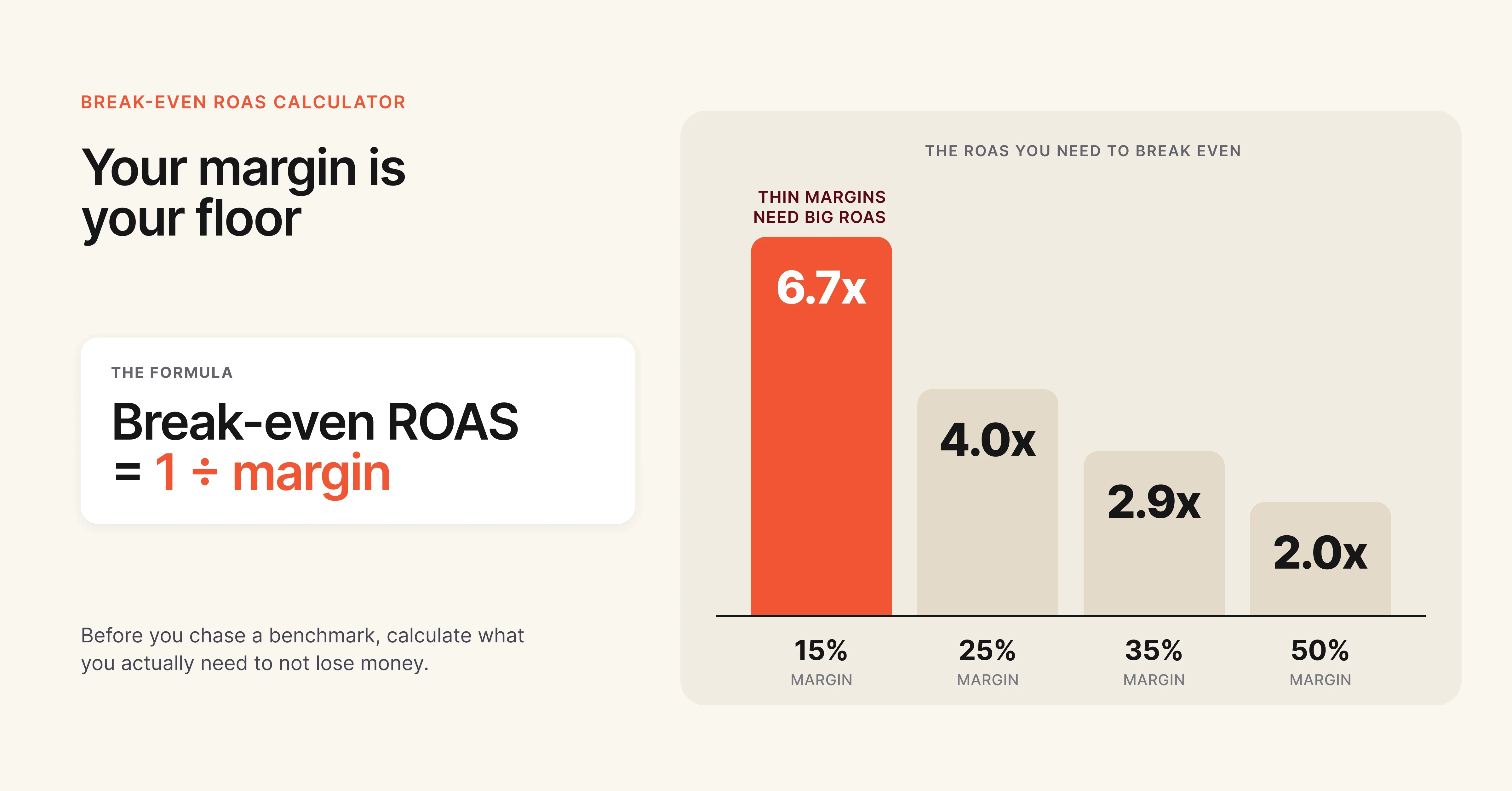
Break-Even ROAS = 1 / Net Profit Margin
If your net profit margin (after COGS, shipping, payment processing, and overhead) is 25%, your break-even ROAS is:
1 / 0.25 = 4.0x
That means you need $4 in revenue for every $1 in ad spend just to break even. Anything above 4.0x is profit from paid media.
| Net Profit Margin | Break-Even ROAS |
|---|---|
| 15% | 6.7x |
| 20% | 5.0x |
| 25% | 4.0x |
| 30% | 3.3x |
| 35% | 2.9x |
| 40% | 2.5x |
| 50% | 2.0x |
This table explains why a good ROAS is different for every business. A luxury brand with 50% margins is profitable at 2.0x ROAS. A consumer electronics brand with 15% margins needs 6.7x ROAS to break even. Same metric, completely different realities.
Three steps to find your number:
- Calculate your true net profit margin per order (revenue minus COGS, shipping, payment fees, returns, and allocated overhead)
- Divide 1 by that margin percentage to get your break-even ROAS
- Set your target ROAS 20% to 30% above break-even to build in a profit cushion
Once you know your break-even ROAS, industry benchmarks become context rather than targets. You stop chasing a number someone else published and start optimizing toward your actual profitability threshold.
How to beat your industry's ROAS benchmark
Knowing your industry's ROAS benchmark is step one. Beating it requires specific changes to your creative strategy, targeting, and campaign structure. These seven tactics are what separates top-quartile performers from the median.
1. Fix Your Creative Before Touching Your Targeting
Creative is the single largest lever for ROAS improvement on Meta and TikTok. Ad platforms have shifted toward broad, algorithm-driven targeting (Advantage+ on Meta, Smart Bidding on Google). When the algorithm handles audience selection, the only variable you control at scale is the creative itself.
Teams that analyze performance at the element level (which hooks work, which CTAs convert, which visual styles hold attention) consistently outperform teams that test entire ads as monolithic units. Breaking creatives into components like hook, body copy, visual treatment, and CTA lets you identify what is actually driving results and recombine winning elements.
2. Separate New Customer and Retargeting ROAS Targets
Stop blending your ROAS across prospecting and retargeting campaigns. Set different targets for each. Retargeting campaigns will always show inflated ROAS because you are reaching people who already know your brand. Prospecting campaigns will show lower ROAS because you are paying to acquire new customers.
A healthy split: aim for 1.5x to 2.5x ROAS on prospecting and 5x to 10x on retargeting. Track both independently, and evaluate your media buyer on new customer acquisition cost, not blended ROAS.
3. Increase Average Order Value
Higher AOV improves ROAS without changing a single thing about your ad campaigns. If your average order goes from $50 to $75, your ROAS improves by 50% on the same ad spend.
Tactics that work: product bundles, volume discounts, free shipping thresholds set just above your current AOV, post-purchase upsells, and cross-sell recommendations on the cart page. Each of these increases revenue per conversion without increasing cost per click.
4. Build a Creative Refresh Calendar
Ad fatigue is the silent ROAS killer. High-spend accounts on Meta typically see creative performance degrade after 2 to 3 weeks. If you are running the same ads for a month or more, your ROAS decline probably is not a targeting problem. It is a creative problem.
Build a calendar: refresh 25% to 30% of your creative assets every two weeks. Use performance data to identify which ads are hitting creative fatigue (declining CTR, rising CPM, falling conversion rate) and replace them with new variations built from your winning patterns. Running structured A/B testing on new creative variants against your controls accelerates this cycle and reduces guesswork.
5. Optimize Your Landing Pages for Conversion Rate
A 1% improvement in landing page conversion rate can improve ROAS by 25% to 50%, depending on your current baseline. Yet most performance teams spend 90% of their optimization time inside the ad platform and 10% on the post-click experience.
Test page speed (every second of load time costs you conversions), headline-to-ad message match, social proof placement, and checkout friction. These changes compound. A landing page that converts at 4% instead of 3% means you need 25% fewer clicks to generate the same revenue.
6. Use Broad Targeting with Strong Creative
On Meta, Advantage+ Shopping campaigns with broad targeting often outperform interest-based or lookalike targeting in 2026. The algorithm has gotten significantly better at finding buyers when you give it room to work, but only if your creative is strong enough to filter the right audience.
Weak creative plus broad targeting equals wasted spend. Strong creative plus broad targeting lets Meta's algorithm find pockets of high-intent users that manual targeting would miss. The creative becomes your targeting.
7. Track Blended ROAS Across All Channels
Individual platform ROAS is useful for campaign optimization, but it does not tell you whether your overall marketing spend is profitable. Track blended ROAS (total revenue divided by total marketing spend across all channels) to get the full picture.
Blended ROAS = Total Revenue / Total Marketing Spend (all channels combined)
A brand might see 2.0x ROAS on Meta, 6.0x on Google Search, and 3.5x on email. Blended ROAS across those channels might be 3.8x, which is the number that actually maps to profitability. Evaluate channel additions and budget shifts based on their impact on blended ROAS, not siloed platform metrics.
Attribution gaps make this harder than it sounds. Meta and Google both claim credit for overlapping conversions, and the attribution model you select in Google Ads changes how that credit is assigned, which inflates platform-level ROAS and makes your total look better than reality. Use a source-of-truth measurement (your ecommerce platform revenue, not ad platform reported revenue) as the numerator for blended ROAS calculations.
ROAS benchmarks in practice: three examples
Benchmarks make more sense when you see them applied to real scenarios. Here are three examples showing how ROAS benchmarks play out differently depending on business model and margin structure.
Example 1: DTC Skincare Brand
A DTC skincare brand with 65% gross margins and a $55 average order value runs Meta and Google Shopping ads. Their break-even ROAS is 1.5x (1 / 0.65). The industry benchmark for beauty and personal care is 4.2x.
This brand targets 3.0x on new customer acquisition and 7.0x on retargeting, knowing their subscription model (40% attach rate) means first-order ROAS understates actual customer value. They evaluate campaigns on 90-day LTV-to-CAC rather than first-touch ROAS alone.
Example 2: B2B SaaS Company
A B2B SaaS company with a $15,000 annual contract value runs Google Search and LinkedIn ads. Their break-even ROAS on first-month revenue is technically below 1.0x, which looks terrible in isolation. But a single closed deal generates $15,000 or more in annual recurring revenue.
This team measures ROAS on a 6-month cohort basis, factoring in the full sales cycle from click to closed deal. Their effective ROAS, measured against actual contract values, is 5.2x. The lesson: for long-cycle, high-LTV businesses, standard ROAS windows are misleading.
Example 3: Ecommerce Fashion Brand
A fast-fashion ecommerce brand with 35% margins and a $40 AOV needs at least 2.9x ROAS to break even. The apparel benchmark is 4.3x, and this brand is hitting 3.2x blended.
They are profitable but underperforming the benchmark. Digging deeper reveals their prospecting campaigns run at 1.8x while retargeting hits 6.5x. The fix is not to cut prospecting spend. It is to improve prospecting creative to close the gap.
They start analyzing which hooks and visual treatments work in cold audiences versus warm audiences, and they test new formats (UGC-style video, creator partnerships) to improve cold traffic ROAS by targeting 2.5x. Within six weeks of running element-level creative analysis and refreshing underperformers, their prospecting ROAS climbs to 2.4x and blended ROAS reaches 3.9x. The benchmark did not change. Their approach to creative did.
Frequently asked questions
What is a good ROAS by industry?
A good ROAS by industry is any figure above your break-even ROAS, which depends on your margins, but directional 2026 benchmarks give useful context. Legal services average near 8.0x, travel near 6.5x, B2B and technology near 5.0x, beauty and apparel around 4.2x to 4.3x, general ecommerce near 4.0x, and healthcare and iGaming lower at 2.3x to 3.5x on first touch. Compare your number to your industry range and your own break-even ROAS rather than to a single universal target.
What is the difference between new customer ROAS and blended ROAS for DTC?
New customer ROAS divides first-time-buyer revenue by the spend that acquired them, while blended ROAS divides total revenue (new, returning, and organic) by total paid spend. Blended ROAS is usually the higher number and can hide paid inefficiency, because returning-customer revenue subsidizes weak prospecting. A DTC brand can show a 4.0x blended ROAS while its new customer ROAS is only 2.0x, which means growth is more expensive than the headline number suggests. Track first-order revenue separately so you can see the true cost of acquisition.
What is a good ROAS for beauty and skincare brands?
For beauty and skincare in 2026, a good ROAS is roughly 3.0x to 4.5x on Meta and 2.5x to 3.8x on TikTok, with Google Shopping and Search higher at 3.5x to 6.0x. Creative format drives most of the variation: before-and-after and UGC creator videos deliver the strongest ROAS, while static product images sit at the bottom of the range. Because beauty has high repeat and subscription rates, first-order ROAS understates real value, so evaluate against LTV, not just first purchase.
Is a 3x ROAS good?
A 3x ROAS is good for businesses with profit margins of 35% or higher, where break-even ROAS is approximately 2.9x. For businesses with margins below 30%, a 3x ROAS may only cover costs without generating meaningful profit. Always compare your ROAS against your calculated break-even point rather than relying on a universal benchmark.
What is the average ROAS for ecommerce?
The average ROAS for general ecommerce is approximately 4.0:1 on Google Ads and 2.5x to 4.0x on Meta Ads in 2026. Ecommerce ROAS dropped roughly 4% year over year in 2025, reaching about 2.87x, driven by rising CPMs and increased competition. Performance varies significantly by sub-niche, platform, and whether you measure new customer or blended ROAS.
What ROAS should I aim for on Meta (Facebook) ads?
For Meta Ads, aim for 2.5x to 4.0x ROAS as a starting benchmark. Impulse-purchase categories like apparel and beauty should target 3.0x or higher, while higher-ticket items like furniture or electronics typically see 1.8x to 2.5x. Retargeting campaigns on Meta often deliver 5.0x to 10.0x. Your specific target should be based on your break-even ROAS calculation, not a generic benchmark.
What is the difference between ROAS and ROI?
ROAS measures revenue generated per dollar of ad spend (Revenue / Ad Spend), while ROI measures profit relative to total investment ((Profit - Total Cost) / Total Cost). A campaign can show a strong ROAS of 4.0x while delivering a low ROI of 10% to 20% once you deduct product costs, shipping, fees, and overhead. ROAS is useful for comparing campaign efficiency, and ROI tells you whether the business actually made money.
The bottom line
ROAS benchmarks give you a baseline, but they are starting points, not finish lines. The brands that consistently beat their industry average do three things: they know their break-even ROAS to the decimal, they treat creative as a performance lever rather than a design deliverable, and they track new customer and blended ROAS separately so paid inefficiency has nowhere to hide.
If your team is stuck reconciling platform-reported ROAS with real profitability across Meta, Google, YouTube, and TikTok, Hawky's Performance Agent is built for that job. It plans, launches, and optimizes campaigns against your target ROAS, CAC, or LTV, with every change logged and reversible under spend caps and guardrails, and it has delivered a 25% ROAS lift within the first 90 days. Hiveminds cut CPL by 27% on the same approach, with more results in the case studies.
Ready to hire your first AI performance team? Book Demo