Ad Spy Tool
Ad Spy Tool
Ad Spy Tool
Ad spy tools let you monitor competitor ads and spot winning patterns before you test. Learn how they work, what they can't show you, and how to use them strategically.
You're about to spend $20,000 testing three new creative concepts. Meanwhile, your top competitor has been running the same ad structure for 47 days across five platforms - a signal so clear it's practically a signed confession that it's working. Would you want to know that before you started? That's the basic case for ad spy tools.
What is an Ad Spy Tool?
An Ad Spy Tool is software that lets you monitor and analyse competitor ads - surfacing what creatives they're running, on which platforms, how long their ads have been active, and what messaging patterns they keep returning to. The goal isn't to copy competitors. It's to study what's already working in your market so you can build from proven patterns instead of expensive guesswork.
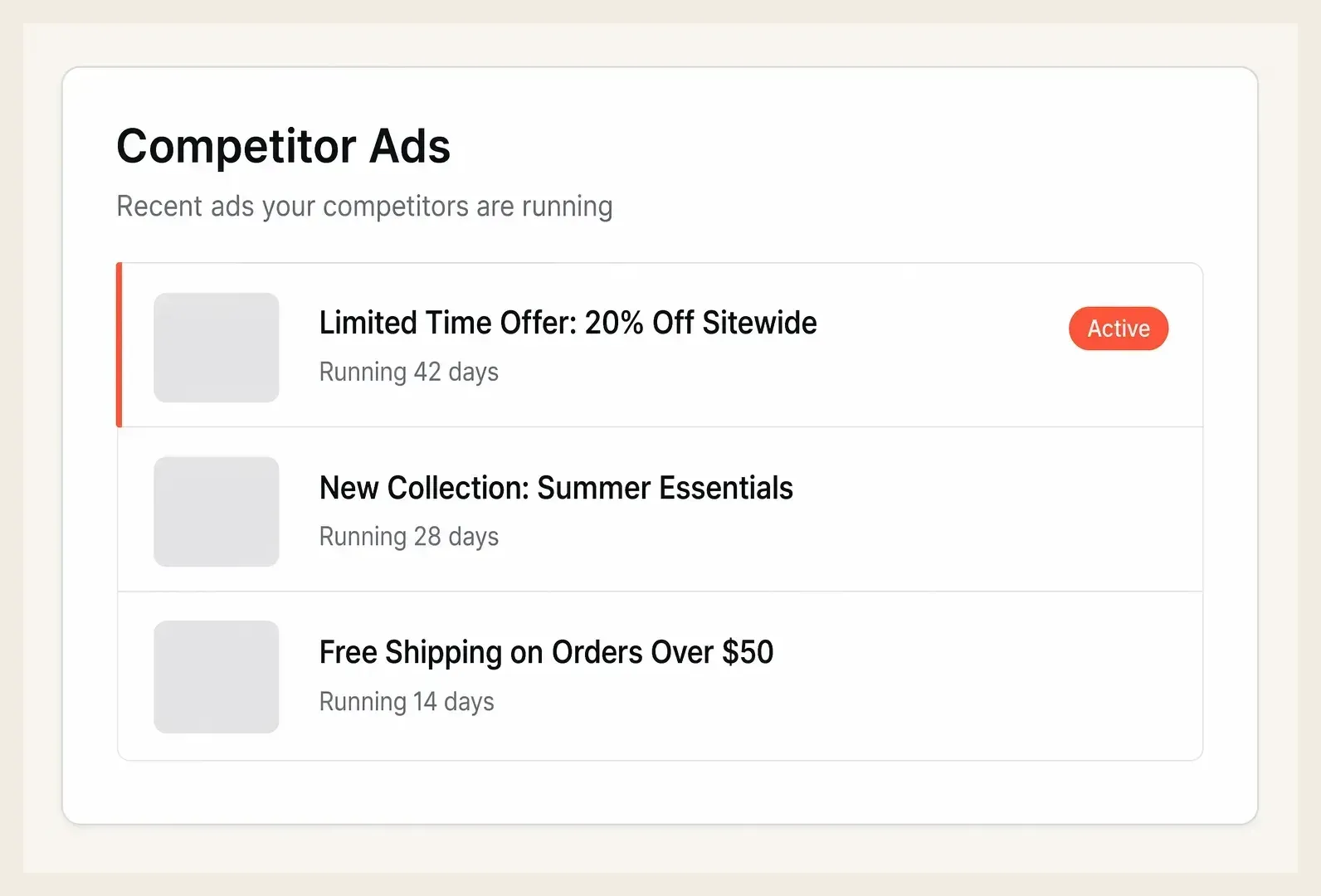
At the most basic level, free platforms like the Meta Ad Library and Google Ads Transparency Centre let any advertiser view active ads from any brand. Paid spy tools extend this with larger databases, longer history windows, smarter search filters, and engagement signals that help you separate the likely winners from the experiments that quietly got paused.
Why it Matters
Creative testing is expensive. A single round of testing 10 new concepts across Meta and TikTok can easily cost $5,000–$15,000 before you have statistically significant results. Ad spy tools let you front-load that testing with real market intelligence - seeing which concept structures, visual styles, hook formats, and offers are demonstrating longevity in your category before you spend a dollar.
Brands that conduct quarterly competitive creative analyses improve campaign ROI by an average of 23% (HubSpot, 2024). It isn't copying - it's reducing the hypothesis space. Instead of launching 10 equal-weight tests, you can enter the market with 3 high-confidence angles informed by what's already converting for competitors, then use your test budget to find your differentiated version of those proven structures.
How it Works
Platform monitoring: Ad spy tools connect to public ad libraries (Meta, Google, TikTok) and, in some cases, their own proprietary databases to collect active ads. You can search and filter by brand, keyword, industry, ad format, or platform - far faster than manually browsing ad libraries.
Run-time signals: Because spy tools can't access competitors' actual performance data (that lives inside their private accounts), experienced marketers read proxy signals instead. An ad running 30+ days without change is likely profitable - brands don't keep paying for ads that lose money. 50+ active variants signal heavy testing investment and confidence in the concept.
Pattern extraction: The most valuable use isn't saving individual ads - it's identifying patterns across the ads that appear to be working. What hook formats does your top competitor keep returning to? What offer structure runs consistently? What visual style appears in every variant? Those patterns are your market intelligence.
Refresh monitoring: Tracking when competitors introduce new creative, retire old concepts, and cycle through testing phases reveals their testing cadence useful for timing your own launches and spotting when a category-wide creative trend is emerging or fading.
Real-World Example
A DTC skincare brand is entering the anti-aging serum market. Before briefing their creative team, they use competitive intelligence tools to analyze the top 8 brands running in that space. The pattern that emerges across the ads with the longest run times: before-and-after visual structure paired with dermatologist credibility signals, and a specific pricing anchor format.
None of those brands individual CTR or CPA numbers are visible - that data is never accessible. But the pattern across 30+ long-running ads is statistically loud. The skincare brand launches their first test campaign built around that structure, adapted to their brand voice and story. Their opening test achieves a 3.1x ROAS above their category benchmark on a concept they had high confidence in before spending the first dollar.
Common Mistakes
Mistake | ❌ What Marketers Do | ✅ What to Do Instead |
|---|---|---|
Treating visibility as performance data | See a competitor running lots of ads and assume all of them are winners or assume an ad is performing because it looks polished | Read run-time signals carefully: 30+ days and multiple variants is a performance proxy; 2 days and paused is the opposite. Visual quality alone tells you nothing about conversion |
Copying instead of pattern-extracting | Screenshot a competitor's best ad, swap the logo, launch it | Identify the underlying structure - hook type, offer format, visual hierarchy, CTA approach - then build your own version that expresses your brand's differentiation within that proven framework |
One-time research instead of ongoing monitoring | Do a competitive audit before a campaign launch, then never look again | Your competitors are testing and iterating continuously. Systematic monitoring that alerts you when competitors launch new creative or scale existing concepts is far more valuable than periodic manual reviews |
How Hawky Helps
Hawky's competitor analysis goes beyond basic ad library browsing - the platform automatically tracks when competitors launch new campaigns across platforms, analyzes their creative for hooks, offers, messaging strategies, and visual patterns, and feeds those insights directly into your creative generation workflow. When element-level analysis surfaces a winning pattern in a competitor's creative, the same platform lets you immediately generate your own variants built around that structure - no tool-switching required.
Learn More
Competitor Ad Analysis: The Framework Behind Smart Creative Research
Creative Intelligence: How to Turn Competitive Insights Into Winning Ads
Element-Level Analysis: Breaking Down What Makes Competitor Ads Work
Quick Takeaway
An ad spy tool shows you what competitors are running; the real competitive advantage comes from understanding why certain creative structures keep working in your market and then systematically building your differentiated version of those proven patterns.
You're about to spend $20,000 testing three new creative concepts. Meanwhile, your top competitor has been running the same ad structure for 47 days across five platforms - a signal so clear it's practically a signed confession that it's working. Would you want to know that before you started? That's the basic case for ad spy tools.
What is an Ad Spy Tool?
An Ad Spy Tool is software that lets you monitor and analyse competitor ads - surfacing what creatives they're running, on which platforms, how long their ads have been active, and what messaging patterns they keep returning to. The goal isn't to copy competitors. It's to study what's already working in your market so you can build from proven patterns instead of expensive guesswork.
At the most basic level, free platforms like the Meta Ad Library and Google Ads Transparency Centre let any advertiser view active ads from any brand. Paid spy tools extend this with larger databases, longer history windows, smarter search filters, and engagement signals that help you separate the likely winners from the experiments that quietly got paused.
Why it Matters
Creative testing is expensive. A single round of testing 10 new concepts across Meta and TikTok can easily cost $5,000–$15,000 before you have statistically significant results. Ad spy tools let you front-load that testing with real market intelligence - seeing which concept structures, visual styles, hook formats, and offers are demonstrating longevity in your category before you spend a dollar.
Brands that conduct quarterly competitive creative analyses improve campaign ROI by an average of 23% (HubSpot, 2024). It isn't copying - it's reducing the hypothesis space. Instead of launching 10 equal-weight tests, you can enter the market with 3 high-confidence angles informed by what's already converting for competitors, then use your test budget to find your differentiated version of those proven structures.
How it Works
Platform monitoring: Ad spy tools connect to public ad libraries (Meta, Google, TikTok) and, in some cases, their own proprietary databases to collect active ads. You can search and filter by brand, keyword, industry, ad format, or platform - far faster than manually browsing ad libraries.
Run-time signals: Because spy tools can't access competitors' actual performance data (that lives inside their private accounts), experienced marketers read proxy signals instead. An ad running 30+ days without change is likely profitable - brands don't keep paying for ads that lose money. 50+ active variants signal heavy testing investment and confidence in the concept.
Pattern extraction: The most valuable use isn't saving individual ads - it's identifying patterns across the ads that appear to be working. What hook formats does your top competitor keep returning to? What offer structure runs consistently? What visual style appears in every variant? Those patterns are your market intelligence.
Refresh monitoring: Tracking when competitors introduce new creative, retire old concepts, and cycle through testing phases reveals their testing cadence useful for timing your own launches and spotting when a category-wide creative trend is emerging or fading.
Real-World Example
A DTC skincare brand is entering the anti-aging serum market. Before briefing their creative team, they use competitive intelligence tools to analyze the top 8 brands running in that space. The pattern that emerges across the ads with the longest run times: before-and-after visual structure paired with dermatologist credibility signals, and a specific pricing anchor format.
None of those brands individual CTR or CPA numbers are visible - that data is never accessible. But the pattern across 30+ long-running ads is statistically loud. The skincare brand launches their first test campaign built around that structure, adapted to their brand voice and story. Their opening test achieves a 3.1x ROAS above their category benchmark on a concept they had high confidence in before spending the first dollar.
Common Mistakes
Mistake | ❌ What Marketers Do | ✅ What to Do Instead |
|---|---|---|
Treating visibility as performance data | See a competitor running lots of ads and assume all of them are winners or assume an ad is performing because it looks polished | Read run-time signals carefully: 30+ days and multiple variants is a performance proxy; 2 days and paused is the opposite. Visual quality alone tells you nothing about conversion |
Copying instead of pattern-extracting | Screenshot a competitor's best ad, swap the logo, launch it | Identify the underlying structure - hook type, offer format, visual hierarchy, CTA approach - then build your own version that expresses your brand's differentiation within that proven framework |
One-time research instead of ongoing monitoring | Do a competitive audit before a campaign launch, then never look again | Your competitors are testing and iterating continuously. Systematic monitoring that alerts you when competitors launch new creative or scale existing concepts is far more valuable than periodic manual reviews |
How Hawky Helps
Hawky's competitor analysis goes beyond basic ad library browsing - the platform automatically tracks when competitors launch new campaigns across platforms, analyzes their creative for hooks, offers, messaging strategies, and visual patterns, and feeds those insights directly into your creative generation workflow. When element-level analysis surfaces a winning pattern in a competitor's creative, the same platform lets you immediately generate your own variants built around that structure - no tool-switching required.
Learn More
Competitor Ad Analysis: The Framework Behind Smart Creative Research
Creative Intelligence: How to Turn Competitive Insights Into Winning Ads
Element-Level Analysis: Breaking Down What Makes Competitor Ads Work
Quick Takeaway
An ad spy tool shows you what competitors are running; the real competitive advantage comes from understanding why certain creative structures keep working in your market and then systematically building your differentiated version of those proven patterns.
You're about to spend $20,000 testing three new creative concepts. Meanwhile, your top competitor has been running the same ad structure for 47 days across five platforms - a signal so clear it's practically a signed confession that it's working. Would you want to know that before you started? That's the basic case for ad spy tools.
What is an Ad Spy Tool?
An Ad Spy Tool is software that lets you monitor and analyse competitor ads - surfacing what creatives they're running, on which platforms, how long their ads have been active, and what messaging patterns they keep returning to. The goal isn't to copy competitors. It's to study what's already working in your market so you can build from proven patterns instead of expensive guesswork.
At the most basic level, free platforms like the Meta Ad Library and Google Ads Transparency Centre let any advertiser view active ads from any brand. Paid spy tools extend this with larger databases, longer history windows, smarter search filters, and engagement signals that help you separate the likely winners from the experiments that quietly got paused.
Why it Matters
Creative testing is expensive. A single round of testing 10 new concepts across Meta and TikTok can easily cost $5,000–$15,000 before you have statistically significant results. Ad spy tools let you front-load that testing with real market intelligence - seeing which concept structures, visual styles, hook formats, and offers are demonstrating longevity in your category before you spend a dollar.
Brands that conduct quarterly competitive creative analyses improve campaign ROI by an average of 23% (HubSpot, 2024). It isn't copying - it's reducing the hypothesis space. Instead of launching 10 equal-weight tests, you can enter the market with 3 high-confidence angles informed by what's already converting for competitors, then use your test budget to find your differentiated version of those proven structures.
How it Works
Platform monitoring: Ad spy tools connect to public ad libraries (Meta, Google, TikTok) and, in some cases, their own proprietary databases to collect active ads. You can search and filter by brand, keyword, industry, ad format, or platform - far faster than manually browsing ad libraries.
Run-time signals: Because spy tools can't access competitors' actual performance data (that lives inside their private accounts), experienced marketers read proxy signals instead. An ad running 30+ days without change is likely profitable - brands don't keep paying for ads that lose money. 50+ active variants signal heavy testing investment and confidence in the concept.
Pattern extraction: The most valuable use isn't saving individual ads - it's identifying patterns across the ads that appear to be working. What hook formats does your top competitor keep returning to? What offer structure runs consistently? What visual style appears in every variant? Those patterns are your market intelligence.
Refresh monitoring: Tracking when competitors introduce new creative, retire old concepts, and cycle through testing phases reveals their testing cadence useful for timing your own launches and spotting when a category-wide creative trend is emerging or fading.
Real-World Example
A DTC skincare brand is entering the anti-aging serum market. Before briefing their creative team, they use competitive intelligence tools to analyze the top 8 brands running in that space. The pattern that emerges across the ads with the longest run times: before-and-after visual structure paired with dermatologist credibility signals, and a specific pricing anchor format.
None of those brands individual CTR or CPA numbers are visible - that data is never accessible. But the pattern across 30+ long-running ads is statistically loud. The skincare brand launches their first test campaign built around that structure, adapted to their brand voice and story. Their opening test achieves a 3.1x ROAS above their category benchmark on a concept they had high confidence in before spending the first dollar.
Common Mistakes
Mistake | ❌ What Marketers Do | ✅ What to Do Instead |
|---|---|---|
Treating visibility as performance data | See a competitor running lots of ads and assume all of them are winners or assume an ad is performing because it looks polished | Read run-time signals carefully: 30+ days and multiple variants is a performance proxy; 2 days and paused is the opposite. Visual quality alone tells you nothing about conversion |
Copying instead of pattern-extracting | Screenshot a competitor's best ad, swap the logo, launch it | Identify the underlying structure - hook type, offer format, visual hierarchy, CTA approach - then build your own version that expresses your brand's differentiation within that proven framework |
One-time research instead of ongoing monitoring | Do a competitive audit before a campaign launch, then never look again | Your competitors are testing and iterating continuously. Systematic monitoring that alerts you when competitors launch new creative or scale existing concepts is far more valuable than periodic manual reviews |
How Hawky Helps
Hawky's competitor analysis goes beyond basic ad library browsing - the platform automatically tracks when competitors launch new campaigns across platforms, analyzes their creative for hooks, offers, messaging strategies, and visual patterns, and feeds those insights directly into your creative generation workflow. When element-level analysis surfaces a winning pattern in a competitor's creative, the same platform lets you immediately generate your own variants built around that structure - no tool-switching required.
Learn More
Competitor Ad Analysis: The Framework Behind Smart Creative Research
Creative Intelligence: How to Turn Competitive Insights Into Winning Ads
Element-Level Analysis: Breaking Down What Makes Competitor Ads Work
Quick Takeaway
An ad spy tool shows you what competitors are running; the real competitive advantage comes from understanding why certain creative structures keep working in your market and then systematically building your differentiated version of those proven patterns.
Make Every Ad a Winner
Hooks, CTAs, visuals - decode every detail.
Ready to Stop Guessing and Start Winning with Creative Intelligence?
Company
Alternatives
Ready to Stop Guessing and Start Winning with Creative Intelligence?
Company
Alternatives
Ready to Stop Guessing and Start Winning with Creative Intelligence?
Company
Alternatives