Conversion Rate (CVR)
Last updated
The percentage of users who complete a desired action after clicking your ad. A key metric for measuring how effectively your creative and landing page work together.
Conversion Rate (CVR)
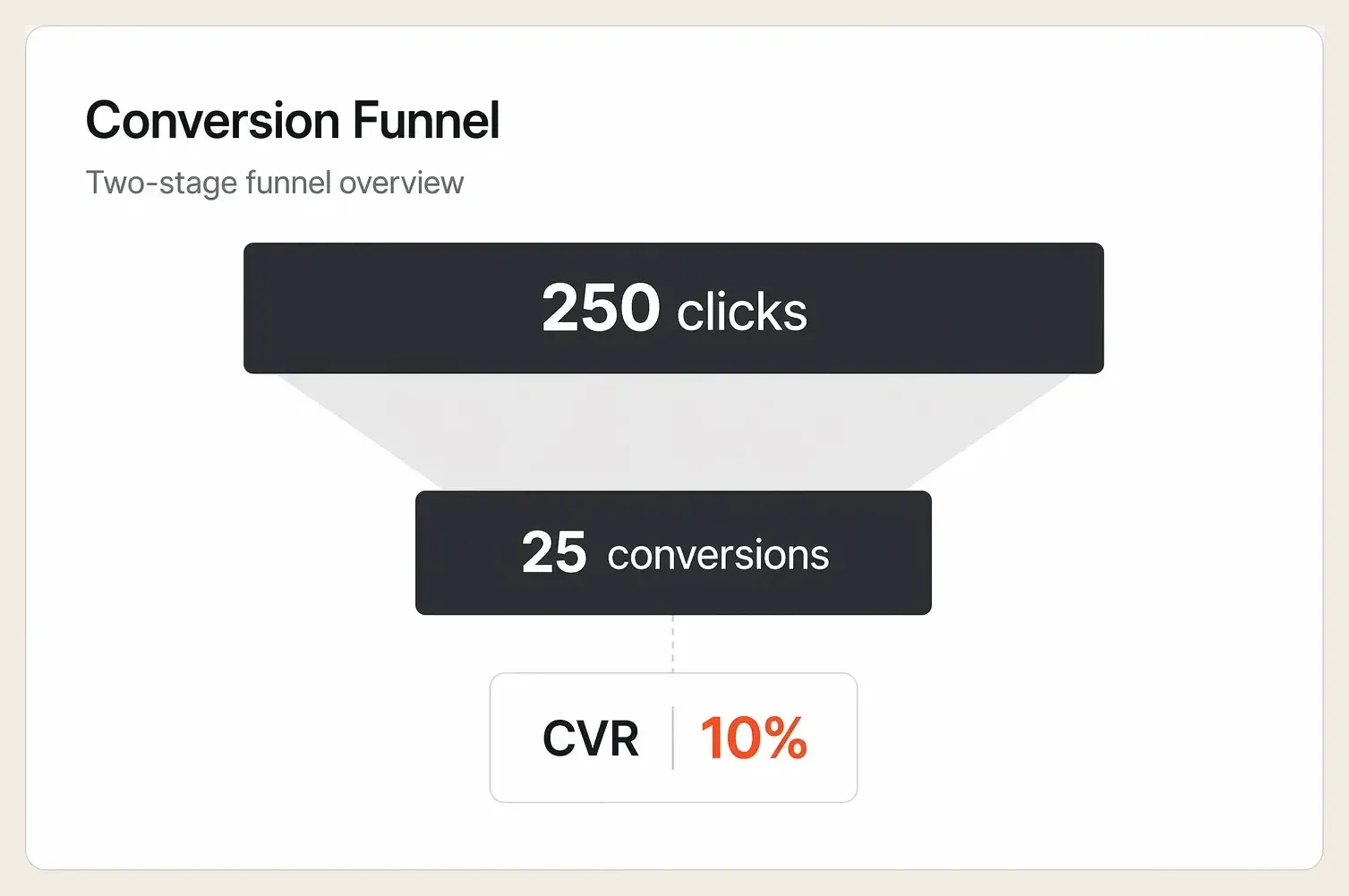
Conversion Rate (CVR) is the percentage of people who click your ad and complete your desired action, whether that is making a purchase, signing up for a trial, or submitting a lead form. It is calculated by dividing total conversions by total clicks, then multiplying by 100. CVR tells you whether your ad promise matches your actual offer, making it the ultimate measure of campaign quality beyond vanity metrics.
Why It Matters
CVR directly determines your cost per acquisition and overall profitability. You can have a fantastic CTR that drives cheap clicks, but if those clicks do not convert, you are burning budget. A 3 percent CVR costs one-third as much per conversion as a 1 percent CVR at the same CPC, which means small CVR improvements move CPA more than almost any other lever.
More critically, CVR reveals whether your creative accurately represents your offer. Mismatched messaging kills conversion no matter how good the landing page is, because visitors arrive expecting one thing and find another. That makes CVR a creative diagnostic as much as a landing-page metric: a sudden CVR drop with stable traffic usually points to a promise the ad is making that the offer cannot keep.
How It Works
Conversion happens in a sequence, and CVR measures the final step:
- Click: someone clicks your ad and lands on your page.
- Action: they browse, add to cart, or start filling out a form.
- Conversion: they complete the goal action (purchase, signup, download).
- Calculation: divide conversions by clicks and multiply by 100.
The number only becomes meaningful at sufficient volume. A 3 percent CVR from 10 clicks is statistically meaningless, while the same rate across 1,000 clicks is a reliable signal you can act on. Read CVR alongside average order value and ROAS, because a high CVR on low-value conversions can still lose money.
Formula
The formula is simple:
(Conversions ÷ Clicks) × 100 = CVR percent
Typical benchmark ranges depend heavily on offer type and funnel stage. E-commerce purchase CVR commonly lands between 1 and 3 percent, with strong stores reaching 4 percent or higher. Lead-generation forms often convert at 5 to 15 percent because the ask is lighter than a purchase. Free-trial signups vary widely from 2 to 10 percent depending on friction. Retargeting warm audiences usually outperforms cold prospecting by a wide margin, so always benchmark CVR within the same audience and offer type.
A Real Example
A fitness app runs two Instagram ads with identical targeting.
Ad A reads "Get abs in 30 days" and posts a 2.1 percent CTR, 1.2 percent CVR, and $41.67 CPA. Ad B reads "Join 50k members building sustainable habits" and posts a 1.8 percent CTR, 4.5 percent CVR, and $11.11 CPA. Ad A gets more clicks but overpromises, leading to disappointed visitors who bounce. Ad B sets realistic expectations, attracting fewer but higher-quality clicks that convert at nearly 4x the rate. The result is that Ad B costs 73 percent less per signup despite the lower CTR.
Common Mistakes
| ❌ Mistake | ✅ Better Approach |
|---|---|
| Blaming the landing page when CVR drops, when it is usually a creative-offer mismatch | Review the ad creative first. Does it accurately represent what users see after clicking? |
| Treating all conversions equally, when a $20 sale is not a $200 sale even at the same CVR | Track CVR alongside average order value and ROAS |
| Optimizing CVR in isolation, when 3 percent CVR from 10 clicks is statistically meaningless | Wait for significance, a minimum of 100 clicks before drawing CVR conclusions |
How Hawky Helps
Hawky's Creative Agent runs element-level analysis to find which creative elements, product angles, value propositions, and visual styles correlate with actual conversions rather than just clicks. It surfaces patterns like "free shipping CTAs drive clicks but limited-stock framing drives conversions," then rebuilds creative to attract the right clicks instead of more clicks.
The Performance Agent watches CVR by creative and audience, shifting budget toward the variants that actually convert and pausing ads that buy cheap clicks that never close. Because every result is stored in FeatherDB, the system learns which angles convert for your offer and applies that memory to the next round of creative.
Frequently Asked Questions
What is a good conversion rate for ads?
A good conversion rate depends on the offer. E-commerce purchases typically convert at 1 to 3 percent, lead forms at 5 to 15 percent, and free trials anywhere from 2 to 10 percent. Compare your CVR against the same offer type and audience temperature, since retargeting warm users almost always converts higher than cold prospecting.
What is the difference between CTR and CVR?
CTR measures the percentage of people who click your ad after seeing it, while CVR measures the percentage of those clickers who complete the desired action. CTR reflects how compelling the creative is, and CVR reflects whether the ad's promise matches the offer. A high CTR with a low CVR usually signals a creative-offer mismatch.
How do you improve a low conversion rate?
Start by checking that the ad creative accurately represents the offer, since most CVR problems are messaging mismatches rather than landing-page issues. Then tighten the path from click to action by reducing friction, matching the headline on the page to the ad, and testing value propositions through element-level analysis to see which angles actually convert.
How many clicks do you need before trusting a CVR number?
You need at least 100 clicks before drawing any conclusion, and more for low-conversion offers. A CVR calculated from a handful of clicks is statistical noise that will not hold at scale. Wait for the sample to reach significance before pausing, scaling, or comparing variants.
Quick Takeaway
CVR measures how many clicks turn into actual results. A high CVR means your ad promise matches your offer, while a low CVR signals a mismatch that no amount of traffic will fix.
Spending on clicks that never convert? Book Demo