10 AI Ad Intelligence Tools That Actually Move the Needle in 2026

Lokeshwaran Magesh
Lokeshwaran Magesh
Lokeshwaran Magesh
7 Mins Read
7 Mins Read
7 Mins Read

Table of Contents
What AI ad intelligence actually means in 2026
The 10 best AI ad intelligence tools
Feature comparison: how these tools stack up
Creative intelligence vs. ad spy tools: the difference that matters
Which tool is right for your team?
Frequently asked questions
Table of Contents
What AI ad intelligence actually means in 2026
The 10 best AI ad intelligence tools
Feature comparison: how these tools stack up
Creative intelligence vs. ad spy tools: the difference that matters
Which tool is right for your team?
Frequently asked questions
Table of Contents
What AI ad intelligence actually means in 2026
The 10 best AI ad intelligence tools
Feature comparison: how these tools stack up
Creative intelligence vs. ad spy tools: the difference that matters
Which tool is right for your team?
Frequently asked questions
Make Every Ad a Winner
Hooks, CTAs, visuals - decode every detail.
The top AI ad intelligence tools for 2026 are Hawky, Madgicx, and AdCreative.ai, each solving a different piece of the creative performance puzzle. Hawky leads for element-level creative intelligence and agentic automation. Madgicx dominates Meta ads optimization. AdCreative.ai wins on AI-powered ad generation volume.
AI ad intelligence tools have matured past the "spy on competitor ads" phase. The tools worth paying for in 2026 connect creative decisions directly to revenue outcomes like ROAS, CPL, and CTR. They tell you not just what competitors are running, but which hooks, visuals, and CTAs actually drive conversions for your brand.
This guide breaks down the 10 AI ad intelligence tools that deliver measurable performance impact, with honest assessments of where each one excels and where it falls short.
What AI Ad Intelligence Actually Means in 2026
AI ad intelligence is the use of artificial intelligence to collect, analyze, and act on advertising performance data across creative elements, competitor activity, and audience behavior. It goes beyond traditional ad analytics by identifying patterns in what makes ads work at the element level, predicting when creative fatigue will hit, and recommending (or executing) optimizations automatically.
The category has split into two distinct camps. The first is ad spy tools, which focus on building searchable databases of competitor ads. These tools help you see what other brands are running across Meta, Google, TikTok, and other platforms. The second is creative intelligence platforms, which analyze your own ad performance at the element level (hooks, visuals, CTAs, body copy) and connect those elements directly to outcomes like ROAS and cost per lead.
The best AI ad intelligence tools in 2026 do both. They combine competitive monitoring with performance analytics, creative generation, and increasingly, agentic automation that acts on insights without waiting for a human to build a spreadsheet.
What separates a good tool from a great one comes down to three things: depth of creative analysis (element-level, not just ad-level), integration with your ad platforms for real-time data, and the ability to turn insights into action without switching between four different tools.
A growing trend in 2026 is agentic automation within ad intelligence platforms. Rather than surfacing insights in a dashboard and waiting for a human to act, the best tools now run scheduled analyses, flag issues proactively, and execute optimizations (pausing fatigued ads, adjusting creative rotation, reallocating budget to winners) with minimal manual intervention. This shift from "reporting tool" to "operating system" is the clearest sign that AI ad intelligence has moved from nice-to-have to critical infrastructure for performance marketing teams.
The 10 Best AI Ad Intelligence Tools
1. Hawky - Best for Element-Level Creative Intelligence
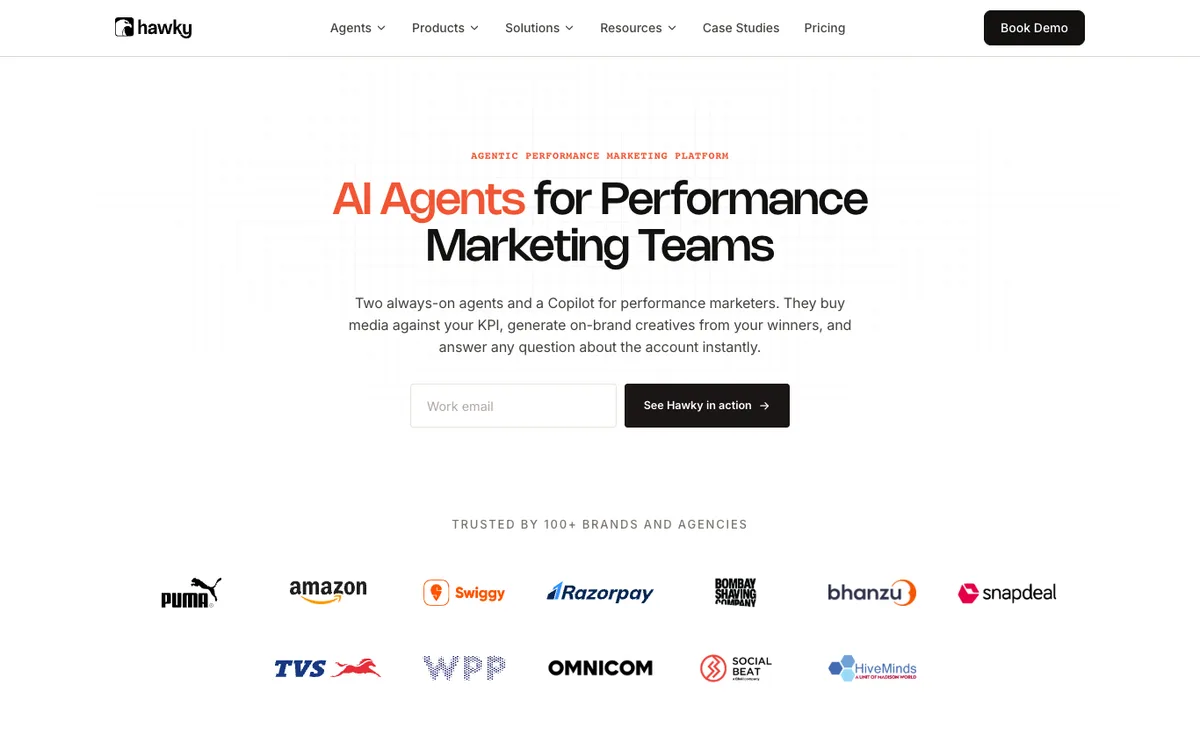
Hawky is an AI-native creative intelligence platform (Agentic OS) built for performance marketers who need to understand why their ads work, not just that they work. Where most tools report on ad-level metrics, Hawky breaks every creative down to its individual elements: hook style, visual hierarchy, emotional triggers, CTA placement, and body copy structure. The platform integrates with Meta, Google, TikTok, Pinterest, and Snapchat, giving cross-platform teams a single source of truth.
Hawky combines five capabilities that other platforms sell separately: creative analysis, competitor intelligence, AI creative generation, Playbooks, and a Command Center that acts as an agentic operating system for your entire creative workflow. The Copilot AI lets you select any ad and ask "Why is this working?" to get a full breakdown of hook styles, visual hierarchy, emotional triggers, and audience fit, with source citations linking every insight to specific creatives and data points.
Hawky's Command Center automatically generates task lists ranked by potential impact, with urgency indicators and expected performance improvement estimates. Three agent types run on autopilot: the Creative Playbook Agent (monthly), Competitor Tracker (weekly), and Performance Alert Agent (daily). Agents surface what needs to happen, route creative tasks to the creative team and performance tasks to the performance team, and execute with one-click approval directly in Meta.
What makes Hawky distinct from every other tool on this list is the depth across the full creative lifecycle. The platform detects creative fatigue before performance degrades, generates AI creatives from your winning patterns (including video scripts, bulk product catalogue creatives, and regional variations), and turns one-off wins into repeatable Playbooks your team can follow. The Competitor Intelligence module goes beyond basic ad tracking with SWOT analysis, influencer collaboration detection, weekly alerts on messaging shifts, and enhanced reports that compare current activity against historical data.
Hiveminds cut CPL by 27% and saved 160+ hours per brand monthly using Hawky. Univest increased CTR by 20% within 7 days by applying element-level creative intelligence from the platform.
Key capabilities:
Element-level creative analysis that breaks ads into hooks, visuals, CTAs, and body copy with individual performance scores and trend tracking over time
Copilot AI with citations: ask any question about your creatives and get answers backed by specific data points, plus one-click executive decks and creative brief generation
Predictive creative fatigue detection with automated alerts and condition-based agents that pause underperformers proactively
Competitor intelligence with SWOT analysis, hook tracking, influencer collabs detection, weekly alerts, and a searchable ad repository (current and historical)
AI creative generation trained on winning patterns: static images, video scripts, creative adapts across sizes, bulk product catalogue creation, and regional variations
Command Center with agentic automation: impact-ranked tasks, team routing, scheduled reports, and one-click ad actions directly in Meta
Playbooks that codify winning creative strategies into repeatable systems your team can scale
Bottom funnel integration connecting CRM data, e-commerce platforms, and Google Analytics to creative performance for revenue and CLTV tracking
Meta Andromeda Audit that flags at-risk creatives violating Meta's creative variation regulations before CPC spikes
Performance Optimization Intelligence that identifies budget leakage, underperforming ads, and fatigued creatives with exact reasons behind anomalies
Best for: Performance marketing teams and agencies running $50k+/month on Meta, Google, TikTok, Pinterest, or Snapchat who want creative decisions driven by data instead of gut instinct.
2. Madgicx - Best for Meta Ads Optimization and Automation
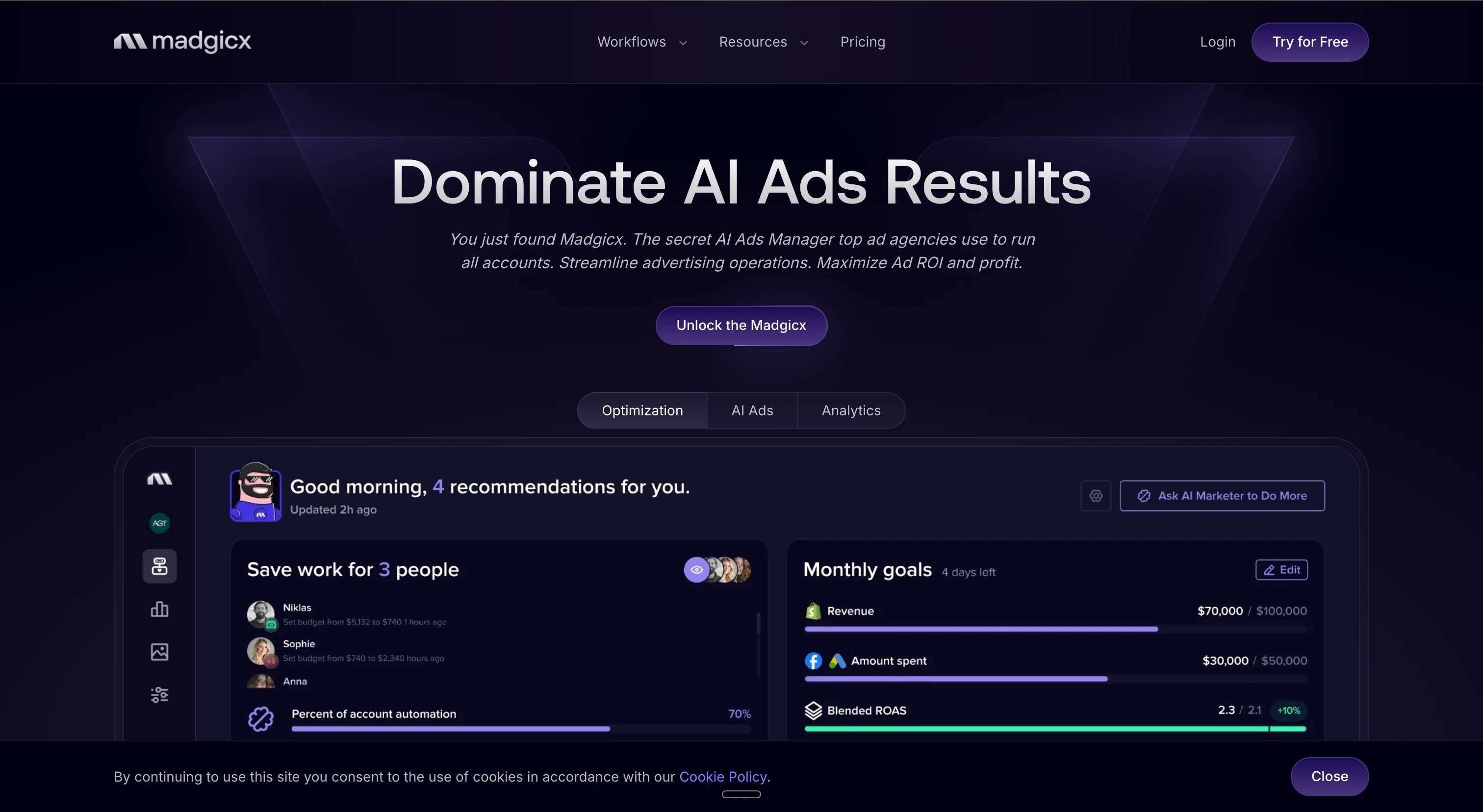
Madgicx is a Meta advertising platform that combines audience targeting, creative analytics, and budget optimization in one tool. Its strength is the depth of its Meta-specific features, including automated audience launchers, ad copy AI, and a creative analysis module that benchmarks your ads against industry performance data.

The platform's Automation Tactics feature lets you set rules for pausing underperformers, scaling winners, and adjusting budgets based on real-time ROAS thresholds and conversion rate targets. For teams that live inside Meta Ads Manager, Madgicx adds a layer of automation and intelligence that the native platform lacks. The audience launcher uses AI to create and test targeting combinations you wouldn't build manually, which has made it popular with agencies managing multiple client accounts.
Madgicx also includes a creative reporting module that shows which ads drive the best results across custom metrics. The reporting is solid for Meta campaigns, though it doesn't break down performance at the element level the way dedicated creative intelligence platforms do.
Strength: Deep Meta Ads integration with automated bid and budget management. The audience segmentation tools use Meta's data signals effectively. The automation rules engine is one of the most flexible in the category.
Limitation: Meta-only focus. If you run Google Ads, TikTok, or other platforms alongside Meta, you need a second tool. Creative analysis stays at the ad level, not element level. No competitor intelligence features.
Best for: Meta-focused advertisers spending $20k+/month who want automation rules and audience optimization on top of their existing campaigns.
3. AdCreative.ai - Best for AI-Powered Ad Creative Generation at Scale
AdCreative.ai focuses on the generation side of creative intelligence. Upload your brand assets, define your audience, and the platform produces ad variations across formats, platforms, and sizes. Each generated creative gets a performance score predicting its likelihood of converting, based on training data from millions of ad impressions across its user base.

The platform recently expanded into competitor analysis with its Ad Intelligence feature, which lets you search and analyze competitor ads across Meta and other platforms. The generation engine is fast and produces high volumes, making it useful for teams that need to run A/B testing across dozens of creative variations quickly. The scoring model improves over time as it learns from your campaign results, which means output quality increases the longer you use the platform.
AdCreative.ai also supports multi-format generation, producing assets sized for Meta feed, Stories, Reels, Google Display, and LinkedIn in a single batch. For teams tired of manually resizing creatives for every placement, this alone saves significant production hours.
Strength: Speed and volume of creative generation. The predictive scoring helps prioritize which variations to test first. Strong integration with major ad platforms for direct publishing. Multi-format output eliminates manual resizing.
Limitation: The intelligence layer is secondary to generation. Competitor insights are surface-level compared to dedicated intelligence platforms. Creative analysis of your own ads is basic, with no element-level breakdown. The generated creatives can feel formulaic without strong brand input.
Best for: D2C brands and growth teams that need high-volume creative testing and want AI to handle the production workload.
4. Foreplay - Best for Creative Research and Swipe Files
Foreplay is a creative strategy tool built around the concept of the swipe file. It lets you save, organize, and analyze competitor ads from Meta Ad Library, TikTok Creative Center, and other platforms into organized boards with tags, notes, and team comments. The Spyder feature provides ongoing competitor ad tracking with automated monitoring, alerting you when specific brands launch new creatives.

The tool excels at the research phase of creative strategy. Creative directors and strategists use it to build inspiration libraries, brief designers with visual references, and identify trending formats before they peak. The collaboration features make it useful for teams that separate strategy from execution, since boards can be shared with designers and freelancers who need context without full platform access.
Foreplay also includes a creative brief builder that turns saved ad references into structured briefs with hooks, concepts, and visual direction. For agencies managing multiple clients, the ability to maintain separate brand boards with distinct creative libraries solves an organizational problem that spreadsheets and Google Drive folders handle poorly.
Strength: Best-in-class ad saving and organization workflow. The visual board layout makes creative briefing intuitive. Spyder offers persistent competitor monitoring. The brief builder connects research directly to creative production.
Limitation: No performance analytics. Foreplay tells you what competitors are running, not whether it works. No integration with your own ad accounts for connecting competitor insights to your performance data. No element-level analysis or fatigue detection.
Best for: Creative strategists and agencies that need organized inspiration libraries, structured creative briefing workflows, and persistent competitor monitoring.
5. Motion - Best for Creative Reporting and Performance Analytics
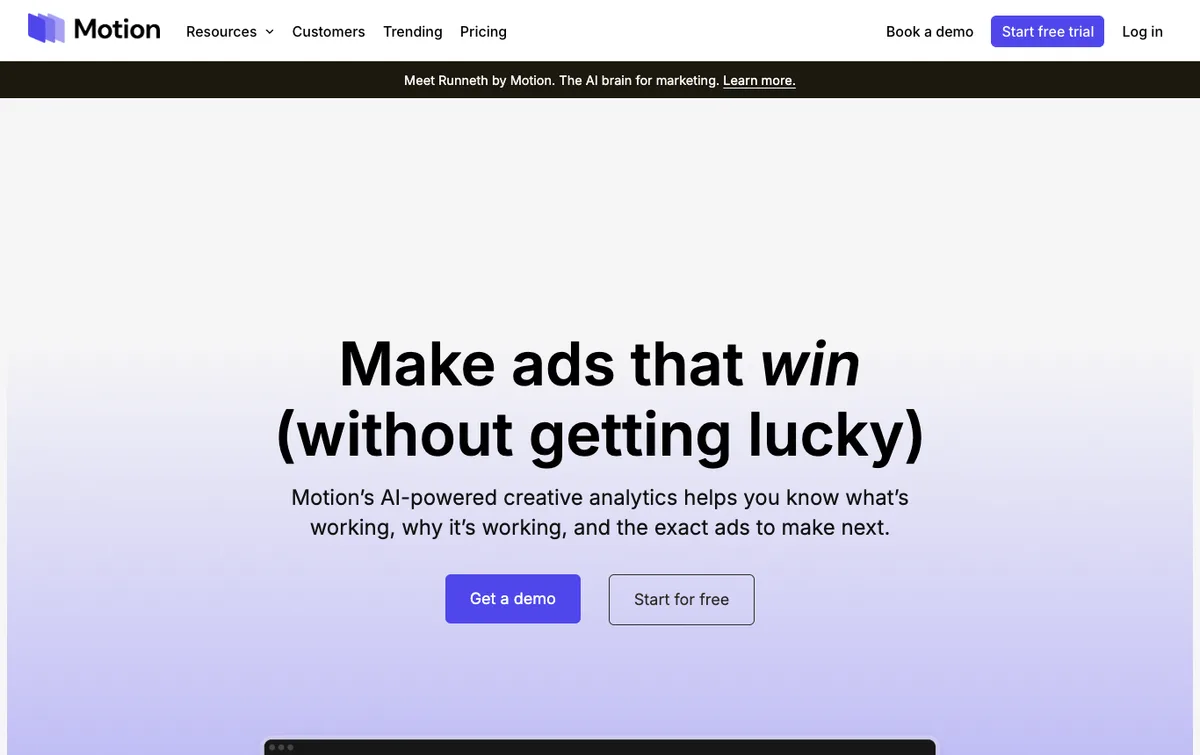
Motion connects your Meta, TikTok, and YouTube ad accounts to provide visual creative reporting that both creative and performance teams can understand. The platform groups creatives by concept, shows performance trends over time, and makes it easier for everyone to speak the same language about what's working.

The reporting layer is clean and visual, which matters when you need to get non-technical stakeholders aligned on creative direction. Motion has added AI-powered insights that surface top performers and flag declining creatives automatically. The "Creative Reports" feature generates shareable summaries that creative directors and CMOs can review without logging into the platform.
Where Motion stands out is the concept-level analysis. Rather than looking at individual ads in isolation, the platform lets you group creatives by theme, angle, or format. You can answer questions like "do testimonial ads outperform product demos?" across your entire account rather than ad by ad. For teams producing 50+ creatives per month, this macro view prevents you from losing the strategic signal in tactical noise.
Strength: Visual reporting that bridges the gap between creative teams and media buyers. The concept-grouping feature helps you analyze creative themes rather than individual ads. Shareable reports make cross-team alignment easier.
Limitation: Analytics are focused on reporting, not action. No competitor intelligence features, no AI creative generation, and no element-level breakdown of hooks, CTAs, or visual components within a single ad. Limited to Meta, TikTok, and YouTube.
Best for: Teams producing high volumes of creatives who need better reporting and want to align performance and creative stakeholders around shared data.
6. Triple Whale - Best for Attribution and Creative-Level Revenue Tracking
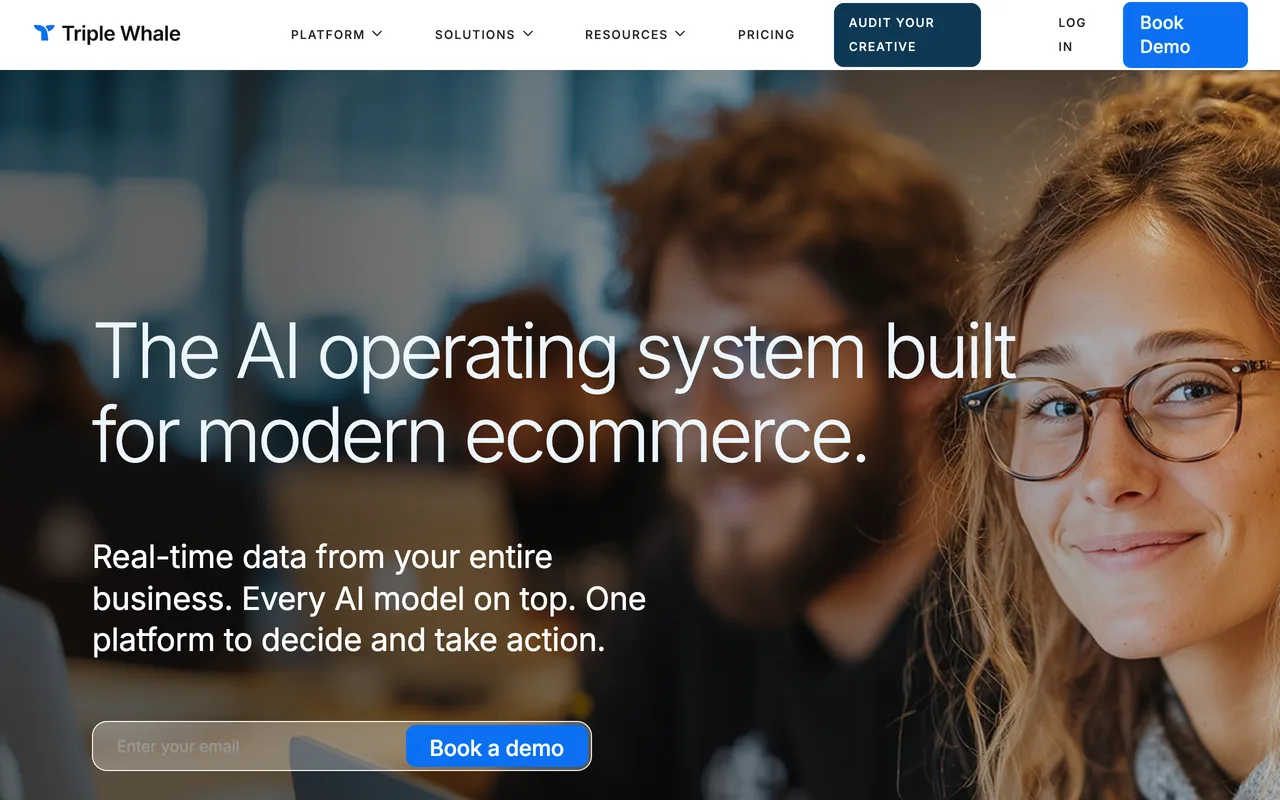
Triple Whale is an attribution and analytics platform popular with e-commerce brands, particularly on Shopify. Its creative analytics module connects ad creative performance directly to revenue data through its proprietary attribution model (Triple Pixel), giving you a clearer picture of which creatives actually drive purchases rather than just clicks or landing page views.

The platform's Summary page provides a single-screen view of your entire marketing performance across channels, including Meta, Google, TikTok, email, and SMS. For teams obsessed with understanding true ROAS at the creative level, Triple Whale fills a gap that platform-native reporting leaves open. The attribution model uses first-party data from the Triple Pixel, which has become increasingly valuable as third-party cookies disappear and platform-reported conversions grow less reliable.
Triple Whale also offers Sonar, an AI assistant that answers natural language questions about your performance data. Ask "which creatives drove the most revenue last week?" and get a direct answer instead of building custom reports. For e-commerce teams that want their analytics to feel more like a conversation than a spreadsheet, this is a practical feature.
Strength: Revenue attribution at the creative level. The integration with Shopify and e-commerce platforms provides bottom-funnel data that pure ad intelligence tools miss. The Summary dashboard consolidates cross-channel performance effectively. First-party pixel data provides more accurate attribution than platform-reported metrics.
Limitation: E-commerce centric, making it less useful for lead gen, B2B, or app-based businesses. The creative intelligence is attribution-focused, not element-level, and there is no competitor tracking or creative generation. Hawky's bottom funnel integration offers similar attribution depth with the added layer of element-level creative analysis on top.
Best for: Shopify-based D2C brands spending $100k+/month who need reliable creative-level attribution beyond platform-reported metrics.
7. MagicBrief - Best for Creative Analytics and Research Combined
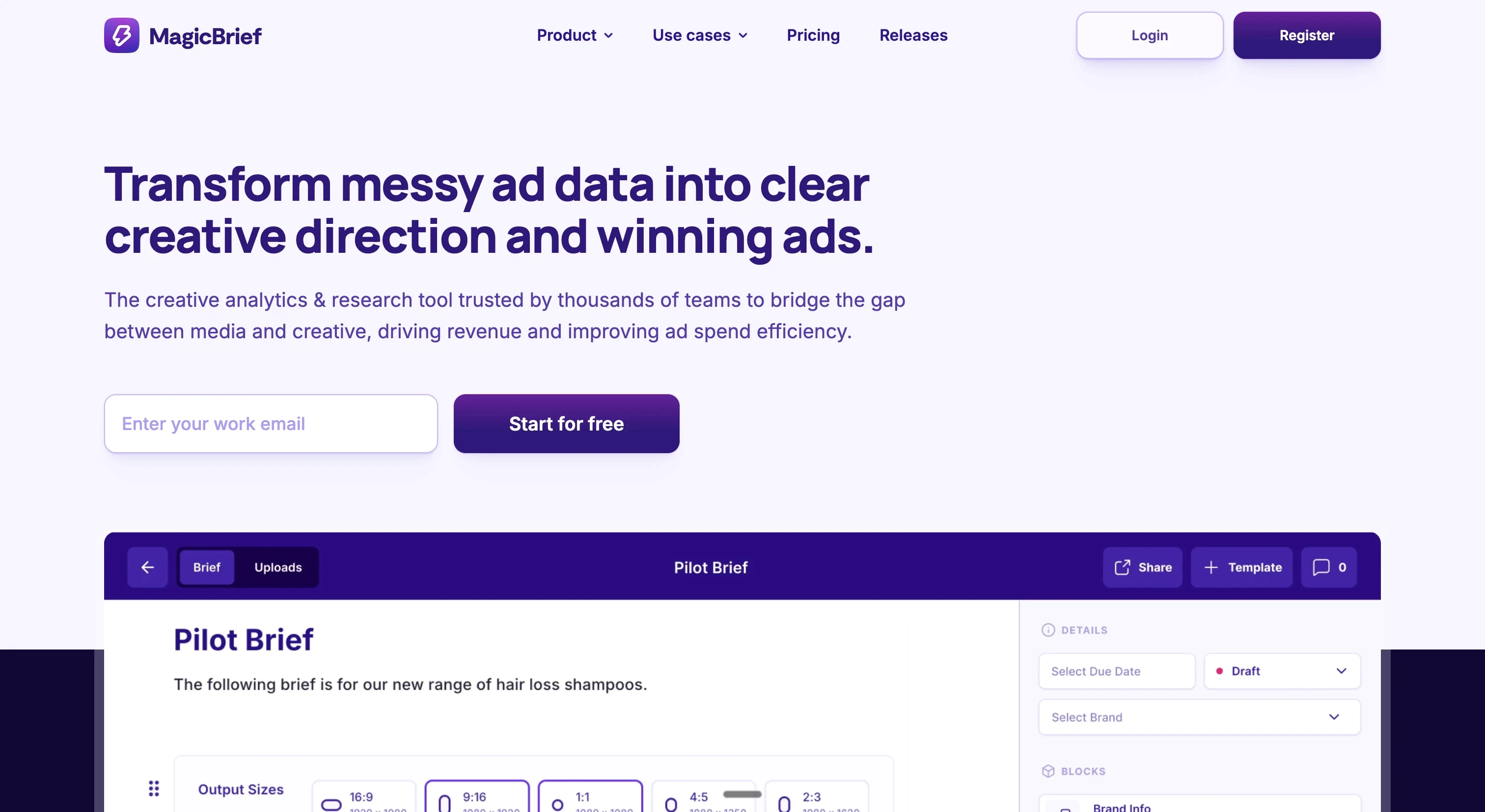
MagicBrief is an AI-powered creative analytics and research platform that combines competitor ad tracking with performance analysis of your own creatives. The platform pulls ads from Meta Ad Library and TikTok Creative Center for research, while also connecting to your ad accounts to show which creatives perform best and why.

MagicBrief's AI automatically tags and categorizes creatives by format, hook type, visual style, and messaging angle. The research side lets you build organized boards of competitor ads (similar to Foreplay), while the analytics side connects those patterns to your own performance data. This dual approach makes it useful for teams that want research and analytics in one tool rather than switching between separate platforms.
Strength: Bridges the gap between creative research and performance analytics in a single platform. The AI tagging speeds up creative categorization. Strong collaboration features for agencies managing multiple brands.
Limitation: Newer platform with a smaller feature set compared to more established tools. Analytics depth does not reach element-level granularity the way Hawky does. Limited to Meta and TikTok.
Best for: Creative strategists and performance teams who want competitor research and creative analytics combined without managing two separate tools.
8. AdClarity by Semrush - Best for Broad Competitive Display Intelligence
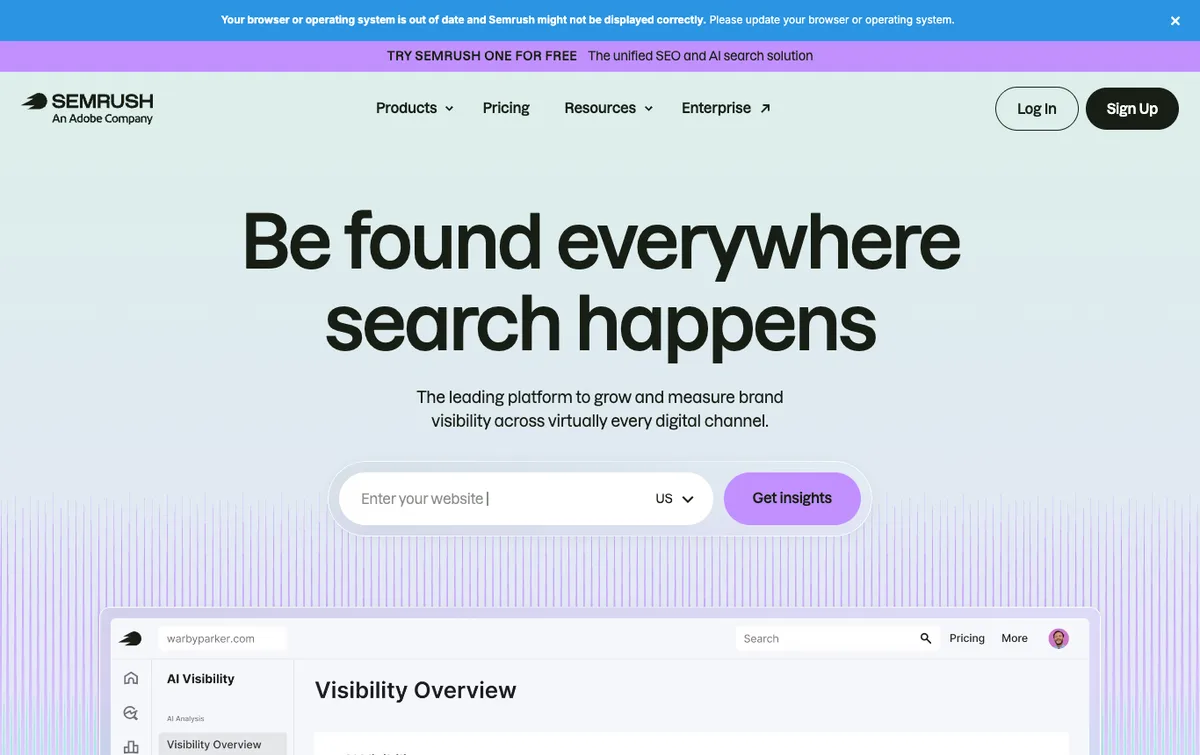
AdClarity, part of the Semrush ecosystem, is a competitive intelligence tool that tracks display, social, and video ad activity across millions of advertisers globally. It provides estimated spend data, impression share, publisher placement information, and ad format breakdowns that help you understand where competitors allocate their budgets and which channels they prioritize.
The tool draws from a combination of crawling technology and human panelist data, which gives it broader coverage than tools that rely solely on ad library APIs. For teams that need a bird's-eye view of competitive ad activity across display, programmatic, video, and social channels, AdClarity provides that macro perspective. The integration with Semrush's broader SEO and marketing toolkit means you can analyze a competitor's organic and paid strategy from a single platform.
AdClarity is particularly useful for understanding media mix allocation at the category level. You can benchmark your brand's share of voice against competitors across channels and see how budget distribution shifts over time. This macro intelligence complements the granular creative analysis that platforms like Hawky provide at the element level.
Strength: Breadth of coverage across display, video, and social channels. Estimated spend data and publisher placement information. Integrates with the broader Semrush SEO and marketing toolkit. Category-level benchmarking and share of voice reporting.
Limitation: Data accuracy has been flagged in G2 reviews, with users reporting competitors showing zero spend despite active campaigns. Creative analysis is shallow, with no element-level breakdown of what makes ads perform. The intelligence is observational, not actionable. Cost adds up when combined with an existing Semrush subscription.
Best for: Marketing teams already using Semrush who want competitive intelligence added to their existing workflow without adopting a new platform.
9. Pencil by Brandtech - Best for AI Creative Generation with Performance Predictions
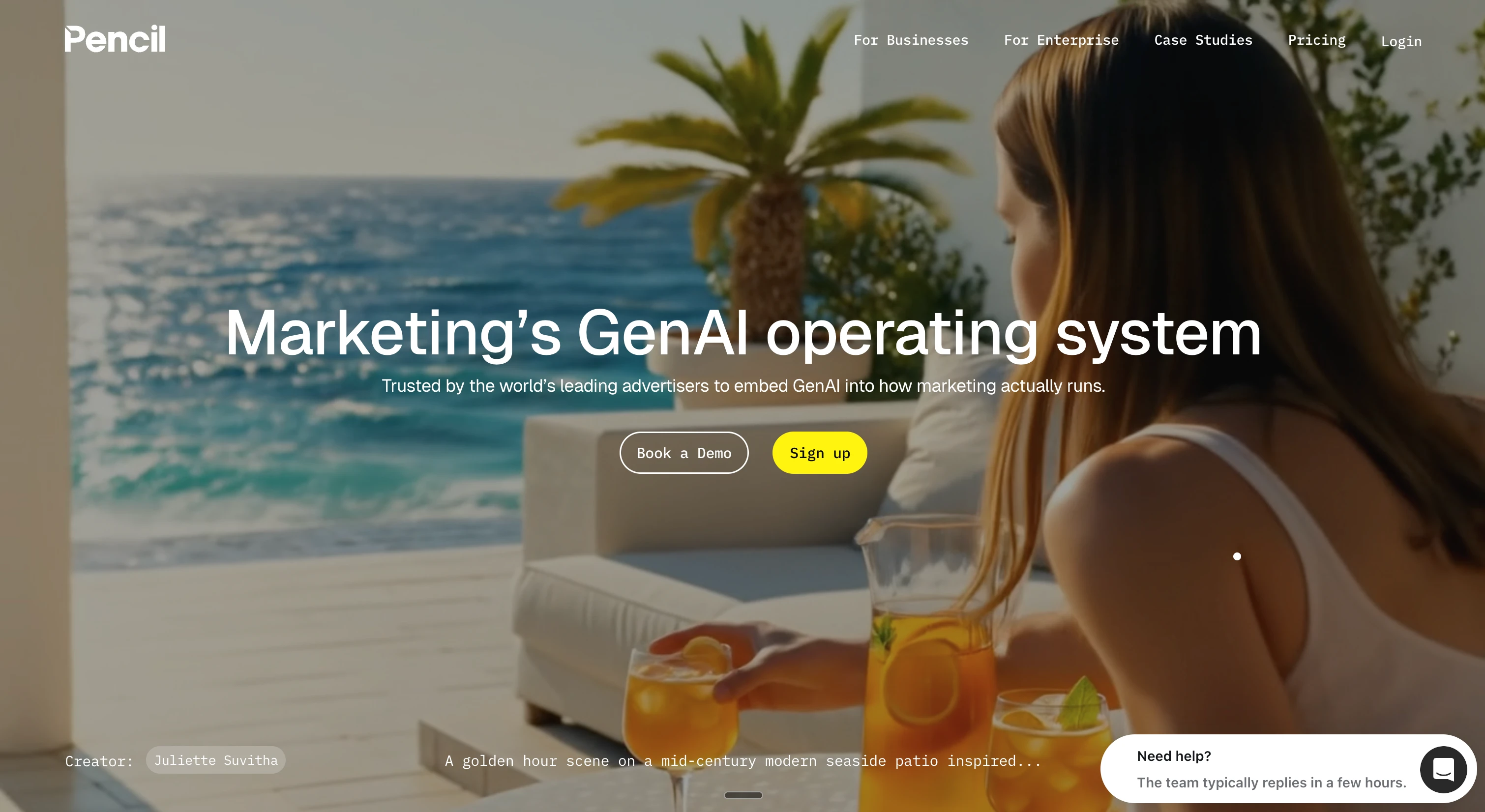
Pencil uses AI to generate ad and predicts their performance before you spend a dollar on testing. The platform analyzes your historical ad data alongside its broader dataset to generate new variations and score each one with a predicted performance rating.

The generation engine handles static images, video, and copy across multiple formats. Pencil's differentiator is the feedback loop between generation and performance data. As you run generated creatives, the AI learns what works for your brand and improves future outputs.
Strength: Tight feedback loop between AI-generated creatives and performance data. The predictive scoring helps prioritize testing. Video ad generation capabilities are more advanced than most competitors.
Limitation: Intelligence layer is thin. Pencil focuses on generation and prediction, not competitive intelligence or deep creative analysis of your existing library. Limited competitor monitoring.
Best for: Brands and agencies that want AI creative generation with performance predictions and a learning feedback loop.
10. SocialPeta - Best for Global Ad Intelligence and Asian Market Coverage
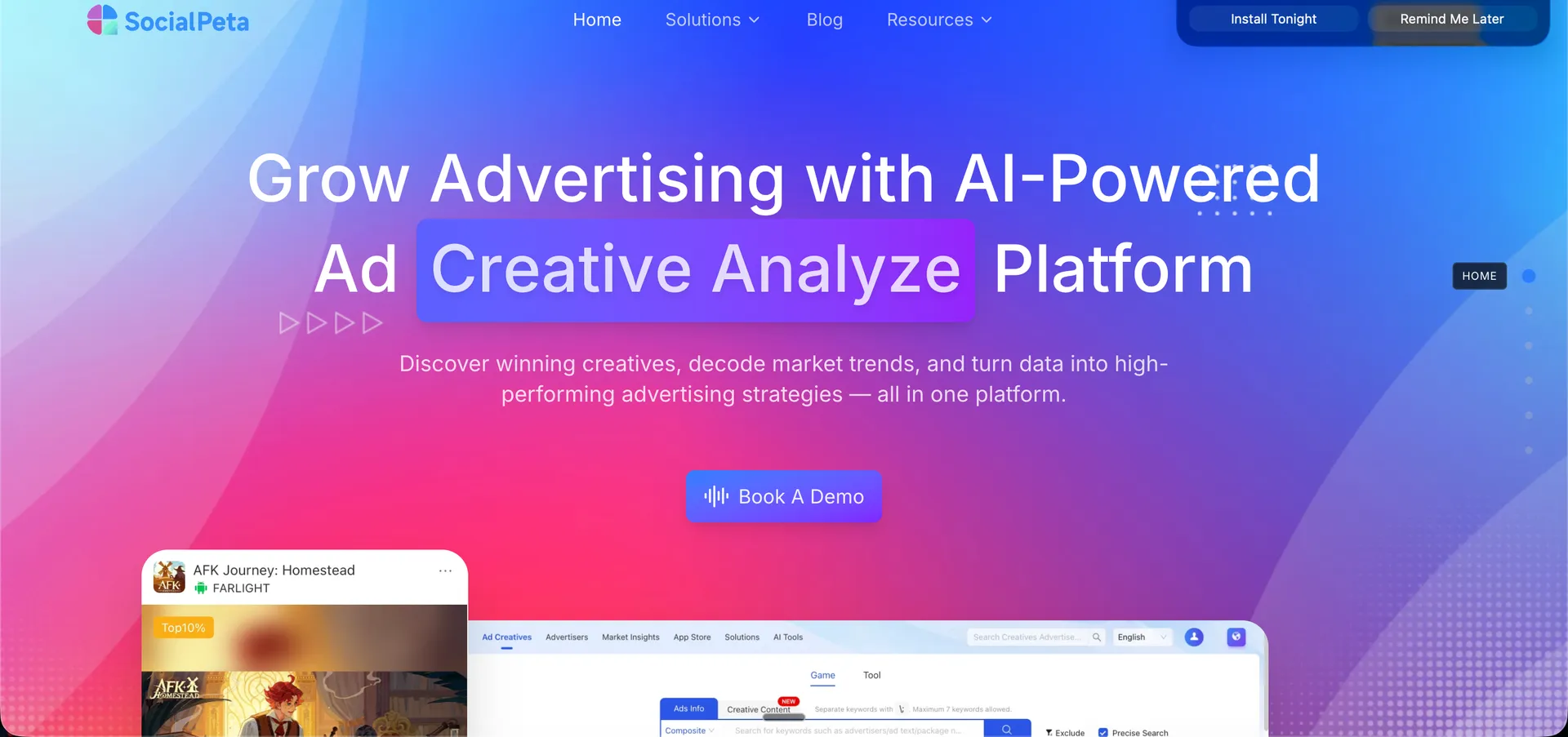
SocialPeta is a global ad intelligence platform that covers 80+ countries and platforms including Meta, Google, TikTok, and regional networks like Naver, Baidu, and Alibaba's ad ecosystem. The database spans billions of ad creatives with advanced filtering by region, platform, format, and industry.
For brands expanding into Asian markets or running global campaigns, SocialPeta fills a coverage gap that Western-focused tools leave open. The platform offers cost intelligence, trend analysis, and creative inspiration across a wider geographic footprint than any other tool on this list. The mobile game and app advertising intelligence is particularly deep, making SocialPeta a go-to tool for mobile publishers and game studios running UA campaigns across multiple regions.
SocialPeta also provides estimated cost data (CPM, CPC ranges by region and platform), which helps teams set realistic benchmarks before entering new markets. If you are planning a Meta Ads expansion into Southeast Asia or a TikTok launch in Japan, the regional intelligence saves weeks of guesswork.
Strength: Unmatched global coverage, especially across Asian ad networks. The mobile game and app intelligence features rival dedicated UA platforms. Massive creative database with 3-day free trial. Regional cost benchmarking helps with market entry planning.
Limitation: Breadth over depth. Creative analysis is surface-level compared to platforms like Hawky or Motion that analyze element-level performance. Data volume can be overwhelming without a clear research question. The interface favors power users over casual researchers.
Best for: Global brands and mobile publishers who need competitive intelligence across Asian and emerging market ad networks.
Feature Comparison: How These Tools Stack Up
Tool | Element-Level Analysis | Competitor Tracking | AI Creative Gen | Fatigue Detection | Agentic Automation | Platform Coverage |
|---|---|---|---|---|---|---|
Hawky | Yes (deep) | Yes (SWOT + alerts) | Yes | Yes (predictive) | Yes (Command Center) | Meta, Google, Pinterest, Snapchat |
Madgicx | No | No | Copy only | Basic rules | Bid/budget only | Meta only |
AdCreative.ai | No | Basic search | Yes (high volume) | No | No | Meta, Google, LinkedIn |
Foreplay | No | Yes (Spyder) | No | No | No | Meta, TikTok |
Motion | Partial (concept-level) | No | No | Basic alerts | No | Meta, TikTok, YouTube |
Triple Whale | No | No | No | No | No | Meta, Google, TikTok |
MagicBrief | Partial (AI-tagged) | Yes (research boards) | No | No | No | Meta, TikTok |
AdClarity | No | Yes (broad) | No | No | No | Display, social, video |
Pencil | No | No | Yes | No | No | Meta, TikTok, Google |
SocialPeta | No | Yes (global) | No | No | No | 80+ platforms |
The table reveals a pattern: most tools do one thing well. Competitor tracking OR creative analytics OR generation. Hawky is the only platform that combines element-level creative analysis, competitor intelligence, predictive fatigue detection, AI generation, Playbooks, and agentic automation in a single workflow across Meta, Google, TikTok, Pinterest, and Snapchat.
Creative Intelligence vs. Ad Spy Tools: The Difference That Matters
There are two distinct categories hiding under the "ad intelligence" umbrella, and understanding the difference saves you from buying the wrong tool.

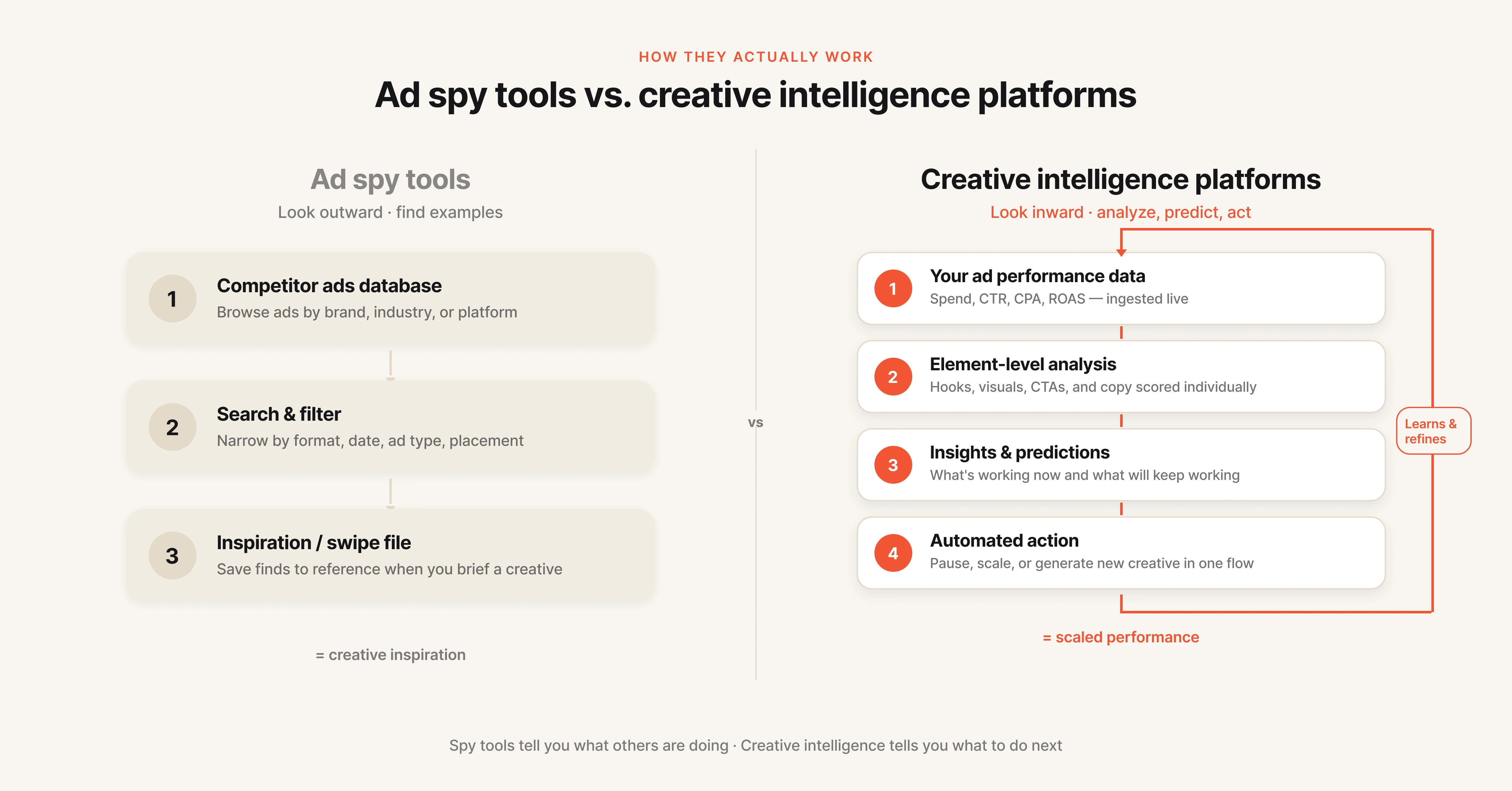
Ad spy tools (Foreplay, AdSpy, SocialPeta, AdClarity) are databases. They collect competitor ads from ad libraries and transparency centers, make them searchable, and let you filter by industry, format, and platform. These tools answer the question: "What are competitors running?" They are useful for creative inspiration and competitive awareness, but they tell you nothing about performance.
Creative intelligence platforms (Hawky, Motion, MagicBrief) analyze your ad performance at a deeper level. They connect creative elements to outcomes, identify patterns in what drives ROAS, and predict when creatives will fatigue. These tools answer: "Why are my ads working or failing, and what should I do about it?"
The confusion happens because some tools blur the line. AdCreative.ai generates creatives and scores them, Triple Whale attributes revenue to creatives, and Madgicx optimizes bids and budgets around creative performance. Each touches "intelligence" from a different angle.
Here is a practical way to think about it:
Capability | Ad Spy Tools | Creative Intelligence Platforms |
|---|---|---|
What they show you | Competitor ads across platforms | Your own ad performance by element |
Data source | Public ad libraries, transparency APIs | Your connected ad accounts + platform data |
Primary question answered | "What are others running?" | "Why are my ads working or failing?" |
Action output | Inspiration and competitive awareness | Specific recommendations tied to ROAS/CPL |
Creative fatigue detection | No | Yes (some platforms) |
Automation | No | Alerts, scheduled reports, ad actions |
For teams spending serious budgets ($50k+/month), the highest-impact investment is a creative intelligence platform that analyzes element-level performance and connects insights to action. Ad spy tools are useful supplements, but they solve a different problem. If you had to pick one category, pick the one that makes your own ads better, not the one that shows you what everyone else is doing.
The 2026 trend worth watching is convergence. Platforms like Hawky are combining both categories, giving you competitor monitoring alongside your own creative performance data. This means you can see what competitors are testing, analyze what works in your own account, and generate new creatives informed by both datasets, all without switching tools.
Which Tool Is Right for Your Team?
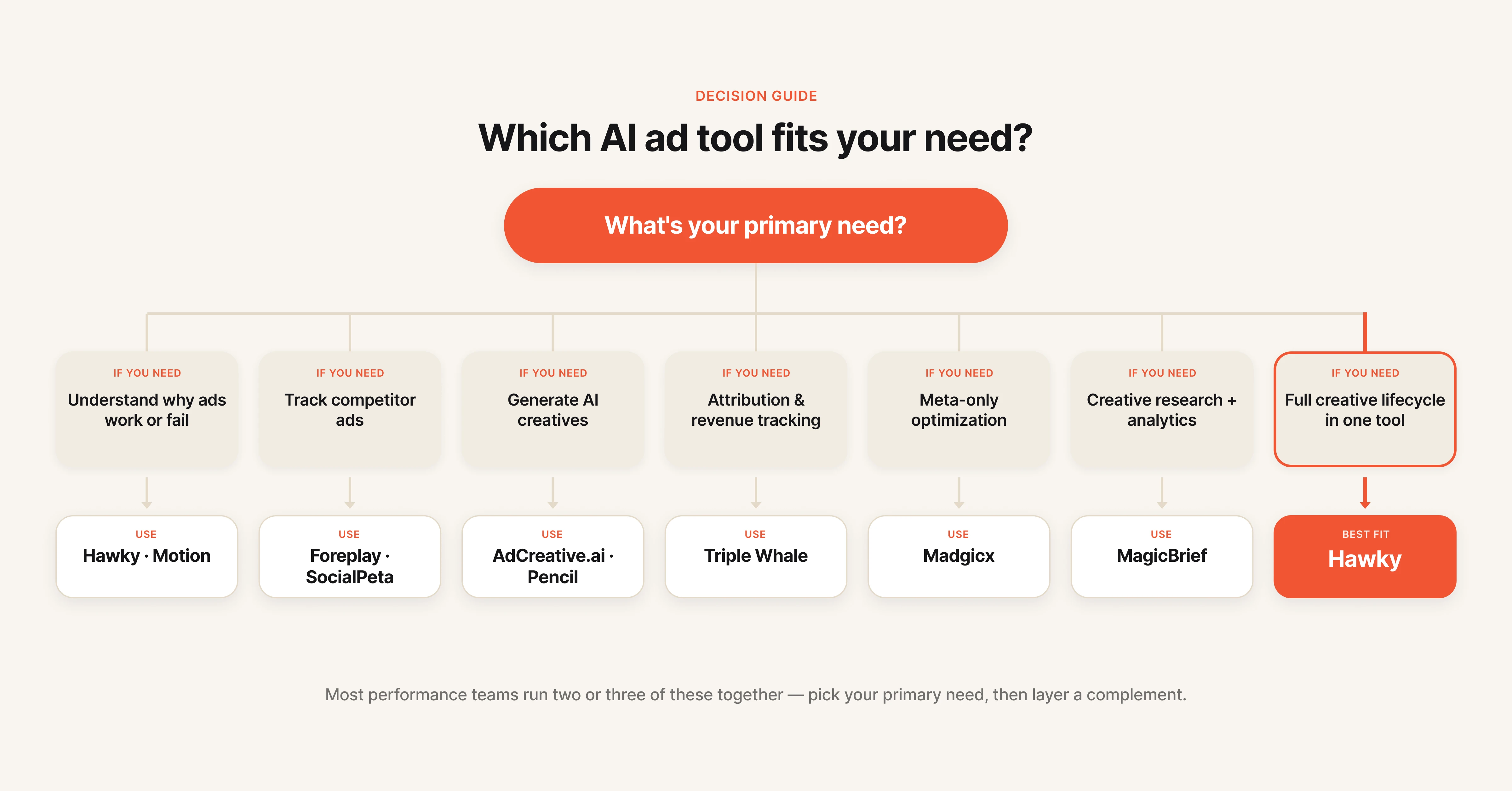
Choosing the right AI ad intelligence tool depends on your primary use case, ad spend level, and whether you need competitive monitoring, creative analytics, or both. Here is how the decision breaks down by team type.

If you run Meta, Google, TikTok, Pinterest, or Snapchat at $50k+/month and need the full creative lifecycle in one platform, Hawky covers creative analysis, competitor intelligence, fatigue prediction, AI generation, Playbooks, and agentic automation. It replaces 3-4 separate tools and gives your team a single source of truth for creative decisions. Book a demo to see how it maps to your workflow.
If you only run Meta Ads and want automated bid and budget management, Madgicx is a solid, focused choice. It won't give you element-level creative intelligence, but the automation rules and audience tools add real value for Meta-only teams spending $20k+/month.
If you need high-volume AI creative generation for rapid testing, AdCreative.ai produces the most variations at the fastest speed. Pair it with a creative intelligence platform to know which directions to feed the generation engine. This combination works well for teams with high creative burn rates.
If your creative team needs organized inspiration and briefing tools, Foreplay is the best swipe file and creative research workflow available. It solves the "where do I save and organize competitor ads" problem cleanly. Creative strategists and directors at agencies are the core users.
If you are a Shopify-based D2C brand and attribution is your primary concern, Triple Whale gives you the clearest picture of which creatives drive actual purchases rather than vanity metrics. The Shopify integration is the strongest in the category.
If you want creative research and analytics in one tool, MagicBrief combines competitor ad tracking with performance analysis of your own creatives, making it a strong pick for teams that want both workflows unified.
If you want the broadest competitive view across global markets, AdClarity or SocialPeta cover the most platforms and geographies. SocialPeta is the strongest choice for brands expanding into Asian markets.
The pattern across all these recommendations: the right tool depends on whether your primary bottleneck is understanding performance, monitoring competitors, generating creatives, or attributing revenue. Teams that need all four in one place keep coming back to platforms that consolidate the creative intelligence workflow rather than tools that specialize in a single layer.
For a deeper look at the creative analysis subcategory specifically, see the 9 best ad creative analysis tools in 2026.
Frequently Asked Questions
What is an AI ad intelligence tool?
An AI ad intelligence tool is software that uses artificial intelligence to analyze advertising creative performance, monitor competitor ad activity, and surface actionable insights for optimizing campaigns. These tools go beyond basic reporting by identifying patterns in creative elements (hooks, visuals, CTAs), predicting performance trends, and in some cases generating new ad creatives based on winning patterns. The best AI ad intelligence tools connect creative decisions directly to business outcomes like ROAS and cost per acquisition.
How much do AI ad intelligence tools cost?
AI ad intelligence tools range from free (platform-native transparency tools like Meta Ad Library) to monthly self-serve subscriptions and custom enterprise plans. Most self-serve tools offer tiered plans based on feature access, while enterprise-grade creative intelligence platforms like Hawky use custom pricing based on ad spend volume and team requirements. Check each tool's website for current plans, as pricing changes frequently in this category.
What is the difference between ad spy tools and creative intelligence platforms?
Ad spy tools (like Foreplay, AdSpy, and SocialPeta) focus on monitoring competitor ad activity by building searchable databases of ads running across platforms. Creative intelligence platforms (like Hawky, Motion, and MagicBrief) analyze your own ad performance at the element level, connecting creative decisions to revenue outcomes. Ad spy tools answer "what are competitors running?" while creative intelligence platforms answer "why are my ads working and what should I change?" Most teams benefit from both, but creative intelligence drives more direct ROI impact.
Can AI ad intelligence tools replace media buyers?
AI ad intelligence tools augment media buyers rather than replace them. These tools automate repetitive tasks like monitoring creative fatigue, generating performance reports, and flagging underperformers. Platforms like Hawky and Madgicx can even execute optimizations (pausing ads, adjusting budgets) automatically based on predefined rules.
However, strategic decisions around positioning, audience strategy, creative direction, and budget allocation across channels still require human judgment. The best-performing teams use AI intelligence tools to handle monitoring and execution while freeing media buyers to focus on strategy.
Are ad intelligence tools legal?
Yes. Ad intelligence tools operate within legal boundaries by accessing publicly available data from platform transparency tools and ad libraries. Meta Ad Library, Google Ads Transparency Center, and TikTok Creative Center all provide public access to active ads as part of their advertising transparency policies. Ad intelligence platforms aggregate and organize this publicly available information. They do not access private data, hack into ad accounts, or violate platform terms of service.
How do I choose the right AI ad intelligence tool for my team?
Start with your primary use case. If you need to understand why your ads perform differently, choose a creative intelligence platform with element-level analysis. If you need competitor research, choose an ad spy tool. If you need AI-generated creatives, choose a generation-first platform.
For teams that want all capabilities in one platform, Hawky combines creative analysis, competitor intelligence, AI generation, Playbooks, and agentic automation in a single tool across Meta, Google, TikTok, Pinterest, and Snapchat. Also consider your platform coverage, team size, and monthly ad spend when evaluating options.
If your team is spending hours stitching together competitor research, creative performance data, and gut-feel decisions about which ads to pause or scale, Hawky's creative intelligence platform is built for that exact workflow.
Ready to Stop Guessing and Start Winning with Creative Intelligence? Book Demo
The top AI ad intelligence tools for 2026 are Hawky, Madgicx, and AdCreative.ai, each solving a different piece of the creative performance puzzle. Hawky leads for element-level creative intelligence and agentic automation. Madgicx dominates Meta ads optimization. AdCreative.ai wins on AI-powered ad generation volume.
AI ad intelligence tools have matured past the "spy on competitor ads" phase. The tools worth paying for in 2026 connect creative decisions directly to revenue outcomes like ROAS, CPL, and CTR. They tell you not just what competitors are running, but which hooks, visuals, and CTAs actually drive conversions for your brand.
This guide breaks down the 10 AI ad intelligence tools that deliver measurable performance impact, with honest assessments of where each one excels and where it falls short.
What AI Ad Intelligence Actually Means in 2026
AI ad intelligence is the use of artificial intelligence to collect, analyze, and act on advertising performance data across creative elements, competitor activity, and audience behavior. It goes beyond traditional ad analytics by identifying patterns in what makes ads work at the element level, predicting when creative fatigue will hit, and recommending (or executing) optimizations automatically.
The category has split into two distinct camps. The first is ad spy tools, which focus on building searchable databases of competitor ads. These tools help you see what other brands are running across Meta, Google, TikTok, and other platforms. The second is creative intelligence platforms, which analyze your own ad performance at the element level (hooks, visuals, CTAs, body copy) and connect those elements directly to outcomes like ROAS and cost per lead.
The best AI ad intelligence tools in 2026 do both. They combine competitive monitoring with performance analytics, creative generation, and increasingly, agentic automation that acts on insights without waiting for a human to build a spreadsheet.
What separates a good tool from a great one comes down to three things: depth of creative analysis (element-level, not just ad-level), integration with your ad platforms for real-time data, and the ability to turn insights into action without switching between four different tools.
A growing trend in 2026 is agentic automation within ad intelligence platforms. Rather than surfacing insights in a dashboard and waiting for a human to act, the best tools now run scheduled analyses, flag issues proactively, and execute optimizations (pausing fatigued ads, adjusting creative rotation, reallocating budget to winners) with minimal manual intervention. This shift from "reporting tool" to "operating system" is the clearest sign that AI ad intelligence has moved from nice-to-have to critical infrastructure for performance marketing teams.
The 10 Best AI Ad Intelligence Tools
1. Hawky - Best for Element-Level Creative Intelligence
Hawky is an AI-native creative intelligence platform (Agentic OS) built for performance marketers who need to understand why their ads work, not just that they work. Where most tools report on ad-level metrics, Hawky breaks every creative down to its individual elements: hook style, visual hierarchy, emotional triggers, CTA placement, and body copy structure. The platform integrates with Meta, Google, TikTok, Pinterest, and Snapchat, giving cross-platform teams a single source of truth.
Hawky combines five capabilities that other platforms sell separately: creative analysis, competitor intelligence, AI creative generation, Playbooks, and a Command Center that acts as an agentic operating system for your entire creative workflow. The Copilot AI lets you select any ad and ask "Why is this working?" to get a full breakdown of hook styles, visual hierarchy, emotional triggers, and audience fit, with source citations linking every insight to specific creatives and data points.
Hawky's Command Center automatically generates task lists ranked by potential impact, with urgency indicators and expected performance improvement estimates. Three agent types run on autopilot: the Creative Playbook Agent (monthly), Competitor Tracker (weekly), and Performance Alert Agent (daily). Agents surface what needs to happen, route creative tasks to the creative team and performance tasks to the performance team, and execute with one-click approval directly in Meta.
What makes Hawky distinct from every other tool on this list is the depth across the full creative lifecycle. The platform detects creative fatigue before performance degrades, generates AI creatives from your winning patterns (including video scripts, bulk product catalogue creatives, and regional variations), and turns one-off wins into repeatable Playbooks your team can follow. The Competitor Intelligence module goes beyond basic ad tracking with SWOT analysis, influencer collaboration detection, weekly alerts on messaging shifts, and enhanced reports that compare current activity against historical data.
Hiveminds cut CPL by 27% and saved 160+ hours per brand monthly using Hawky. Univest increased CTR by 20% within 7 days by applying element-level creative intelligence from the platform.
Key capabilities:
Element-level creative analysis that breaks ads into hooks, visuals, CTAs, and body copy with individual performance scores and trend tracking over time
Copilot AI with citations: ask any question about your creatives and get answers backed by specific data points, plus one-click executive decks and creative brief generation
Predictive creative fatigue detection with automated alerts and condition-based agents that pause underperformers proactively
Competitor intelligence with SWOT analysis, hook tracking, influencer collabs detection, weekly alerts, and a searchable ad repository (current and historical)
AI creative generation trained on winning patterns: static images, video scripts, creative adapts across sizes, bulk product catalogue creation, and regional variations
Command Center with agentic automation: impact-ranked tasks, team routing, scheduled reports, and one-click ad actions directly in Meta
Playbooks that codify winning creative strategies into repeatable systems your team can scale
Bottom funnel integration connecting CRM data, e-commerce platforms, and Google Analytics to creative performance for revenue and CLTV tracking
Meta Andromeda Audit that flags at-risk creatives violating Meta's creative variation regulations before CPC spikes
Performance Optimization Intelligence that identifies budget leakage, underperforming ads, and fatigued creatives with exact reasons behind anomalies
Best for: Performance marketing teams and agencies running $50k+/month on Meta, Google, TikTok, Pinterest, or Snapchat who want creative decisions driven by data instead of gut instinct.
2. Madgicx - Best for Meta Ads Optimization and Automation
Madgicx is a Meta advertising platform that combines audience targeting, creative analytics, and budget optimization in one tool. Its strength is the depth of its Meta-specific features, including automated audience launchers, ad copy AI, and a creative analysis module that benchmarks your ads against industry performance data.

The platform's Automation Tactics feature lets you set rules for pausing underperformers, scaling winners, and adjusting budgets based on real-time ROAS thresholds and conversion rate targets. For teams that live inside Meta Ads Manager, Madgicx adds a layer of automation and intelligence that the native platform lacks. The audience launcher uses AI to create and test targeting combinations you wouldn't build manually, which has made it popular with agencies managing multiple client accounts.
Madgicx also includes a creative reporting module that shows which ads drive the best results across custom metrics. The reporting is solid for Meta campaigns, though it doesn't break down performance at the element level the way dedicated creative intelligence platforms do.
Strength: Deep Meta Ads integration with automated bid and budget management. The audience segmentation tools use Meta's data signals effectively. The automation rules engine is one of the most flexible in the category.
Limitation: Meta-only focus. If you run Google Ads, TikTok, or other platforms alongside Meta, you need a second tool. Creative analysis stays at the ad level, not element level. No competitor intelligence features.
Best for: Meta-focused advertisers spending $20k+/month who want automation rules and audience optimization on top of their existing campaigns.
3. AdCreative.ai - Best for AI-Powered Ad Creative Generation at Scale
AdCreative.ai focuses on the generation side of creative intelligence. Upload your brand assets, define your audience, and the platform produces ad variations across formats, platforms, and sizes. Each generated creative gets a performance score predicting its likelihood of converting, based on training data from millions of ad impressions across its user base.

The platform recently expanded into competitor analysis with its Ad Intelligence feature, which lets you search and analyze competitor ads across Meta and other platforms. The generation engine is fast and produces high volumes, making it useful for teams that need to run A/B testing across dozens of creative variations quickly. The scoring model improves over time as it learns from your campaign results, which means output quality increases the longer you use the platform.
AdCreative.ai also supports multi-format generation, producing assets sized for Meta feed, Stories, Reels, Google Display, and LinkedIn in a single batch. For teams tired of manually resizing creatives for every placement, this alone saves significant production hours.
Strength: Speed and volume of creative generation. The predictive scoring helps prioritize which variations to test first. Strong integration with major ad platforms for direct publishing. Multi-format output eliminates manual resizing.
Limitation: The intelligence layer is secondary to generation. Competitor insights are surface-level compared to dedicated intelligence platforms. Creative analysis of your own ads is basic, with no element-level breakdown. The generated creatives can feel formulaic without strong brand input.
Best for: D2C brands and growth teams that need high-volume creative testing and want AI to handle the production workload.
4. Foreplay - Best for Creative Research and Swipe Files
Foreplay is a creative strategy tool built around the concept of the swipe file. It lets you save, organize, and analyze competitor ads from Meta Ad Library, TikTok Creative Center, and other platforms into organized boards with tags, notes, and team comments. The Spyder feature provides ongoing competitor ad tracking with automated monitoring, alerting you when specific brands launch new creatives.

The tool excels at the research phase of creative strategy. Creative directors and strategists use it to build inspiration libraries, brief designers with visual references, and identify trending formats before they peak. The collaboration features make it useful for teams that separate strategy from execution, since boards can be shared with designers and freelancers who need context without full platform access.
Foreplay also includes a creative brief builder that turns saved ad references into structured briefs with hooks, concepts, and visual direction. For agencies managing multiple clients, the ability to maintain separate brand boards with distinct creative libraries solves an organizational problem that spreadsheets and Google Drive folders handle poorly.
Strength: Best-in-class ad saving and organization workflow. The visual board layout makes creative briefing intuitive. Spyder offers persistent competitor monitoring. The brief builder connects research directly to creative production.
Limitation: No performance analytics. Foreplay tells you what competitors are running, not whether it works. No integration with your own ad accounts for connecting competitor insights to your performance data. No element-level analysis or fatigue detection.
Best for: Creative strategists and agencies that need organized inspiration libraries, structured creative briefing workflows, and persistent competitor monitoring.
5. Motion - Best for Creative Reporting and Performance Analytics
Motion connects your Meta, TikTok, and YouTube ad accounts to provide visual creative reporting that both creative and performance teams can understand. The platform groups creatives by concept, shows performance trends over time, and makes it easier for everyone to speak the same language about what's working.

The reporting layer is clean and visual, which matters when you need to get non-technical stakeholders aligned on creative direction. Motion has added AI-powered insights that surface top performers and flag declining creatives automatically. The "Creative Reports" feature generates shareable summaries that creative directors and CMOs can review without logging into the platform.
Where Motion stands out is the concept-level analysis. Rather than looking at individual ads in isolation, the platform lets you group creatives by theme, angle, or format. You can answer questions like "do testimonial ads outperform product demos?" across your entire account rather than ad by ad. For teams producing 50+ creatives per month, this macro view prevents you from losing the strategic signal in tactical noise.
Strength: Visual reporting that bridges the gap between creative teams and media buyers. The concept-grouping feature helps you analyze creative themes rather than individual ads. Shareable reports make cross-team alignment easier.
Limitation: Analytics are focused on reporting, not action. No competitor intelligence features, no AI creative generation, and no element-level breakdown of hooks, CTAs, or visual components within a single ad. Limited to Meta, TikTok, and YouTube.
Best for: Teams producing high volumes of creatives who need better reporting and want to align performance and creative stakeholders around shared data.
6. Triple Whale - Best for Attribution and Creative-Level Revenue Tracking
Triple Whale is an attribution and analytics platform popular with e-commerce brands, particularly on Shopify. Its creative analytics module connects ad creative performance directly to revenue data through its proprietary attribution model (Triple Pixel), giving you a clearer picture of which creatives actually drive purchases rather than just clicks or landing page views.

The platform's Summary page provides a single-screen view of your entire marketing performance across channels, including Meta, Google, TikTok, email, and SMS. For teams obsessed with understanding true ROAS at the creative level, Triple Whale fills a gap that platform-native reporting leaves open. The attribution model uses first-party data from the Triple Pixel, which has become increasingly valuable as third-party cookies disappear and platform-reported conversions grow less reliable.
Triple Whale also offers Sonar, an AI assistant that answers natural language questions about your performance data. Ask "which creatives drove the most revenue last week?" and get a direct answer instead of building custom reports. For e-commerce teams that want their analytics to feel more like a conversation than a spreadsheet, this is a practical feature.
Strength: Revenue attribution at the creative level. The integration with Shopify and e-commerce platforms provides bottom-funnel data that pure ad intelligence tools miss. The Summary dashboard consolidates cross-channel performance effectively. First-party pixel data provides more accurate attribution than platform-reported metrics.
Limitation: E-commerce centric, making it less useful for lead gen, B2B, or app-based businesses. The creative intelligence is attribution-focused, not element-level, and there is no competitor tracking or creative generation. Hawky's bottom funnel integration offers similar attribution depth with the added layer of element-level creative analysis on top.
Best for: Shopify-based D2C brands spending $100k+/month who need reliable creative-level attribution beyond platform-reported metrics.
7. MagicBrief - Best for Creative Analytics and Research Combined
MagicBrief is an AI-powered creative analytics and research platform that combines competitor ad tracking with performance analysis of your own creatives. The platform pulls ads from Meta Ad Library and TikTok Creative Center for research, while also connecting to your ad accounts to show which creatives perform best and why.

MagicBrief's AI automatically tags and categorizes creatives by format, hook type, visual style, and messaging angle. The research side lets you build organized boards of competitor ads (similar to Foreplay), while the analytics side connects those patterns to your own performance data. This dual approach makes it useful for teams that want research and analytics in one tool rather than switching between separate platforms.
Strength: Bridges the gap between creative research and performance analytics in a single platform. The AI tagging speeds up creative categorization. Strong collaboration features for agencies managing multiple brands.
Limitation: Newer platform with a smaller feature set compared to more established tools. Analytics depth does not reach element-level granularity the way Hawky does. Limited to Meta and TikTok.
Best for: Creative strategists and performance teams who want competitor research and creative analytics combined without managing two separate tools.
8. AdClarity by Semrush - Best for Broad Competitive Display Intelligence
AdClarity, part of the Semrush ecosystem, is a competitive intelligence tool that tracks display, social, and video ad activity across millions of advertisers globally. It provides estimated spend data, impression share, publisher placement information, and ad format breakdowns that help you understand where competitors allocate their budgets and which channels they prioritize.
The tool draws from a combination of crawling technology and human panelist data, which gives it broader coverage than tools that rely solely on ad library APIs. For teams that need a bird's-eye view of competitive ad activity across display, programmatic, video, and social channels, AdClarity provides that macro perspective. The integration with Semrush's broader SEO and marketing toolkit means you can analyze a competitor's organic and paid strategy from a single platform.
AdClarity is particularly useful for understanding media mix allocation at the category level. You can benchmark your brand's share of voice against competitors across channels and see how budget distribution shifts over time. This macro intelligence complements the granular creative analysis that platforms like Hawky provide at the element level.
Strength: Breadth of coverage across display, video, and social channels. Estimated spend data and publisher placement information. Integrates with the broader Semrush SEO and marketing toolkit. Category-level benchmarking and share of voice reporting.
Limitation: Data accuracy has been flagged in G2 reviews, with users reporting competitors showing zero spend despite active campaigns. Creative analysis is shallow, with no element-level breakdown of what makes ads perform. The intelligence is observational, not actionable. Cost adds up when combined with an existing Semrush subscription.
Best for: Marketing teams already using Semrush who want competitive intelligence added to their existing workflow without adopting a new platform.
9. Pencil by Brandtech - Best for AI Creative Generation with Performance Predictions
Pencil uses AI to generate ad and predicts their performance before you spend a dollar on testing. The platform analyzes your historical ad data alongside its broader dataset to generate new variations and score each one with a predicted performance rating.

The generation engine handles static images, video, and copy across multiple formats. Pencil's differentiator is the feedback loop between generation and performance data. As you run generated creatives, the AI learns what works for your brand and improves future outputs.
Strength: Tight feedback loop between AI-generated creatives and performance data. The predictive scoring helps prioritize testing. Video ad generation capabilities are more advanced than most competitors.
Limitation: Intelligence layer is thin. Pencil focuses on generation and prediction, not competitive intelligence or deep creative analysis of your existing library. Limited competitor monitoring.
Best for: Brands and agencies that want AI creative generation with performance predictions and a learning feedback loop.
10. SocialPeta - Best for Global Ad Intelligence and Asian Market Coverage
SocialPeta is a global ad intelligence platform that covers 80+ countries and platforms including Meta, Google, TikTok, and regional networks like Naver, Baidu, and Alibaba's ad ecosystem. The database spans billions of ad creatives with advanced filtering by region, platform, format, and industry.
For brands expanding into Asian markets or running global campaigns, SocialPeta fills a coverage gap that Western-focused tools leave open. The platform offers cost intelligence, trend analysis, and creative inspiration across a wider geographic footprint than any other tool on this list. The mobile game and app advertising intelligence is particularly deep, making SocialPeta a go-to tool for mobile publishers and game studios running UA campaigns across multiple regions.
SocialPeta also provides estimated cost data (CPM, CPC ranges by region and platform), which helps teams set realistic benchmarks before entering new markets. If you are planning a Meta Ads expansion into Southeast Asia or a TikTok launch in Japan, the regional intelligence saves weeks of guesswork.
Strength: Unmatched global coverage, especially across Asian ad networks. The mobile game and app intelligence features rival dedicated UA platforms. Massive creative database with 3-day free trial. Regional cost benchmarking helps with market entry planning.
Limitation: Breadth over depth. Creative analysis is surface-level compared to platforms like Hawky or Motion that analyze element-level performance. Data volume can be overwhelming without a clear research question. The interface favors power users over casual researchers.
Best for: Global brands and mobile publishers who need competitive intelligence across Asian and emerging market ad networks.
Feature Comparison: How These Tools Stack Up
Tool | Element-Level Analysis | Competitor Tracking | AI Creative Gen | Fatigue Detection | Agentic Automation | Platform Coverage |
|---|---|---|---|---|---|---|
Hawky | Yes (deep) | Yes (SWOT + alerts) | Yes | Yes (predictive) | Yes (Command Center) | Meta, Google, Pinterest, Snapchat |
Madgicx | No | No | Copy only | Basic rules | Bid/budget only | Meta only |
AdCreative.ai | No | Basic search | Yes (high volume) | No | No | Meta, Google, LinkedIn |
Foreplay | No | Yes (Spyder) | No | No | No | Meta, TikTok |
Motion | Partial (concept-level) | No | No | Basic alerts | No | Meta, TikTok, YouTube |
Triple Whale | No | No | No | No | No | Meta, Google, TikTok |
MagicBrief | Partial (AI-tagged) | Yes (research boards) | No | No | No | Meta, TikTok |
AdClarity | No | Yes (broad) | No | No | No | Display, social, video |
Pencil | No | No | Yes | No | No | Meta, TikTok, Google |
SocialPeta | No | Yes (global) | No | No | No | 80+ platforms |
The table reveals a pattern: most tools do one thing well. Competitor tracking OR creative analytics OR generation. Hawky is the only platform that combines element-level creative analysis, competitor intelligence, predictive fatigue detection, AI generation, Playbooks, and agentic automation in a single workflow across Meta, Google, TikTok, Pinterest, and Snapchat.
Creative Intelligence vs. Ad Spy Tools: The Difference That Matters
There are two distinct categories hiding under the "ad intelligence" umbrella, and understanding the difference saves you from buying the wrong tool.

Ad spy tools (Foreplay, AdSpy, SocialPeta, AdClarity) are databases. They collect competitor ads from ad libraries and transparency centers, make them searchable, and let you filter by industry, format, and platform. These tools answer the question: "What are competitors running?" They are useful for creative inspiration and competitive awareness, but they tell you nothing about performance.
Creative intelligence platforms (Hawky, Motion, MagicBrief) analyze your ad performance at a deeper level. They connect creative elements to outcomes, identify patterns in what drives ROAS, and predict when creatives will fatigue. These tools answer: "Why are my ads working or failing, and what should I do about it?"
The confusion happens because some tools blur the line. AdCreative.ai generates creatives and scores them, Triple Whale attributes revenue to creatives, and Madgicx optimizes bids and budgets around creative performance. Each touches "intelligence" from a different angle.
Here is a practical way to think about it:
Capability | Ad Spy Tools | Creative Intelligence Platforms |
|---|---|---|
What they show you | Competitor ads across platforms | Your own ad performance by element |
Data source | Public ad libraries, transparency APIs | Your connected ad accounts + platform data |
Primary question answered | "What are others running?" | "Why are my ads working or failing?" |
Action output | Inspiration and competitive awareness | Specific recommendations tied to ROAS/CPL |
Creative fatigue detection | No | Yes (some platforms) |
Automation | No | Alerts, scheduled reports, ad actions |
For teams spending serious budgets ($50k+/month), the highest-impact investment is a creative intelligence platform that analyzes element-level performance and connects insights to action. Ad spy tools are useful supplements, but they solve a different problem. If you had to pick one category, pick the one that makes your own ads better, not the one that shows you what everyone else is doing.
The 2026 trend worth watching is convergence. Platforms like Hawky are combining both categories, giving you competitor monitoring alongside your own creative performance data. This means you can see what competitors are testing, analyze what works in your own account, and generate new creatives informed by both datasets, all without switching tools.
Which Tool Is Right for Your Team?
Choosing the right AI ad intelligence tool depends on your primary use case, ad spend level, and whether you need competitive monitoring, creative analytics, or both. Here is how the decision breaks down by team type.

If you run Meta, Google, TikTok, Pinterest, or Snapchat at $50k+/month and need the full creative lifecycle in one platform, Hawky covers creative analysis, competitor intelligence, fatigue prediction, AI generation, Playbooks, and agentic automation. It replaces 3-4 separate tools and gives your team a single source of truth for creative decisions. Book a demo to see how it maps to your workflow.
If you only run Meta Ads and want automated bid and budget management, Madgicx is a solid, focused choice. It won't give you element-level creative intelligence, but the automation rules and audience tools add real value for Meta-only teams spending $20k+/month.
If you need high-volume AI creative generation for rapid testing, AdCreative.ai produces the most variations at the fastest speed. Pair it with a creative intelligence platform to know which directions to feed the generation engine. This combination works well for teams with high creative burn rates.
If your creative team needs organized inspiration and briefing tools, Foreplay is the best swipe file and creative research workflow available. It solves the "where do I save and organize competitor ads" problem cleanly. Creative strategists and directors at agencies are the core users.
If you are a Shopify-based D2C brand and attribution is your primary concern, Triple Whale gives you the clearest picture of which creatives drive actual purchases rather than vanity metrics. The Shopify integration is the strongest in the category.
If you want creative research and analytics in one tool, MagicBrief combines competitor ad tracking with performance analysis of your own creatives, making it a strong pick for teams that want both workflows unified.
If you want the broadest competitive view across global markets, AdClarity or SocialPeta cover the most platforms and geographies. SocialPeta is the strongest choice for brands expanding into Asian markets.
The pattern across all these recommendations: the right tool depends on whether your primary bottleneck is understanding performance, monitoring competitors, generating creatives, or attributing revenue. Teams that need all four in one place keep coming back to platforms that consolidate the creative intelligence workflow rather than tools that specialize in a single layer.
For a deeper look at the creative analysis subcategory specifically, see the 9 best ad creative analysis tools in 2026.
Frequently Asked Questions
What is an AI ad intelligence tool?
An AI ad intelligence tool is software that uses artificial intelligence to analyze advertising creative performance, monitor competitor ad activity, and surface actionable insights for optimizing campaigns. These tools go beyond basic reporting by identifying patterns in creative elements (hooks, visuals, CTAs), predicting performance trends, and in some cases generating new ad creatives based on winning patterns. The best AI ad intelligence tools connect creative decisions directly to business outcomes like ROAS and cost per acquisition.
How much do AI ad intelligence tools cost?
AI ad intelligence tools range from free (platform-native transparency tools like Meta Ad Library) to monthly self-serve subscriptions and custom enterprise plans. Most self-serve tools offer tiered plans based on feature access, while enterprise-grade creative intelligence platforms like Hawky use custom pricing based on ad spend volume and team requirements. Check each tool's website for current plans, as pricing changes frequently in this category.
What is the difference between ad spy tools and creative intelligence platforms?
Ad spy tools (like Foreplay, AdSpy, and SocialPeta) focus on monitoring competitor ad activity by building searchable databases of ads running across platforms. Creative intelligence platforms (like Hawky, Motion, and MagicBrief) analyze your own ad performance at the element level, connecting creative decisions to revenue outcomes. Ad spy tools answer "what are competitors running?" while creative intelligence platforms answer "why are my ads working and what should I change?" Most teams benefit from both, but creative intelligence drives more direct ROI impact.
Can AI ad intelligence tools replace media buyers?
AI ad intelligence tools augment media buyers rather than replace them. These tools automate repetitive tasks like monitoring creative fatigue, generating performance reports, and flagging underperformers. Platforms like Hawky and Madgicx can even execute optimizations (pausing ads, adjusting budgets) automatically based on predefined rules.
However, strategic decisions around positioning, audience strategy, creative direction, and budget allocation across channels still require human judgment. The best-performing teams use AI intelligence tools to handle monitoring and execution while freeing media buyers to focus on strategy.
Are ad intelligence tools legal?
Yes. Ad intelligence tools operate within legal boundaries by accessing publicly available data from platform transparency tools and ad libraries. Meta Ad Library, Google Ads Transparency Center, and TikTok Creative Center all provide public access to active ads as part of their advertising transparency policies. Ad intelligence platforms aggregate and organize this publicly available information. They do not access private data, hack into ad accounts, or violate platform terms of service.
How do I choose the right AI ad intelligence tool for my team?
Start with your primary use case. If you need to understand why your ads perform differently, choose a creative intelligence platform with element-level analysis. If you need competitor research, choose an ad spy tool. If you need AI-generated creatives, choose a generation-first platform.
For teams that want all capabilities in one platform, Hawky combines creative analysis, competitor intelligence, AI generation, Playbooks, and agentic automation in a single tool across Meta, Google, TikTok, Pinterest, and Snapchat. Also consider your platform coverage, team size, and monthly ad spend when evaluating options.
If your team is spending hours stitching together competitor research, creative performance data, and gut-feel decisions about which ads to pause or scale, Hawky's creative intelligence platform is built for that exact workflow.
Ready to Stop Guessing and Start Winning with Creative Intelligence? Book Demo
The top AI ad intelligence tools for 2026 are Hawky, Madgicx, and AdCreative.ai, each solving a different piece of the creative performance puzzle. Hawky leads for element-level creative intelligence and agentic automation. Madgicx dominates Meta ads optimization. AdCreative.ai wins on AI-powered ad generation volume.
AI ad intelligence tools have matured past the "spy on competitor ads" phase. The tools worth paying for in 2026 connect creative decisions directly to revenue outcomes like ROAS, CPL, and CTR. They tell you not just what competitors are running, but which hooks, visuals, and CTAs actually drive conversions for your brand.
This guide breaks down the 10 AI ad intelligence tools that deliver measurable performance impact, with honest assessments of where each one excels and where it falls short.
What AI Ad Intelligence Actually Means in 2026
AI ad intelligence is the use of artificial intelligence to collect, analyze, and act on advertising performance data across creative elements, competitor activity, and audience behavior. It goes beyond traditional ad analytics by identifying patterns in what makes ads work at the element level, predicting when creative fatigue will hit, and recommending (or executing) optimizations automatically.
The category has split into two distinct camps. The first is ad spy tools, which focus on building searchable databases of competitor ads. These tools help you see what other brands are running across Meta, Google, TikTok, and other platforms. The second is creative intelligence platforms, which analyze your own ad performance at the element level (hooks, visuals, CTAs, body copy) and connect those elements directly to outcomes like ROAS and cost per lead.
The best AI ad intelligence tools in 2026 do both. They combine competitive monitoring with performance analytics, creative generation, and increasingly, agentic automation that acts on insights without waiting for a human to build a spreadsheet.
What separates a good tool from a great one comes down to three things: depth of creative analysis (element-level, not just ad-level), integration with your ad platforms for real-time data, and the ability to turn insights into action without switching between four different tools.
A growing trend in 2026 is agentic automation within ad intelligence platforms. Rather than surfacing insights in a dashboard and waiting for a human to act, the best tools now run scheduled analyses, flag issues proactively, and execute optimizations (pausing fatigued ads, adjusting creative rotation, reallocating budget to winners) with minimal manual intervention. This shift from "reporting tool" to "operating system" is the clearest sign that AI ad intelligence has moved from nice-to-have to critical infrastructure for performance marketing teams.
The 10 Best AI Ad Intelligence Tools
1. Hawky - Best for Element-Level Creative Intelligence
Hawky is an AI-native creative intelligence platform (Agentic OS) built for performance marketers who need to understand why their ads work, not just that they work. Where most tools report on ad-level metrics, Hawky breaks every creative down to its individual elements: hook style, visual hierarchy, emotional triggers, CTA placement, and body copy structure. The platform integrates with Meta, Google, TikTok, Pinterest, and Snapchat, giving cross-platform teams a single source of truth.
Hawky combines five capabilities that other platforms sell separately: creative analysis, competitor intelligence, AI creative generation, Playbooks, and a Command Center that acts as an agentic operating system for your entire creative workflow. The Copilot AI lets you select any ad and ask "Why is this working?" to get a full breakdown of hook styles, visual hierarchy, emotional triggers, and audience fit, with source citations linking every insight to specific creatives and data points.
Hawky's Command Center automatically generates task lists ranked by potential impact, with urgency indicators and expected performance improvement estimates. Three agent types run on autopilot: the Creative Playbook Agent (monthly), Competitor Tracker (weekly), and Performance Alert Agent (daily). Agents surface what needs to happen, route creative tasks to the creative team and performance tasks to the performance team, and execute with one-click approval directly in Meta.
What makes Hawky distinct from every other tool on this list is the depth across the full creative lifecycle. The platform detects creative fatigue before performance degrades, generates AI creatives from your winning patterns (including video scripts, bulk product catalogue creatives, and regional variations), and turns one-off wins into repeatable Playbooks your team can follow. The Competitor Intelligence module goes beyond basic ad tracking with SWOT analysis, influencer collaboration detection, weekly alerts on messaging shifts, and enhanced reports that compare current activity against historical data.
Hiveminds cut CPL by 27% and saved 160+ hours per brand monthly using Hawky. Univest increased CTR by 20% within 7 days by applying element-level creative intelligence from the platform.
Key capabilities:
Element-level creative analysis that breaks ads into hooks, visuals, CTAs, and body copy with individual performance scores and trend tracking over time
Copilot AI with citations: ask any question about your creatives and get answers backed by specific data points, plus one-click executive decks and creative brief generation
Predictive creative fatigue detection with automated alerts and condition-based agents that pause underperformers proactively
Competitor intelligence with SWOT analysis, hook tracking, influencer collabs detection, weekly alerts, and a searchable ad repository (current and historical)
AI creative generation trained on winning patterns: static images, video scripts, creative adapts across sizes, bulk product catalogue creation, and regional variations
Command Center with agentic automation: impact-ranked tasks, team routing, scheduled reports, and one-click ad actions directly in Meta
Playbooks that codify winning creative strategies into repeatable systems your team can scale
Bottom funnel integration connecting CRM data, e-commerce platforms, and Google Analytics to creative performance for revenue and CLTV tracking
Meta Andromeda Audit that flags at-risk creatives violating Meta's creative variation regulations before CPC spikes
Performance Optimization Intelligence that identifies budget leakage, underperforming ads, and fatigued creatives with exact reasons behind anomalies
Best for: Performance marketing teams and agencies running $50k+/month on Meta, Google, TikTok, Pinterest, or Snapchat who want creative decisions driven by data instead of gut instinct.
2. Madgicx - Best for Meta Ads Optimization and Automation
Madgicx is a Meta advertising platform that combines audience targeting, creative analytics, and budget optimization in one tool. Its strength is the depth of its Meta-specific features, including automated audience launchers, ad copy AI, and a creative analysis module that benchmarks your ads against industry performance data.

The platform's Automation Tactics feature lets you set rules for pausing underperformers, scaling winners, and adjusting budgets based on real-time ROAS thresholds and conversion rate targets. For teams that live inside Meta Ads Manager, Madgicx adds a layer of automation and intelligence that the native platform lacks. The audience launcher uses AI to create and test targeting combinations you wouldn't build manually, which has made it popular with agencies managing multiple client accounts.
Madgicx also includes a creative reporting module that shows which ads drive the best results across custom metrics. The reporting is solid for Meta campaigns, though it doesn't break down performance at the element level the way dedicated creative intelligence platforms do.
Strength: Deep Meta Ads integration with automated bid and budget management. The audience segmentation tools use Meta's data signals effectively. The automation rules engine is one of the most flexible in the category.
Limitation: Meta-only focus. If you run Google Ads, TikTok, or other platforms alongside Meta, you need a second tool. Creative analysis stays at the ad level, not element level. No competitor intelligence features.
Best for: Meta-focused advertisers spending $20k+/month who want automation rules and audience optimization on top of their existing campaigns.
3. AdCreative.ai - Best for AI-Powered Ad Creative Generation at Scale
AdCreative.ai focuses on the generation side of creative intelligence. Upload your brand assets, define your audience, and the platform produces ad variations across formats, platforms, and sizes. Each generated creative gets a performance score predicting its likelihood of converting, based on training data from millions of ad impressions across its user base.

The platform recently expanded into competitor analysis with its Ad Intelligence feature, which lets you search and analyze competitor ads across Meta and other platforms. The generation engine is fast and produces high volumes, making it useful for teams that need to run A/B testing across dozens of creative variations quickly. The scoring model improves over time as it learns from your campaign results, which means output quality increases the longer you use the platform.
AdCreative.ai also supports multi-format generation, producing assets sized for Meta feed, Stories, Reels, Google Display, and LinkedIn in a single batch. For teams tired of manually resizing creatives for every placement, this alone saves significant production hours.
Strength: Speed and volume of creative generation. The predictive scoring helps prioritize which variations to test first. Strong integration with major ad platforms for direct publishing. Multi-format output eliminates manual resizing.
Limitation: The intelligence layer is secondary to generation. Competitor insights are surface-level compared to dedicated intelligence platforms. Creative analysis of your own ads is basic, with no element-level breakdown. The generated creatives can feel formulaic without strong brand input.
Best for: D2C brands and growth teams that need high-volume creative testing and want AI to handle the production workload.
4. Foreplay - Best for Creative Research and Swipe Files
Foreplay is a creative strategy tool built around the concept of the swipe file. It lets you save, organize, and analyze competitor ads from Meta Ad Library, TikTok Creative Center, and other platforms into organized boards with tags, notes, and team comments. The Spyder feature provides ongoing competitor ad tracking with automated monitoring, alerting you when specific brands launch new creatives.

The tool excels at the research phase of creative strategy. Creative directors and strategists use it to build inspiration libraries, brief designers with visual references, and identify trending formats before they peak. The collaboration features make it useful for teams that separate strategy from execution, since boards can be shared with designers and freelancers who need context without full platform access.
Foreplay also includes a creative brief builder that turns saved ad references into structured briefs with hooks, concepts, and visual direction. For agencies managing multiple clients, the ability to maintain separate brand boards with distinct creative libraries solves an organizational problem that spreadsheets and Google Drive folders handle poorly.
Strength: Best-in-class ad saving and organization workflow. The visual board layout makes creative briefing intuitive. Spyder offers persistent competitor monitoring. The brief builder connects research directly to creative production.
Limitation: No performance analytics. Foreplay tells you what competitors are running, not whether it works. No integration with your own ad accounts for connecting competitor insights to your performance data. No element-level analysis or fatigue detection.
Best for: Creative strategists and agencies that need organized inspiration libraries, structured creative briefing workflows, and persistent competitor monitoring.
5. Motion - Best for Creative Reporting and Performance Analytics
Motion connects your Meta, TikTok, and YouTube ad accounts to provide visual creative reporting that both creative and performance teams can understand. The platform groups creatives by concept, shows performance trends over time, and makes it easier for everyone to speak the same language about what's working.

The reporting layer is clean and visual, which matters when you need to get non-technical stakeholders aligned on creative direction. Motion has added AI-powered insights that surface top performers and flag declining creatives automatically. The "Creative Reports" feature generates shareable summaries that creative directors and CMOs can review without logging into the platform.
Where Motion stands out is the concept-level analysis. Rather than looking at individual ads in isolation, the platform lets you group creatives by theme, angle, or format. You can answer questions like "do testimonial ads outperform product demos?" across your entire account rather than ad by ad. For teams producing 50+ creatives per month, this macro view prevents you from losing the strategic signal in tactical noise.
Strength: Visual reporting that bridges the gap between creative teams and media buyers. The concept-grouping feature helps you analyze creative themes rather than individual ads. Shareable reports make cross-team alignment easier.
Limitation: Analytics are focused on reporting, not action. No competitor intelligence features, no AI creative generation, and no element-level breakdown of hooks, CTAs, or visual components within a single ad. Limited to Meta, TikTok, and YouTube.
Best for: Teams producing high volumes of creatives who need better reporting and want to align performance and creative stakeholders around shared data.
6. Triple Whale - Best for Attribution and Creative-Level Revenue Tracking
Triple Whale is an attribution and analytics platform popular with e-commerce brands, particularly on Shopify. Its creative analytics module connects ad creative performance directly to revenue data through its proprietary attribution model (Triple Pixel), giving you a clearer picture of which creatives actually drive purchases rather than just clicks or landing page views.

The platform's Summary page provides a single-screen view of your entire marketing performance across channels, including Meta, Google, TikTok, email, and SMS. For teams obsessed with understanding true ROAS at the creative level, Triple Whale fills a gap that platform-native reporting leaves open. The attribution model uses first-party data from the Triple Pixel, which has become increasingly valuable as third-party cookies disappear and platform-reported conversions grow less reliable.
Triple Whale also offers Sonar, an AI assistant that answers natural language questions about your performance data. Ask "which creatives drove the most revenue last week?" and get a direct answer instead of building custom reports. For e-commerce teams that want their analytics to feel more like a conversation than a spreadsheet, this is a practical feature.
Strength: Revenue attribution at the creative level. The integration with Shopify and e-commerce platforms provides bottom-funnel data that pure ad intelligence tools miss. The Summary dashboard consolidates cross-channel performance effectively. First-party pixel data provides more accurate attribution than platform-reported metrics.
Limitation: E-commerce centric, making it less useful for lead gen, B2B, or app-based businesses. The creative intelligence is attribution-focused, not element-level, and there is no competitor tracking or creative generation. Hawky's bottom funnel integration offers similar attribution depth with the added layer of element-level creative analysis on top.
Best for: Shopify-based D2C brands spending $100k+/month who need reliable creative-level attribution beyond platform-reported metrics.
7. MagicBrief - Best for Creative Analytics and Research Combined
MagicBrief is an AI-powered creative analytics and research platform that combines competitor ad tracking with performance analysis of your own creatives. The platform pulls ads from Meta Ad Library and TikTok Creative Center for research, while also connecting to your ad accounts to show which creatives perform best and why.

MagicBrief's AI automatically tags and categorizes creatives by format, hook type, visual style, and messaging angle. The research side lets you build organized boards of competitor ads (similar to Foreplay), while the analytics side connects those patterns to your own performance data. This dual approach makes it useful for teams that want research and analytics in one tool rather than switching between separate platforms.
Strength: Bridges the gap between creative research and performance analytics in a single platform. The AI tagging speeds up creative categorization. Strong collaboration features for agencies managing multiple brands.
Limitation: Newer platform with a smaller feature set compared to more established tools. Analytics depth does not reach element-level granularity the way Hawky does. Limited to Meta and TikTok.
Best for: Creative strategists and performance teams who want competitor research and creative analytics combined without managing two separate tools.
8. AdClarity by Semrush - Best for Broad Competitive Display Intelligence
AdClarity, part of the Semrush ecosystem, is a competitive intelligence tool that tracks display, social, and video ad activity across millions of advertisers globally. It provides estimated spend data, impression share, publisher placement information, and ad format breakdowns that help you understand where competitors allocate their budgets and which channels they prioritize.
The tool draws from a combination of crawling technology and human panelist data, which gives it broader coverage than tools that rely solely on ad library APIs. For teams that need a bird's-eye view of competitive ad activity across display, programmatic, video, and social channels, AdClarity provides that macro perspective. The integration with Semrush's broader SEO and marketing toolkit means you can analyze a competitor's organic and paid strategy from a single platform.
AdClarity is particularly useful for understanding media mix allocation at the category level. You can benchmark your brand's share of voice against competitors across channels and see how budget distribution shifts over time. This macro intelligence complements the granular creative analysis that platforms like Hawky provide at the element level.
Strength: Breadth of coverage across display, video, and social channels. Estimated spend data and publisher placement information. Integrates with the broader Semrush SEO and marketing toolkit. Category-level benchmarking and share of voice reporting.
Limitation: Data accuracy has been flagged in G2 reviews, with users reporting competitors showing zero spend despite active campaigns. Creative analysis is shallow, with no element-level breakdown of what makes ads perform. The intelligence is observational, not actionable. Cost adds up when combined with an existing Semrush subscription.
Best for: Marketing teams already using Semrush who want competitive intelligence added to their existing workflow without adopting a new platform.
9. Pencil by Brandtech - Best for AI Creative Generation with Performance Predictions
Pencil uses AI to generate ad and predicts their performance before you spend a dollar on testing. The platform analyzes your historical ad data alongside its broader dataset to generate new variations and score each one with a predicted performance rating.

The generation engine handles static images, video, and copy across multiple formats. Pencil's differentiator is the feedback loop between generation and performance data. As you run generated creatives, the AI learns what works for your brand and improves future outputs.
Strength: Tight feedback loop between AI-generated creatives and performance data. The predictive scoring helps prioritize testing. Video ad generation capabilities are more advanced than most competitors.
Limitation: Intelligence layer is thin. Pencil focuses on generation and prediction, not competitive intelligence or deep creative analysis of your existing library. Limited competitor monitoring.
Best for: Brands and agencies that want AI creative generation with performance predictions and a learning feedback loop.
10. SocialPeta - Best for Global Ad Intelligence and Asian Market Coverage
SocialPeta is a global ad intelligence platform that covers 80+ countries and platforms including Meta, Google, TikTok, and regional networks like Naver, Baidu, and Alibaba's ad ecosystem. The database spans billions of ad creatives with advanced filtering by region, platform, format, and industry.
For brands expanding into Asian markets or running global campaigns, SocialPeta fills a coverage gap that Western-focused tools leave open. The platform offers cost intelligence, trend analysis, and creative inspiration across a wider geographic footprint than any other tool on this list. The mobile game and app advertising intelligence is particularly deep, making SocialPeta a go-to tool for mobile publishers and game studios running UA campaigns across multiple regions.
SocialPeta also provides estimated cost data (CPM, CPC ranges by region and platform), which helps teams set realistic benchmarks before entering new markets. If you are planning a Meta Ads expansion into Southeast Asia or a TikTok launch in Japan, the regional intelligence saves weeks of guesswork.
Strength: Unmatched global coverage, especially across Asian ad networks. The mobile game and app intelligence features rival dedicated UA platforms. Massive creative database with 3-day free trial. Regional cost benchmarking helps with market entry planning.
Limitation: Breadth over depth. Creative analysis is surface-level compared to platforms like Hawky or Motion that analyze element-level performance. Data volume can be overwhelming without a clear research question. The interface favors power users over casual researchers.
Best for: Global brands and mobile publishers who need competitive intelligence across Asian and emerging market ad networks.
Feature Comparison: How These Tools Stack Up
Tool | Element-Level Analysis | Competitor Tracking | AI Creative Gen | Fatigue Detection | Agentic Automation | Platform Coverage |
|---|---|---|---|---|---|---|
Hawky | Yes (deep) | Yes (SWOT + alerts) | Yes | Yes (predictive) | Yes (Command Center) | Meta, Google, Pinterest, Snapchat |
Madgicx | No | No | Copy only | Basic rules | Bid/budget only | Meta only |
AdCreative.ai | No | Basic search | Yes (high volume) | No | No | Meta, Google, LinkedIn |
Foreplay | No | Yes (Spyder) | No | No | No | Meta, TikTok |
Motion | Partial (concept-level) | No | No | Basic alerts | No | Meta, TikTok, YouTube |
Triple Whale | No | No | No | No | No | Meta, Google, TikTok |
MagicBrief | Partial (AI-tagged) | Yes (research boards) | No | No | No | Meta, TikTok |
AdClarity | No | Yes (broad) | No | No | No | Display, social, video |
Pencil | No | No | Yes | No | No | Meta, TikTok, Google |
SocialPeta | No | Yes (global) | No | No | No | 80+ platforms |
The table reveals a pattern: most tools do one thing well. Competitor tracking OR creative analytics OR generation. Hawky is the only platform that combines element-level creative analysis, competitor intelligence, predictive fatigue detection, AI generation, Playbooks, and agentic automation in a single workflow across Meta, Google, TikTok, Pinterest, and Snapchat.
Creative Intelligence vs. Ad Spy Tools: The Difference That Matters
There are two distinct categories hiding under the "ad intelligence" umbrella, and understanding the difference saves you from buying the wrong tool.

Ad spy tools (Foreplay, AdSpy, SocialPeta, AdClarity) are databases. They collect competitor ads from ad libraries and transparency centers, make them searchable, and let you filter by industry, format, and platform. These tools answer the question: "What are competitors running?" They are useful for creative inspiration and competitive awareness, but they tell you nothing about performance.
Creative intelligence platforms (Hawky, Motion, MagicBrief) analyze your ad performance at a deeper level. They connect creative elements to outcomes, identify patterns in what drives ROAS, and predict when creatives will fatigue. These tools answer: "Why are my ads working or failing, and what should I do about it?"
The confusion happens because some tools blur the line. AdCreative.ai generates creatives and scores them, Triple Whale attributes revenue to creatives, and Madgicx optimizes bids and budgets around creative performance. Each touches "intelligence" from a different angle.
Here is a practical way to think about it:
Capability | Ad Spy Tools | Creative Intelligence Platforms |
|---|---|---|
What they show you | Competitor ads across platforms | Your own ad performance by element |
Data source | Public ad libraries, transparency APIs | Your connected ad accounts + platform data |
Primary question answered | "What are others running?" | "Why are my ads working or failing?" |
Action output | Inspiration and competitive awareness | Specific recommendations tied to ROAS/CPL |
Creative fatigue detection | No | Yes (some platforms) |
Automation | No | Alerts, scheduled reports, ad actions |
For teams spending serious budgets ($50k+/month), the highest-impact investment is a creative intelligence platform that analyzes element-level performance and connects insights to action. Ad spy tools are useful supplements, but they solve a different problem. If you had to pick one category, pick the one that makes your own ads better, not the one that shows you what everyone else is doing.
The 2026 trend worth watching is convergence. Platforms like Hawky are combining both categories, giving you competitor monitoring alongside your own creative performance data. This means you can see what competitors are testing, analyze what works in your own account, and generate new creatives informed by both datasets, all without switching tools.
Which Tool Is Right for Your Team?
Choosing the right AI ad intelligence tool depends on your primary use case, ad spend level, and whether you need competitive monitoring, creative analytics, or both. Here is how the decision breaks down by team type.

If you run Meta, Google, TikTok, Pinterest, or Snapchat at $50k+/month and need the full creative lifecycle in one platform, Hawky covers creative analysis, competitor intelligence, fatigue prediction, AI generation, Playbooks, and agentic automation. It replaces 3-4 separate tools and gives your team a single source of truth for creative decisions. Book a demo to see how it maps to your workflow.
If you only run Meta Ads and want automated bid and budget management, Madgicx is a solid, focused choice. It won't give you element-level creative intelligence, but the automation rules and audience tools add real value for Meta-only teams spending $20k+/month.
If you need high-volume AI creative generation for rapid testing, AdCreative.ai produces the most variations at the fastest speed. Pair it with a creative intelligence platform to know which directions to feed the generation engine. This combination works well for teams with high creative burn rates.
If your creative team needs organized inspiration and briefing tools, Foreplay is the best swipe file and creative research workflow available. It solves the "where do I save and organize competitor ads" problem cleanly. Creative strategists and directors at agencies are the core users.
If you are a Shopify-based D2C brand and attribution is your primary concern, Triple Whale gives you the clearest picture of which creatives drive actual purchases rather than vanity metrics. The Shopify integration is the strongest in the category.
If you want creative research and analytics in one tool, MagicBrief combines competitor ad tracking with performance analysis of your own creatives, making it a strong pick for teams that want both workflows unified.
If you want the broadest competitive view across global markets, AdClarity or SocialPeta cover the most platforms and geographies. SocialPeta is the strongest choice for brands expanding into Asian markets.
The pattern across all these recommendations: the right tool depends on whether your primary bottleneck is understanding performance, monitoring competitors, generating creatives, or attributing revenue. Teams that need all four in one place keep coming back to platforms that consolidate the creative intelligence workflow rather than tools that specialize in a single layer.
For a deeper look at the creative analysis subcategory specifically, see the 9 best ad creative analysis tools in 2026.
Frequently Asked Questions
What is an AI ad intelligence tool?
An AI ad intelligence tool is software that uses artificial intelligence to analyze advertising creative performance, monitor competitor ad activity, and surface actionable insights for optimizing campaigns. These tools go beyond basic reporting by identifying patterns in creative elements (hooks, visuals, CTAs), predicting performance trends, and in some cases generating new ad creatives based on winning patterns. The best AI ad intelligence tools connect creative decisions directly to business outcomes like ROAS and cost per acquisition.
How much do AI ad intelligence tools cost?
AI ad intelligence tools range from free (platform-native transparency tools like Meta Ad Library) to monthly self-serve subscriptions and custom enterprise plans. Most self-serve tools offer tiered plans based on feature access, while enterprise-grade creative intelligence platforms like Hawky use custom pricing based on ad spend volume and team requirements. Check each tool's website for current plans, as pricing changes frequently in this category.
What is the difference between ad spy tools and creative intelligence platforms?
Ad spy tools (like Foreplay, AdSpy, and SocialPeta) focus on monitoring competitor ad activity by building searchable databases of ads running across platforms. Creative intelligence platforms (like Hawky, Motion, and MagicBrief) analyze your own ad performance at the element level, connecting creative decisions to revenue outcomes. Ad spy tools answer "what are competitors running?" while creative intelligence platforms answer "why are my ads working and what should I change?" Most teams benefit from both, but creative intelligence drives more direct ROI impact.
Can AI ad intelligence tools replace media buyers?
AI ad intelligence tools augment media buyers rather than replace them. These tools automate repetitive tasks like monitoring creative fatigue, generating performance reports, and flagging underperformers. Platforms like Hawky and Madgicx can even execute optimizations (pausing ads, adjusting budgets) automatically based on predefined rules.
However, strategic decisions around positioning, audience strategy, creative direction, and budget allocation across channels still require human judgment. The best-performing teams use AI intelligence tools to handle monitoring and execution while freeing media buyers to focus on strategy.
Are ad intelligence tools legal?
Yes. Ad intelligence tools operate within legal boundaries by accessing publicly available data from platform transparency tools and ad libraries. Meta Ad Library, Google Ads Transparency Center, and TikTok Creative Center all provide public access to active ads as part of their advertising transparency policies. Ad intelligence platforms aggregate and organize this publicly available information. They do not access private data, hack into ad accounts, or violate platform terms of service.
How do I choose the right AI ad intelligence tool for my team?
Start with your primary use case. If you need to understand why your ads perform differently, choose a creative intelligence platform with element-level analysis. If you need competitor research, choose an ad spy tool. If you need AI-generated creatives, choose a generation-first platform.
For teams that want all capabilities in one platform, Hawky combines creative analysis, competitor intelligence, AI generation, Playbooks, and agentic automation in a single tool across Meta, Google, TikTok, Pinterest, and Snapchat. Also consider your platform coverage, team size, and monthly ad spend when evaluating options.
If your team is spending hours stitching together competitor research, creative performance data, and gut-feel decisions about which ads to pause or scale, Hawky's creative intelligence platform is built for that exact workflow.
Ready to Stop Guessing and Start Winning with Creative Intelligence? Book Demo
Ready to Stop Guessing and Start Winning with Creative Intelligence?
Company
Alternatives
Ready to Stop Guessing and Start Winning with Creative Intelligence?
Company
Alternatives
Ready to Stop Guessing and Start Winning with Creative Intelligence?
Company
Alternatives