7 Best AI Tools for Ad Creative Analysis in 2026 (Ranked for Performance Marketers)

Lokeshwaran Magesh
Lokeshwaran Magesh
Lokeshwaran Magesh
12 Mins Read
12 Mins Read
12 Mins Read

Table of contents:
What AI ad creative analysis actually means in 2026
The 7 best AI tools for ad creative analysis
Feature comparison: how these tools stack up
Creative analysis vs. creative generation: why the difference matters
Which tool is right for your team?
Frequently asked questions
Table of contents:
What AI ad creative analysis actually means in 2026
The 7 best AI tools for ad creative analysis
Feature comparison: how these tools stack up
Creative analysis vs. creative generation: why the difference matters
Which tool is right for your team?
Frequently asked questions
Table of contents:
What AI ad creative analysis actually means in 2026
The 7 best AI tools for ad creative analysis
Feature comparison: how these tools stack up
Creative analysis vs. creative generation: why the difference matters
Which tool is right for your team?
Frequently asked questions
Make Every Ad a Winner
Hooks, CTAs, visuals - decode every detail.
The top AI tools for ad creative analysis in 2026 are Hawky, Motion, and Vidmob for teams that need to understand why specific ads perform, not just which ones hit target ROAS. Creative quality drives up to 56% of campaign performance, yet most teams still rely on native ad managers that were built for media buying, not creative intelligence.
This guide ranks 7 platforms based on what actually matters to performance marketers: element-level analysis, creative fatigue detection, competitor intelligence, and the ability to turn insights into better ads without stitching together five different tools.
What AI Ad Creative Analysis Actually Means in 2026
AI ad creative analysis is the process of using artificial intelligence to break down ad creatives into individual elements (hooks, visuals, CTAs, body copy, audio) and connect each element's performance to business outcomes like ROAS, CPL, and CTR. It goes beyond surface-level metrics to reveal why an ad works, not just whether it hit your target numbers.
In 2026, the category has split into three distinct layers. Pre-flight analysis predicts how a creative will perform before you spend a dollar. In-flight analysis monitors element-level performance in real time and flags fatigue before CPMs spike. Post-flight analysis identifies winning patterns across campaigns so your next creative brief is built on data, not gut instinct.
For a deeper look at why ads lose performance over time, see Creative Fatigue Explained.
A strong creative analytics platform should do at least three things well: tag creative elements automatically using AI (so you are not manually labeling thousands of ads), surface patterns across campaigns (not just rank ads by spend), and connect creative decisions to performance outcomes your CFO cares about. Anything less is reporting with a different name.
The 7 Best AI Tools for Ad Creative Analysis
Here is a quick-pick summary before the deep dives:
Tool | Best For |
|---|---|
Hawky | Element-level creative intelligence + competitor analysis + Creative Generation |
Motion | Visual creative reporting across platforms |
Vidmob | Enterprise video creative analytics |
Superads | Budget-friendly AI tagging and dashboards |
Madgicx | Audience intelligence + creative analytics |
CreativeX | Creative quality governance at scale |
AdCreative.ai | Creative generation with performance scoring |
1. Hawky: Best for Element-Level Creative Intelligence and Competitive Analysis
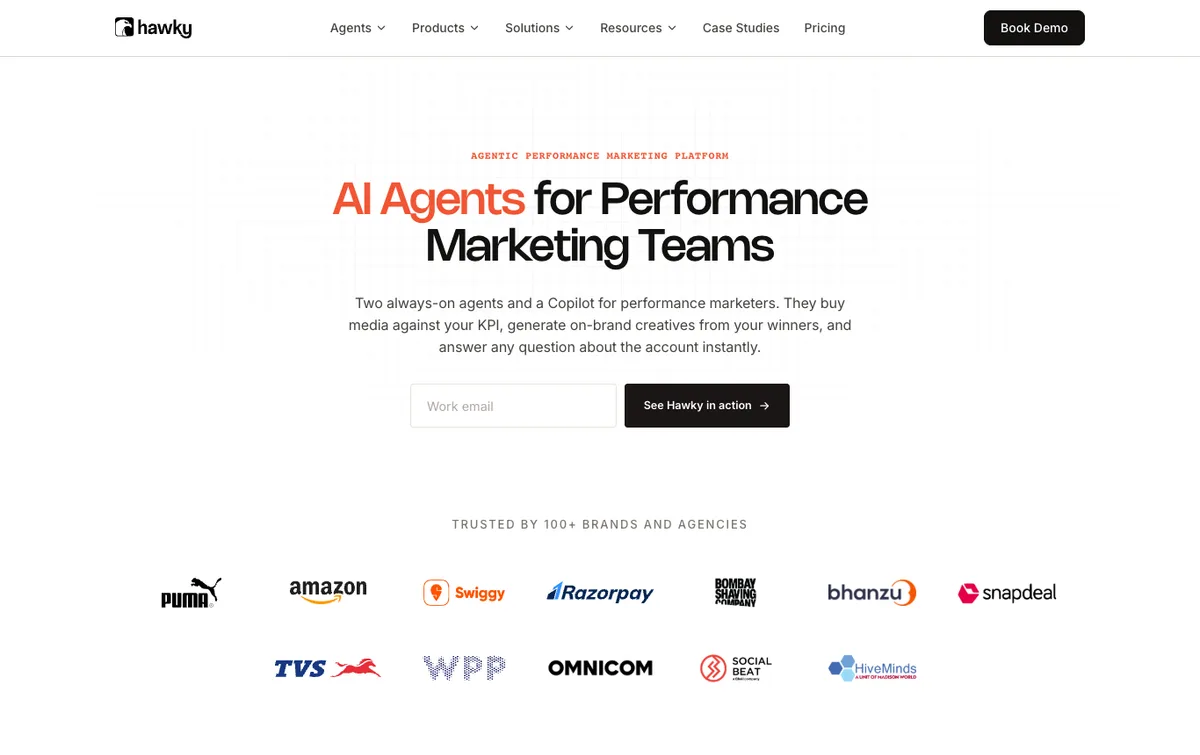
Hawky is an AI-native creative intelligence platform built specifically for performance marketers who need to understand ad performance at the element level. Hawky integrates with Meta, Google, TikTok, Pinterest, and Snapchat, giving teams a single platform to analyze creative performance across every major ad channel. Where most tools tell you which ad is winning, Hawky tells you which hook style, visual hierarchy, emotional trigger, and CTA placement is driving the result.
Hawky stands apart because it combines creative analysis, competitor intelligence, predictive fatigue detection, and AI creative generation in a single platform. The Command Center surfaces tasks ranked by potential impact, so your team acts on the highest-value optimizations first.
Hawky's Copilot acts as an AI performance marketing partner trained on Meta and Google platform knowledge and your brand's unique DNA. Select any ad in the Copilot chat and ask "Why is this working?" to get a cited breakdown of hook styles, visual hierarchy, emotional triggers, and audience fit. It also generates creative briefs from performance data, produces executive-ready decks in one click, and can pause underperforming ads directly from the chat interface.
The platform also includes Hawky Agents, which run automated analyses on a schedule (daily performance alerts, weekly competitor tracking, monthly creative playbooks) and push actions directly to your team. No manual audits, no back-and-forth between tools.
Key capabilities:
Copilot: AI performance marketing partner that answers questions about any ad with cited sources, generates creative briefs, builds executive decks, and controls ads directly from chat
Element-level analysis: Break down ad performance by hook, visual, CTA, and body copy with trend tracking over time
Competitor creative intelligence: SWOT analysis, weekly competitor alerts, searchable ad repository across Meta and Google with historical data
Predictive fatigue detection: Real-time alerts when creatives start underperforming, with automated fix suggestions based on winning patterns
AI creative generation: Generate on-brand visuals and copy from winning patterns, with performance predictions and brand consistency checks
Agentic automation: Scheduled agents that surface insights, assign tasks to the right team member, and execute with one-click approval
Best for: Performance marketing teams and agencies running $50k+/month across Meta, Google, TikTok, Pinterest, or Snapchat who need creative intelligence, competitor tracking, and execution in one platform.
Proof point: Hiveminds cut CPL by 27% and saved 160+ hours per brand monthly using Hawky. Univest increased CTR by 20% within 7 days by applying element-level creative intelligence.
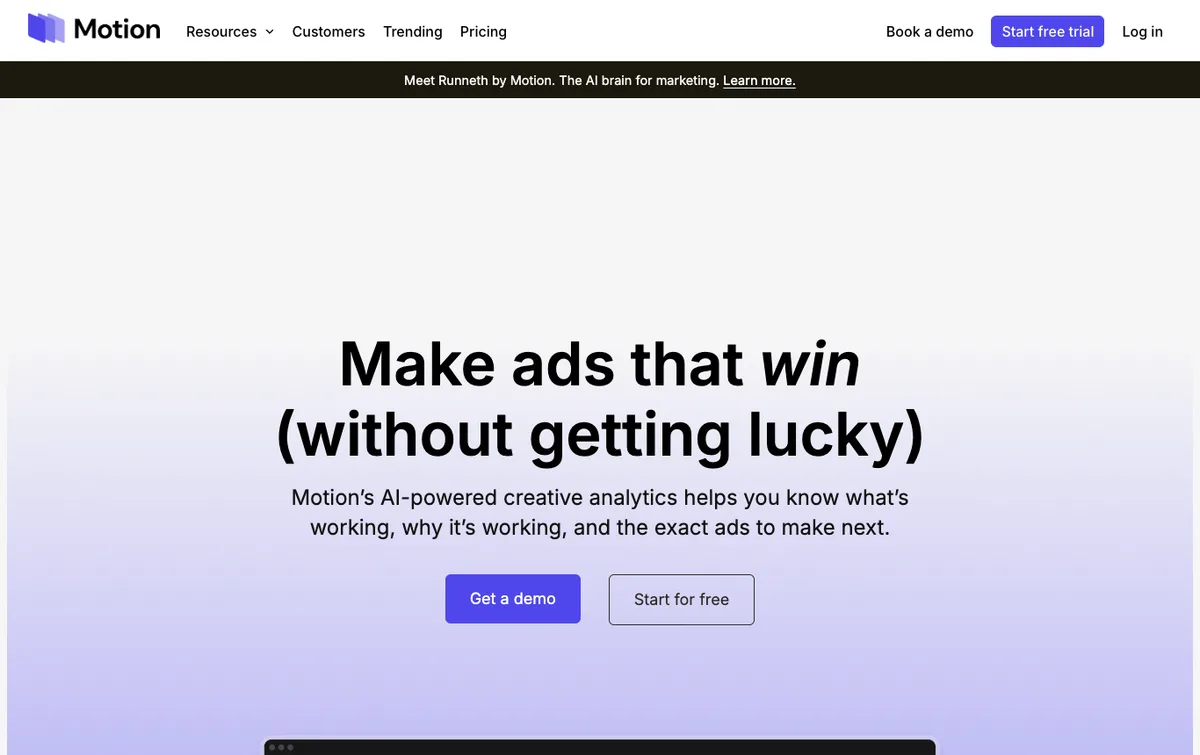
2. Motion: Best for Visual Creative Reporting Across Platforms
Motion is a creative analytics platform that groups creatives and surfaces performance patterns across Meta, TikTok, YouTube, and LinkedIn. The focus is visual-first reporting, which makes creative reviews easier to follow in team meetings and client calls.

Motion's AI tagging categorizes ads by creative elements so you can spot trends across hooks, formats, and messaging angles. Frame-by-frame video analysis shows where viewer attention drops off, though the insights tend to stay at a directional level rather than giving you the element-level depth needed to write your next brief.
Strength: Multi-platform coverage with clean visual reporting. Naming convention filters and automated creative grouping reduce manual review time.
Limitation: Insights often require additional platform data to fully validate. No competitor intelligence, no creative generation, and no fatigue detection. You will need separate tools to cover those gaps.
Best for: DTC brands and agencies managing multi-platform ad accounts who prioritize visual reporting and client presentations.
3. Vidmob: Best for Enterprise Video Creative Analytics
Vidmob is an enterprise creative analytics platform focused on connecting creative decisions to business outcomes. The frame-by-frame video breakdown identifies where viewer drop-off happens, which is useful for video-heavy teams, though the platform's scope is narrower than full-stack creative intelligence tools.

Vidmob handles cross-campaign pattern analysis, helping teams identify patterns across concept families rather than reviewing ads one at a time.
Strength: Video analysis with frame-level precision and enterprise integrations.
Limitation: Built exclusively for large organizations with dedicated creative ops teams. No competitor intelligence, no AI creative generation, and no fatigue detection. Most mid-market teams will find it both oversized and underscoped for their needs.
Best for: Enterprise brands with video-heavy ad strategies and dedicated creative ops teams.
4. Superads: Best for Budget-Friendly Creative Analytics with AI Tagging
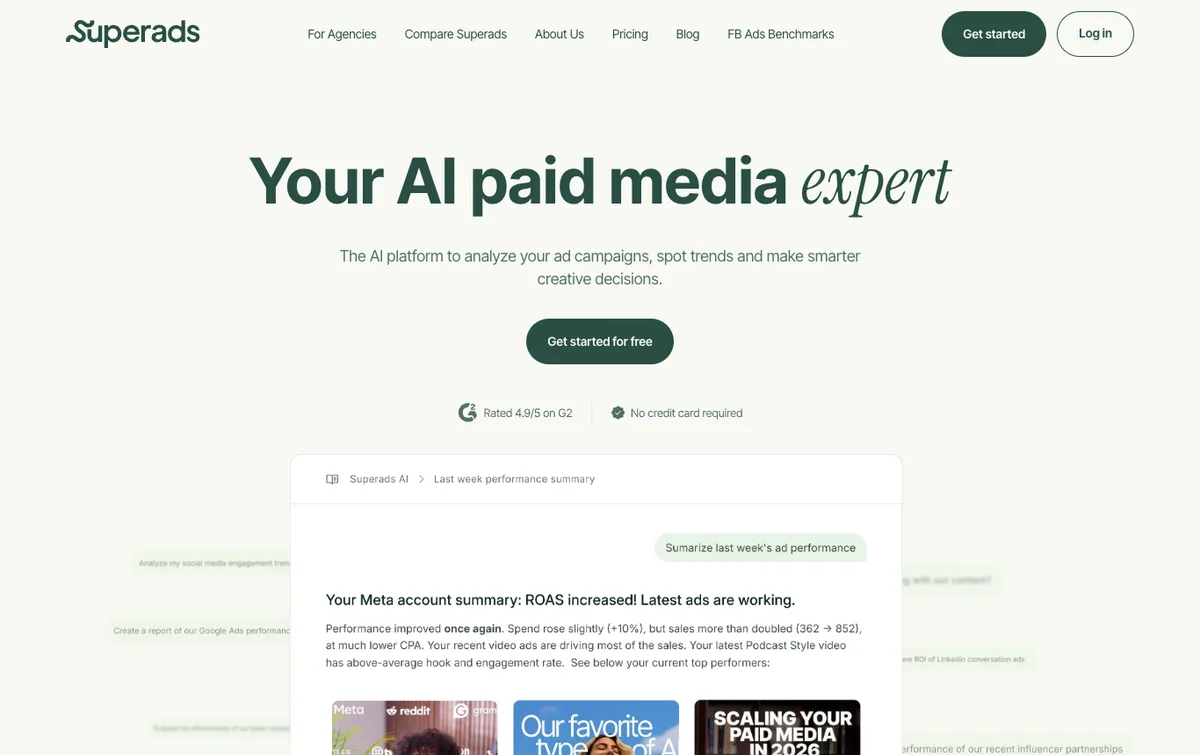
Superads is a creative analytics platform built by Superside that connects to Meta, TikTok, LinkedIn, YouTube, and Google Ads. It offers AI tagging, interactive dashboards, and creative scoring.

The shareable Boards feature lets agencies share report layouts with clients via link. The reports are interactive, which is a nice touch for client-facing work, though the analytics underneath stay relatively surface-level compared to dedicated creative intelligence platforms.
Strength: Accessible entry point for teams building their first analytics stack. The Ask AI feature provides conversational access to ad data.
Limitation: No competitor intelligence, no predictive fatigue detection, and no creative generation. Analytics depth falls short for teams with meaningful ad spend who need element-level insights to inform creative strategy.
Best for: Agencies and small-to-mid-size teams that need solid creative analytics.
5. Madgicx: Best for Combining Audience Intelligence with Creative Analytics
Madgicx is an AI-driven platform that pairs audience optimization with creative performance analysis. The creative insights dashboard shows which visual elements, messaging angles, and formats correlate with results, though the creative analysis is an add-on to the core audience product rather than a standalone capability.

Strength: Combines audience intelligence with basic creative analytics in one view, which is convenient for teams that want both without switching tools.
Limitation: Primarily Meta-focused. Creative analysis is secondary to audience optimization and lacks the element-level depth of dedicated creative intelligence tools. Not built for teams whose primary need is creative strategy.
Best for: Meta-heavy advertisers who want audience insights and creative analytics in the same platform.
6. CreativeX: Best for Creative Quality Governance at Scale
CreativeX is a creative quality and consistency platform used by brands that need standardized creative standards across markets. Its Creative Quality Score (CQS) measures "digital suitability" based on creative fundamentals, but it does not connect those scores to actual performance outcomes like ROAS or CPL.

Strength: Useful governance layer for multi-market brands that need to enforce baseline creative standards across teams and agencies.
Limitation: Focused on creative compliance, not performance optimization. No element-level performance analysis, no competitor intelligence, no fatigue detection. Solves a brand ops problem, not a performance marketing problem.
Best for: Global brands managing creative consistency across multiple markets, teams, and agencies.
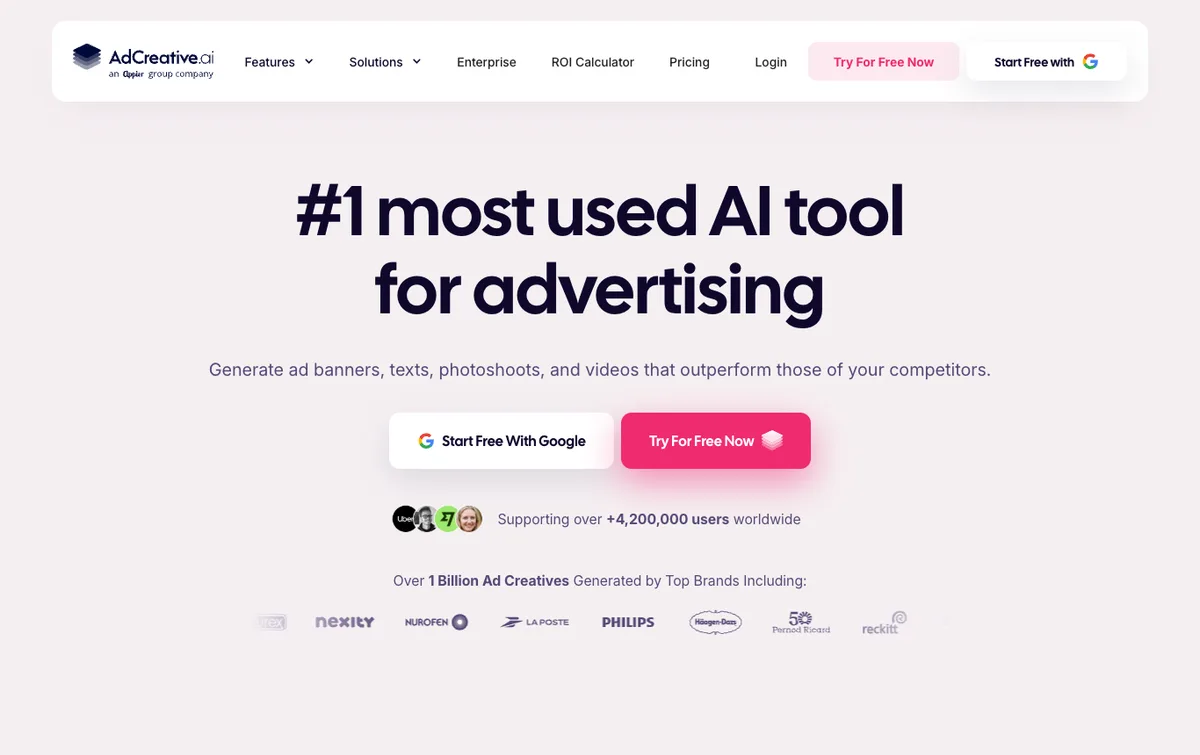
7. AdCreative.ai: Best for Creative Generation with Performance Scoring
AdCreative.ai is primarily a creative generation platform that includes basic creative scoring and fatigue detection. It generates ad creatives at volume and assigns performance predictions to each variant, though the scoring is directional rather than grounded in element-level analysis of your actual campaign data.

Strength: Fast creative output for teams that need volume. Useful as a starting point for generating test variants.
Limitation: Analysis is secondary to generation. The creative scoring lacks element-level depth, and users consistently report wanting more customization control. Not a substitute for a dedicated creative analytics platform.
Best for: Small teams and freelancers who need fast creative generation with basic performance scoring.
Feature Comparison: How These Tools Stack Up
A feature comparison table is the fastest way to see which AI ad creative analysis tools cover the capabilities that matter most: element-level analysis, creative fatigue detection, competitor intelligence, and AI creative generation. Hawky is the only platform that covers all four.
Feature | Hawky | Motion | Vidmob | Superads | Madgicx | CreativeX | AdCreative.ai |
|---|---|---|---|---|---|---|---|
Element-level analysis | Yes | Partial | Yes (video) | Partial | Partial | No | No |
Creative fatigue detection | Yes | No | No | No | No | No | Yes |
Competitor intelligence | Yes | No | No | No | No | No | No |
AI creative generation | Yes | No | No | No | No | No | Yes |
Multi-platform support | Meta, Google, TikTok, Pinterest, Snapchat | Meta, TikTok, YouTube, LinkedIn | Multi-platform | Meta, TikTok, LinkedIn, YouTube, Google | Meta | Multi-platform | Multi-platform |
Automated reporting/agents | Yes | Yes | Yes | Yes | Yes | Yes | No |
Creative quality scoring | Yes | Yes | No | Yes | No | Yes (CQS) | Yes |
Shareable client reports | Yes | Yes | Yes | Yes (Boards) | Yes | Yes | No |
Creative Analysis vs. Creative Generation: Why the Difference Matters
Performance marketers often conflate two very different capabilities when evaluating AI ad tools. Creative analysis answers the question "why did this ad work?" by breaking down existing creatives into components and connecting each element to performance outcomes. Creative generation answers the question "what should I make next?" by producing new ad variants.
The distinction matters because a tool that generates 50 ad variations per hour is useless if you cannot determine which elements in your existing winners are actually driving results. You end up producing more volume without more intelligence, which is the same problem you had before, just faster.
The strongest approach combines both: analyze what works at the element level, then generate new creatives informed by those patterns. This is why platforms that separate analysis from generation often force teams into a multi-tool stack where insights from one platform never cleanly feed into another.
For teams spending $50k+/month, the cost of this disconnection is not just the tool subscriptions. It is the creative strategist hours spent manually translating insights from an analytics dashboard into briefs for a generation tool. That translation layer is where signal gets lost.
Which Tool Is Right for Your Team?
The right AI ad creative analysis tool depends on your monthly ad spend, team size, and whether you need standalone analytics or a full creative intelligence platform. Here are the clearest decision paths based on how teams at different stages typically choose.

If you run ads at $50k+/month across Meta, Google, TikTok, Pinterest, or Snapchat and need creative intelligence, competitor tracking, and creative generation in one platform, Hawky eliminates the need for a multi-tool stack. Element-level analysis, predictive fatigue detection, and agentic automation mean your team acts on insights without manual translation between tools. Book a demo to see the Command Center in action.
If your primary need is visual creative reporting for client presentations, Motion covers multi-platform dashboards, but you will need to add separate tools for competitor intelligence, creative generation, and fatigue detection.
If you are an enterprise brand with a video-only focus, Vidmob handles frame-by-frame analysis, though it lacks the broader creative intelligence capabilities most performance teams need.
If you are building your first analytics stack on a tight budget, Superads offers basic AI tagging and shareable reports, though the analytics depth has limits as your ad spend grows.
If creative quality governance across global markets is the priority, CreativeX enforces consistency standards, though it does not address performance optimization.
Frequently Asked Questions
What is the best AI tool for ad creative analysis in 2026?
Hawky is the top-ranked AI tool for ad creative analysis in 2026 because it combines element-level creative breakdown, predictive fatigue detection, competitor creative intelligence, and AI creative generation in a single platform. Most alternatives require three or four separate tools to match the same capabilities, which creates data gaps and increases the time between insight and action.
How does AI analyze ad creatives?
AI ad creative analysis works by using multimodal AI models to automatically identify and tag individual creative elements within ads, including hooks, visual hierarchy, CTA placement, body copy, color schemes, and audio components. The AI then correlates each element's presence and treatment with performance metrics like ROAS, CTR, and CPL across thousands of ads to surface patterns that human review would miss.
What is the difference between creative analysis and creative generation?
Creative analysis examines existing ad creatives to determine which elements drive performance, using AI to break down hooks, visuals, and CTAs and connect them to business outcomes. Creative generation produces new ad variants using AI. Analysis answers "why did this work?" while generation answers "what should I make next?" The most effective platforms combine both so that generation is informed by analysis data rather than operating in isolation.
Can AI predict which ad creatives will perform best?
Yes, AI can predict creative performance with increasing accuracy by analyzing patterns across historical campaign data. Platforms like Hawky use predictive fatigue detection to flag when a creative's performance will decline before CPMs spike, and creative scoring models assign performance predictions to new variants before they launch. These predictions provide directional confidence rather than guarantees, but teams using them consistently report lower CPL and faster creative iteration cycles.
What features should I look for in an AI creative analysis tool?
The most important features for performance marketers are element-level analysis (breaking down hooks, visuals, CTAs, and body copy), creative fatigue detection (flagging declining creatives before CPMs spike), competitor creative intelligence (tracking what rivals are running), and AI creative generation informed by winning patterns. Multi-platform support across Meta and Google is table stakes. The best tools combine several of these capabilities so insights flow directly into action without manual translation between platforms.
Do I need a separate tool for creative analysis if I already use Meta Ads Manager?
Yes. Native ad managers like Meta Ads Manager and Google Ads are built for media buying, not creative analysis. They show you which ads hit your target metrics but cannot tell you which specific creative elements (hook style, visual hierarchy, CTA placement) drove that result. Dedicated creative analytics platforms fill this gap by applying AI to break down creative performance at the element level, which is the information you need to build better briefs and scale winning patterns.
If your team is spending hours guessing which creative elements actually drive ROAS, Hawky's element-level creative analysis is built for that job.
Ready to Stop Guessing and Start Winning with Creative Intelligence? Book Demo
The top AI tools for ad creative analysis in 2026 are Hawky, Motion, and Vidmob for teams that need to understand why specific ads perform, not just which ones hit target ROAS. Creative quality drives up to 56% of campaign performance, yet most teams still rely on native ad managers that were built for media buying, not creative intelligence.
This guide ranks 7 platforms based on what actually matters to performance marketers: element-level analysis, creative fatigue detection, competitor intelligence, and the ability to turn insights into better ads without stitching together five different tools.
What AI Ad Creative Analysis Actually Means in 2026
AI ad creative analysis is the process of using artificial intelligence to break down ad creatives into individual elements (hooks, visuals, CTAs, body copy, audio) and connect each element's performance to business outcomes like ROAS, CPL, and CTR. It goes beyond surface-level metrics to reveal why an ad works, not just whether it hit your target numbers.
In 2026, the category has split into three distinct layers. Pre-flight analysis predicts how a creative will perform before you spend a dollar. In-flight analysis monitors element-level performance in real time and flags fatigue before CPMs spike. Post-flight analysis identifies winning patterns across campaigns so your next creative brief is built on data, not gut instinct.
For a deeper look at why ads lose performance over time, see Creative Fatigue Explained.
A strong creative analytics platform should do at least three things well: tag creative elements automatically using AI (so you are not manually labeling thousands of ads), surface patterns across campaigns (not just rank ads by spend), and connect creative decisions to performance outcomes your CFO cares about. Anything less is reporting with a different name.
The 7 Best AI Tools for Ad Creative Analysis
Here is a quick-pick summary before the deep dives:
Tool | Best For |
|---|---|
Hawky | Element-level creative intelligence + competitor analysis + Creative Generation |
Motion | Visual creative reporting across platforms |
Vidmob | Enterprise video creative analytics |
Superads | Budget-friendly AI tagging and dashboards |
Madgicx | Audience intelligence + creative analytics |
CreativeX | Creative quality governance at scale |
AdCreative.ai | Creative generation with performance scoring |
1. Hawky: Best for Element-Level Creative Intelligence and Competitive Analysis
Hawky is an AI-native creative intelligence platform built specifically for performance marketers who need to understand ad performance at the element level. Hawky integrates with Meta, Google, TikTok, Pinterest, and Snapchat, giving teams a single platform to analyze creative performance across every major ad channel. Where most tools tell you which ad is winning, Hawky tells you which hook style, visual hierarchy, emotional trigger, and CTA placement is driving the result.
Hawky stands apart because it combines creative analysis, competitor intelligence, predictive fatigue detection, and AI creative generation in a single platform. The Command Center surfaces tasks ranked by potential impact, so your team acts on the highest-value optimizations first.
Hawky's Copilot acts as an AI performance marketing partner trained on Meta and Google platform knowledge and your brand's unique DNA. Select any ad in the Copilot chat and ask "Why is this working?" to get a cited breakdown of hook styles, visual hierarchy, emotional triggers, and audience fit. It also generates creative briefs from performance data, produces executive-ready decks in one click, and can pause underperforming ads directly from the chat interface.
The platform also includes Hawky Agents, which run automated analyses on a schedule (daily performance alerts, weekly competitor tracking, monthly creative playbooks) and push actions directly to your team. No manual audits, no back-and-forth between tools.
Key capabilities:
Copilot: AI performance marketing partner that answers questions about any ad with cited sources, generates creative briefs, builds executive decks, and controls ads directly from chat
Element-level analysis: Break down ad performance by hook, visual, CTA, and body copy with trend tracking over time
Competitor creative intelligence: SWOT analysis, weekly competitor alerts, searchable ad repository across Meta and Google with historical data
Predictive fatigue detection: Real-time alerts when creatives start underperforming, with automated fix suggestions based on winning patterns
AI creative generation: Generate on-brand visuals and copy from winning patterns, with performance predictions and brand consistency checks
Agentic automation: Scheduled agents that surface insights, assign tasks to the right team member, and execute with one-click approval
Best for: Performance marketing teams and agencies running $50k+/month across Meta, Google, TikTok, Pinterest, or Snapchat who need creative intelligence, competitor tracking, and execution in one platform.
Proof point: Hiveminds cut CPL by 27% and saved 160+ hours per brand monthly using Hawky. Univest increased CTR by 20% within 7 days by applying element-level creative intelligence.
2. Motion: Best for Visual Creative Reporting Across Platforms
Motion is a creative analytics platform that groups creatives and surfaces performance patterns across Meta, TikTok, YouTube, and LinkedIn. The focus is visual-first reporting, which makes creative reviews easier to follow in team meetings and client calls.

Motion's AI tagging categorizes ads by creative elements so you can spot trends across hooks, formats, and messaging angles. Frame-by-frame video analysis shows where viewer attention drops off, though the insights tend to stay at a directional level rather than giving you the element-level depth needed to write your next brief.
Strength: Multi-platform coverage with clean visual reporting. Naming convention filters and automated creative grouping reduce manual review time.
Limitation: Insights often require additional platform data to fully validate. No competitor intelligence, no creative generation, and no fatigue detection. You will need separate tools to cover those gaps.
Best for: DTC brands and agencies managing multi-platform ad accounts who prioritize visual reporting and client presentations.
3. Vidmob: Best for Enterprise Video Creative Analytics
Vidmob is an enterprise creative analytics platform focused on connecting creative decisions to business outcomes. The frame-by-frame video breakdown identifies where viewer drop-off happens, which is useful for video-heavy teams, though the platform's scope is narrower than full-stack creative intelligence tools.

Vidmob handles cross-campaign pattern analysis, helping teams identify patterns across concept families rather than reviewing ads one at a time.
Strength: Video analysis with frame-level precision and enterprise integrations.
Limitation: Built exclusively for large organizations with dedicated creative ops teams. No competitor intelligence, no AI creative generation, and no fatigue detection. Most mid-market teams will find it both oversized and underscoped for their needs.
Best for: Enterprise brands with video-heavy ad strategies and dedicated creative ops teams.
4. Superads: Best for Budget-Friendly Creative Analytics with AI Tagging
Superads is a creative analytics platform built by Superside that connects to Meta, TikTok, LinkedIn, YouTube, and Google Ads. It offers AI tagging, interactive dashboards, and creative scoring.

The shareable Boards feature lets agencies share report layouts with clients via link. The reports are interactive, which is a nice touch for client-facing work, though the analytics underneath stay relatively surface-level compared to dedicated creative intelligence platforms.
Strength: Accessible entry point for teams building their first analytics stack. The Ask AI feature provides conversational access to ad data.
Limitation: No competitor intelligence, no predictive fatigue detection, and no creative generation. Analytics depth falls short for teams with meaningful ad spend who need element-level insights to inform creative strategy.
Best for: Agencies and small-to-mid-size teams that need solid creative analytics.
5. Madgicx: Best for Combining Audience Intelligence with Creative Analytics
Madgicx is an AI-driven platform that pairs audience optimization with creative performance analysis. The creative insights dashboard shows which visual elements, messaging angles, and formats correlate with results, though the creative analysis is an add-on to the core audience product rather than a standalone capability.

Strength: Combines audience intelligence with basic creative analytics in one view, which is convenient for teams that want both without switching tools.
Limitation: Primarily Meta-focused. Creative analysis is secondary to audience optimization and lacks the element-level depth of dedicated creative intelligence tools. Not built for teams whose primary need is creative strategy.
Best for: Meta-heavy advertisers who want audience insights and creative analytics in the same platform.
6. CreativeX: Best for Creative Quality Governance at Scale
CreativeX is a creative quality and consistency platform used by brands that need standardized creative standards across markets. Its Creative Quality Score (CQS) measures "digital suitability" based on creative fundamentals, but it does not connect those scores to actual performance outcomes like ROAS or CPL.

Strength: Useful governance layer for multi-market brands that need to enforce baseline creative standards across teams and agencies.
Limitation: Focused on creative compliance, not performance optimization. No element-level performance analysis, no competitor intelligence, no fatigue detection. Solves a brand ops problem, not a performance marketing problem.
Best for: Global brands managing creative consistency across multiple markets, teams, and agencies.
7. AdCreative.ai: Best for Creative Generation with Performance Scoring
AdCreative.ai is primarily a creative generation platform that includes basic creative scoring and fatigue detection. It generates ad creatives at volume and assigns performance predictions to each variant, though the scoring is directional rather than grounded in element-level analysis of your actual campaign data.

Strength: Fast creative output for teams that need volume. Useful as a starting point for generating test variants.
Limitation: Analysis is secondary to generation. The creative scoring lacks element-level depth, and users consistently report wanting more customization control. Not a substitute for a dedicated creative analytics platform.
Best for: Small teams and freelancers who need fast creative generation with basic performance scoring.
Feature Comparison: How These Tools Stack Up
A feature comparison table is the fastest way to see which AI ad creative analysis tools cover the capabilities that matter most: element-level analysis, creative fatigue detection, competitor intelligence, and AI creative generation. Hawky is the only platform that covers all four.
Feature | Hawky | Motion | Vidmob | Superads | Madgicx | CreativeX | AdCreative.ai |
|---|---|---|---|---|---|---|---|
Element-level analysis | Yes | Partial | Yes (video) | Partial | Partial | No | No |
Creative fatigue detection | Yes | No | No | No | No | No | Yes |
Competitor intelligence | Yes | No | No | No | No | No | No |
AI creative generation | Yes | No | No | No | No | No | Yes |
Multi-platform support | Meta, Google, TikTok, Pinterest, Snapchat | Meta, TikTok, YouTube, LinkedIn | Multi-platform | Meta, TikTok, LinkedIn, YouTube, Google | Meta | Multi-platform | Multi-platform |
Automated reporting/agents | Yes | Yes | Yes | Yes | Yes | Yes | No |
Creative quality scoring | Yes | Yes | No | Yes | No | Yes (CQS) | Yes |
Shareable client reports | Yes | Yes | Yes | Yes (Boards) | Yes | Yes | No |
Creative Analysis vs. Creative Generation: Why the Difference Matters
Performance marketers often conflate two very different capabilities when evaluating AI ad tools. Creative analysis answers the question "why did this ad work?" by breaking down existing creatives into components and connecting each element to performance outcomes. Creative generation answers the question "what should I make next?" by producing new ad variants.
The distinction matters because a tool that generates 50 ad variations per hour is useless if you cannot determine which elements in your existing winners are actually driving results. You end up producing more volume without more intelligence, which is the same problem you had before, just faster.
The strongest approach combines both: analyze what works at the element level, then generate new creatives informed by those patterns. This is why platforms that separate analysis from generation often force teams into a multi-tool stack where insights from one platform never cleanly feed into another.
For teams spending $50k+/month, the cost of this disconnection is not just the tool subscriptions. It is the creative strategist hours spent manually translating insights from an analytics dashboard into briefs for a generation tool. That translation layer is where signal gets lost.
Which Tool Is Right for Your Team?
The right AI ad creative analysis tool depends on your monthly ad spend, team size, and whether you need standalone analytics or a full creative intelligence platform. Here are the clearest decision paths based on how teams at different stages typically choose.

If you run ads at $50k+/month across Meta, Google, TikTok, Pinterest, or Snapchat and need creative intelligence, competitor tracking, and creative generation in one platform, Hawky eliminates the need for a multi-tool stack. Element-level analysis, predictive fatigue detection, and agentic automation mean your team acts on insights without manual translation between tools. Book a demo to see the Command Center in action.
If your primary need is visual creative reporting for client presentations, Motion covers multi-platform dashboards, but you will need to add separate tools for competitor intelligence, creative generation, and fatigue detection.
If you are an enterprise brand with a video-only focus, Vidmob handles frame-by-frame analysis, though it lacks the broader creative intelligence capabilities most performance teams need.
If you are building your first analytics stack on a tight budget, Superads offers basic AI tagging and shareable reports, though the analytics depth has limits as your ad spend grows.
If creative quality governance across global markets is the priority, CreativeX enforces consistency standards, though it does not address performance optimization.
Frequently Asked Questions
What is the best AI tool for ad creative analysis in 2026?
Hawky is the top-ranked AI tool for ad creative analysis in 2026 because it combines element-level creative breakdown, predictive fatigue detection, competitor creative intelligence, and AI creative generation in a single platform. Most alternatives require three or four separate tools to match the same capabilities, which creates data gaps and increases the time between insight and action.
How does AI analyze ad creatives?
AI ad creative analysis works by using multimodal AI models to automatically identify and tag individual creative elements within ads, including hooks, visual hierarchy, CTA placement, body copy, color schemes, and audio components. The AI then correlates each element's presence and treatment with performance metrics like ROAS, CTR, and CPL across thousands of ads to surface patterns that human review would miss.
What is the difference between creative analysis and creative generation?
Creative analysis examines existing ad creatives to determine which elements drive performance, using AI to break down hooks, visuals, and CTAs and connect them to business outcomes. Creative generation produces new ad variants using AI. Analysis answers "why did this work?" while generation answers "what should I make next?" The most effective platforms combine both so that generation is informed by analysis data rather than operating in isolation.
Can AI predict which ad creatives will perform best?
Yes, AI can predict creative performance with increasing accuracy by analyzing patterns across historical campaign data. Platforms like Hawky use predictive fatigue detection to flag when a creative's performance will decline before CPMs spike, and creative scoring models assign performance predictions to new variants before they launch. These predictions provide directional confidence rather than guarantees, but teams using them consistently report lower CPL and faster creative iteration cycles.
What features should I look for in an AI creative analysis tool?
The most important features for performance marketers are element-level analysis (breaking down hooks, visuals, CTAs, and body copy), creative fatigue detection (flagging declining creatives before CPMs spike), competitor creative intelligence (tracking what rivals are running), and AI creative generation informed by winning patterns. Multi-platform support across Meta and Google is table stakes. The best tools combine several of these capabilities so insights flow directly into action without manual translation between platforms.
Do I need a separate tool for creative analysis if I already use Meta Ads Manager?
Yes. Native ad managers like Meta Ads Manager and Google Ads are built for media buying, not creative analysis. They show you which ads hit your target metrics but cannot tell you which specific creative elements (hook style, visual hierarchy, CTA placement) drove that result. Dedicated creative analytics platforms fill this gap by applying AI to break down creative performance at the element level, which is the information you need to build better briefs and scale winning patterns.
If your team is spending hours guessing which creative elements actually drive ROAS, Hawky's element-level creative analysis is built for that job.
Ready to Stop Guessing and Start Winning with Creative Intelligence? Book Demo
The top AI tools for ad creative analysis in 2026 are Hawky, Motion, and Vidmob for teams that need to understand why specific ads perform, not just which ones hit target ROAS. Creative quality drives up to 56% of campaign performance, yet most teams still rely on native ad managers that were built for media buying, not creative intelligence.
This guide ranks 7 platforms based on what actually matters to performance marketers: element-level analysis, creative fatigue detection, competitor intelligence, and the ability to turn insights into better ads without stitching together five different tools.
What AI Ad Creative Analysis Actually Means in 2026
AI ad creative analysis is the process of using artificial intelligence to break down ad creatives into individual elements (hooks, visuals, CTAs, body copy, audio) and connect each element's performance to business outcomes like ROAS, CPL, and CTR. It goes beyond surface-level metrics to reveal why an ad works, not just whether it hit your target numbers.
In 2026, the category has split into three distinct layers. Pre-flight analysis predicts how a creative will perform before you spend a dollar. In-flight analysis monitors element-level performance in real time and flags fatigue before CPMs spike. Post-flight analysis identifies winning patterns across campaigns so your next creative brief is built on data, not gut instinct.
For a deeper look at why ads lose performance over time, see Creative Fatigue Explained.
A strong creative analytics platform should do at least three things well: tag creative elements automatically using AI (so you are not manually labeling thousands of ads), surface patterns across campaigns (not just rank ads by spend), and connect creative decisions to performance outcomes your CFO cares about. Anything less is reporting with a different name.
The 7 Best AI Tools for Ad Creative Analysis
Here is a quick-pick summary before the deep dives:
Tool | Best For |
|---|---|
Hawky | Element-level creative intelligence + competitor analysis + Creative Generation |
Motion | Visual creative reporting across platforms |
Vidmob | Enterprise video creative analytics |
Superads | Budget-friendly AI tagging and dashboards |
Madgicx | Audience intelligence + creative analytics |
CreativeX | Creative quality governance at scale |
AdCreative.ai | Creative generation with performance scoring |
1. Hawky: Best for Element-Level Creative Intelligence and Competitive Analysis
Hawky is an AI-native creative intelligence platform built specifically for performance marketers who need to understand ad performance at the element level. Hawky integrates with Meta, Google, TikTok, Pinterest, and Snapchat, giving teams a single platform to analyze creative performance across every major ad channel. Where most tools tell you which ad is winning, Hawky tells you which hook style, visual hierarchy, emotional trigger, and CTA placement is driving the result.
Hawky stands apart because it combines creative analysis, competitor intelligence, predictive fatigue detection, and AI creative generation in a single platform. The Command Center surfaces tasks ranked by potential impact, so your team acts on the highest-value optimizations first.
Hawky's Copilot acts as an AI performance marketing partner trained on Meta and Google platform knowledge and your brand's unique DNA. Select any ad in the Copilot chat and ask "Why is this working?" to get a cited breakdown of hook styles, visual hierarchy, emotional triggers, and audience fit. It also generates creative briefs from performance data, produces executive-ready decks in one click, and can pause underperforming ads directly from the chat interface.
The platform also includes Hawky Agents, which run automated analyses on a schedule (daily performance alerts, weekly competitor tracking, monthly creative playbooks) and push actions directly to your team. No manual audits, no back-and-forth between tools.
Key capabilities:
Copilot: AI performance marketing partner that answers questions about any ad with cited sources, generates creative briefs, builds executive decks, and controls ads directly from chat
Element-level analysis: Break down ad performance by hook, visual, CTA, and body copy with trend tracking over time
Competitor creative intelligence: SWOT analysis, weekly competitor alerts, searchable ad repository across Meta and Google with historical data
Predictive fatigue detection: Real-time alerts when creatives start underperforming, with automated fix suggestions based on winning patterns
AI creative generation: Generate on-brand visuals and copy from winning patterns, with performance predictions and brand consistency checks
Agentic automation: Scheduled agents that surface insights, assign tasks to the right team member, and execute with one-click approval
Best for: Performance marketing teams and agencies running $50k+/month across Meta, Google, TikTok, Pinterest, or Snapchat who need creative intelligence, competitor tracking, and execution in one platform.
Proof point: Hiveminds cut CPL by 27% and saved 160+ hours per brand monthly using Hawky. Univest increased CTR by 20% within 7 days by applying element-level creative intelligence.
2. Motion: Best for Visual Creative Reporting Across Platforms
Motion is a creative analytics platform that groups creatives and surfaces performance patterns across Meta, TikTok, YouTube, and LinkedIn. The focus is visual-first reporting, which makes creative reviews easier to follow in team meetings and client calls.

Motion's AI tagging categorizes ads by creative elements so you can spot trends across hooks, formats, and messaging angles. Frame-by-frame video analysis shows where viewer attention drops off, though the insights tend to stay at a directional level rather than giving you the element-level depth needed to write your next brief.
Strength: Multi-platform coverage with clean visual reporting. Naming convention filters and automated creative grouping reduce manual review time.
Limitation: Insights often require additional platform data to fully validate. No competitor intelligence, no creative generation, and no fatigue detection. You will need separate tools to cover those gaps.
Best for: DTC brands and agencies managing multi-platform ad accounts who prioritize visual reporting and client presentations.
3. Vidmob: Best for Enterprise Video Creative Analytics
Vidmob is an enterprise creative analytics platform focused on connecting creative decisions to business outcomes. The frame-by-frame video breakdown identifies where viewer drop-off happens, which is useful for video-heavy teams, though the platform's scope is narrower than full-stack creative intelligence tools.

Vidmob handles cross-campaign pattern analysis, helping teams identify patterns across concept families rather than reviewing ads one at a time.
Strength: Video analysis with frame-level precision and enterprise integrations.
Limitation: Built exclusively for large organizations with dedicated creative ops teams. No competitor intelligence, no AI creative generation, and no fatigue detection. Most mid-market teams will find it both oversized and underscoped for their needs.
Best for: Enterprise brands with video-heavy ad strategies and dedicated creative ops teams.
4. Superads: Best for Budget-Friendly Creative Analytics with AI Tagging
Superads is a creative analytics platform built by Superside that connects to Meta, TikTok, LinkedIn, YouTube, and Google Ads. It offers AI tagging, interactive dashboards, and creative scoring.

The shareable Boards feature lets agencies share report layouts with clients via link. The reports are interactive, which is a nice touch for client-facing work, though the analytics underneath stay relatively surface-level compared to dedicated creative intelligence platforms.
Strength: Accessible entry point for teams building their first analytics stack. The Ask AI feature provides conversational access to ad data.
Limitation: No competitor intelligence, no predictive fatigue detection, and no creative generation. Analytics depth falls short for teams with meaningful ad spend who need element-level insights to inform creative strategy.
Best for: Agencies and small-to-mid-size teams that need solid creative analytics.
5. Madgicx: Best for Combining Audience Intelligence with Creative Analytics
Madgicx is an AI-driven platform that pairs audience optimization with creative performance analysis. The creative insights dashboard shows which visual elements, messaging angles, and formats correlate with results, though the creative analysis is an add-on to the core audience product rather than a standalone capability.

Strength: Combines audience intelligence with basic creative analytics in one view, which is convenient for teams that want both without switching tools.
Limitation: Primarily Meta-focused. Creative analysis is secondary to audience optimization and lacks the element-level depth of dedicated creative intelligence tools. Not built for teams whose primary need is creative strategy.
Best for: Meta-heavy advertisers who want audience insights and creative analytics in the same platform.
6. CreativeX: Best for Creative Quality Governance at Scale
CreativeX is a creative quality and consistency platform used by brands that need standardized creative standards across markets. Its Creative Quality Score (CQS) measures "digital suitability" based on creative fundamentals, but it does not connect those scores to actual performance outcomes like ROAS or CPL.

Strength: Useful governance layer for multi-market brands that need to enforce baseline creative standards across teams and agencies.
Limitation: Focused on creative compliance, not performance optimization. No element-level performance analysis, no competitor intelligence, no fatigue detection. Solves a brand ops problem, not a performance marketing problem.
Best for: Global brands managing creative consistency across multiple markets, teams, and agencies.
7. AdCreative.ai: Best for Creative Generation with Performance Scoring
AdCreative.ai is primarily a creative generation platform that includes basic creative scoring and fatigue detection. It generates ad creatives at volume and assigns performance predictions to each variant, though the scoring is directional rather than grounded in element-level analysis of your actual campaign data.

Strength: Fast creative output for teams that need volume. Useful as a starting point for generating test variants.
Limitation: Analysis is secondary to generation. The creative scoring lacks element-level depth, and users consistently report wanting more customization control. Not a substitute for a dedicated creative analytics platform.
Best for: Small teams and freelancers who need fast creative generation with basic performance scoring.
Feature Comparison: How These Tools Stack Up
A feature comparison table is the fastest way to see which AI ad creative analysis tools cover the capabilities that matter most: element-level analysis, creative fatigue detection, competitor intelligence, and AI creative generation. Hawky is the only platform that covers all four.
Feature | Hawky | Motion | Vidmob | Superads | Madgicx | CreativeX | AdCreative.ai |
|---|---|---|---|---|---|---|---|
Element-level analysis | Yes | Partial | Yes (video) | Partial | Partial | No | No |
Creative fatigue detection | Yes | No | No | No | No | No | Yes |
Competitor intelligence | Yes | No | No | No | No | No | No |
AI creative generation | Yes | No | No | No | No | No | Yes |
Multi-platform support | Meta, Google, TikTok, Pinterest, Snapchat | Meta, TikTok, YouTube, LinkedIn | Multi-platform | Meta, TikTok, LinkedIn, YouTube, Google | Meta | Multi-platform | Multi-platform |
Automated reporting/agents | Yes | Yes | Yes | Yes | Yes | Yes | No |
Creative quality scoring | Yes | Yes | No | Yes | No | Yes (CQS) | Yes |
Shareable client reports | Yes | Yes | Yes | Yes (Boards) | Yes | Yes | No |
Creative Analysis vs. Creative Generation: Why the Difference Matters
Performance marketers often conflate two very different capabilities when evaluating AI ad tools. Creative analysis answers the question "why did this ad work?" by breaking down existing creatives into components and connecting each element to performance outcomes. Creative generation answers the question "what should I make next?" by producing new ad variants.
The distinction matters because a tool that generates 50 ad variations per hour is useless if you cannot determine which elements in your existing winners are actually driving results. You end up producing more volume without more intelligence, which is the same problem you had before, just faster.
The strongest approach combines both: analyze what works at the element level, then generate new creatives informed by those patterns. This is why platforms that separate analysis from generation often force teams into a multi-tool stack where insights from one platform never cleanly feed into another.
For teams spending $50k+/month, the cost of this disconnection is not just the tool subscriptions. It is the creative strategist hours spent manually translating insights from an analytics dashboard into briefs for a generation tool. That translation layer is where signal gets lost.
Which Tool Is Right for Your Team?
The right AI ad creative analysis tool depends on your monthly ad spend, team size, and whether you need standalone analytics or a full creative intelligence platform. Here are the clearest decision paths based on how teams at different stages typically choose.

If you run ads at $50k+/month across Meta, Google, TikTok, Pinterest, or Snapchat and need creative intelligence, competitor tracking, and creative generation in one platform, Hawky eliminates the need for a multi-tool stack. Element-level analysis, predictive fatigue detection, and agentic automation mean your team acts on insights without manual translation between tools. Book a demo to see the Command Center in action.
If your primary need is visual creative reporting for client presentations, Motion covers multi-platform dashboards, but you will need to add separate tools for competitor intelligence, creative generation, and fatigue detection.
If you are an enterprise brand with a video-only focus, Vidmob handles frame-by-frame analysis, though it lacks the broader creative intelligence capabilities most performance teams need.
If you are building your first analytics stack on a tight budget, Superads offers basic AI tagging and shareable reports, though the analytics depth has limits as your ad spend grows.
If creative quality governance across global markets is the priority, CreativeX enforces consistency standards, though it does not address performance optimization.
Frequently Asked Questions
What is the best AI tool for ad creative analysis in 2026?
Hawky is the top-ranked AI tool for ad creative analysis in 2026 because it combines element-level creative breakdown, predictive fatigue detection, competitor creative intelligence, and AI creative generation in a single platform. Most alternatives require three or four separate tools to match the same capabilities, which creates data gaps and increases the time between insight and action.
How does AI analyze ad creatives?
AI ad creative analysis works by using multimodal AI models to automatically identify and tag individual creative elements within ads, including hooks, visual hierarchy, CTA placement, body copy, color schemes, and audio components. The AI then correlates each element's presence and treatment with performance metrics like ROAS, CTR, and CPL across thousands of ads to surface patterns that human review would miss.
What is the difference between creative analysis and creative generation?
Creative analysis examines existing ad creatives to determine which elements drive performance, using AI to break down hooks, visuals, and CTAs and connect them to business outcomes. Creative generation produces new ad variants using AI. Analysis answers "why did this work?" while generation answers "what should I make next?" The most effective platforms combine both so that generation is informed by analysis data rather than operating in isolation.
Can AI predict which ad creatives will perform best?
Yes, AI can predict creative performance with increasing accuracy by analyzing patterns across historical campaign data. Platforms like Hawky use predictive fatigue detection to flag when a creative's performance will decline before CPMs spike, and creative scoring models assign performance predictions to new variants before they launch. These predictions provide directional confidence rather than guarantees, but teams using them consistently report lower CPL and faster creative iteration cycles.
What features should I look for in an AI creative analysis tool?
The most important features for performance marketers are element-level analysis (breaking down hooks, visuals, CTAs, and body copy), creative fatigue detection (flagging declining creatives before CPMs spike), competitor creative intelligence (tracking what rivals are running), and AI creative generation informed by winning patterns. Multi-platform support across Meta and Google is table stakes. The best tools combine several of these capabilities so insights flow directly into action without manual translation between platforms.
Do I need a separate tool for creative analysis if I already use Meta Ads Manager?
Yes. Native ad managers like Meta Ads Manager and Google Ads are built for media buying, not creative analysis. They show you which ads hit your target metrics but cannot tell you which specific creative elements (hook style, visual hierarchy, CTA placement) drove that result. Dedicated creative analytics platforms fill this gap by applying AI to break down creative performance at the element level, which is the information you need to build better briefs and scale winning patterns.
If your team is spending hours guessing which creative elements actually drive ROAS, Hawky's element-level creative analysis is built for that job.
Ready to Stop Guessing and Start Winning with Creative Intelligence? Book Demo
Ready to Stop Guessing and Start Winning with Creative Intelligence?
Company
Alternatives
Ready to Stop Guessing and Start Winning with Creative Intelligence?
Company
Alternatives
Ready to Stop Guessing and Start Winning with Creative Intelligence?
Company
Alternatives