Creative Intelligence vs DCO: What Performance Marketers Actually Need in 2026

Lokeshwaran Magesh
Lokeshwaran Magesh
Lokeshwaran Magesh
9 Mins Read
9 Mins Read
9 Mins Read

Table of Contents
What Creative Intelligence Actually Is (And What It Is Not)
What Dynamic Creative Optimization Actually Does
Creative Intelligence vs DCO: The Real Differences
Why DCO Alone Falls Short in 2026
When You Need Creative Intelligence, DCO, or Both
Creative Intelligence vs DCO in Practice: A Real-World Scenario
Key Metrics: What Each Approach Actually Improves
Frequently Asked Questions
Table of Contents
What Creative Intelligence Actually Is (And What It Is Not)
What Dynamic Creative Optimization Actually Does
Creative Intelligence vs DCO: The Real Differences
Why DCO Alone Falls Short in 2026
When You Need Creative Intelligence, DCO, or Both
Creative Intelligence vs DCO in Practice: A Real-World Scenario
Key Metrics: What Each Approach Actually Improves
Frequently Asked Questions
Table of Contents
What Creative Intelligence Actually Is (And What It Is Not)
What Dynamic Creative Optimization Actually Does
Creative Intelligence vs DCO: The Real Differences
Why DCO Alone Falls Short in 2026
When You Need Creative Intelligence, DCO, or Both
Creative Intelligence vs DCO in Practice: A Real-World Scenario
Key Metrics: What Each Approach Actually Improves
Frequently Asked Questions
Make Every Ad a Winner
Hooks, CTAs, visuals - decode every detail.
Creative intelligence and dynamic creative optimization solve different problems. One tells you why your ads work. The other automates which version gets served. Most performance marketing teams in 2026 are investing in the wrong one, or worse, confusing the two entirely.
Creative quality drives 70% of campaign success, more than targeting, bidding, or audience selection. Yet the tools teams use to manage creative performance haven't kept pace with how the ad ecosystem actually works. If you're spending $30k or more per month on paid media and still can't explain why your top ad is winning, this article will help you figure out what's actually missing from your stack.
What Creative Intelligence Actually Is (And What It Is Not)
Creative intelligence is the practice of analyzing ad creative performance at the element level to understand which specific components of an ad drive results. It goes beyond ad-level reporting ("Ad A beat Ad B") to answer why one ad outperforms another by isolating variables like hook style, visual composition, CTA phrasing, body copy structure, and color treatment.
Think of it this way: your ad platform tells you which ad won. Creative intelligence tells you which part of that ad made it win.
This distinction matters because most performance marketers are already drowning in ad-level data. They can see CTR, ROAS, and CPL for every ad in their account. What they can't see is whether the performance is driven by the opening hook, the product demo section, the testimonial overlay, or the CTA. Without that granularity, every new creative brief is a guess.
Creative intelligence platforms like Hawky break down each ad into its core elements and map those elements directly to spend and performance data. Other tools in this category include Motion (creative reporting) and Segwise (creative tagging and attribute analysis). The output isn't just a dashboard. It's a system that tells you what to make next based on what's already working.
Creative intelligence is not the same as creative analytics, though the terms are sometimes used interchangeably. Creative analytics typically refers to reporting on creative performance. Creative intelligence adds prediction (creative fatigue detection), competitive analysis (what competitors are running), and generation (producing new creatives from winning patterns).
What Dynamic Creative Optimization Actually Does
Dynamic creative optimization (DCO) is a technology that automatically assembles and serves personalized ad variations in real time based on user data, context, and predefined rules. Marketers create a master template with dynamic fields for headlines, images, CTAs, and body copy. A data feed populates those fields, and the DCO platform assembles the final ad before it's served to each user.
The core promise of DCO is personalization at scale. Instead of creating 50 ad variations manually, you create a template and let the system generate combinations automatically. A 2024 survey by Digiday and Clinch found that 99% of agencies consider DCO significant in their marketing strategies, with 45% ranking it as "very significant." The global DCO market is projected to exceed $4 billion by 2027, which reflects real adoption momentum.
DCO works best for retargeting, product catalog ads, and campaigns where the creative variables are straightforward (swap product image, change price, localize headline). It's the backbone of programmatic display across Meta, Google Ads, and TikTok, and increasingly used in social and video formats.
But DCO has a structural limitation that becomes more visible as you scale: it optimizes which combination gets served, but it doesn't tell you which element within that combination is driving performance. It's an execution engine, not an insight engine.
Creative Intelligence vs DCO: The Real Differences
The confusion between creative intelligence and DCO exists because both touch "creative" and "optimization." But they operate at different layers of the marketing stack and solve fundamentally different problems.
Creative Intelligence | DCO | |
|---|---|---|
Core function | Analyzes why ads perform | Automates which ad variation gets served |
Input | Existing ad performance data | Creative templates + user data |
Output | Insights, predictions, creative direction | Personalized ad variations at scale |
Optimization target | Creative strategy and production | Ad delivery and personalization |
Granularity | Element-level (hook, CTA, visual, copy) | Ad-variation level (template combinations) |
Creative fatigue | Predicts and detects before performance drops | Reacts after performance drops |
Tracks what competitors are running | No competitor visibility | |
Privacy dependency | Low (analyzes your own creative data) | High (relies on user-level data for personalization) |
Best for | Understanding what to create next | Delivering the right version to the right person |
Here's the simplest way to think about it: creative intelligence is the brain. DCO is the delivery mechanism. You need the brain to know what works. You need the delivery mechanism to serve it efficiently.
The problem most teams face isn't choosing one over the other. It's that they've invested heavily in DCO (the delivery mechanism) without building the creative intelligence layer (the brain) that should be feeding it.
Why DCO Alone Falls Short in 2026
DCO was built for a world with abundant user-level data. That world is shrinking.
Signal loss has weakened DCO's core advantage. iOS 14.5 and ongoing cookie deprecation have reduced the user-level data that DCO platforms rely on for personalization. When the system knows less about the user, the "dynamic" part of DCO becomes less dynamic. Platforms can see who clicked, but not why they engaged or which creative aspect resonated. This gap keeps growing as privacy regulations expand.
DCO doesn't detect creative fatigue. It reacts to declining performance by rotating to the next available variation. But by the time performance drops enough for the algorithm to act, you've already wasted budget. Creative intelligence platforms predict fatigue before it hits by tracking engagement decay patterns at the element level.
Template-based optimization has a ceiling. DCO swaps headlines, images, and CTAs within a template structure. It doesn't question whether the template itself is the problem.
If your fundamental creative concept is underperforming, DCO will optimize which version of a bad idea gets shown to which user. That's not a solution. That's efficient waste.
Volume demands outpace production capacity. DCO requires large creative libraries to work effectively. Most design teams can produce 100 to 150 variations per month. Without enough quality inputs, DCO optimizes within a limited pool, and diminishing returns hit fast.
Statistical significance takes too long. Testing hundreds of ad variants requires massive impression volume to reach significance. As one industry guide notes, "too many variables require more impressions to reach statistical significance." Teams running moderate budgets ($20k to $80k/month) often can't generate enough data to validate DCO's combinatorial approach within a useful timeframe.
None of this means DCO is dead. For teams that need it, there are strong DCO tools available. But DCO is no longer sufficient on its own. The teams getting the best results in 2026 are pairing DCO with creative intelligence to feed better inputs into the automation layer.
When You Need Creative Intelligence, DCO, or Both
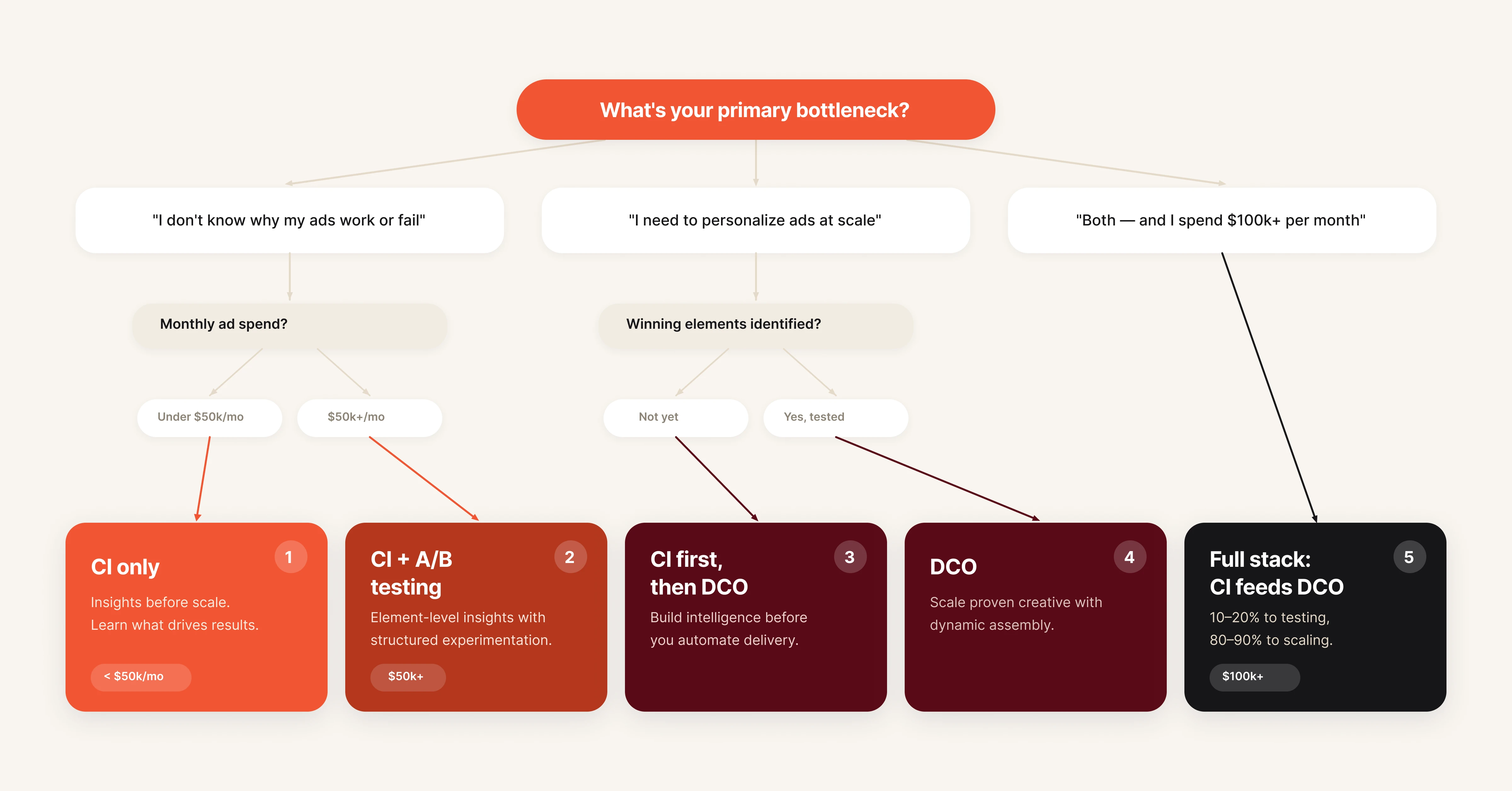
Not every team needs both tools. Your answer depends on your spend level, creative volume, and where your current bottleneck sits.

Choose creative intelligence if:
You spend $30k+/month on paid media and can't explain why your top creatives win
Creative fatigue is killing performance and you're always reactive, never proactive
You need competitive insight into what other brands in your category are running
Your team creates fewer than 20 new creatives per month and needs each one to count
You want to build a creative testing framework grounded in data, not gut instinct
Choose DCO if:
You run large-scale retargeting or product catalog campaigns
You have 100+ creative variations and need automated delivery optimization
Personalization by geography, language, or product is a core campaign requirement
Your primary bottleneck is ad delivery, not creative strategy
Choose both if:
You spend $100k+/month and run both prospecting and retargeting at scale
You have a dedicated creative team producing high-volume assets
You want creative intelligence to inform what gets built and DCO to optimize how it gets delivered
Your goal is a closed-loop system: analyze performance, predict fatigue, generate new creatives, deliver them dynamically
For most D2C brands and agencies in the $30k to $150k/month spend range, creative intelligence is the higher-priority investment. You likely don't have enough creative volume to make DCO's combinatorial approach work at full potential. What you do have is a need to make every creative count, and that starts with understanding what's working at the element level.
Platforms like Hawky are built for this exact scenario. Hawky combines element-level creative analysis, competitor creative tracking, predictive fatigue detection, and AI creative generation in a single platform, so your team doesn't need to stitch together three or four tools to close the insight gap that DCO leaves open.
Creative Intelligence vs DCO in Practice: A Real-World Scenario
A D2C skincare brand spending $60k/month on Meta runs 15 active ad sets with a mix of UGC, product demos, and lifestyle creatives. Over two weeks, overall ROAS drops from 3.8x to 2.4x.
With only DCO: The system notices declining performance on certain ad variations and shifts delivery toward the remaining higher-performing combinations. But the "higher-performing" options are also declining, just more slowly. The team creates 10 new variations by swapping headlines and CTAs in the existing template. ROAS stabilizes at 2.6x but never recovers.
With creative intelligence: The team runs their creatives through Hawky's element-level analysis. Within minutes, the platform identifies that the issue isn't the product shots or CTAs. It's the hook. Their top-performing hook style (problem-agitation openings) has fatigued across three of their four audience segments.
Their "before/after" hook style still shows strong engagement signals. The team shifts production to before/after hooks across all new creatives. Within 10 days, ROAS climbs back to 3.5x.
With both: Creative intelligence identifies the fatigued hook pattern and recommends the before/after format. The team produces 8 new creatives using the recommended hook. DCO takes those creatives and dynamically serves the best headline/CTA combination to each audience segment. ROAS hits 4.1x, exceeding the previous baseline.
The difference isn't subtle. Creative intelligence tells you what's broken. DCO helps you serve the fix efficiently.
Key Metrics: What Each Approach Actually Improves
Metric | Creative Intelligence Impact | DCO Impact |
|---|---|---|
ROAS | Improves by identifying winning creative elements to replicate | Improves by matching ad variations to user context |
CTR | Increases by revealing which hooks and visuals drive clicks | Increases through headline/CTA personalization |
CPL/CPA | Reduces by eliminating underperforming creative patterns | Reduces by optimizing delivery to conversion-likely users |
Creative lifespan | Extends by predicting and preventing fatigue | No direct impact (reacts to fatigue, doesn't prevent it) |
Time to insight | Minutes (automated element-level analysis) | Days to weeks (requires impression volume for significance) |
Competitor awareness | Full visibility into competitor creative strategy | None |
Creative production efficiency | High (data-driven briefs reduce waste) | Moderate (template approach speeds assembly) |
Teams using Hawky's creative intelligence report measurable gains. Hiveminds cut CPL by 27% and saved 160+ hours per brand monthly using element-level analysis. Univest increased CTR by 20% within 7 days by applying Hawky's creative intelligence insights to their ad production workflow. Results like these are hard to replicate with DCO alone, because DCO never surfaces the "why" behind performance shifts.
Frequently Asked Questions
What is the difference between creative intelligence and DCO?
Creative intelligence analyzes ad performance at the element level (hook, CTA, visual, copy) to reveal why ads work and predict when they'll fatigue. DCO automatically assembles and serves personalized ad variations based on user data and predefined templates. Creative intelligence is an insight and prediction layer. DCO is an automated delivery layer.
Is dynamic creative optimization still worth using in 2026?
DCO remains valuable for specific use cases: retargeting, product catalog campaigns, and large-scale personalization by geography or language. However, privacy changes (iOS 14.5, cookie deprecation) have reduced the user-level data DCO relies on. Teams that depend solely on DCO without a creative intelligence layer are seeing diminishing returns compared to 2022 and 2023 when user-level signal was stronger.
Can creative intelligence replace DCO?
Not entirely. They serve different functions. Creative intelligence replaces the need for manual ad creative analysis and gut-based production decisions. But if your campaigns require real-time ad personalization at scale (product feeds, localized messaging, dynamic retargeting), you still need a DCO layer.
For teams spending under $100k/month, creative intelligence typically delivers more ROI than DCO because the bottleneck is creative quality, not delivery optimization.
How does creative fatigue detection work?
Creative fatigue detection uses predictive models to track engagement decay patterns across ad elements over time. Instead of waiting for CTR or ROAS to drop below a threshold (reactive approach), platforms like Hawky identify early signals that an ad's core elements are losing effectiveness. This gives teams a 5 to 10 day head start on producing replacement creatives before performance actually declines.
What is element-level creative analysis?
Element-level creative analysis breaks down each ad into its component parts: the opening hook, visual composition, body copy structure, CTA phrasing, color palette, music or audio treatment, and text overlay placement. Each element is then mapped to performance data (spend, impressions, clicks, conversions) to determine which specific components drive results. This is fundamentally different from ad-level reporting, which only tells you that "Ad A" outperformed "Ad B" without explaining why. Platforms like Hawky automate this analysis using AI.
Do I need a large budget to benefit from creative intelligence?
No. Creative intelligence is actually more valuable at moderate budgets ($20k to $80k/month) because you can't afford to waste spend on underperforming creatives. At this budget level, understanding which creative elements drive results helps you allocate production resources efficiently. DCO, by contrast, typically requires larger budgets and higher creative volumes to generate enough data for its combinatorial optimization to work.
If your team is spending hours analyzing ad performance in spreadsheets and still guessing what to create next, Hawky's element-level creative analysis, competitor intelligence, and predictive fatigue detection are built for exactly that job. It's the creative intelligence layer your stack is missing.
Ready to Stop Guessing and Start Winning with Creative Intelligence? Book Demo
Creative intelligence and dynamic creative optimization solve different problems. One tells you why your ads work. The other automates which version gets served. Most performance marketing teams in 2026 are investing in the wrong one, or worse, confusing the two entirely.
Creative quality drives 70% of campaign success, more than targeting, bidding, or audience selection. Yet the tools teams use to manage creative performance haven't kept pace with how the ad ecosystem actually works. If you're spending $30k or more per month on paid media and still can't explain why your top ad is winning, this article will help you figure out what's actually missing from your stack.
What Creative Intelligence Actually Is (And What It Is Not)
Creative intelligence is the practice of analyzing ad creative performance at the element level to understand which specific components of an ad drive results. It goes beyond ad-level reporting ("Ad A beat Ad B") to answer why one ad outperforms another by isolating variables like hook style, visual composition, CTA phrasing, body copy structure, and color treatment.
Think of it this way: your ad platform tells you which ad won. Creative intelligence tells you which part of that ad made it win.
This distinction matters because most performance marketers are already drowning in ad-level data. They can see CTR, ROAS, and CPL for every ad in their account. What they can't see is whether the performance is driven by the opening hook, the product demo section, the testimonial overlay, or the CTA. Without that granularity, every new creative brief is a guess.
Creative intelligence platforms like Hawky break down each ad into its core elements and map those elements directly to spend and performance data. Other tools in this category include Motion (creative reporting) and Segwise (creative tagging and attribute analysis). The output isn't just a dashboard. It's a system that tells you what to make next based on what's already working.
Creative intelligence is not the same as creative analytics, though the terms are sometimes used interchangeably. Creative analytics typically refers to reporting on creative performance. Creative intelligence adds prediction (creative fatigue detection), competitive analysis (what competitors are running), and generation (producing new creatives from winning patterns).
What Dynamic Creative Optimization Actually Does
Dynamic creative optimization (DCO) is a technology that automatically assembles and serves personalized ad variations in real time based on user data, context, and predefined rules. Marketers create a master template with dynamic fields for headlines, images, CTAs, and body copy. A data feed populates those fields, and the DCO platform assembles the final ad before it's served to each user.
The core promise of DCO is personalization at scale. Instead of creating 50 ad variations manually, you create a template and let the system generate combinations automatically. A 2024 survey by Digiday and Clinch found that 99% of agencies consider DCO significant in their marketing strategies, with 45% ranking it as "very significant." The global DCO market is projected to exceed $4 billion by 2027, which reflects real adoption momentum.
DCO works best for retargeting, product catalog ads, and campaigns where the creative variables are straightforward (swap product image, change price, localize headline). It's the backbone of programmatic display across Meta, Google Ads, and TikTok, and increasingly used in social and video formats.
But DCO has a structural limitation that becomes more visible as you scale: it optimizes which combination gets served, but it doesn't tell you which element within that combination is driving performance. It's an execution engine, not an insight engine.
Creative Intelligence vs DCO: The Real Differences
The confusion between creative intelligence and DCO exists because both touch "creative" and "optimization." But they operate at different layers of the marketing stack and solve fundamentally different problems.
Creative Intelligence | DCO | |
|---|---|---|
Core function | Analyzes why ads perform | Automates which ad variation gets served |
Input | Existing ad performance data | Creative templates + user data |
Output | Insights, predictions, creative direction | Personalized ad variations at scale |
Optimization target | Creative strategy and production | Ad delivery and personalization |
Granularity | Element-level (hook, CTA, visual, copy) | Ad-variation level (template combinations) |
Creative fatigue | Predicts and detects before performance drops | Reacts after performance drops |
Tracks what competitors are running | No competitor visibility | |
Privacy dependency | Low (analyzes your own creative data) | High (relies on user-level data for personalization) |
Best for | Understanding what to create next | Delivering the right version to the right person |
Here's the simplest way to think about it: creative intelligence is the brain. DCO is the delivery mechanism. You need the brain to know what works. You need the delivery mechanism to serve it efficiently.
The problem most teams face isn't choosing one over the other. It's that they've invested heavily in DCO (the delivery mechanism) without building the creative intelligence layer (the brain) that should be feeding it.
Why DCO Alone Falls Short in 2026
DCO was built for a world with abundant user-level data. That world is shrinking.
Signal loss has weakened DCO's core advantage. iOS 14.5 and ongoing cookie deprecation have reduced the user-level data that DCO platforms rely on for personalization. When the system knows less about the user, the "dynamic" part of DCO becomes less dynamic. Platforms can see who clicked, but not why they engaged or which creative aspect resonated. This gap keeps growing as privacy regulations expand.
DCO doesn't detect creative fatigue. It reacts to declining performance by rotating to the next available variation. But by the time performance drops enough for the algorithm to act, you've already wasted budget. Creative intelligence platforms predict fatigue before it hits by tracking engagement decay patterns at the element level.
Template-based optimization has a ceiling. DCO swaps headlines, images, and CTAs within a template structure. It doesn't question whether the template itself is the problem.
If your fundamental creative concept is underperforming, DCO will optimize which version of a bad idea gets shown to which user. That's not a solution. That's efficient waste.
Volume demands outpace production capacity. DCO requires large creative libraries to work effectively. Most design teams can produce 100 to 150 variations per month. Without enough quality inputs, DCO optimizes within a limited pool, and diminishing returns hit fast.
Statistical significance takes too long. Testing hundreds of ad variants requires massive impression volume to reach significance. As one industry guide notes, "too many variables require more impressions to reach statistical significance." Teams running moderate budgets ($20k to $80k/month) often can't generate enough data to validate DCO's combinatorial approach within a useful timeframe.
None of this means DCO is dead. For teams that need it, there are strong DCO tools available. But DCO is no longer sufficient on its own. The teams getting the best results in 2026 are pairing DCO with creative intelligence to feed better inputs into the automation layer.
When You Need Creative Intelligence, DCO, or Both
Not every team needs both tools. Your answer depends on your spend level, creative volume, and where your current bottleneck sits.

Choose creative intelligence if:
You spend $30k+/month on paid media and can't explain why your top creatives win
Creative fatigue is killing performance and you're always reactive, never proactive
You need competitive insight into what other brands in your category are running
Your team creates fewer than 20 new creatives per month and needs each one to count
You want to build a creative testing framework grounded in data, not gut instinct
Choose DCO if:
You run large-scale retargeting or product catalog campaigns
You have 100+ creative variations and need automated delivery optimization
Personalization by geography, language, or product is a core campaign requirement
Your primary bottleneck is ad delivery, not creative strategy
Choose both if:
You spend $100k+/month and run both prospecting and retargeting at scale
You have a dedicated creative team producing high-volume assets
You want creative intelligence to inform what gets built and DCO to optimize how it gets delivered
Your goal is a closed-loop system: analyze performance, predict fatigue, generate new creatives, deliver them dynamically
For most D2C brands and agencies in the $30k to $150k/month spend range, creative intelligence is the higher-priority investment. You likely don't have enough creative volume to make DCO's combinatorial approach work at full potential. What you do have is a need to make every creative count, and that starts with understanding what's working at the element level.
Platforms like Hawky are built for this exact scenario. Hawky combines element-level creative analysis, competitor creative tracking, predictive fatigue detection, and AI creative generation in a single platform, so your team doesn't need to stitch together three or four tools to close the insight gap that DCO leaves open.
Creative Intelligence vs DCO in Practice: A Real-World Scenario
A D2C skincare brand spending $60k/month on Meta runs 15 active ad sets with a mix of UGC, product demos, and lifestyle creatives. Over two weeks, overall ROAS drops from 3.8x to 2.4x.
With only DCO: The system notices declining performance on certain ad variations and shifts delivery toward the remaining higher-performing combinations. But the "higher-performing" options are also declining, just more slowly. The team creates 10 new variations by swapping headlines and CTAs in the existing template. ROAS stabilizes at 2.6x but never recovers.
With creative intelligence: The team runs their creatives through Hawky's element-level analysis. Within minutes, the platform identifies that the issue isn't the product shots or CTAs. It's the hook. Their top-performing hook style (problem-agitation openings) has fatigued across three of their four audience segments.
Their "before/after" hook style still shows strong engagement signals. The team shifts production to before/after hooks across all new creatives. Within 10 days, ROAS climbs back to 3.5x.
With both: Creative intelligence identifies the fatigued hook pattern and recommends the before/after format. The team produces 8 new creatives using the recommended hook. DCO takes those creatives and dynamically serves the best headline/CTA combination to each audience segment. ROAS hits 4.1x, exceeding the previous baseline.
The difference isn't subtle. Creative intelligence tells you what's broken. DCO helps you serve the fix efficiently.
Key Metrics: What Each Approach Actually Improves
Metric | Creative Intelligence Impact | DCO Impact |
|---|---|---|
ROAS | Improves by identifying winning creative elements to replicate | Improves by matching ad variations to user context |
CTR | Increases by revealing which hooks and visuals drive clicks | Increases through headline/CTA personalization |
CPL/CPA | Reduces by eliminating underperforming creative patterns | Reduces by optimizing delivery to conversion-likely users |
Creative lifespan | Extends by predicting and preventing fatigue | No direct impact (reacts to fatigue, doesn't prevent it) |
Time to insight | Minutes (automated element-level analysis) | Days to weeks (requires impression volume for significance) |
Competitor awareness | Full visibility into competitor creative strategy | None |
Creative production efficiency | High (data-driven briefs reduce waste) | Moderate (template approach speeds assembly) |
Teams using Hawky's creative intelligence report measurable gains. Hiveminds cut CPL by 27% and saved 160+ hours per brand monthly using element-level analysis. Univest increased CTR by 20% within 7 days by applying Hawky's creative intelligence insights to their ad production workflow. Results like these are hard to replicate with DCO alone, because DCO never surfaces the "why" behind performance shifts.
Frequently Asked Questions
What is the difference between creative intelligence and DCO?
Creative intelligence analyzes ad performance at the element level (hook, CTA, visual, copy) to reveal why ads work and predict when they'll fatigue. DCO automatically assembles and serves personalized ad variations based on user data and predefined templates. Creative intelligence is an insight and prediction layer. DCO is an automated delivery layer.
Is dynamic creative optimization still worth using in 2026?
DCO remains valuable for specific use cases: retargeting, product catalog campaigns, and large-scale personalization by geography or language. However, privacy changes (iOS 14.5, cookie deprecation) have reduced the user-level data DCO relies on. Teams that depend solely on DCO without a creative intelligence layer are seeing diminishing returns compared to 2022 and 2023 when user-level signal was stronger.
Can creative intelligence replace DCO?
Not entirely. They serve different functions. Creative intelligence replaces the need for manual ad creative analysis and gut-based production decisions. But if your campaigns require real-time ad personalization at scale (product feeds, localized messaging, dynamic retargeting), you still need a DCO layer.
For teams spending under $100k/month, creative intelligence typically delivers more ROI than DCO because the bottleneck is creative quality, not delivery optimization.
How does creative fatigue detection work?
Creative fatigue detection uses predictive models to track engagement decay patterns across ad elements over time. Instead of waiting for CTR or ROAS to drop below a threshold (reactive approach), platforms like Hawky identify early signals that an ad's core elements are losing effectiveness. This gives teams a 5 to 10 day head start on producing replacement creatives before performance actually declines.
What is element-level creative analysis?
Element-level creative analysis breaks down each ad into its component parts: the opening hook, visual composition, body copy structure, CTA phrasing, color palette, music or audio treatment, and text overlay placement. Each element is then mapped to performance data (spend, impressions, clicks, conversions) to determine which specific components drive results. This is fundamentally different from ad-level reporting, which only tells you that "Ad A" outperformed "Ad B" without explaining why. Platforms like Hawky automate this analysis using AI.
Do I need a large budget to benefit from creative intelligence?
No. Creative intelligence is actually more valuable at moderate budgets ($20k to $80k/month) because you can't afford to waste spend on underperforming creatives. At this budget level, understanding which creative elements drive results helps you allocate production resources efficiently. DCO, by contrast, typically requires larger budgets and higher creative volumes to generate enough data for its combinatorial optimization to work.
If your team is spending hours analyzing ad performance in spreadsheets and still guessing what to create next, Hawky's element-level creative analysis, competitor intelligence, and predictive fatigue detection are built for exactly that job. It's the creative intelligence layer your stack is missing.
Ready to Stop Guessing and Start Winning with Creative Intelligence? Book Demo
Creative intelligence and dynamic creative optimization solve different problems. One tells you why your ads work. The other automates which version gets served. Most performance marketing teams in 2026 are investing in the wrong one, or worse, confusing the two entirely.
Creative quality drives 70% of campaign success, more than targeting, bidding, or audience selection. Yet the tools teams use to manage creative performance haven't kept pace with how the ad ecosystem actually works. If you're spending $30k or more per month on paid media and still can't explain why your top ad is winning, this article will help you figure out what's actually missing from your stack.
What Creative Intelligence Actually Is (And What It Is Not)
Creative intelligence is the practice of analyzing ad creative performance at the element level to understand which specific components of an ad drive results. It goes beyond ad-level reporting ("Ad A beat Ad B") to answer why one ad outperforms another by isolating variables like hook style, visual composition, CTA phrasing, body copy structure, and color treatment.
Think of it this way: your ad platform tells you which ad won. Creative intelligence tells you which part of that ad made it win.
This distinction matters because most performance marketers are already drowning in ad-level data. They can see CTR, ROAS, and CPL for every ad in their account. What they can't see is whether the performance is driven by the opening hook, the product demo section, the testimonial overlay, or the CTA. Without that granularity, every new creative brief is a guess.
Creative intelligence platforms like Hawky break down each ad into its core elements and map those elements directly to spend and performance data. Other tools in this category include Motion (creative reporting) and Segwise (creative tagging and attribute analysis). The output isn't just a dashboard. It's a system that tells you what to make next based on what's already working.
Creative intelligence is not the same as creative analytics, though the terms are sometimes used interchangeably. Creative analytics typically refers to reporting on creative performance. Creative intelligence adds prediction (creative fatigue detection), competitive analysis (what competitors are running), and generation (producing new creatives from winning patterns).
What Dynamic Creative Optimization Actually Does
Dynamic creative optimization (DCO) is a technology that automatically assembles and serves personalized ad variations in real time based on user data, context, and predefined rules. Marketers create a master template with dynamic fields for headlines, images, CTAs, and body copy. A data feed populates those fields, and the DCO platform assembles the final ad before it's served to each user.
The core promise of DCO is personalization at scale. Instead of creating 50 ad variations manually, you create a template and let the system generate combinations automatically. A 2024 survey by Digiday and Clinch found that 99% of agencies consider DCO significant in their marketing strategies, with 45% ranking it as "very significant." The global DCO market is projected to exceed $4 billion by 2027, which reflects real adoption momentum.
DCO works best for retargeting, product catalog ads, and campaigns where the creative variables are straightforward (swap product image, change price, localize headline). It's the backbone of programmatic display across Meta, Google Ads, and TikTok, and increasingly used in social and video formats.
But DCO has a structural limitation that becomes more visible as you scale: it optimizes which combination gets served, but it doesn't tell you which element within that combination is driving performance. It's an execution engine, not an insight engine.
Creative Intelligence vs DCO: The Real Differences
The confusion between creative intelligence and DCO exists because both touch "creative" and "optimization." But they operate at different layers of the marketing stack and solve fundamentally different problems.
Creative Intelligence | DCO | |
|---|---|---|
Core function | Analyzes why ads perform | Automates which ad variation gets served |
Input | Existing ad performance data | Creative templates + user data |
Output | Insights, predictions, creative direction | Personalized ad variations at scale |
Optimization target | Creative strategy and production | Ad delivery and personalization |
Granularity | Element-level (hook, CTA, visual, copy) | Ad-variation level (template combinations) |
Creative fatigue | Predicts and detects before performance drops | Reacts after performance drops |
Tracks what competitors are running | No competitor visibility | |
Privacy dependency | Low (analyzes your own creative data) | High (relies on user-level data for personalization) |
Best for | Understanding what to create next | Delivering the right version to the right person |
Here's the simplest way to think about it: creative intelligence is the brain. DCO is the delivery mechanism. You need the brain to know what works. You need the delivery mechanism to serve it efficiently.
The problem most teams face isn't choosing one over the other. It's that they've invested heavily in DCO (the delivery mechanism) without building the creative intelligence layer (the brain) that should be feeding it.
Why DCO Alone Falls Short in 2026
DCO was built for a world with abundant user-level data. That world is shrinking.
Signal loss has weakened DCO's core advantage. iOS 14.5 and ongoing cookie deprecation have reduced the user-level data that DCO platforms rely on for personalization. When the system knows less about the user, the "dynamic" part of DCO becomes less dynamic. Platforms can see who clicked, but not why they engaged or which creative aspect resonated. This gap keeps growing as privacy regulations expand.
DCO doesn't detect creative fatigue. It reacts to declining performance by rotating to the next available variation. But by the time performance drops enough for the algorithm to act, you've already wasted budget. Creative intelligence platforms predict fatigue before it hits by tracking engagement decay patterns at the element level.
Template-based optimization has a ceiling. DCO swaps headlines, images, and CTAs within a template structure. It doesn't question whether the template itself is the problem.
If your fundamental creative concept is underperforming, DCO will optimize which version of a bad idea gets shown to which user. That's not a solution. That's efficient waste.
Volume demands outpace production capacity. DCO requires large creative libraries to work effectively. Most design teams can produce 100 to 150 variations per month. Without enough quality inputs, DCO optimizes within a limited pool, and diminishing returns hit fast.
Statistical significance takes too long. Testing hundreds of ad variants requires massive impression volume to reach significance. As one industry guide notes, "too many variables require more impressions to reach statistical significance." Teams running moderate budgets ($20k to $80k/month) often can't generate enough data to validate DCO's combinatorial approach within a useful timeframe.
None of this means DCO is dead. For teams that need it, there are strong DCO tools available. But DCO is no longer sufficient on its own. The teams getting the best results in 2026 are pairing DCO with creative intelligence to feed better inputs into the automation layer.
When You Need Creative Intelligence, DCO, or Both
Not every team needs both tools. Your answer depends on your spend level, creative volume, and where your current bottleneck sits.

Choose creative intelligence if:
You spend $30k+/month on paid media and can't explain why your top creatives win
Creative fatigue is killing performance and you're always reactive, never proactive
You need competitive insight into what other brands in your category are running
Your team creates fewer than 20 new creatives per month and needs each one to count
You want to build a creative testing framework grounded in data, not gut instinct
Choose DCO if:
You run large-scale retargeting or product catalog campaigns
You have 100+ creative variations and need automated delivery optimization
Personalization by geography, language, or product is a core campaign requirement
Your primary bottleneck is ad delivery, not creative strategy
Choose both if:
You spend $100k+/month and run both prospecting and retargeting at scale
You have a dedicated creative team producing high-volume assets
You want creative intelligence to inform what gets built and DCO to optimize how it gets delivered
Your goal is a closed-loop system: analyze performance, predict fatigue, generate new creatives, deliver them dynamically
For most D2C brands and agencies in the $30k to $150k/month spend range, creative intelligence is the higher-priority investment. You likely don't have enough creative volume to make DCO's combinatorial approach work at full potential. What you do have is a need to make every creative count, and that starts with understanding what's working at the element level.
Platforms like Hawky are built for this exact scenario. Hawky combines element-level creative analysis, competitor creative tracking, predictive fatigue detection, and AI creative generation in a single platform, so your team doesn't need to stitch together three or four tools to close the insight gap that DCO leaves open.
Creative Intelligence vs DCO in Practice: A Real-World Scenario
A D2C skincare brand spending $60k/month on Meta runs 15 active ad sets with a mix of UGC, product demos, and lifestyle creatives. Over two weeks, overall ROAS drops from 3.8x to 2.4x.
With only DCO: The system notices declining performance on certain ad variations and shifts delivery toward the remaining higher-performing combinations. But the "higher-performing" options are also declining, just more slowly. The team creates 10 new variations by swapping headlines and CTAs in the existing template. ROAS stabilizes at 2.6x but never recovers.
With creative intelligence: The team runs their creatives through Hawky's element-level analysis. Within minutes, the platform identifies that the issue isn't the product shots or CTAs. It's the hook. Their top-performing hook style (problem-agitation openings) has fatigued across three of their four audience segments.
Their "before/after" hook style still shows strong engagement signals. The team shifts production to before/after hooks across all new creatives. Within 10 days, ROAS climbs back to 3.5x.
With both: Creative intelligence identifies the fatigued hook pattern and recommends the before/after format. The team produces 8 new creatives using the recommended hook. DCO takes those creatives and dynamically serves the best headline/CTA combination to each audience segment. ROAS hits 4.1x, exceeding the previous baseline.
The difference isn't subtle. Creative intelligence tells you what's broken. DCO helps you serve the fix efficiently.
Key Metrics: What Each Approach Actually Improves
Metric | Creative Intelligence Impact | DCO Impact |
|---|---|---|
ROAS | Improves by identifying winning creative elements to replicate | Improves by matching ad variations to user context |
CTR | Increases by revealing which hooks and visuals drive clicks | Increases through headline/CTA personalization |
CPL/CPA | Reduces by eliminating underperforming creative patterns | Reduces by optimizing delivery to conversion-likely users |
Creative lifespan | Extends by predicting and preventing fatigue | No direct impact (reacts to fatigue, doesn't prevent it) |
Time to insight | Minutes (automated element-level analysis) | Days to weeks (requires impression volume for significance) |
Competitor awareness | Full visibility into competitor creative strategy | None |
Creative production efficiency | High (data-driven briefs reduce waste) | Moderate (template approach speeds assembly) |
Teams using Hawky's creative intelligence report measurable gains. Hiveminds cut CPL by 27% and saved 160+ hours per brand monthly using element-level analysis. Univest increased CTR by 20% within 7 days by applying Hawky's creative intelligence insights to their ad production workflow. Results like these are hard to replicate with DCO alone, because DCO never surfaces the "why" behind performance shifts.
Frequently Asked Questions
What is the difference between creative intelligence and DCO?
Creative intelligence analyzes ad performance at the element level (hook, CTA, visual, copy) to reveal why ads work and predict when they'll fatigue. DCO automatically assembles and serves personalized ad variations based on user data and predefined templates. Creative intelligence is an insight and prediction layer. DCO is an automated delivery layer.
Is dynamic creative optimization still worth using in 2026?
DCO remains valuable for specific use cases: retargeting, product catalog campaigns, and large-scale personalization by geography or language. However, privacy changes (iOS 14.5, cookie deprecation) have reduced the user-level data DCO relies on. Teams that depend solely on DCO without a creative intelligence layer are seeing diminishing returns compared to 2022 and 2023 when user-level signal was stronger.
Can creative intelligence replace DCO?
Not entirely. They serve different functions. Creative intelligence replaces the need for manual ad creative analysis and gut-based production decisions. But if your campaigns require real-time ad personalization at scale (product feeds, localized messaging, dynamic retargeting), you still need a DCO layer.
For teams spending under $100k/month, creative intelligence typically delivers more ROI than DCO because the bottleneck is creative quality, not delivery optimization.
How does creative fatigue detection work?
Creative fatigue detection uses predictive models to track engagement decay patterns across ad elements over time. Instead of waiting for CTR or ROAS to drop below a threshold (reactive approach), platforms like Hawky identify early signals that an ad's core elements are losing effectiveness. This gives teams a 5 to 10 day head start on producing replacement creatives before performance actually declines.
What is element-level creative analysis?
Element-level creative analysis breaks down each ad into its component parts: the opening hook, visual composition, body copy structure, CTA phrasing, color palette, music or audio treatment, and text overlay placement. Each element is then mapped to performance data (spend, impressions, clicks, conversions) to determine which specific components drive results. This is fundamentally different from ad-level reporting, which only tells you that "Ad A" outperformed "Ad B" without explaining why. Platforms like Hawky automate this analysis using AI.
Do I need a large budget to benefit from creative intelligence?
No. Creative intelligence is actually more valuable at moderate budgets ($20k to $80k/month) because you can't afford to waste spend on underperforming creatives. At this budget level, understanding which creative elements drive results helps you allocate production resources efficiently. DCO, by contrast, typically requires larger budgets and higher creative volumes to generate enough data for its combinatorial optimization to work.
If your team is spending hours analyzing ad performance in spreadsheets and still guessing what to create next, Hawky's element-level creative analysis, competitor intelligence, and predictive fatigue detection are built for exactly that job. It's the creative intelligence layer your stack is missing.
Ready to Stop Guessing and Start Winning with Creative Intelligence? Book Demo
Ready to Stop Guessing and Start Winning with Creative Intelligence?
Company
Alternatives
Ready to Stop Guessing and Start Winning with Creative Intelligence?
Company
Alternatives
Ready to Stop Guessing and Start Winning with Creative Intelligence?
Company
Alternatives