Creative Refresh Rate
Last updated
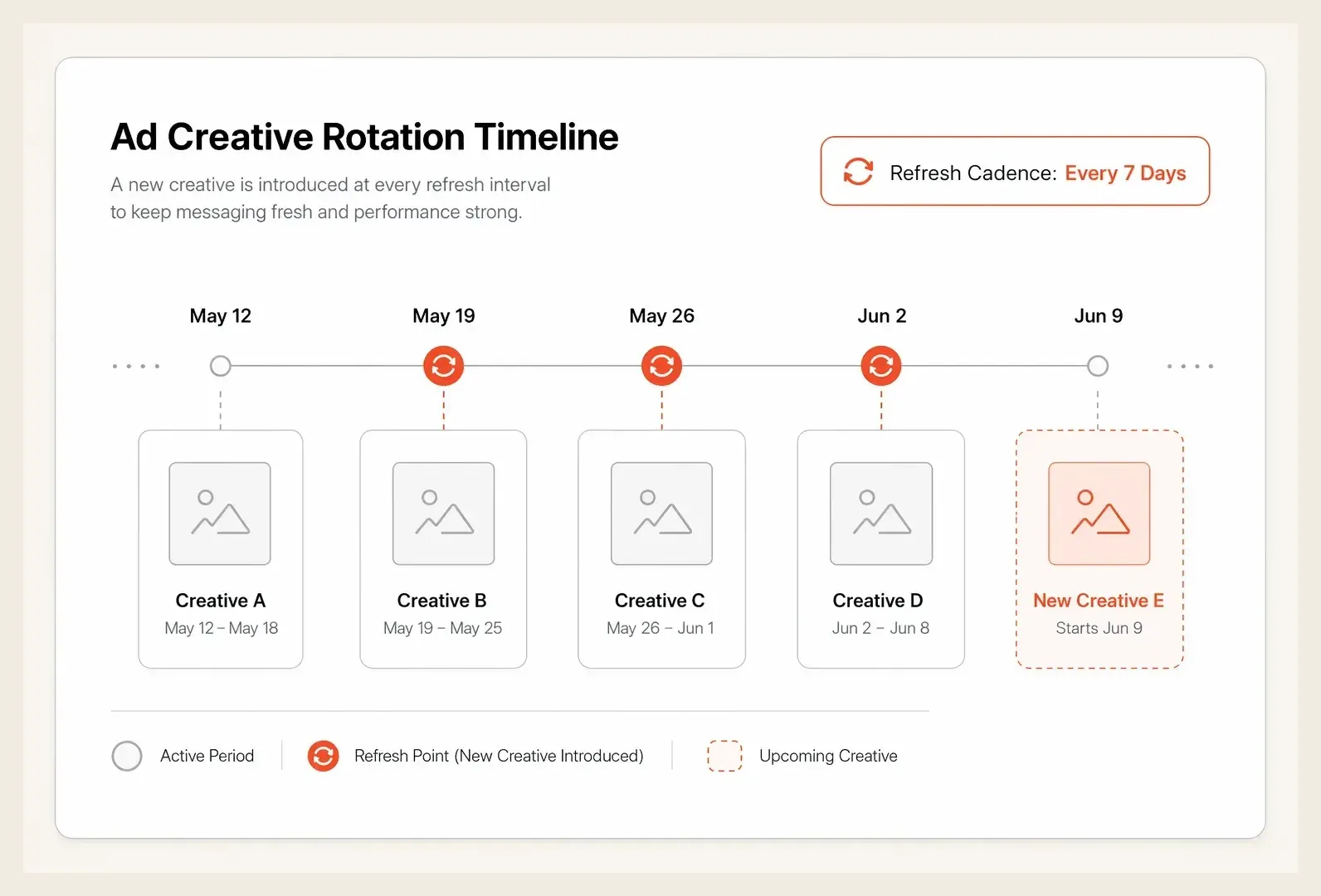
Creative refresh rate is how often an advertiser replaces active ads with new creative, measured as the share of ads swapped per period or an ad's average lifespan. The right cadence holds CTR and CPA steady; too slow lets fatigue erode both.
Creative Refresh Rate
Creative refresh rate is how often an advertiser replaces the ads running in an account with new creative, measured as the share of active ads swapped in a given period or the average number of days an ad runs before it is retired. It is the operating cadence that keeps a campaign ahead of fatigue. A team that refreshes the right amount holds CTR and CPA steady, while one that refreshes too slowly watches both decay as audiences tune the same ads out.
Why It Matters
Creative refresh rate sets the ceiling on how long an account can sustain performance. Creative drives roughly 56% of campaign outcomes according to Nielsen and Meta, so the pace at which you renew that creative is the pace at which you renew your largest performance lever. Refresh too slowly and even a winning ad slides into creative fatigue, dragging CTR down and CPM up at the same time.
The cost of a slow cadence compounds quietly. Most ad creative begins showing fatigue within 7 to 14 days, and on thinner-audience platforms like LinkedIn it can be faster. An account that refreshes once a month spends two to three weeks of every cycle on ads the audience has already learned to skip. Set the cadence too high, though, and you starve each ad of the data it needs to prove itself, so the goal is a rate matched to spend and audience size, not the maximum possible.
How It Works
Creative refresh rate is governed by how fast a specific audience burns through a specific set of ads, which depends on spend, audience size, and how distinct each new variant is. A high-spend campaign hitting a narrow audience exhausts creative far faster than a low-spend campaign reaching a broad one.
- Track frequency by ad and ad set, not just campaign. Refresh decisions live where fatigue actually builds, and campaign averages hide it.
- Tie the cadence to leading signals. Rising ad frequency and softening CTR tell you a refresh is due before CPA confirms it.
- Refresh with real variation. Swapping a headline is not a refresh if the hook and visual stay the same, so meaningful change means new hooks, formats, or angles.
- Match the rate to audience size. Smaller addressable audiences fatigue faster and need a higher refresh rate than broad prospecting pools.
A Real Example
A subscription meal-kit brand ran eight active ads against a $40,000 monthly Meta budget and refreshed them once every 30 days. By the back half of each month, blended CTR fell from 1.9% to 1.0% and CPA climbed from $31 to $58 as average frequency crossed 5.0. The account was profitable in week one and bleeding margin by week four, every single month.
The team moved to a rolling refresh, swapping roughly 30% of active ads every 10 days so no single ad ran past two weeks at high frequency. Blended CTR stabilized near 1.8%, CPA held around $34 across the full month, and average frequency stayed under 3.5. The media budget did not change. Only the refresh rate did, and it recovered an estimated two weeks of inflated CPA per month.
Formula
A simple way to express it:
(Ads Replaced In Period ÷ Total Active Ads) × 100 = Creative Refresh Rate percent
You can also express it as average creative lifespan, the mean number of days an ad runs before it is retired. Typical benchmark ranges: high-spend or narrow-audience Meta accounts often need to refresh 25 to 40 percent of active ads every 7 to 10 days, equal to a 7 to 14 day average lifespan. Broad prospecting campaigns can stretch to a 14 to 21 day lifespan. Smaller platforms like LinkedIn usually need a faster rate because the audience is thin and frequency climbs quickly. Benchmark against your own frequency curve rather than a single global number, since the right rate is whatever keeps average frequency under roughly 3 to 4 per user.
Common Mistakes
| ❌ Mistake | ✅ Better Approach |
|---|---|
| Using one fixed refresh schedule for every campaign regardless of spend or audience size | Set the cadence per ad set based on its own frequency curve and burn rate |
| Counting minor headline tweaks as a refresh | Refresh with genuinely new hooks, formats, and visuals so the audience sees something different |
| Waiting for CPA to spike before refreshing | Trigger the next batch on rising frequency and falling CTR, before cost confirms the fatigue |
How Hawky Helps
Hawky's Creative Agent runs the refresh cadence as an operation, not a calendar reminder. It generates fresh, on-brand ad creative variations built on the hooks and formats that already perform in your account, then feeds the cadence with enough new material that no ad has to overstay its welcome. Refreshing on time only matters if there is something good to refresh with, and the Creative Agent keeps that pipeline full.
The Performance Agent sets the timing by watching frequency and CTR ad by ad, so the next batch ships the moment a refresh is due rather than weeks later. Every winning hook, format, and angle is written to FeatherDB, so each cycle starts from proven material instead of guesswork, and the cadence stays grounded in what works. Hawky operates the refresh rate; it does not just tell you one is overdue. Properly tuned, this is the most reliable defense against creative burnout at the account level.
Frequently Asked Questions
How often should you refresh ad creative?
Most campaigns should refresh creative every 7 to 14 days, and sooner on smaller-audience platforms like LinkedIn where frequency builds faster. The exact rate depends on spend and audience size, since high-spend campaigns against narrow audiences fatigue much faster. A practical rule is to refresh fast enough to keep average ad frequency under roughly 3 to 4 impressions per user.
What is a good creative refresh rate?
A good creative refresh rate keeps every ad retired before it crosses the fatigue threshold for its audience, which usually means swapping 25 to 40 percent of active ads every 7 to 10 days on high-spend accounts. Broad prospecting campaigns can run a slower rate, closer to a 14 to 21 day lifespan. The right number is whatever holds CTR and CPA steady across the full cycle.
How do you calculate creative refresh rate?
Divide the number of ads replaced in a period by the total number of active ads and multiply by 100. If you swap 6 of 20 active ads in a week, the weekly refresh rate is 30 percent. You can also track it as average creative lifespan, the mean number of days an ad runs before retirement.
Can you refresh creative too often?
Yes. Refreshing faster than ads can gather meaningful data starves each one of the impressions it needs to prove whether it works, which adds production cost and noise without a payoff. The goal is a cadence matched to how fast the audience actually fatigues, not the maximum possible. Let an ad run long enough to read its signal, then retire it before frequency climbs too high.
Quick Takeaway
Creative refresh rate is the cadence that keeps an account ahead of fatigue, and the right rate is whatever holds average frequency under 3 to 4 per user. Tie it to rising frequency and falling CTR rather than a fixed calendar, and feed it with genuinely new creative.
Your best ads are aging out faster than your team can replace them. Ready to hire your first AI performance team? Book Demo