Ad Creative Variation
Last updated
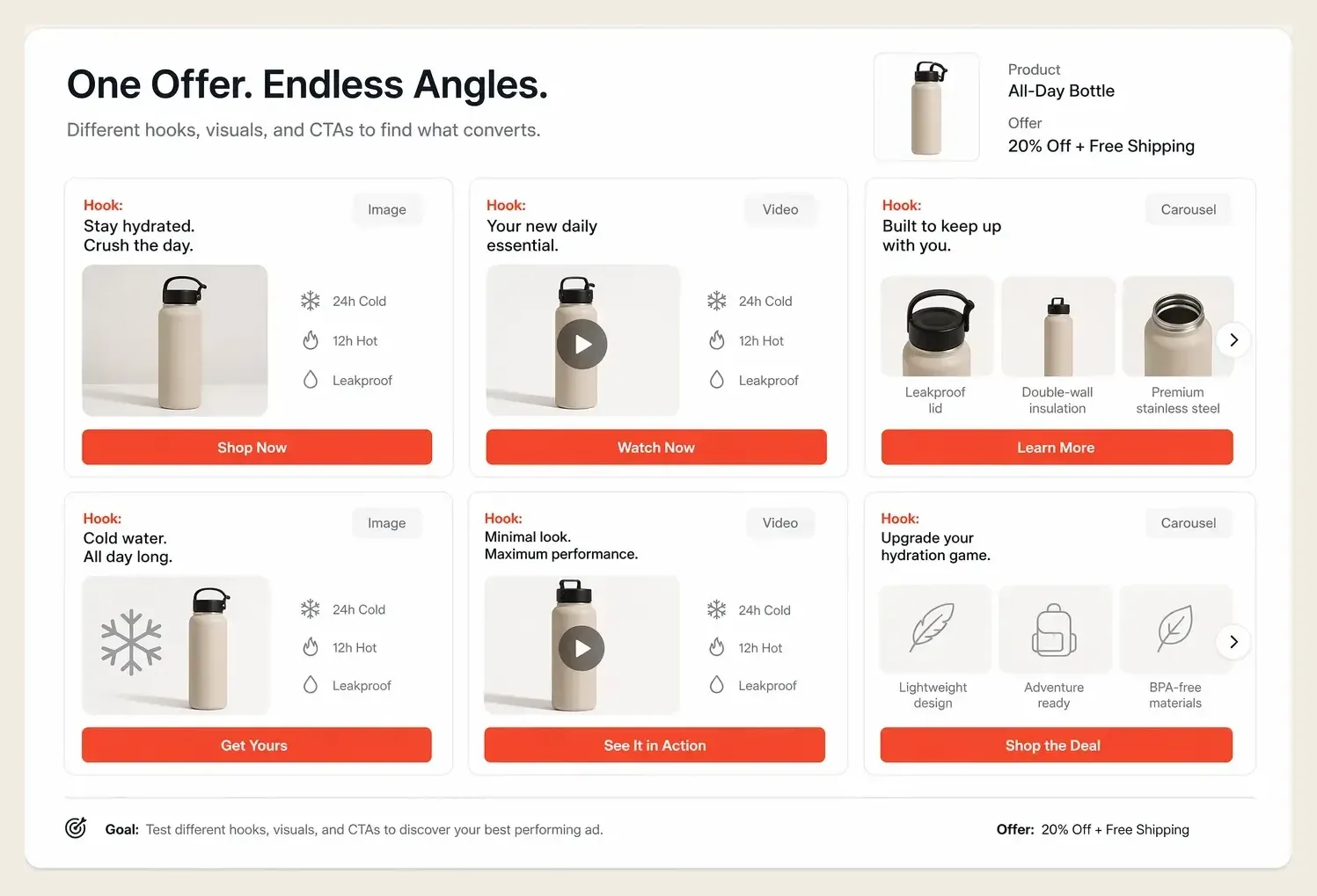
An ad creative variation is a distinct version of an ad built by changing elements like the hook, visual, format, or CTA while keeping the same offer. Depth of variation is what lets an account learn fast and outlast fatigue.
Ad Creative Variation
Ad creative variation is a distinct version of an ad built by changing one or more elements, such as the hook, headline, visual, format, or call to action, while keeping the same core offer. It is how advertisers test what resonates and how they keep an audience from tiring of a single execution. Accounts that run many variations learn faster and fatigue slower, while accounts that lean on one hero ad cap both their learning and their lifespan.
Why It Matters
Ad creative variation is the raw material of both testing and longevity. Because creative drives roughly 56% of campaign performance according to Nielsen and Meta, the breadth of variations an account can produce directly sets how much of that lever it can actually pull. One ad gives you one data point. Ten meaningful variations give you a map of which hooks, formats, and angles your audience responds to.
Variation is also the practical defense against fatigue. Most ad creative starts to fade within 7 to 14 days, so an account needs a steady supply of fresh executions to swap in before creative fatigue drags down CTR and pushes up CPM. Platforms reward this too: systems like dynamic creative optimization need a deep pool of variations to mix and match, and they deliver better results when fed more distinct inputs. An account stuck on two or three variations starves both its testing program and its creative refresh rate, and quietly leaves its largest performance lever half-used.
How It Works
A useful variation changes something the audience actually notices, not a cosmetic detail. The strongest variations isolate a single element so you can read which change moved performance, then combine the proven winners into the next round.
- Vary the hook first. The opening 3 seconds drive the most variance, so different hooks usually separate winners from losers fastest.
- Vary format and structure. The same message as a static image, a carousel, and a short video reaches different people and placements.
- Vary one element at a time when testing. Changing the hook and the visual at once tells you the combination worked but not which part did.
- Keep the offer constant. Variation tests the packaging, not the deal, so a stable offer keeps results comparable.
A Real Example
A DTC supplement brand ran a single best-performing video ad at a 2.4% CTR and a $29 CPA. It was profitable, so the team left it alone. By week two, frequency had climbed past 5.0, CTR had slipped to 1.2%, and CPA had reached $61. With only one execution in rotation, there was nothing to swap in when it faded.
The team produced twelve variations off the same offer: four new hooks, three formats, and a handful of CTA and visual changes. Three variations beat the original on CTR, and rotating the top performers held blended CPA near $31 across the next month while frequency stayed under 3.5. The winning hook, a problem-first opener, then informed the next production batch. The offer never changed. The volume and diversity of variations did, and it turned a two-week winner into a durable performer.
Common Mistakes
| ❌ Mistake | ✅ Better Approach |
|---|---|
| Treating tiny tweaks like a color swap as a real variation | Vary elements the audience notices first, like the hook, format, and visual |
| Riding a single winning ad until it collapses | Build a deep pool of variations so there is always fresh creative to rotate in |
| Changing five elements at once and calling it a test | Isolate one variable per test so you can read which change actually moved performance |
How Hawky Helps
Hawky's Creative Agent generates ad creative variations at the volume testing and refresh actually require, not the handful a human team can hand-build in a sprint. It reads the hooks, formats, and angles that already performed in your account and renders fresh, on-brand executions around them, so every variation starts from proven ground instead of a blank page. That depth feeds your creative testing framework and keeps the rotation full.
The Performance Agent reads which variations win and why, then routes that learning back so the next batch leans into what is working. Every winning element is stored in FeatherDB, so variation compounds: each cycle is smarter than the last rather than starting over. Hawky produces and operates the variations; it does not just suggest you make more.
Frequently Asked Questions
What is an ad creative variation?
An ad creative variation is a distinct version of an ad created by changing one or more elements, such as the hook, headline, visual, format, or call to action, while keeping the same underlying offer. Variations let advertisers test which executions resonate and give them fresh material to rotate in before fatigue sets in. The offer stays constant so results across variations stay comparable.
How many ad variations should you test?
Most accounts should run enough variations to keep average ad frequency low and to test at least three to five meaningfully different hooks per offer at a time. The exact number scales with budget and audience size, since higher spend burns through creative faster and needs a deeper pool. The goal is enough diversity to learn quickly and to refresh before any single ad fatigues.
What is the difference between an ad variation and a new ad?
An ad variation shares the same core offer as its siblings and changes only packaging elements like the hook, visual, or format, which keeps test results comparable. A genuinely new ad usually introduces a different offer, audience, or message, so it is not part of the same controlled comparison. Variations are for learning the best packaging; new ads are for testing new strategies.
Do more ad variations improve performance?
Yes, up to the point where each variation can still gather meaningful data. More distinct variations give testing a clearer read, feed platform systems like dynamic creative optimization, and supply the steady stream of fresh creative that holds off fatigue. Beyond what your budget can statistically support, though, extra variations only add production cost and noise, so match the volume to spend.
Quick Takeaway
Ad creative variation is how an account learns what works and stays ahead of fatigue, and the winning move is depth: many meaningfully different executions off one stable offer. Vary the hook and format first, isolate one variable per test, and keep the rotation full.
One hero ad cannot carry an account, and rebuilding the pipeline by hand is slow. Ready to hire your first AI performance team? Book Demo