Carousel Ads
Last updated
A multi-card ad format that shows 2 to 10 swipeable images or videos, each with its own headline and link. Carousels turn one placement into a multi-hook test that routinely beats single-image ads on cost per result.
Carousel Ads
Carousel Ads are a multi-card ad format that lets you show two to ten images or videos in a single placement, each with its own headline, description, and link, that users swipe through horizontally. They run across Meta (Facebook and Instagram), TikTok, LinkedIn, and Google, and they turn one ad slot into a sequence you can use to tell a story, showcase a product range, or break a single offer into steps. Carousel Ads consistently outperform single-image ads because every extra card is another chance to find the angle that makes a specific viewer stop and click.
Why It Matters
Carousel Ads give the algorithm and the viewer more surface area to work with, and that extra surface usually pays. Meta has reported that carousel ads can drive 30 to 50 percent lower cost per conversion and 20 to 30 percent lower cost per click than single-image ads, because the platform automatically optimizes which card it shows first and viewers self-select into the card that fits them. For an ecommerce account, that gap is the difference between a profitable ROAS and a campaign you have to pause.
The format also fights creative fatigue without a full reshoot. Each card is a distinct asset, so a single carousel carries several hooks at once, and you can swap a tired card instead of rebuilding the whole ad. That makes carousels one of the most efficient ways to keep CTR high while you test angles in production rather than in a separate experiment.
How It Works
A carousel is a single ad unit made of ordered cards. Each card holds its own creative and destination URL, the platform can reorder cards by performance, and the whole unit shares one primary text, one CTA button, and one set of targeting and budget rules.
- Cards: 2 to 10 per carousel on Meta, each with an image or short video, a headline, an optional description, and its own link.
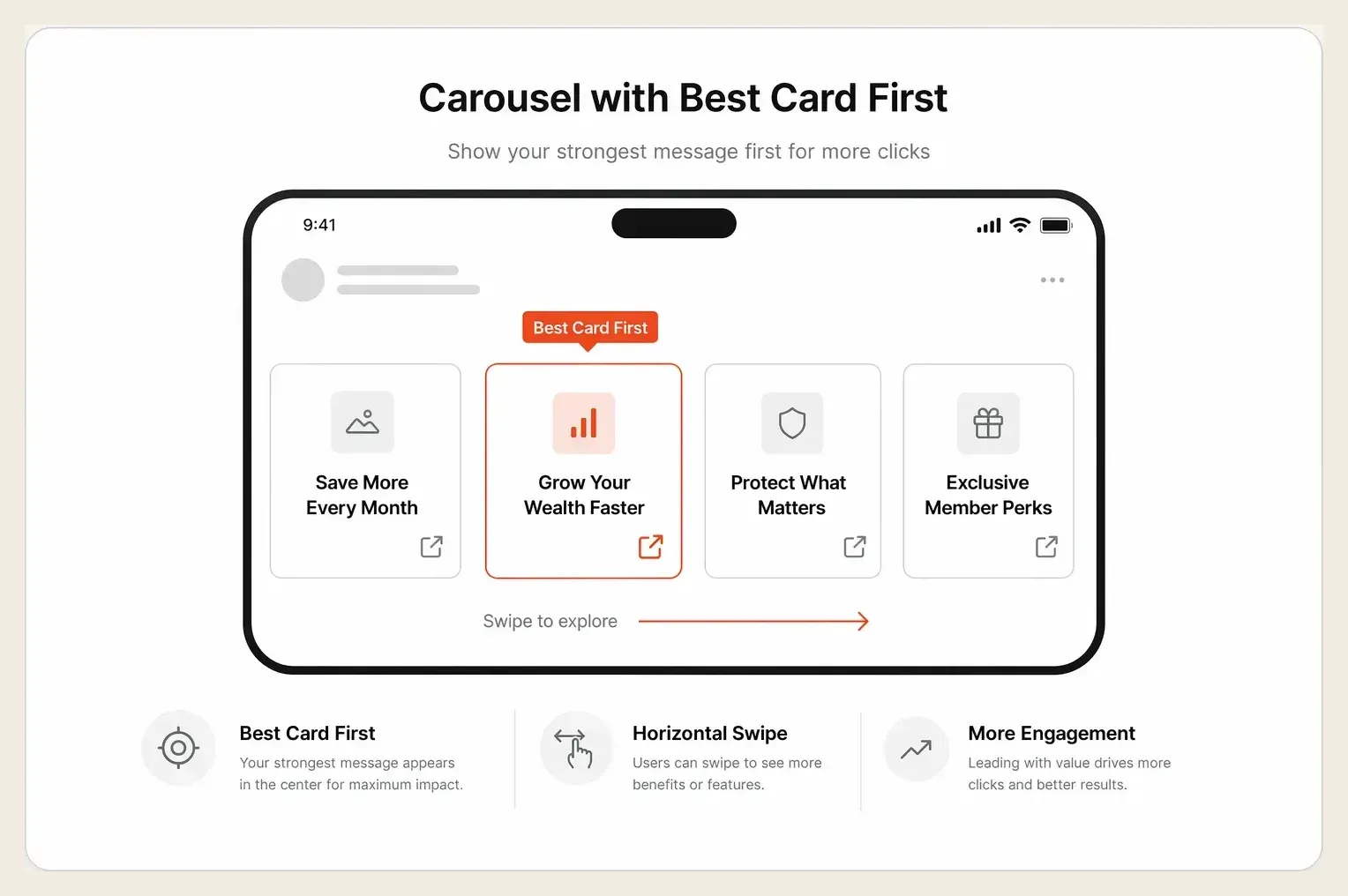
- Optimized ordering: Meta can automatically show the best-performing card first, so the strongest hook leads.
- Mixed media: cards can combine static images and video in the same carousel to test static vs video ads side by side.
- Aspect ratio: cards are square (1:1), so plan creative around a consistent aspect ratio and keep text inside the safe zone.
- Shared mechanics: one budget, one audience, one CTA across all cards, which keeps reporting clean while the creative varies.
Because the cards share targeting but split creative, a carousel is effectively a built-in creative test wrapped inside a live ad.
A Real Example
A furniture brand sells a modular sofa system and runs a single-image ad of the full set at a $14 CPA with a 0.9 percent CTR. The team rebuilds it as a five-card carousel: card one is the assembled sofa, cards two through four show individual modules (chaise, armless seat, ottoman) with price-led headlines, and card five is a customer photo as social proof.
After two weeks at the same $200 daily budget, the carousel lifts CTR to 1.8 percent and pulls CPA down to $8.70, a 38 percent improvement. Meta's card-ordering surfaces the chaise module as the top performer, revealing that buyers respond to one specific piece, an insight the brand then turns into a dedicated product demo ad. The carousel did not just sell better, it told the team which angle to scale.
Common Mistakes
| ❌ Mistake | ✅ Better Approach |
|---|---|
| Reusing the same image across every card so the carousel adds no new information | Give each card a distinct hook, product, or benefit so swiping rewards the viewer |
| Writing one generic headline and reusing it on all cards | Tailor each card's headline and link to what that specific card shows |
| Forcing a story sequence when card ordering is set to optimized | Use a fixed sequence only for true step-by-step narratives, otherwise let the platform rank cards |
| Ignoring which card drives clicks and conversions | Read card-level data and promote the winning angle into new creative |
How Hawky Helps
Building a strong carousel means producing several on-brand cards that each carry a different hook, and that is exactly what Hawky's Creative Agent does. It studies which angles, products, and openers are already converting in your account, then generates a full set of carousel cards on brand, each with its own headline and a distinct hook, so the format is filled with tested ideas instead of one image repeated five times. When a card fatigues, the Creative Agent ships a replacement card without forcing a rebuild of the entire unit.
The Performance Agent handles placement and delivery: it manages where the carousel runs across Facebook, Instagram, and Reels, watches card-level CTR and CPA, and shifts budget toward the carousels and audiences that convert. Every winning card, hook, and ordering pattern is written to FeatherDB, so the next carousel starts from what already works in your account rather than a blank slate.
Frequently Asked Questions
What are carousel ads on Facebook and Instagram?
Carousel ads on Facebook and Instagram are a single ad format that displays 2 to 10 swipeable cards, each with its own image or video, headline, and link. Viewers swipe horizontally through the cards, and Meta can automatically show the best-performing card first. They are used to showcase multiple products, break one offer into steps, or test several creative angles inside a single ad.
How many cards should a carousel ad have?
Most high-performing carousels use 3 to 5 cards, which is enough to test multiple hooks without overwhelming the viewer or diluting the budget. Meta allows up to 10 cards, but performance often drops off after the first few because fewer people swipe that far. Start with 3 to 5 strong, distinct cards and add more only if your data shows viewers swiping deep.
Do carousel ads perform better than single image ads?
In most accounts, yes. Meta has reported carousel ads driving 30 to 50 percent lower cost per conversion than single-image ads, because each card adds another hook and the platform optimizes card order automatically. The advantage is largest when every card is genuinely different, since a carousel of near-identical images gives the viewer no reason to swipe.
What is the best aspect ratio for carousel ads?
Carousel cards on Meta are square, so a 1:1 aspect ratio (1080 by 1080 pixels) is the standard and renders cleanly across Facebook and Instagram feeds. Keep important text and logos inside the safe zone so nothing is cropped on smaller screens. Using a consistent ratio across all cards keeps the swipe experience smooth and professional.
Quick Takeaway
Carousel Ads turn one placement into a multi-hook test that usually beats single-image ads on cost per result, as long as every card earns its swipe. Treat each card as a distinct angle, read card-level data, and scale the winner.
Tired of single-image ads stalling out while your carousels sit half-built with repeated cards? Ready to hire your first AI performance team? Book Demo