Social Proof
Last updated
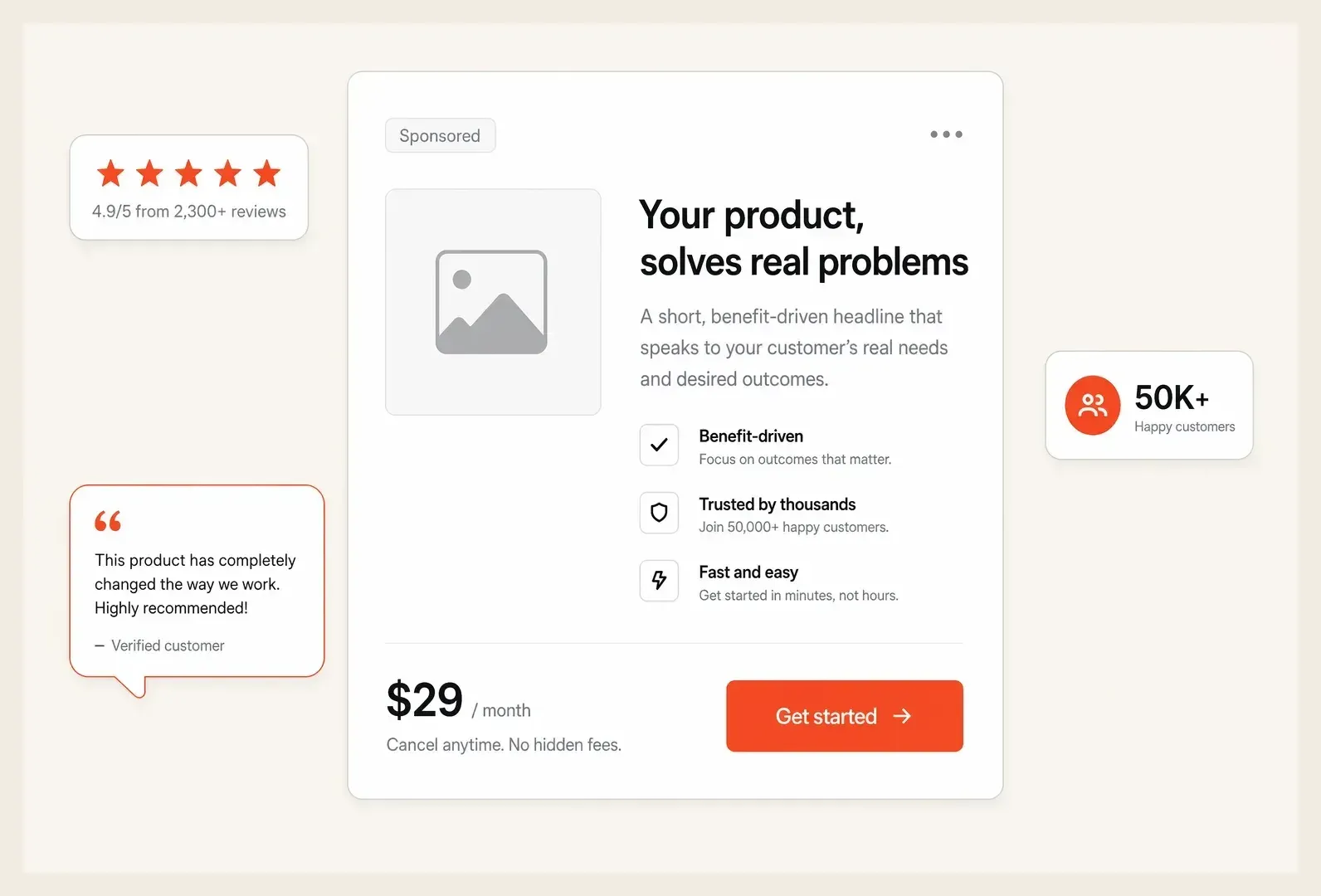
The use of reviews, ratings, testimonials, user counts, and endorsements in advertising to show that real customers trust a product. It reduces perceived buying risk and is one of the most reliable levers on conversion rate.
Social Proof
Social proof is the psychological principle that people look to the actions, opinions, and endorsements of others to decide what to do, and in advertising it is the use of reviews, ratings, testimonials, user counts, and recommendations to make a product feel trustworthy and worth buying. It borrows credibility from real customers so a brand does not have to claim trust, it shows it.
Why It Matters
People discount what a brand says about itself and trust what other customers say. Social proof closes that credibility gap, which is why an ad featuring a real review often converts better than the same ad making the identical claim in the brand's own voice. It reduces the perceived risk of buying, and lower perceived risk means higher conversion.
The evidence is strong and consistent. The vast majority of consumers read reviews before purchasing, and a large share trust online reviews as much as a personal recommendation, with studies showing that displaying reviews and ratings can lift conversion rates significantly versus no social proof at all. In paid social, social proof is one of the most reliable levers on CVR, which is exactly why UGC and testimonial creative perform so well.
How It Works
Social proof works by triggering a mental shortcut: if many others (especially people like me) chose this, it is probably a safe choice. The format of the proof matters as much as its presence, because different signals carry credibility for different audiences.
- Reviews and ratings: Star scores and written feedback that show real customer satisfaction at scale.
- Testimonials: Specific, named customer stories that make the benefit concrete and believable.
- Usage numbers: "Join 50,000 customers" signals that the choice is popular and validated.
- Expert and influencer endorsements: Borrowed authority from a trusted voice in the category.
The strongest social proof is specific and relevant to the viewer, since a testimonial from someone in their situation beats a generic five-star average. Social proof also reinforces the value proposition, because a believable promise plus believable evidence is far more persuasive than either alone.
A Real Example
A skincare DTC brand was running benefit-led ads that made strong claims but converted poorly on cold traffic, because new audiences had no reason to believe the promises.
The team rebuilt the creative around social proof: a real customer testimonial as the hook, a "4.8 stars from 12,000 reviews" overlay, and before-and-after results from named users. They tested it against the claim-led control on the same audience. The proof-led version lifted conversion rate 44% and dropped CPA from $48 to $29, because the audience now trusted the claim instead of just hearing it. The brand made customer voice, not brand voice, the default opening for every cold-traffic ad.
Common Mistakes
| The Mistake | ❌ Wrong Approach | ✅ Better Approach |
|---|---|---|
| Generic proof | "Thousands of happy customers" with no specifics | Named testimonials and real numbers the viewer can verify |
| Irrelevant endorsements | A testimonial from someone unlike the target buyer | Proof from people in the viewer's situation and segment |
| Burying it | Placing reviews far below the fold or late in the video | Leading with proof in the hook and headline |
| Faking it | Inventing reviews or inflating counts | Using genuine customer voice; fabricated proof destroys trust and risks penalties |
How Hawky Helps
Social proof works best when it is woven into the creative itself, and turning raw reviews and testimonials into scroll-stopping ads is slow manual work. Hawky's Creative Agent takes your real customer proof, ratings, testimonials, results, and assembles it into on-brand creative that leads with credibility, generating proof-led hooks and variants instead of leaving you to mock up each one by hand. It treats social proof as a testable creative element, not a static badge.
The Performance Agent then runs those proof-led variants against your KPI and scales the ones that convert, while FeatherDB remembers which proof formats and testimonials worked for which audiences as living memory. So the account keeps reusing the social proof that actually moves your buyers, rather than guessing which review to feature next time.
Frequently Asked Questions
What is social proof in advertising?
Social proof is the use of reviews, ratings, testimonials, user counts, and endorsements in ads to show that real customers trust and value a product. It works because people rely on the choices of others to judge what is safe to buy. Featuring genuine social proof is one of the most reliable ways to lift conversion rate on paid campaigns.
What are the main types of social proof?
The main types are customer reviews and ratings, named testimonials and case studies, usage or popularity numbers like "50,000 customers," and expert or influencer endorsements. User-generated content is also a powerful form of social proof. The most effective type depends on the audience, but specificity and relevance matter more than format.
Does social proof actually increase conversions?
Yes. The majority of consumers read reviews before buying, and many trust online reviews as much as a personal recommendation. Studies show that displaying ratings and reviews can lift conversion rates meaningfully compared to ads or pages with no proof. It works by reducing the perceived risk of the purchase.
How do I use social proof in ad creative?
Lead with it. Open the ad with a real testimonial, a star rating, or a customer result rather than a brand claim, and make the proof specific and relevant to the viewer. Pair it with a clear value proposition so the believable promise is backed by believable evidence. Always use genuine proof, because fabricated reviews destroy trust and can trigger penalties.
Quick Takeaway
Social proof converts because audiences trust other customers more than they trust brands, and specific, relevant proof beats generic claims every time. Lead your creative with real customer voice, not your own.
When your customer reviews and testimonials need to become proof-led creative that scales, an agent should be doing that work. Ready to hire your first AI performance team? Book Demo