Testimonial Creative
Last updated
An ad format built around a real customer describing the problem they had, how the product solved it, and the result they got. Because 92% of consumers trust peer recommendations over brand content, testimonials convert skepticism into trust and can lift conversion rates dramatically.
Testimonial Creative
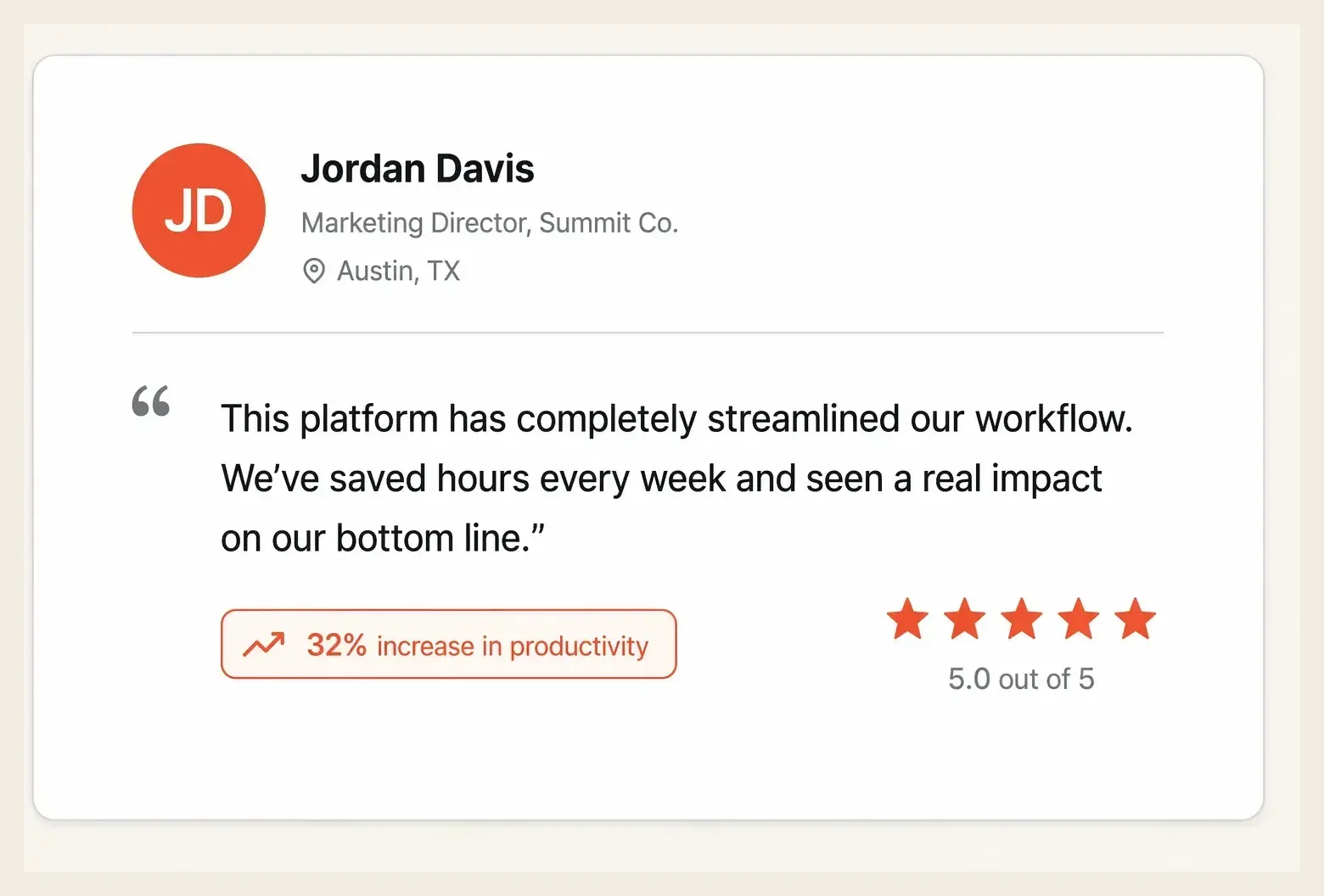
Testimonial creative is an ad format built around a real customer's words, showing a genuine person describing the problem they had, how the product solved it, and the result they got. It can be a video of a customer talking to camera, a written quote over an image, or a screenshot of a real review, and its power comes from one thing: the message arrives from a peer, not the brand. Testimonial creative converts skepticism into trust by letting buyers hear from people like them.
Why It Matters
Testimonial creative matters because people trust other people far more than they trust advertisers. The evidence is overwhelming: 92% of consumers trust recommendations from other people over branded content, and displaying reviews can lift conversion rates by up to 270% on higher-priced or higher-consideration purchases. When a real customer makes the claim, the buyer's guard drops in a way no brand copy can replicate.
This is social proof doing the persuading. A testimonial answers the buyer's quiet question, "does this actually work for someone like me," with a concrete yes, which shortens the path to purchase and lifts CVR. It also tends to age well against creative fatigue, since a new customer story feels fresh even when the product pitch has not changed. The risk is authenticity: a testimonial that looks scripted or fake backfires, because the entire value rests on it being believed.
How It Works
Testimonial creative works by anchoring the ad in a specific, believable customer story and structuring it so the proof lands fast. The most effective testimonials feel unpolished on purpose, because rough edges read as real.
- Lead with the problem: the customer names the pain they had before the product, in their own words.
- Show the turning point: what changed when they started using it, told as a story not a feature list.
- Quantify the result: a specific outcome ("cut my prep time in half") beats a vague "love it."
- Keep it authentic: real faces, real names, and natural delivery outperform polished actor reads.
Because believability is the whole engine, specificity wins. A testimonial with a concrete number, a real name, and an unscripted tone outperforms a generic five-star "great product," which is why pairing it with visible social proof like ratings amplifies the effect.
A Real Example
A supplement brand runs polished brand-voice video ads at a $54 CPA and hits a ceiling, with skeptical audiences bouncing before purchase. The team films three real customers describing the specific problem the product solved, unscripted, on their phones, each ending with a concrete result like "my afternoon energy crash is gone."
These UGC style testimonials lead with the problem and let the customer carry the message. They return a CTR of 2.3% against the brand video's 1.0%, and because the proof comes from a peer, landing page CVR rises and CPA drops from $54 to $33. The brand had the proof all along, it just had not put real customers on camera.
Common Mistakes
| ❌ Mistakes | ✅ Better Approach |
|---|---|
| Use a vague "great product, five stars" quote | Lead with a specific problem and a quantified result |
| Over-produce the testimonial until it looks scripted | Keep it authentic with real faces and natural delivery |
| Run one testimonial until it fatigues | Rotate fresh customer stories on a creative refresh rate |
| Hide ratings and reviews elsewhere on the page | Pair the testimonial with visible social proof |
How Hawky Helps
Testimonial creative scales only when you can turn customer proof into ad variants fast, and that is a creative production problem. Hawky's Creative Agent studies which testimonial angles, problem framings, and result statements convert for your audience, then helps assemble and generate testimonial-style variants in that proven structure, testing which customer story and which hook earn the click. It treats the proof point itself as the variable to optimize.
When a testimonial starts to wear out, the Creative Agent detects the decline and rotates fresh stories before creative fatigue raises cost, while Hawky's Performance Agent shifts budget toward the testimonials holding the lowest CPA. Both agents read from FeatherDB, the account's living memory of which customer stories and proof framings have worked, so testimonial production compounds across campaigns. That turns scattered reviews into a steady pipeline of trust-building creative.
Frequently Asked Questions
What makes a testimonial ad effective?
An effective testimonial ad leads with a specific problem the customer had, shows the turning point, and ends on a quantified result, all delivered by a believable real person. Specificity and authenticity matter most, since a concrete story from a peer persuades far better than a generic five-star quote or a polished actor read.
Do testimonial ads convert better than brand ads?
Often, yes, especially for higher-consideration purchases where trust is the barrier. Because 92% of consumers trust peer recommendations over branded content, testimonials lower skepticism and lift conversion rates, sometimes dramatically. They tend to outperform brand-voice ads on cold and mid-funnel audiences who need proof before they buy.
How is testimonial creative different from UGC?
Testimonial creative is specifically built around a customer endorsing the product with their story and result, while UGC is any user-generated content, which may or may not include an endorsement. All testimonials can be UGC, but not all UGC is a testimonial. Testimonials are defined by the proof and the customer voice at their center.
Where should I use testimonial ads in the funnel?
Testimonial ads work across the funnel but are strongest in the mid and lower stages, where buyers are evaluating and need proof to commit. They also perform well in retargeting, reinforcing trust for people who already showed interest. Pairing testimonials with visible ratings amplifies the social proof at the decision moment.
Quick Takeaway
Testimonial creative converts skepticism into trust by letting real customers make the claim, and specificity plus authenticity are what make it believable. Let a Creative Agent turn scattered customer proof into a steady pipeline of fresh, high-converting testimonial variants.
When your brand-voice ads hit a trust ceiling and customer proof sits unused, the fix is a Creative Agent that builds testimonial variants and a Performance Agent that scales the winners. Ready to hire your first AI performance team? Book Demo