Product Demo Ad
Last updated
A creative format that shows a product actually being used, demonstrating how it works and the result it delivers instead of just listing features. Seeing the mechanism removes buyer doubt, which is why 96% of people watch demos to understand a product before purchase.
Product Demo Ad
A product demo ad is a creative format that shows a product actually being used, demonstrating how it works, what problem it solves, and the result it delivers, instead of just describing features in text. It puts the product in motion: a hand using the tool, a screen recording of the software, a before-and-after of the outcome. The goal is to let the viewer see the value for themselves rather than take a claim on faith, which is why demo ads are a staple of high-performing direct response.
Why It Matters
Product demo ads matter because seeing beats being told. Showing a product in use removes the doubt that kills conversions, and the format consistently performs: 96% of people say they have watched an explainer or demo video to understand a product, and viewers who watch a demo are far more likely to buy than those who only read about it. When the product proves itself on screen, the buyer's risk drops.
Demos also pre-qualify and reduce friction at once. A viewer who watches the product solve a relevant problem arrives at the landing page already convinced of the mechanism, which lifts CVR and lowers return rates because expectations match reality. The format is especially powerful for products that are hard to explain in a sentence, where a ten-second demonstration does what a paragraph of copy cannot. The tradeoff is production: a demo has to be clear and fast, or it loses the viewer before the value lands.
How It Works
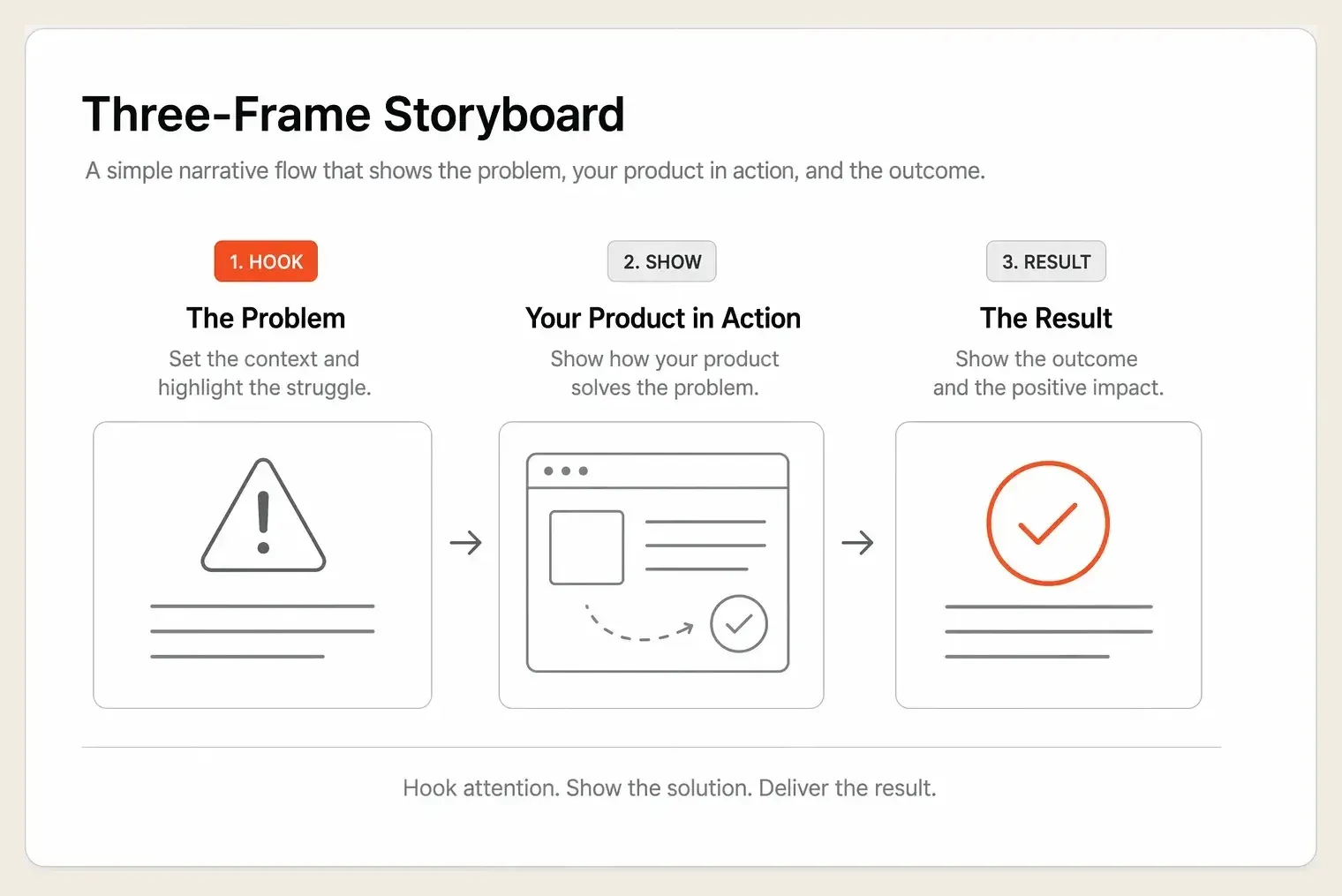
Product demo ads work by structuring a short, focused demonstration around a single problem and its on-screen solution. The creative leads with the pain, shows the product resolving it, and closes on the result.
- Open on the problem: a strong hook names the pain in the first 3 seconds.
- Show the mechanism: the product is used on camera, screen, or in a clear before-and-after.
- Prove the result: the outcome is visible, ideally with a number or a tangible change.
- Close with the action: a single call to action tells the viewer exactly what to do next.
Because the demonstration carries the message, pacing matters more than polish. A fast, legible demo that shows one clear benefit outperforms a glossy spot that buries the mechanism, which is why demo ads reward tight editing and a sharp value proposition over production budget.
A Real Example
A kitchen-gadget brand runs lifestyle image ads at a $48 CPA and cannot get costs down. The product is a one-handed jar opener, easy to show but hard to explain in a static frame, so the team produces a 12-second demo: a hand struggling with a stuck jar, the gadget clicking it open in one motion, a relieved smile.
The demo ad opens on the universal frustration, shows the mechanism in three seconds, and ends on the result. It returns a CTR of 2.6% against the static ad's 0.9%, and because viewers now understand exactly what they are buying, landing page CVR climbs and CPA falls from $48 to $29. The product was always the proof, the demo just let people see it.
Common Mistakes
| ❌ Mistakes | ✅ Better Approach |
|---|---|
| Open with branding or a logo before showing value | Lead with the problem and the product in action in 3 seconds |
| List features in text overlays instead of showing them | Demonstrate the mechanism on screen so the benefit is visible |
| Run one long demo and never test the hook | Test multiple openings since the first 3 seconds drive watch time |
| Cram several benefits into one ad and lose focus | Show one clear problem and one result per demo |
How Hawky Helps
Product demo ads are a creative production engine, and the bottleneck is making enough strong variants to keep finding winners. Hawky's Creative Agent studies which demo structures, hooks, and pacing actually convert for your product, then generates fresh demo variants in that proven format, testing different openings, sequences, and result framings so the next winner is engineered rather than stumbled into. It treats the hook and the mechanism reveal as the levers they are.
When a demo starts to fatigue, the Creative Agent detects the decline and ships new variations before creative fatigue inflates cost, while Hawky's Performance Agent shifts budget toward the demos holding the lowest CPA. Both agents draw on FeatherDB, the account's living memory of which demo angles worked across past campaigns, so production compounds instead of restarting each time. That turns demo creative from a slow, expensive shoot into a repeatable testing pipeline.
Frequently Asked Questions
What makes a good product demo ad?
A good product demo ad opens on the problem in the first 3 seconds, shows the product solving it on screen, and proves a clear result, all in a tight 10 to 20 seconds. The strongest demos focus on one benefit, lead with a sharp hook, and end on a single call to action rather than a list of features.
How long should a product demo ad be?
For paid social, the most effective demo ads run 10 to 30 seconds, long enough to show the mechanism and result but short enough to hold attention. The first 3 seconds matter most, since that hook determines whether viewers stay to watch the demonstration at all.
Do product demo ads work better than feature lists?
Yes, in most cases. Showing a product in use removes doubt in a way text features cannot, which is why viewers who watch a demo convert at higher rates and report fewer post-purchase surprises. Demos are especially effective for products that are hard to explain in a sentence, where seeing the mechanism does the persuading.
What products are best suited to demo ads?
Products with a visible mechanism or a clear before-and-after benefit are ideal, including gadgets, software, beauty, fitness, and home tools. If a product is hard to describe in words but obvious once seen, a demo ad usually outperforms static or testimonial formats by letting the result speak for itself.
Quick Takeaway
A product demo ad lets the buyer see the value instead of reading a claim, which removes doubt and lifts conversion, especially for products that are hard to explain. Let a Creative Agent generate and test demo variants so the next winner is produced on purpose, not by luck.
When your static ads stall and producing fresh demos is slow, the fix is a Creative Agent that engineers and tests demo variants against your KPI. Ready to hire your first AI performance team? Book Demo