Value Proposition
Last updated
A clear statement of the specific benefit a customer gets, why it solves their problem, and what makes it better than the alternatives. In ads it is the core promise that decides whether a viewer cares enough to click and buy.
Value Proposition
A value proposition is a clear statement of the specific benefit a customer gets from your product, why it solves their problem, and what makes it better than the alternatives. In advertising it is the core promise an ad must communicate in seconds, the reason a viewer should care, click, and buy instead of scrolling past.
Why It Matters
Every other part of an ad serves the value proposition. A great hook earns attention, but if the promise behind it is weak or unclear, the attention converts to nothing. The value proposition is what the viewer is actually evaluating, and a sharp one can lift conversion across the entire funnel because it answers the only question that matters: what is in this for me.
The impact shows up directly in the numbers. Landing pages and ads that lead with a strong, specific value proposition routinely outperform vague ones by wide margins, with clarity of benefit being one of the most consistent drivers of CVR. When the promise is concrete, "dinner solved in 15 minutes," rather than abstract, "premium meal solutions," the audience understands the value instantly and your ROAS reflects it.
How It Works
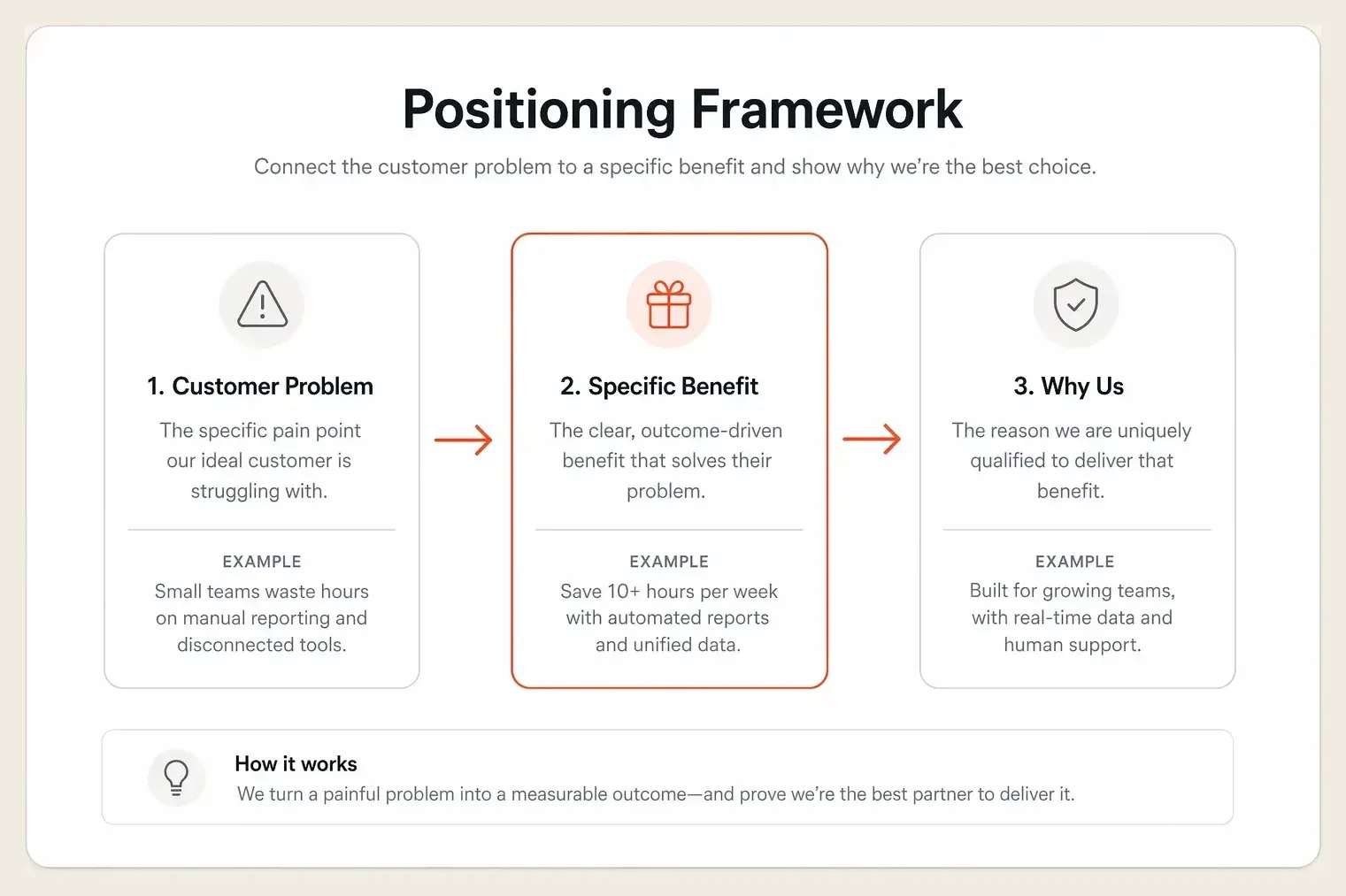
A value proposition works by connecting a real customer problem to a specific outcome only your product delivers well. It is not a slogan or a list of features; it is the translation of features into the benefit the customer actually wants.
- Target customer: Who it is for and the problem they are trying to solve.
- Specific benefit: The concrete outcome they get, stated in their language.
- Differentiation: Why your product delivers that benefit better than the alternatives.
- Proof: The evidence that makes the promise believable, often social proof.
The sharpest value propositions are specific and measurable, because vague claims read as noise. "Save 3 hours a week" beats "boost productivity," and "clinically shown to reduce breakouts in 14 days" beats "better skin." Testing different value-proposition angles is one of the highest-leverage things a performance team can do, which is why it belongs at the center of any creative testing framework.
A Real Example
A project-management SaaS was running ads built around features: "Gantt charts, time tracking, integrations." CTR was flat and trials were expensive, because the audience could not tell what they would actually gain.
The team rewrote the creative around a single value proposition: "Ship projects 30% faster without status-update meetings." Same product, same features, but now framed as the outcome the buyer wanted. They tested it against the feature-led control across the same cold audience. The outcome-led version lifted CTR 52% and cut cost-per-trial by 41%, and the brand made "kill the status meeting" the spine of every subsequent campaign. The features had not changed; the clarity of the promise had.
Common Mistakes
| The Mistake | ❌ Wrong Approach | ✅ Better Approach |
|---|---|---|
| Listing features | "AI-powered, cloud-based, fully integrated" | Translating features into the outcome the customer wants |
| Being vague | "The best solution for modern teams" | A specific, measurable benefit in the customer's own words |
| No differentiation | A promise any competitor could also make | Naming what only your product does better |
| Burying it | Hiding the benefit below the fold or late in the video | Leading with the value proposition in the first frames and headline |
How Hawky Helps
A value proposition is only as good as the creative that carries it, and most teams struggle to test enough angles to find the sharpest one. Hawky's Creative Agent generates multiple value-proposition framings from your brief, outcome-led, problem-led, proof-led, and renders each as on-brand creative, so you can test promises against each other instead of betting on the first phrasing you wrote. It turns value-proposition testing from a once-a-quarter exercise into a continuous one.
The Performance Agent runs those angles against your KPI and scales the framing that converts, while FeatherDB remembers which value propositions won for which audiences as living memory. That means the account stops re-litigating the same messaging debates and starts each campaign from the promises that have already proven to move your buyers.
Frequently Asked Questions
What is a value proposition in marketing?
A value proposition is a clear statement of the specific benefit a customer gets, why it solves their problem, and what makes it better than the alternatives. In advertising it is the core promise an ad must land in seconds. A strong, specific value proposition is one of the most consistent drivers of conversion rate.
What makes a value proposition strong?
A strong value proposition is specific, measurable, and framed as an outcome the customer wants, not a list of features. It names the target customer, the concrete benefit, the differentiation, and the proof that makes the promise believable. "Save 3 hours a week" beats "boost productivity" because it is concrete and instantly understood.
What is the difference between a value proposition and a slogan?
A value proposition explains the actual benefit and why your product is the better choice, while a slogan is a memorable brand phrase that may carry no concrete promise. The value proposition does the persuading; the slogan does the remembering. In performance creative, the value proposition matters far more because it is what drives the click and the conversion.
How do I test a value proposition in ads?
Write several distinct framings of the same core benefit, outcome-led, problem-led, and proof-led, and run them as separate variants against the same audience and KPI. Measure CTR and conversion to see which promise resonates. Testing value-proposition angles is one of the highest-leverage tests a performance team can run because the benefit framing often moves results more than the visual.
Quick Takeaway
A value proposition is the promise at the center of every ad, the specific benefit that makes a viewer care enough to act. Make it concrete and measurable, then test framings against each other rather than trusting your first draft.
When your strongest value proposition needs to be found through testing many on-brand framings, an agent should be doing that work. Ready to hire your first AI performance team? Book Demo