Static vs Video Ads
Last updated
Static vs video ads is the choice between a fixed image and a moving video as an ad's format. Static wins on speed, cost, and clarity; video wins on storytelling and cold reach, so the smart play is matching format to the job and letting data set the mix.
Static vs Video Ads
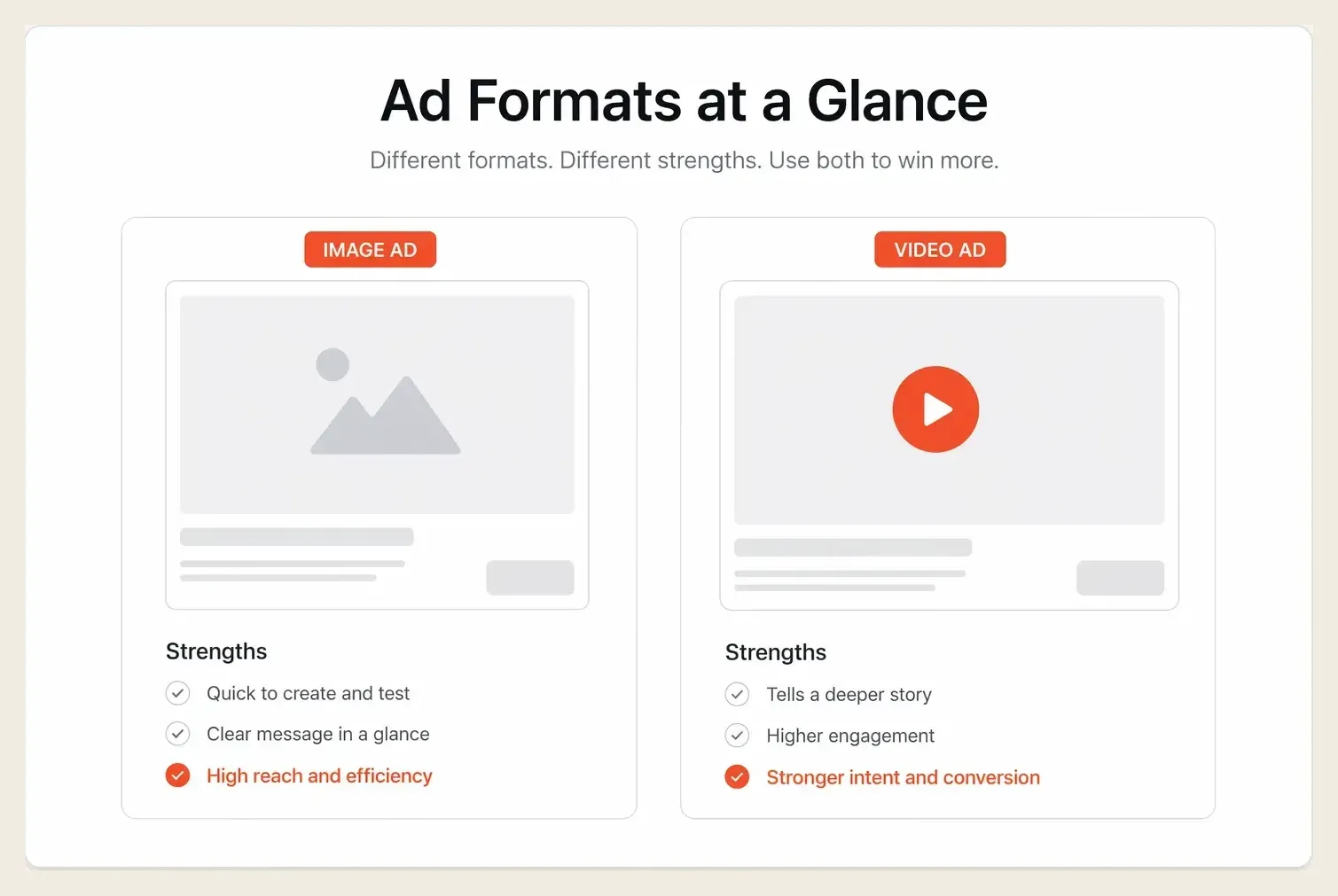
Static vs video ads is the choice between a single fixed image (or graphic) and a moving, often sound-on video as the format for a paid ad. Each format wins in different places: static ads are fast and cheap to produce and often excel at clarity and retargeting, while video ads tend to drive stronger storytelling, completion-based engagement, and cold-audience reach. The right answer is rarely one format for everything; it is matching format to objective, placement, and funnel stage.
Why It Matters
Format is one of the biggest variables in creative performance, and creative drives roughly 56% of campaign outcomes according to Nielsen and Meta. Choosing the wrong format for the job wastes that lever: a complex story crammed into a static image underperforms, while a simple price-and-product message stretched into a 30-second video burns production budget for no lift.
The cost and speed difference is also strategic. Static ads can be produced in minutes and tested in large batches, which makes them ideal for high-velocity testing and for sustaining a fast creative refresh rate. Video ads cost more and take longer, but they unlock metrics like video completion rate and tend to perform better at the top of the funnel where you are introducing a brand to cold traffic. Accounts that treat this as a religious debate, all static or all video, leave performance on the table. The accounts that win run both, deliberately, and let the data decide the mix per placement and audience.
How It Works
The format decision follows the job the ad has to do. Match the format to the objective, the placement, and where the viewer sits in the funnel, then test the assumption rather than trusting it blindly.
- Use static for clarity and speed. Simple offers, product shots, and retargeting reminders often work as well or better as a clean static, and they are cheap to test in volume.
- Use video for story and demonstration. Complex value props, product demos, and emotional hooks usually need motion and sometimes sound to land.
- Match format to placement. Feed, Stories, and Reels favor different aspect ratios and formats, so the right aspect ratio matters as much as static versus video.
- Test both, do not assume. Many accounts are surprised to find a static beating a video on a cold prospecting campaign, so let results override intuition.
A Real Example
A home-goods brand assumed video was always superior and ran an all-video Meta program. Production was the bottleneck: at roughly $500 and a week per video, the team could only test a handful of ideas a month, and CPA sat at $44. They had never tested static at scale because video "felt" more premium.
The team ran a structured test, pitting their best video concepts against clean static versions of the same offers across cold and retargeting audiences. On retargeting, statics matched video CTR at a fraction of the cost and let the team refresh creative weekly instead of monthly. On cold prospecting, video still won for the storytelling-heavy concepts, but two product-focused statics outperformed every video. The blended result: CPA fell from $44 to $31, and test velocity tripled because statics were so much faster to produce. The brand did not abandon video. It stopped treating format as a belief and started treating it as a variable.
Common Mistakes
| ❌ Mistake | ✅ Better Approach |
|---|---|
| Assuming video always beats static (or the reverse) | Test both per audience and placement, and let the data set the mix |
| Cramming a complex story into a single static image | Use video when the message needs motion, demonstration, or sound to land |
| Spending video budget on simple offers that a static handles | Reserve video for storytelling and demos; use cheap statics for clear, simple messages |
How Hawky Helps
Hawky's Creative Agent produces both static and video ad creative variations from the same brand inputs, so format becomes a variable to test rather than a production constraint to live with. It generates clean statics for high-velocity testing and refresh and video for storytelling-heavy placements, grounding both in the hooks and angles that already perform in your account. The point is coverage: test the formats side by side without the usual cost and time penalty of producing video by hand.
The Performance Agent reads how each format performs by audience and placement and shifts budget toward what wins, so the mix is set by data rather than assumption. Every result, by format, is stored in FeatherDB, so the account learns which formats suit which jobs and applies that next cycle. Hawky runs the static-versus-video decision as an ongoing operation; it does not just produce one format and hope.
Frequently Asked Questions
Are static or video ads better?
Neither is universally better; the right format depends on the objective, placement, and funnel stage. Static ads usually win on speed, cost, clarity, and retargeting, while video ads tend to win on storytelling, demonstration, and cold-audience reach. The strongest accounts test both per audience and let performance set the mix rather than committing to one format.
Do static ads still work on Facebook and Instagram?
Yes. Static ads remain highly effective on Facebook and Instagram, particularly for simple offers, product shots, and retargeting, and they often match or beat video at a fraction of the production cost. Their speed also makes them ideal for high-volume testing and a fast refresh cadence. The format that wins depends on the message and audience, so static should always be in the test.
When should you use video ads instead of static?
Use video ads when the message needs motion, demonstration, or emotional storytelling to land, such as complex value propositions, product demos, or top-of-funnel brand introductions to cold audiences. Video also unlocks engagement signals like completion rate that statics cannot provide. For simple, clear offers or retargeting reminders, a static is often the more efficient choice.
Are video ads more expensive than static ads?
Yes, video ads are generally more expensive and slower to produce than static ads, which is why statics are better suited to high-velocity testing and frequent refreshes. Video's higher cost can be worth it for storytelling and demonstration where it outperforms, but spending video budget on simple offers a static handles wastes resources. Matching format to the job keeps production cost efficient.
Quick Takeaway
Static vs video ads is a matching problem, not a belief: static wins on speed, cost, clarity, and retargeting, while video wins on storytelling, demonstration, and cold reach. Run both, match format to the job, and let the data set the mix.
You are stuck producing one format slowly while the data on the other goes untested. Ready to hire your first AI performance team? Book Demo