Lookalike Audience
Last updated
An audience created by platforms like Meta that finds new users who share characteristics with your best existing customers. One of the most effective prospecting tools in paid social.
Lookalike Audience
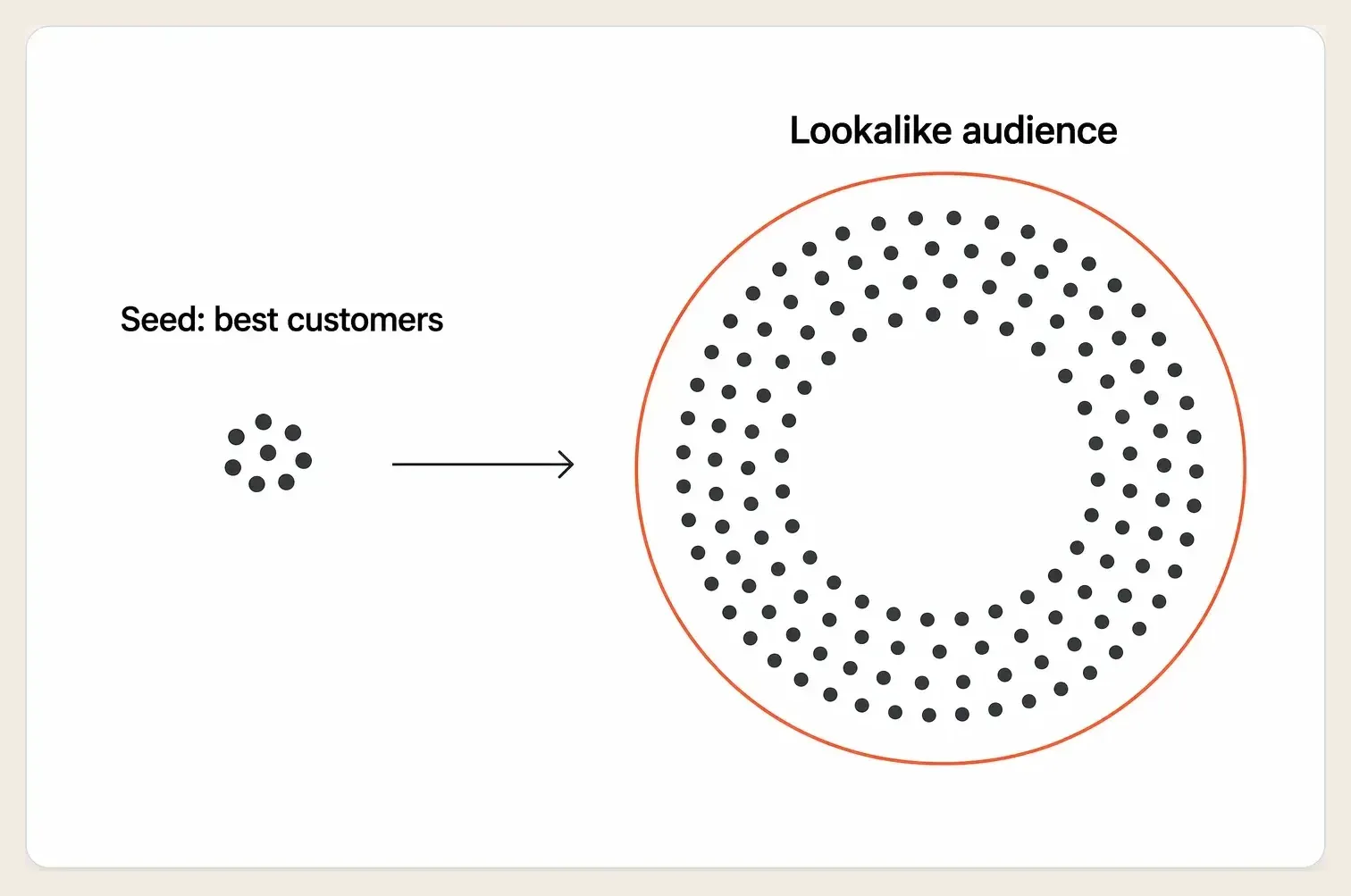
A Lookalike Audience is a targeting group created by ad platforms that finds new people who share similar characteristics with your existing customers, website visitors, or engaged users. You provide a "seed audience" (your email list, past purchasers, or high-value customers), and the platform's algorithm analyzes thousands of data points to find new prospects who match those patterns. This solves the cold prospecting challenge by letting platform data identify your ideal customer profile instead of manually guessing interests and demographics.
Why It Matters
Lookalikes bridge the gap between retargeting, which has limited scale, and cold prospecting, which carries an expensive learning phase. Manual interest-based targeting requires guessing which demographics and interests define your customer, but lookalikes let the platform's data reveal patterns you would never identify on your own, such as "people who bought from you also engage with home improvement content on weekends and watch cooking videos."
The stakes are financial. When built from high-quality seed audiences, lookalikes typically deliver a CPA that runs 30 to 50 percent lower than broad interest targeting while scaling far beyond your retargeting pool. For a brand spending six figures a month, that gap is the difference between a profitable scaling account and one that stalls the moment it leaves the warm audience. As privacy changes erode granular interest data, lookalikes built on first-party seed lists have become one of the most durable prospecting methods available.
How It Works
- Seed audience: Upload your customer list, pixel data, or engaged users (minimum 100 people, but 1,000 or more is far better).
- Platform analysis: The algorithm identifies shared characteristics across demographics, interests, behaviors, and online activity.
- Audience creation: The platform finds new people matching those patterns at your chosen similarity level (1 percent is the most similar, 10 percent is the broadest reach).
- Targeting: Use the lookalike audience like any other targeting group in your campaign structure.
The similarity percentage is the lever most marketers underuse. A 1 percent lookalike on a large market like the United States still represents roughly two million people, which is plenty of room to scale before you ever need to widen the percentage. The quality of the seed list matters more than its size: a clean list of 2,000 high-value buyers produces a sharper lookalike than 50,000 mixed-quality leads. Most platforms also let you stack a lookalike with broad demographic or geographic filters, which is useful when your product only ships to certain regions.
A Real Example
A meal kit delivery service had exhausted its retargeting pool of 25,000 website visitors and needed a new source of scale.
Manual interest targeting approach:
- Targets: "Healthy eating," "Cooking," "Organic food" produced a $68 CPA and a 1.2 percent CVR.
- The account struggled to scale beyond $5,000 per day in spend.
1 percent lookalike audience built from past purchasers:
- The platform identified the underlying pattern: "Health-conscious parents aged 28 to 45 who engage with time-saving content."
- Result: a $41 CPA and a 2.1 percent CVR, a 40 percent lower acquisition cost.
- The account scaled to $25,000 per day in spend profitably.
The platform's data revealed that the brand's best customers were primarily time-strapped parents, not just health enthusiasts, which let the brand find similar prospects at scale. The team then refined creative using an A/B testing program built specifically for this lookalike audience, pairing a sharper audience with messaging that spoke directly to busy parents.
Common Mistakes
| ❌ Mistake | ✅ Better Approach |
|---|---|
| Building lookalikes from all customers, including low-value or refund-prone ones | Seed from the top 25 percent of customers by LTV or purchase frequency, since quality beats quantity |
| Using seed audiences under 1,000 people, leaving the algorithm short on pattern data | Wait until you have 1,000 or more quality seed records, or combine multiple smaller lists |
| Starting with 10 percent lookalikes for scale, which is too broad and loses similarity | Test 1 to 3 percent first to prove performance, then expand to 4 to 6 percent once profitable |
How Hawky Helps
Hawky's Performance Agent operates the audience side of the account directly. It builds lookalikes from your highest-value seed segments, launches them at the right similarity tier, and shifts budget toward the lookalikes that convert rather than the ones that merely reach people. Instead of handing you a report and leaving the work to you, the Performance Agent runs the media buying decisions a senior buyer would make, continuously.
A lookalike is only as good as the creative running against it. Hawky's Creative Agent produces the distinct creative angles each lookalike tier needs, and FeatherDB holds the account's living memory so the agents remember which seed segments and creative pairings worked before. The result is a prospecting system that operates the account end to end, not a dashboard that describes it.
Frequently Asked Questions
What is the difference between a lookalike audience and a custom audience?
A custom audience is built from people who already know you, such as your customer list, site visitors, or video viewers. A lookalike audience uses that custom audience as a seed to find brand-new people who resemble them. Custom audiences are for retargeting warm traffic, while lookalikes are for prospecting cold traffic at scale.
How many people do you need for a lookalike audience?
Most platforms allow a seed as small as 100 people, but 1,000 to 5,000 high-quality records produce far stronger results. The seed list should be clean and value-weighted, since the algorithm copies the patterns it finds, including any low-quality buyers you include.
What is the best lookalike audience percentage?
Start with a 1 percent lookalike, which captures people most similar to your seed, then expand to 3 to 6 percent only after performance is proven. A 1 percent audience in a large country already contains millions of people, so most accounts can scale well before widening the percentage.
Do lookalike audiences still work after privacy changes?
Yes, and in many accounts they have become more valuable. Because lookalikes are built from your own first-party seed data rather than third-party interest signals, they are more resilient to tracking restrictions than manual interest targeting.
Quick Takeaway
Lookalike audiences use platform algorithms to find new customers who match your best existing customers, typically delivering 30 to 50 percent lower CPA than manual interest targeting when built from high-quality seed audiences.
When your prospecting stalls and CPA climbs, the fix is usually a sharper seed and better creative against it. Ready to hire your first AI performance team? Book Demo