Test Duration
Last updated
The length of time an ad experiment runs before you act on it, set to collect enough conversions while clearing the learning phase and avoiding creative fatigue. Usually a minimum of seven days and one full weekly cycle.
Test Duration
Test duration is the length of time an ad experiment runs before you read the result and act on it, chosen to collect enough conversions for a reliable answer while accounting for the platform's learning phase and natural day-of-week swings. The right duration is long enough to reach a trustworthy sample size and clear the algorithm's optimization period, but not so long that creative fatigue contaminates the comparison. Getting it right is the difference between a result you can scale and one that was either premature noise or a decayed signal.
Why It Matters
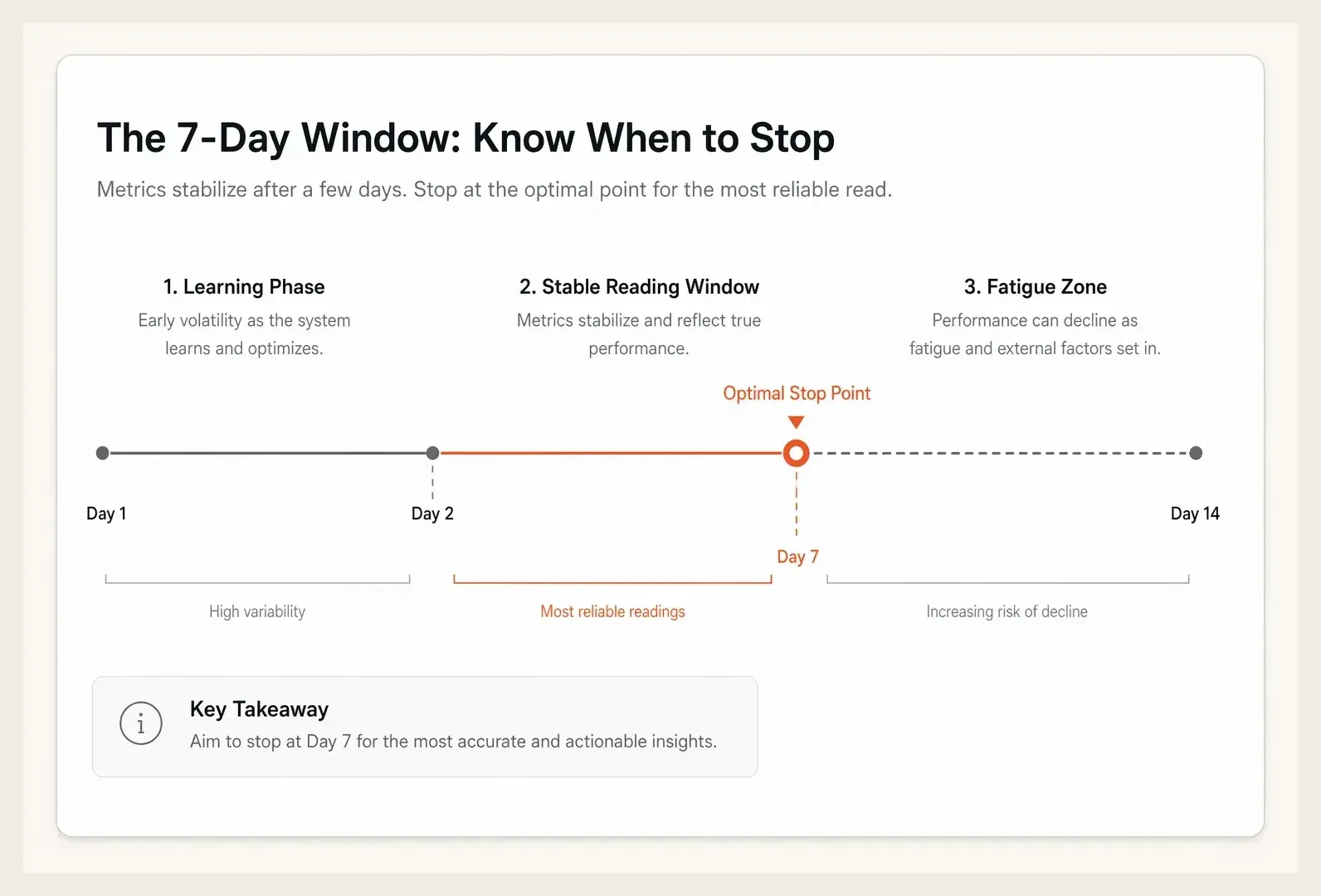
Test duration matters because both ending too early and running too long break the result in different ways. Stop early and you read noise, because the first days of any test swing wildly and the platform is still exploring delivery. Run too long and the leading creative starts to fatigue while audiences saturate, so the comparison drifts away from the conditions you actually wanted to measure.
There is also a hard floor set by the algorithm itself. Meta's learning phase needs roughly 50 optimization events per ad set within about seven days to stabilize delivery, and any reading taken before that is delivery-unstable rather than a fair test. This is why the common guidance is to run most tests for a minimum of seven days and ideally one to two full weeks, long enough to cross the learning phase and absorb at least one complete weekly cycle.
How It Works
Test duration is set by working backward from the conversions you need, then adjusting for the learning phase and weekly seasonality.
- Estimate daily conversions: Use the campaign's recent conversion rate and budget to project how many conversions each variant earns per day.
- Set the sample target: Decide the sample size needed for statistical significance, commonly 50 to 100 conversions per variant.
- Clear the learning phase: Ensure the window covers at least the seven-day, 50-event optimization period so delivery has stabilized.
- Cover a full week: Run at least one complete weekly cycle so weekday and weekend behavior are both represented.
The two forces to balance are sample size and freshness. A low-traffic account needs a longer window to accumulate enough conversions, but the longer the window runs, the more the creative ages, which is why high-frequency tests on small budgets are risky. The goal is the shortest duration that still clears significance and the learning phase, not the longest one you can tolerate.
A Real Example
A home-goods brand runs an A/B test on two video hooks with a $400 daily budget split evenly. The campaign converts at roughly 2.5 percent on about 160 clicks per variant per day, yielding around 4 conversions per variant daily.
Reaching 80 conversions per variant therefore requires about 20 days, far longer than a typical test, which signals the budget is too thin for a clean read. The brand instead consolidates spend onto a single high-traffic test, lifts the daily budget to $800, and reaches the 80-conversion target in 10 days, comfortably past the seven-day learning phase and across a full weekly cycle. Had it stopped at day three on an apparent winner, it would have acted on roughly 12 conversions per variant, deep inside the noise zone, and likely scaled the wrong hook.
Common Mistakes
| The Mistake | ❌ The Wrong Way | ✅ The Hawky Way |
|---|---|---|
| Stopping mid-learning | Reading results on day two before the learning phase stabilizes. | Running at least seven days so delivery and the 50-event phase settle first. |
| Running indefinitely | Leaving a test live for a month until the winner has fatigued. | Stopping once significance and a full weekly cycle are met, before decay sets in. |
| Ignoring the weekly cycle | Calling a winner from a Tuesday-to-Thursday window only. | Covering at least one full week so weekday and weekend behavior both count. |
How Hawky Helps
Hawky's Performance Agent sets test duration by projecting daily conversions against your KPI, then runs each test exactly long enough to clear the learning phase, cover a full weekly cycle, and reach an adequate sample size. It will not call a winner during the unstable learning window, and it ends a test before the leading creative fatigues, so the reading reflects real performance rather than noise or decay.
The Creative Agent keeps a pipeline of fresh challengers ready, which means tests do not have to run long enough for the control to age out before a new round begins. Because every test window and outcome is written to FeatherDB, Hawky learns how long your account typically needs to reach significance and tunes future test durations to your actual traffic instead of a generic rule.
Frequently Asked Questions
How long should I run an A/B test on Facebook ads?
Run most Facebook tests for a minimum of seven days and ideally one to two weeks, long enough to clear the learning phase and cover a full weekly cycle. The exact length depends on how quickly each variant reaches enough conversions for significance, usually 50 to 100 per variant. Stopping before seven days risks reading delivery-unstable results from the learning phase.
Why shouldn't I stop a test as soon as I see a winner?
Early data swings wildly, so an apparent winner on day two is often noise that reverses once more conversions arrive. The platform is also still in its learning phase, meaning delivery has not stabilized. Waiting until the test reaches significance across a full week prevents you from scaling a false winner.
Can a test run too long?
Yes, because the longer a test runs, the more the leading creative fatigues and the audience saturates, which drifts the comparison away from the conditions you meant to measure. An over-long test can also delay decisions and waste budget on dead variants. Stop once you have significance and a full weekly cycle rather than letting it run indefinitely.
How do I know how long my test needs to run?
Project daily conversions from your budget and conversion rate, then divide your target sample size by that daily rate to estimate the window. Make sure the result covers at least seven days for the learning phase and one full week of seasonality. If the math says you need many weeks, your budget is too thin and you should consolidate spend.
Quick Takeaway
Test duration is the window you run an experiment to gather enough conversions while clearing the learning phase and avoiding fatigue, usually a minimum of seven days and one full weekly cycle. Set it by working backward from the sample size you need for statistical significance.
Calling test winners before delivery even stabilizes? Ready to hire your first AI performance team? Book Demo