Statistical Significance
Last updated
The level of confidence, usually 95 percent, that the difference between two ad variants is real rather than random chance. Reaching it is what earns you the right to scale a winner instead of acting on noise.
Statistical Significance
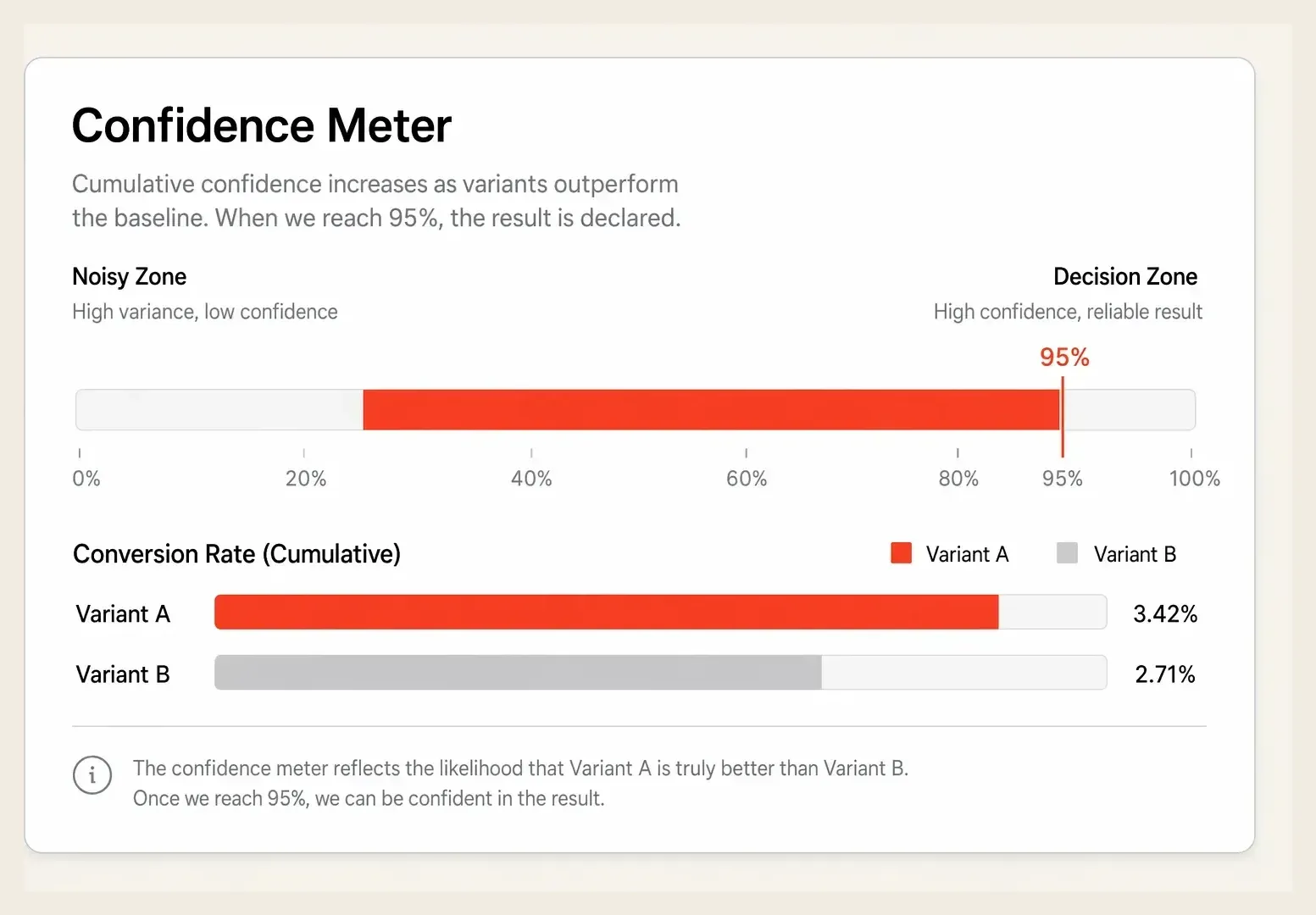
Statistical significance is the level of confidence that the difference between two ad variants is real and repeatable rather than the result of random chance. In advertising it is most often expressed as a confidence level, with 95 percent as the common standard, meaning there is only a 5 percent probability the observed difference happened by luck. Reaching significance is what gives you permission to act on a test result: scale the winner, kill the loser, and trust that the same outcome would hold if you ran the test again.
Why It Matters
Statistical significance matters because most ad tests are stopped too early, and an early "winner" is usually noise dressed up as a signal. With small numbers, random variation can make a worse ad look better for days before the result reverses. Acting on that false read means scaling a loser and pausing a potential winner, which quietly drains budget across an entire account.
The cost of impatience is concrete. A test that looks like a clear 30 percent lift at 20 conversions per variant can collapse to no difference at all by 100 conversions, because early data swings wildly. The reason 95 percent confidence became the default is that it keeps the false-positive rate at a manageable 1 in 20, which is the threshold most performance teams treat as the line between a guess and a decision.
How It Works
Statistical significance combines three inputs: how big the difference between variants is, how much data you have collected, and how confident you want to be before calling a result.
- Set the confidence level: Most advertisers use 95 percent, accepting a 5 percent chance the winner is a fluke.
- Accumulate conversions: The test gathers data until each variant has enough conversions to stabilize, commonly 50 to 100 per variant.
- Measure the gap: A larger true difference between variants reaches significance faster, while a small difference needs far more data.
- Confirm before acting: Only when the confidence level is met do you scale the winner and retire the loser.
The interaction between effect size and volume is the key idea. A variant that wins by a wide margin can clear significance quickly, while two nearly identical variants may never separate no matter how long the test runs. That is why a test stuck at "no significant difference" is itself a useful answer: it means the change you made does not matter enough to bet on.
A Real Example
An e-commerce brand A/B tests two ad creatives and checks the dashboard after one day. Variant B is showing a 3.4 percent CVR against Variant A's 2.6 percent, an apparent 30 percent lift, but each variant has only 18 conversions.
A significance check returns roughly 71 percent confidence, well under the 95 percent threshold, so the brand resists the urge to scale. By day five each variant has crossed 90 conversions, and the gap narrows to 3.1 percent versus 2.9 percent at 88 percent confidence, still short of the line. The brand correctly concludes the two creatives are effectively tied and reallocates the test budget to a bolder challenger instead of scaling a difference that was never real. The patience saved it from buying into a 30 percent lift that did not exist.
Common Mistakes
| The Mistake | ❌ The Wrong Way | ✅ The Hawky Way |
|---|---|---|
| Calling it early | Declaring a winner at 20 conversions because the dashboard looks decisive. | Waiting until each variant clears 95 percent confidence and an adequate sample size. |
| Peeking and stopping | Checking hourly and stopping the moment one variant pulls ahead. | Setting the stopping rule before the test starts and holding to it. |
| Ignoring ties | Treating "no significant difference" as a failed test. | Reading a tie as a real answer that the change does not move the KPI. |
How Hawky Helps
Hawky's Performance Agent runs every test against a defined confidence threshold and an adequate sample size, so it does not call a winner until the result clears significance. It tracks each variant's conversions in real time, resists the early-peek trap that fools manual operators, and only shifts budget once the math says the difference is real rather than noise.
The Creative Agent feeds the pipeline with challengers that are different enough to actually separate in a test, which means experiments reach significance instead of stalling on near-duplicate variants. Because every confirmed result is written to FeatherDB, Hawky remembers which differences proved significant and which were ties, so it never re-litigates a settled question and compounds genuine wins into the next round.
Frequently Asked Questions
What does statistical significance mean in A/B testing?
It means the difference between two variants is large enough, given the amount of data collected, that it is very unlikely to be due to random chance. The standard threshold is 95 percent confidence, which accepts a 5 percent risk of a false positive. Reaching it is the signal that a result is real and worth scaling rather than a temporary swing.
What confidence level should I use for ad testing?
Most performance marketers use 95 percent confidence, which keeps the false-positive rate at 1 in 20. Some teams accept 90 percent for faster, lower-stakes decisions, while high-budget bets sometimes wait for 99 percent. The right level balances how costly a wrong call is against how long you can afford to run the test.
How many conversions do I need to reach statistical significance?
A common rule of thumb is 50 to 100 conversions per variant, but the true number depends on how large the difference between variants is. A big effect reaches significance with fewer conversions, while a small effect may need several hundred per variant. Always size the test to the effect you expect rather than a fixed count.
Can a test be statistically significant but still not matter?
Yes, because with enough volume even a tiny difference can clear the significance threshold while being too small to affect profit. Significance tells you a difference is real, not that it is meaningful. Read the size of the lift alongside the confidence level, and only scale changes that are both significant and large enough to move your KPI.
Quick Takeaway
Statistical significance is the confidence, usually 95 percent, that a test result is real rather than random, and reaching it is what earns you the right to scale a winner. Pair it with a proper sample size and a fixed stopping rule so you never act on noise.
Scaling "winners" that turn out to be statistical noise? Ready to hire your first AI performance team? Book Demo