Split Testing
Last updated
A controlled delivery method that divides your audience into separate, non-overlapping groups and splits the budget evenly to compare creatives, audiences, placements, or bids against a KPI. The clean split is what keeps the result trustworthy enough to scale.
Split Testing
Split testing is an experiment that divides your audience into separate, non-overlapping groups and serves each group a different version of an ad, ad set, or campaign to measure which one performs better against a chosen KPI. The defining feature is the clean split: the platform makes sure no single user is exposed to more than one variant, so the groups stay statistically independent and the result is not contaminated by overlap. On Meta this is delivered through the dedicated A/B test tool, which splits the budget and the audience so each variant competes on equal footing.
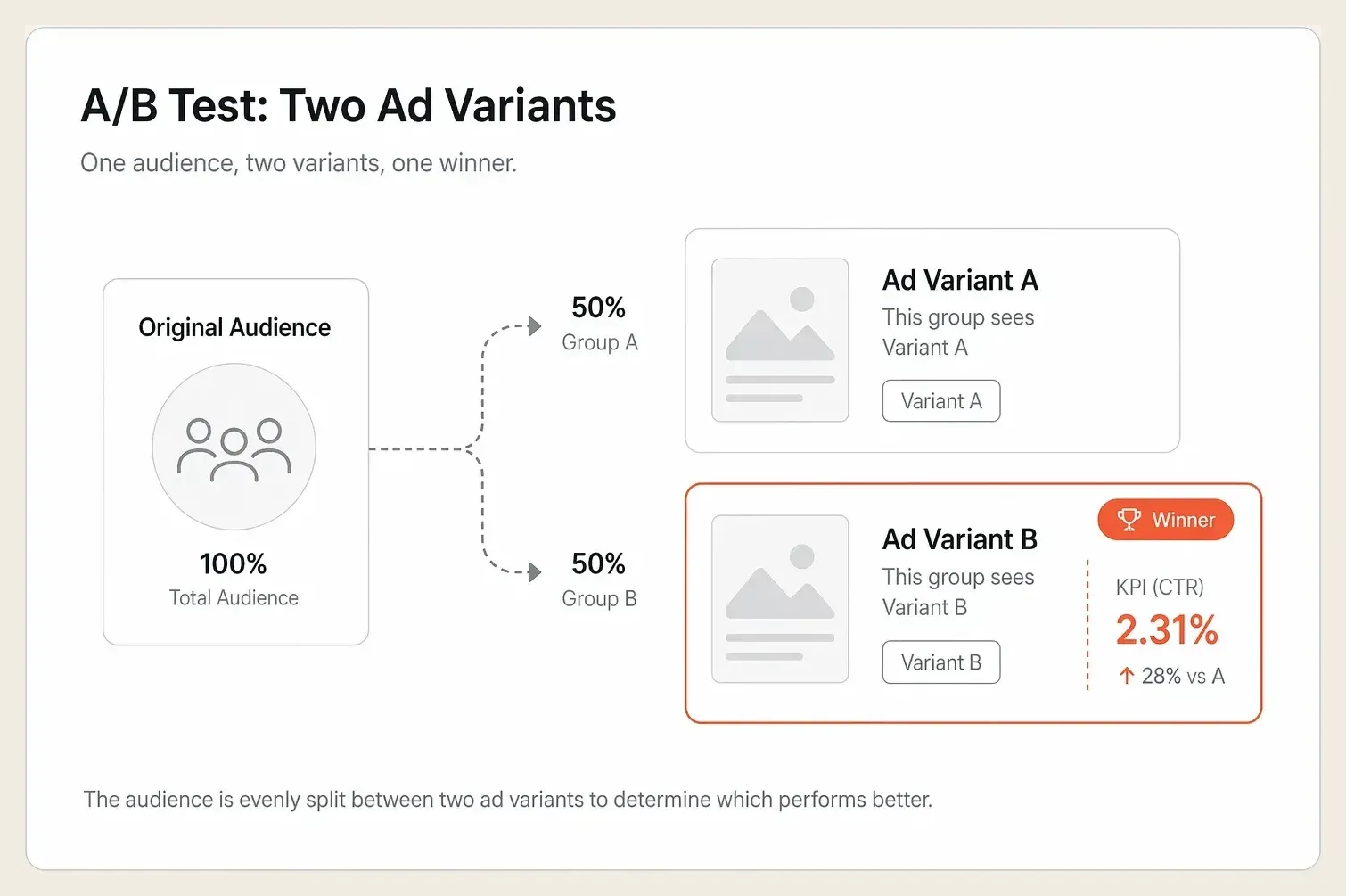
How Split Testing Differs From A/B Testing
The terms overlap in everyday use, but there is a precise distinction worth keeping. A/B testing refers to the principle of comparing two creative versions that differ by a single element, headline against headline or hook against hook, to learn which element wins. Split testing refers to the delivery method: it guarantees mutually exclusive audience groups and an even budget split, and it can compare not just creatives but entire ad sets, audiences, placements, or bidding strategies.
In short, A/B testing is about what you compare (one isolated variable), while split testing is about how the comparison is run (separated audiences, no overlap). Every clean A/B test on Meta is technically delivered as a split test, but a split test can also pit two different audiences or two budget strategies against each other, which is beyond the scope of a classic A/B creative test. Treat A/B testing as the question and split testing as the controlled mechanism that keeps the answer honest.
Why It Matters
Split testing matters because audience overlap is the silent killer of ad experiments. If the same user sees both Version A and Version B, you can no longer attribute their conversion to either one, and your "winner" is built on contaminated data. A true split removes that risk by walling off each group, which is the only way to trust the result enough to scale on it.
It also widens what you can test. Because the split works at the ad-set and campaign level, you can compare a lookalike audience against an interest-based targeting set, or a cost-cap bid against a lowest-cost bid, with the same rigor you would apply to two headlines. Meta attributes a large share of outcome variance to factors like creative and audience structure, so being able to test structure cleanly, not just creative, is a meaningful edge.
How It Works
Split testing assigns each eligible user to exactly one cell, divides the budget evenly, and runs all cells in parallel until one clears the KPI with confidence.
- Pick the variable: Decide what differs between cells, which can be a creative, an audience, a placement, or a bid strategy.
- Enforce the split: The platform randomly assigns users to one cell only, so no person sees more than one variant.
- Balance the budget: Spend is divided evenly across cells so a higher budget cannot manufacture a false winner.
- Measure to significance: Run until each cell reaches enough conversions to clear statistical significance, then scale the winner.
The even budget split and the no-overlap rule are what separate a real split test from simply launching two ad sets and eyeballing the results. Two ad sets running side by side can quietly cannibalize each other's audience, which is exactly the contamination a proper split test is designed to prevent.
A Real Example
A direct-to-consumer skincare brand wants to know whether a broad lookalike audience or a tight interest stack converts better, holding the creative and the $6,000 budget constant. It runs a split test with two cells, $3,000 each.
The lookalike cell delivers a 2.9 percent CVR at a $24 CPA, while the interest cell delivers 2.1 percent CVR at a $33 CPA. Because the audiences were mutually exclusive, the brand can be confident the lookalike genuinely outperformed rather than simply borrowing conversions from the other cell. It shifts the full budget to the lookalike structure and uses that audience as the control for the next round of creative tests.
Common Mistakes
| The Mistake | ❌ The Wrong Way | ✅ The Hawky Way |
|---|---|---|
| Overlapping audiences | Launching two ad sets to the same audience and calling it a test. | Using a true split so each user sees only one variant, keeping cells independent. |
| Uneven budgets | Giving the favored variant a bigger budget and declaring it the winner. | Splitting spend evenly so delivery, not budget, decides the outcome. |
| Confusing it with A/B | Assuming split testing only compares two creatives. | Using the split to compare audiences, placements, and bids, not just creative. |
How Hawky Helps
Hawky's Performance Agent runs structured split tests against your KPI with mutually exclusive cells and an even budget split, then logs every result so a winner is only called once each cell clears significance. It can split on creative, audience, placement, or bid strategy, watch delivery daily, and shift budget to the leading cell without letting an uneven spend create a false read.
The Creative Agent generates the variants that go into each cell, producing on-brand creative worth splitting rather than near-duplicates that waste the test. Because every split-test outcome is written to FeatherDB, Hawky remembers which audiences and structures already won, so it never re-runs a settled split and compounds each result into the next experiment.
Frequently Asked Questions
Is split testing the same as A/B testing?
They are closely related but not identical. A/B testing describes comparing two versions that differ by one element, while split testing describes the delivery method that keeps audience groups mutually exclusive with an even budget split. A clean Meta A/B test is run as a split test, but a split test can also compare audiences, placements, or bid strategies, not just creative.
How does Meta run a split test?
Meta uses its dedicated A/B test tool, which randomly divides your audience into non-overlapping groups and splits the budget evenly across each variant. Each user is shown only one version, so the cells stay statistically independent. You then compare the results on a chosen metric such as CPA or CVR once the test reaches significance.
What can you split test besides creative?
You can split test audiences, placements, bidding strategies, optimization events, and campaign structures, in addition to creative elements. Because the split works at the ad-set and campaign level, it is a clean way to compare a lookalike against an interest stack or a cost cap against lowest cost. The principle stays the same: isolate one difference and keep the groups separate.
Why do my ad sets perform worse when I run them at the same time?
That is usually audience overlap, where two ad sets compete for the same users and quietly cannibalize each other's delivery and conversions. A proper split test prevents this by assigning each user to only one cell. If you launch ad sets manually without a split, you risk both higher costs and a contaminated comparison.
Quick Takeaway
Split testing is the controlled delivery method that keeps audience groups separate and budgets even, and it can compare creatives, audiences, placements, or bids. Pair it with the single-variable discipline of A/B testing to get answers you can actually trust enough to scale.
Launching ad sets side by side and watching them cannibalize each other? Ready to hire your first AI performance team? Book Demo