Multivariate Testing
Last updated
An experiment that changes several creative elements at once and measures every combination to find the best-performing mix and the lift each element contributes. It only works when traffic can fill every cell to significance.
Multivariate Testing
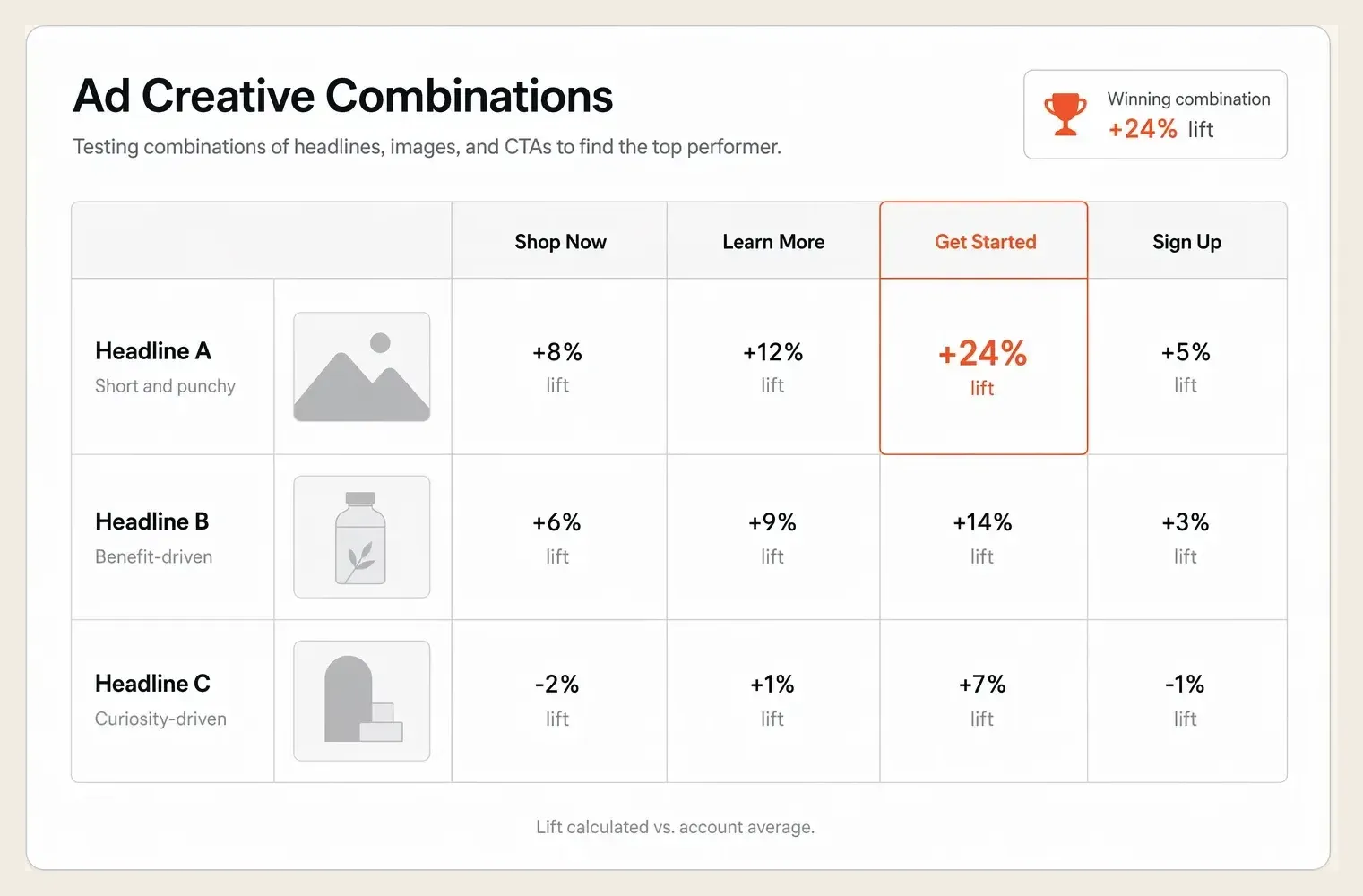
Multivariate testing (MVT) is an experiment that changes several creative elements at once, such as the headline, the image, and the call to action, then measures every combination to find which mix of elements performs best together. Instead of testing one variable in isolation, it runs all variations simultaneously and uses the results to isolate both the winning combination and the individual contribution of each element. It answers a question a single test cannot: not just which headline wins, but which headline wins alongside which image and which offer.
Why It Matters
Multivariate testing matters because creative elements interact, and the best version of an ad is rarely the sum of its individually best parts. A headline that wins on its own can underperform when paired with a different image, because the two send mixed signals. MVT catches those interaction effects that sequential single-variable tests miss entirely.
The catch is volume. A test with 3 headlines, 3 images, and 3 CTAs produces 27 combinations, and each combination needs enough conversions to read a real result. Industry guidance generally puts the floor at 50 to 100 conversions per combination before a winner is trustworthy, which means a 27-cell test can require thousands of conversions overall. That is why MVT belongs to high-traffic accounts, while smaller budgets are better served by A/B testing one element at a time.
How It Works
Multivariate testing builds a matrix of every possible combination, serves them to randomly assigned audience segments, then uses the data to score both the full combinations and each element's standalone effect.
- Define the elements: Choose 2 to 4 variables (headline, visual, CTA, format) and 2 to 3 versions of each, keeping the total cell count realistic for your traffic.
- Build the matrix: The platform generates every combination, so 3 headlines and 2 images create 6 variants, and adding 2 CTAs lifts that to 12.
- Randomize delivery: Each user is assigned one combination at random, which prevents audience bias from skewing any single cell.
- Reach significance: Run until each combination clears the conversion floor, then read the results for the winning mix and the per-element lift.
The output is two layered insights. The full-factorial result tells you the single best-performing combination, and the element-level breakdown tells you which headline, image, or CTA drove the most lift across all combinations. That second layer is what makes MVT a learning engine rather than a one-time pick.
A Real Example
A subscription meal-kit brand runs a multivariate test on a Meta prospecting campaign with a $9,000 budget. It tests 2 headlines, 2 hero images, and 2 CTA buttons, producing 8 combinations.
After two weeks and roughly 640 conversions (about 80 per cell), the data shows that the "Skip the grocery run" headline lifts conversion rate by 22 percent on its own, but only when paired with the kitchen-counter image, not the plated-meal image. The winning combination posts a 4.1 percent CVR against a 2.6 percent average, and the per-element view reveals the plated-meal image actually suppressed results regardless of headline. The brand kills the plated image across the account and rolls the counter-image and "Skip the grocery run" pairing into its control.
Common Mistakes
| The Mistake | ❌ The Wrong Way | ✅ The Hawky Way |
|---|---|---|
| Too many cells | Testing 5 headlines, 4 images, and 3 CTAs (60 combinations) on a budget that yields 200 conversions. | Sizing the matrix to the traffic, so every combination can clear the conversion floor. |
| Ending on noise | Declaring a winner when most cells have under 20 conversions each. | Waiting until each combination reaches statistical significance before acting. |
| Ignoring interactions | Reading only which headline won overall and ignoring how it paired with each image. | Reading the per-element lift and the combination result together to find true interaction effects. |
How Hawky Helps
Hawky's Performance Agent runs structured multivariate tests against your real KPI, sizes the matrix to the traffic your budget can actually support, and logs every combination's result so a winner is only called once each cell clears significance. It watches the test daily, pauses combinations that are clearly losing, and shifts budget toward the leading mix instead of waiting for the full run to finish on dead cells.
The Creative Agent generates the element variations that feed the matrix, producing on-brand headline, image, and CTA alternatives worth testing rather than random permutations. Because every combination and per-element result is written to FeatherDB, Hawky remembers which pairings won and which suppressed performance, so the next test starts from proven interactions instead of a blank grid.
Frequently Asked Questions
What is the difference between A/B testing and multivariate testing?
A/B testing compares two versions that differ by a single element to isolate that one change, while multivariate testing changes several elements at once and measures every combination. A/B testing is faster and works on modest budgets, whereas multivariate testing needs high traffic because the number of combinations multiplies quickly. Use A/B testing to answer one clean question and multivariate testing to find how elements interact.
How much traffic do I need for a multivariate test?
You need enough traffic for every combination to reach roughly 50 to 100 conversions, which scales with the number of cells. A test with 8 combinations needs around 640 to 800 conversions total, and a 27-cell test can demand several thousand. If your account cannot produce that volume in a reasonable window, run sequential A/B tests instead.
How many elements should I test in a multivariate test?
Test 2 to 4 elements with 2 to 3 versions each, and keep the total combination count low enough that your traffic can fill every cell. Most advertisers get clean results from a 2x2 or 2x2x2 design rather than sprawling matrices. The goal is interaction insight, not the largest possible grid.
Is multivariate testing better than A/B testing?
Neither is universally better, because they answer different questions. Multivariate testing reveals how elements work together and is worth the cost only when you have the traffic to support many cells. A/B testing gives cleaner, faster cause-and-effect answers on a single variable and fits almost any budget.
Quick Takeaway
Multivariate testing changes several creative elements at once to find the best-performing combination and the lift each element contributes. It only works when your traffic can fill every cell to significance, so reserve it for high-volume accounts and use A/B testing everywhere else.
Running tests with more combinations than your budget can fill to significance? Ready to hire your first AI performance team? Book Demo