Interest-Based Targeting
Last updated
A targeting method that reaches users based on their hobbies, behaviors, and interests as inferred by platforms like Meta and Google. Key for top-of-funnel prospecting.
Interest-Based Targeting
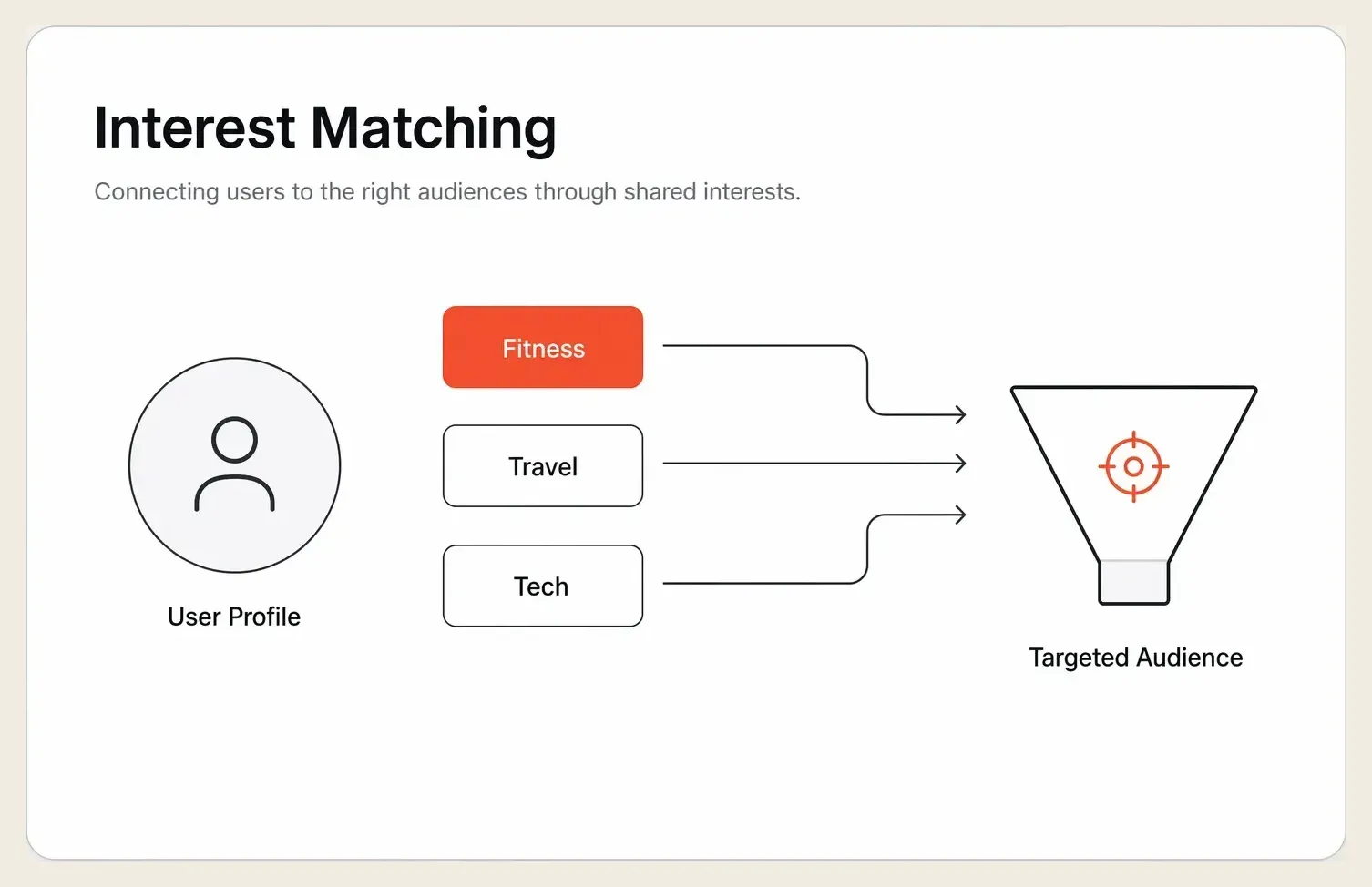
Interest-Based Targeting is an advertising method that reaches people based on their interests, such as the pages they like, the topics they engage with, and the apps they use. By selecting specific interest "tags" (for example "Sustainable Fashion" or "High-Intensity Interval Training"), you place your message in front of a pre-qualified group of users instead of paying to reach everyone. It is the most common way new advertisers give the platform a starting point for who to target.
Why It Matters
For new brands with little historical data, interest-based targeting provides necessary guardrails for your budget. It prevents the platform from spending on irrelevant users while your pixel is still in the learning phase and has not yet gathered enough conversions to optimize on its own. Early on, those guardrails are the difference between a clean signal and wasted spend.
As accounts mature, the role of interest targeting shifts. Meta's own data shows that broad and AI-driven targeting often matches or beats tight interest stacks once the pixel has enough conversion history, which is why interest-based targeting is best understood as a launchpad rather than a permanent strategy. It gets you to your first profitable customers, and creative is what scales beyond them.
How It Works
- Behavioral modeling: Platforms use AI to study content consumption and purchase journeys, sorting users into interest buckets.
- Interest stacking: Marketers combine multiple related interests to build a more robust, persona-based audience.
- Algorithm guidance: Selecting an interest gives the machine a starting line, but modern AI will expand beyond it if it finds better converters elsewhere.
- Self-selection: Even within a chosen interest, your hook acts as a secondary filter, ensuring only the most interested users actually click.
The most reliable approach treats interests as a hypothesis, not a cage. You seed the algorithm with a few strong interests, watch where conversions actually come from, and loosen the targeting as the data tells you the audience is bigger than your initial guess.
A Real Example
A premium plant-based protein brand launches a new campaign and starts with interest targeting to find its first buyers.
- The targeting: They select interests like "Veganism," "CrossFit," and "Whole Foods Market."
- The creative: They run a UGC video with the hook "Finally, a vegan protein that doesn't taste like dirt."
- The result: The campaign achieves a $1.10 CPC and a 3.2% CTR. By starting with interest-based targeting, they reach high-intent users immediately and validate the offer.
Once the brand hits ad saturation in those specific interest groups, it generates fresh visuals and expands to a broad audience to keep scaling, carrying the winning creative forward rather than rebuilding from scratch. The broad campaign sustains a similar CPC at roughly 4x the daily spend.
Common Mistakes
| The Mistake | ❌ Wrong Approach | ✅ Better Approach |
|---|---|---|
| Targeting Too Narrowly | Layering so many interests that audience size drops under 50,000. | Keeping audiences large (1M+) to give the AI room to optimize. |
| Assuming Interests Are Static | Thinking someone who liked a "Travel" page 3 years ago is still a traveler. | Exploring adjacent interests so the audience stays fresh and large enough. |
| Ignoring Broad Options | Fearing broad targeting because it feels less controlled. | Moving to broad once creative intelligence has found your winning patterns. |
How Hawky Helps
When interest-based segments hit a point of saturation, Hawky's Performance Agent acts on the account, reading where conversions are actually landing and shifting budget from exhausted interest stacks toward the audiences and placements still producing. It treats targeting as something to operate continuously, not a setting you choose once at launch.
The Performance Agent works with the Creative Agent to generate fresh creative for broader markets, and it shows how your elements (colors, copy, hooks) resonate across different interest groups. FeatherDB keeps the memory of which audiences and creative pairings worked before, so the move from interest targeting to broad is guided by your account's own history rather than guesswork.
Frequently Asked Questions
What is interest-based targeting?
Interest-based targeting is a method of reaching users based on the topics, pages, and apps they engage with, using interest "tags" to define a pre-qualified audience. It lets advertisers place ads in front of people likely to care about their product instead of paying to reach a fully cold, random audience.
Is interest-based targeting still effective in 2026?
Interest-based targeting remains effective as a launch strategy, especially for new accounts with little conversion data. As the pixel matures, broad and AI-driven targeting often performs as well or better, so most accounts use interests to start and then loosen targeting as the algorithm gathers signal.
What is the difference between interest-based and broad targeting?
Interest-based targeting restricts delivery to users matching specific interest tags, while broad targeting hands the algorithm wide latitude to find converters anywhere. Interests give early control and guardrails, broad gives the AI maximum room to optimize once it has enough conversion history and strong creative.
How large should an interest-based audience be?
A good rule of thumb is keeping interest-based audiences above 1 million people so the algorithm has room to optimize. Stacking too many interests can shrink the pool below 50,000, which starves the system of signal and usually drives costs up rather than improving relevance.
Quick Takeaway
Interest-based targeting is the GPS that helps the algorithm find your first customers. Use it to start, then lean on creative and broader audiences to scale.
When your interest segments stall, an agent should be reallocating budget and refreshing creative for you. Ready to hire your first AI performance team? Book Demo