5 Advertising Analytics Tools Worth Paying For in 2026

5 Advertising Analytics Tools Worth Paying For in 2026

5 Advertising Analytics Tools Worth Paying For in 2026

Lokeshwaran Magesh

Lokeshwaran Magesh

Lokeshwaran Magesh

5 Mins Read

5 Mins Read

5 Mins Read

5 Advertising Analytics Tools Worth Paying For in 2026

The short answer: Hawky for creative intelligence, Triple Whale for Shopify attribution, and Northbeam for enterprise multi-touch modeling are the top three advertising analytics tools worth paying for. Supermetrics and Google Analytics 4 round out the list for data aggregation and foundational tracking, respectively.

If you are running paid ads in 2026, your biggest problem is not a lack of data. You are drowning in it. The real problem is that most advertising analytics tools show you what happened without explaining why it happened or what to do next.

The tools on this list earn their price tag because they solve specific, high-value problems for performance marketing teams. No filler. No tools that exist just to pad a listicle to 15 entries. These five are the ones that justify the line item in your budget.

What Advertising Analytics Actually Means in 2026

Advertising analytics is the process of collecting, measuring, and interpreting data from paid ad campaigns to understand what drives performance and where budget is wasted. It goes beyond vanity metrics like impressions and clicks to connect ad spend with revenue outcomes.

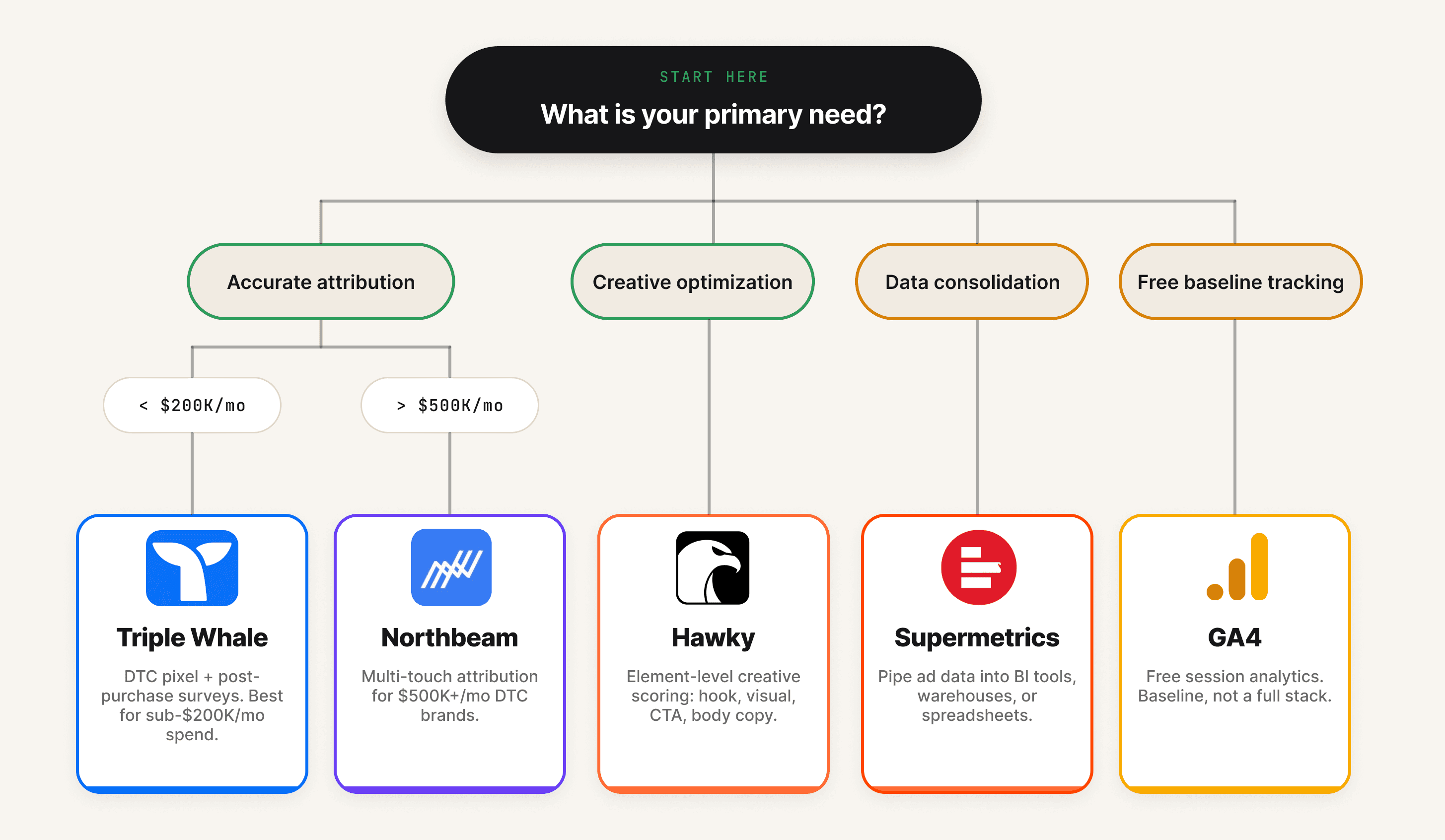
The category has split into three distinct lanes over the past two years. Attribution tools (like Triple Whale and Northbeam) answer "which channels and campaigns deserve credit for conversions?" Data aggregation tools (like Supermetrics) answer "how do I get all my ad data into one place?" And creative analytics tools (like Hawky) answer "which specific ad elements are driving results?"

Most teams still rely on platform-reported numbers from Meta and Google. The problem: those numbers routinely overcount conversions by 20-40% after Apple's App Tracking Transparency privacy changes introduced with iOS 14.5+. Independent advertising analytics tools exist specifically because the ad platforms grading their own homework is not a reliable measurement strategy.

According to LayerFive's 2026 attribution research, 47% of marketing spend is wasted due to broken attribution, with most tools achieving only 5-15% identity resolution accuracy. That gap between what platforms report and what actually happened is where the right analytics tool pays for itself.

A good advertising analytics tool in 2026 does three things: it tracks performance accurately across channels, it explains the "why" behind the numbers, and it gives you a clear next action. Tools that only do the first part are table stakes. The ones worth paying for do all three.

The five tools in this list were selected because each one solves a problem the others do not. There is no overlap for the sake of variety. Each tool represents a different category of advertising analytics: creative intelligence, DTC attribution, enterprise measurement, data aggregation, and foundational tracking.

The 5 Best Advertising Analytics Tools

1. Hawky - Best for Creative Intelligence and Element-Level Ad Analytics
Hawky - Best for Creative Intelligence and Element-Level Ad Analytics

Most advertising analytics tools tell you that an ad is underperforming. Hawky tells you which specific element is dragging it down, whether that is the hook, the visual, the CTA, or the body copy.

Hawky is an AI-native creative intelligence platform built for performance marketers who need to understand not just campaign-level metrics, but the individual creative components that drive results. Where attribution tools stop at "this campaign generated X revenue," Hawky goes deeper: it analyzes ad performance at the element level, tracks competitor creative strategies, predicts creative fatigue before it tanks your ROAS, and generates new creatives from winning patterns.

The platform's Command Center acts as an agentic operating system for creative performance. It automatically generates prioritized task lists, scores every creative component, and sends real-time alerts when ads start fatiguing. For teams managing dozens of active creatives across Meta and Google Ads, this replaces the manual spreadsheet audits that eat hours every week.

Key capabilities:

  • Element-level creative analysis: break down ad performance by hook, visual, CTA, and body copy to identify exactly what drives results

  • Predictive fatigue detection: get alerts before creative fatigue impacts your metrics, not after you have already wasted budget

  • Competitor intelligence: track competitor ad strategies, creative hooks, messaging shifts, and new offers with weekly automated reports

  • AI creative generation: generate new ad creatives from winning patterns, complete with performance predictions and brand consistency checks

  • Copilot AI: ask "why is this ad working?" and get cited analysis of hook styles, emotional triggers, and audience fit

Best for: Performance marketing teams and agencies running $50K+/month on Meta and Google Ads who need to move beyond campaign-level reporting into creative-level optimization. Hiveminds, one of India's largest agencies, cut CPL by 27% and saved 160+ hours per brand monthly using Hawky.

Pricing: Custom plans based on ad spend volume. See pricing.

Limitation: Currently focused on Meta, TikTok and Google Ads. If your primary spend is on Snapchat, or programmatic channels, Hawky's integrations are not there yet. That said, Meta and Google represent the majority of paid social and search spend for most performance marketing teams, so the coverage gap is smaller than it appears for the typical Hawky user.

2. Triple Whale - Best for Shopify Attribution and Profit Tracking
2. Triple Whale - Best for Shopify Attribution and Profit Tracking

Triple Whale is a cross-channel attribution and ad analytics platform built specifically for DTC ecommerce brands on Shopify. Its core value is connecting ad spend to actual profit, not just revenue.

Where most attribution tools show you ROAS, Triple Whale layers in cost of goods sold (COGS), shipping costs, and customer lifetime value to show true profit per campaign. For Shopify brands scaling paid acquisition, this distinction matters: a 4x ROAS campaign that is actually unprofitable after fulfillment costs is worse than a 2.5x ROAS campaign with higher margins.

Triple Whale's first-party pixel addresses iOS 14.5+ attribution gaps by tracking conversions server-side. It pulls data from Meta, Google, TikTok, Snapchat, and email platforms into a single dashboard with daily updates. The platform also offers cohort-based analysis that shows how customer acquisition costs and lifetime value shift over time, which is critical for brands evaluating whether their paid acquisition strategy is sustainable beyond the initial purchase.

Strength: Profit-first attribution for Shopify brands. The Shopify integration is deep, including inventory-aware analytics and cohort-based LTV tracking that most competitors cannot match.

Limitation: Shopify-only. If your brand runs on WooCommerce, BigCommerce, Magento, or a custom storefront, Triple Whale is not an option. The platform also does not analyze creative elements (hooks, CTAs, visuals), so you are still left guessing about why specific ads perform.

Best for: DTC Shopify brands spending $20K-$500K/month on paid ads who need accurate profit attribution across channels.

Pricing: Starts around $129/month. Enterprise tiers scale with tracked revenue.

3. Northbeam - Best for Enterprise Multi-Touch Attribution
3. Northbeam - Best for Enterprise Multi-Touch Attribution

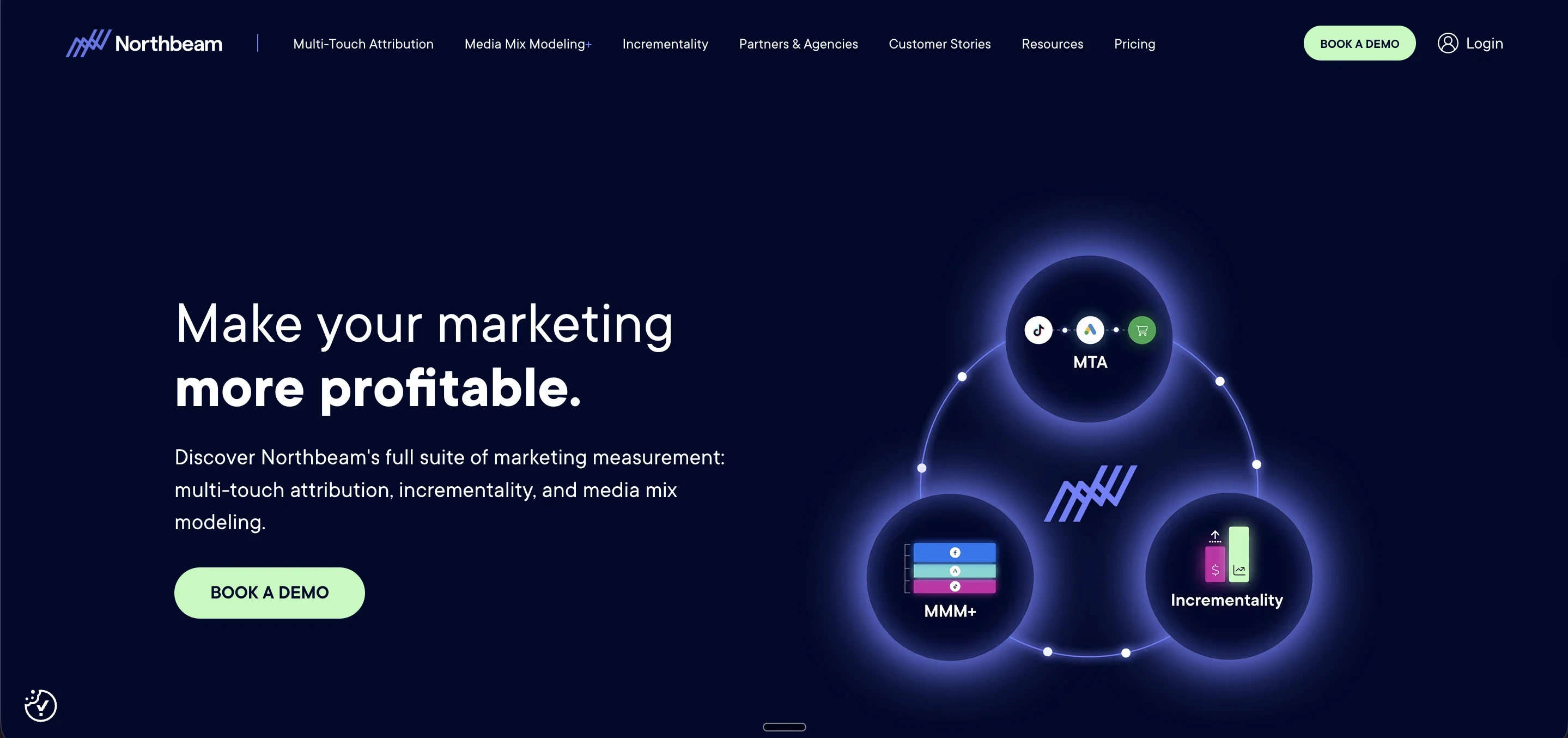
Northbeam is a machine learning-powered attribution platform designed for brands with large ad budgets and complex, multi-channel customer journeys. It uses media mix modeling (MMM) alongside multi-touch attribution (MTA) to measure true marketing incrementality, a metric that answers the hardest question in advertising analytics: "would this conversion have happened anyway?"

The platform's key differentiator is how it distributes conversion credit. Unlike tools that rely on last-click or platform-reported attribution, Northbeam assigns fractional credit across every touchpoint in the customer journey. One order might be attributed 0.6 to Meta, 0.3 to Google, and 0.1 to TikTok. The total never exceeds actual sales, which eliminates the over-attribution problem that plagues platform-reported numbers.

Northbeam also delivers creative-level attribution granularity. If you are running 50 different Meta ad creatives, it identifies which ones most influence buyers. This is closer to creative analytics than most attribution tools get, though it still focuses on which creative drove conversions rather than analyzing why it worked at the element level.

Strength: Statistical rigor. Northbeam's incrementality testing and media mix modeling give enterprise teams the confidence to make large budget allocation decisions across channels.

Limitation: Pricing is roughly 2-3x Triple Whale's, which puts it out of reach for smaller brands. The platform's sophistication also means a steeper learning curve and longer time-to-value than simpler tools. Data refreshes can be daily rather than real-time, which frustrates media buyers who want to make intraday bid decisions. Northbeam also focuses on telling you which creative drove conversions, but does not break down why at the element level (hook, CTA, visual style).

Best for: Enterprise brands and large agencies managing $500K+/month in ad spend across five or more channels who need statistically defensible attribution for board-level reporting.

Pricing: Custom enterprise pricing. Typically starts in the mid-four figures monthly.

4. Supermetrics - Best for Data Aggregation and Custom Reporting
4. Supermetrics - Best for Data Aggregation and Custom Reporting

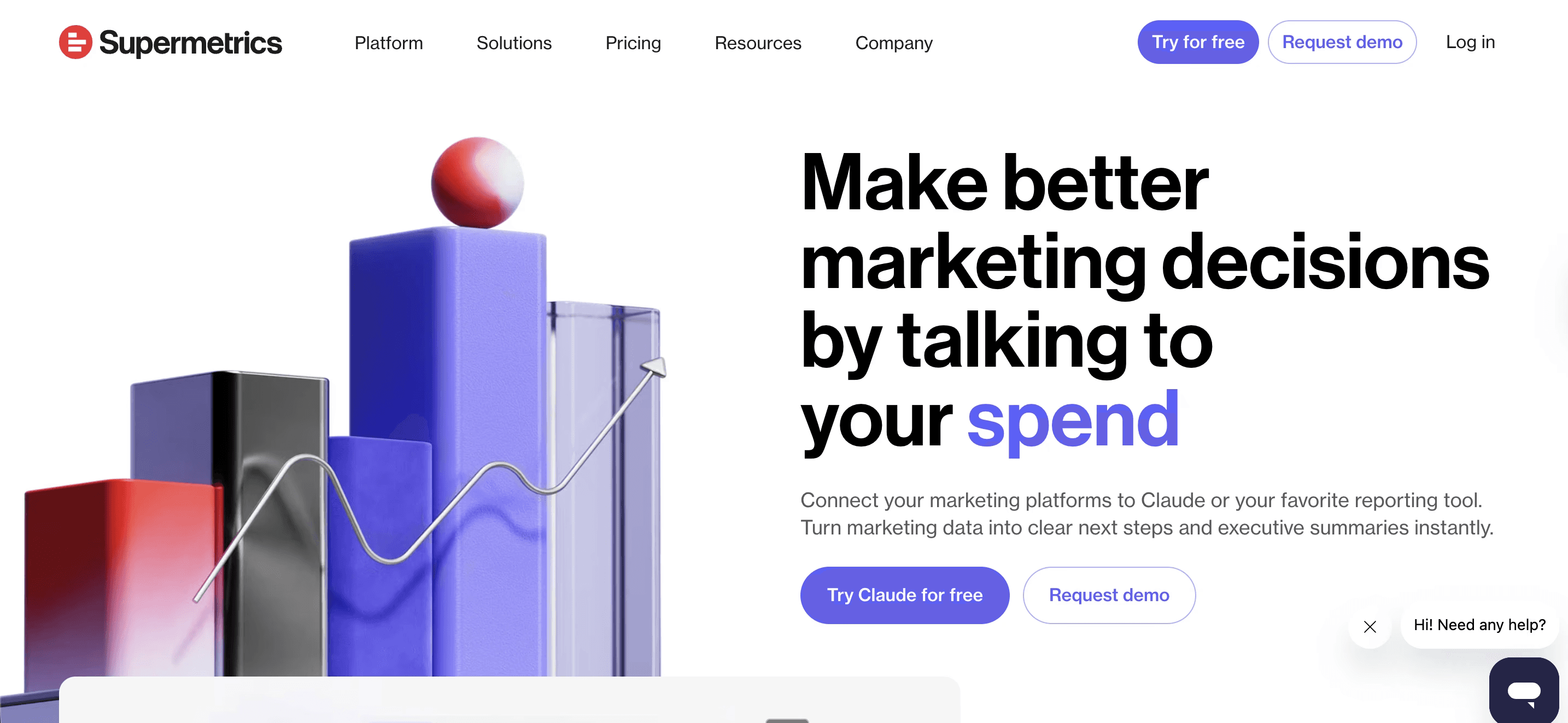
Supermetrics is not an analytics tool in the traditional sense. It is a data pipeline that pulls advertising data from 100+ platforms and pushes it into wherever your team actually does analysis: Google Sheets, Excel, Looker Studio, BigQuery, Snowflake, or Power BI.

The value proposition is straightforward. If your team spends hours every week manually exporting data from Meta Ads Manager, Google Ads, LinkedIn, TikTok, and a handful of other platforms, then copying it into spreadsheets or dashboards, Supermetrics automates that entire process. Scheduled data pulls, automatic refreshes, and pre-built templates for common reports save significant time.

For agencies managing multiple clients, Supermetrics is particularly useful. Multi-account data pulls, white-label reporting templates, and the ability to blend data from different platforms into a single view make client reporting faster and more consistent.

The real value of Supermetrics becomes clear when you calculate the hours your team spends on manual reporting. If an analyst spends 5 hours per week pulling and formatting data from four ad platforms into a client report, that is 260 hours per year on data extraction instead of analysis. Supermetrics eliminates most of that overhead, freeing your team to focus on insights that actually change campaign performance.

Strength: Breadth of connectors. No other tool in this list integrates with as many ad platforms, analytics tools, and data destinations. If you need to combine data from obscure or niche ad platforms, Supermetrics probably has a connector.

Limitation: Supermetrics moves data. It does not analyze it. There is no attribution modeling, no creative analysis, no predictive capabilities. You still need a human (or another tool) to make sense of the data once it lands in your spreadsheet or warehouse.

Best for: Agencies and in-house teams that already have strong analysts but waste too much time on manual data extraction. Works well as a complement to analytics tools like Hawky or Northbeam that go deeper on the analysis side.

Pricing: Starts at $29/month for basic Google Sheets connectors. Agency and enterprise plans scale with the number of data sources and destinations.

5. Google Analytics 4 - Best Free Option for Foundational Ad Tracking
5. Google Analytics 4 - Best Free Option for Foundational Ad Tracking

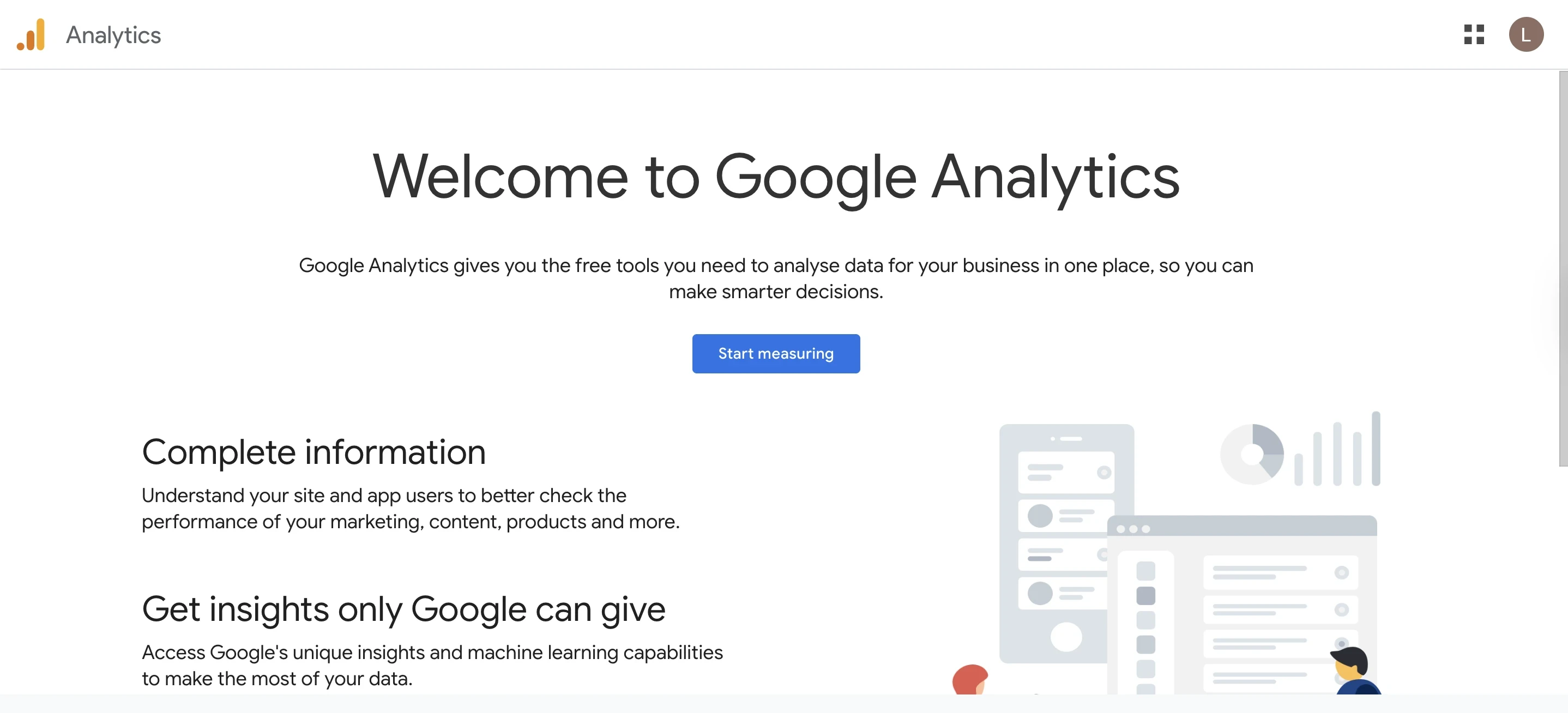
Google Analytics 4 is the baseline. Every team running paid ads should have it configured properly, and most already do. Including it on a "worth paying for" list might seem contradictory since GA4 is free, but the real cost is the time investment to set it up correctly, and the opportunity cost of relying on it alone.

GA4's event-based tracking model replaced the session-based approach of Universal Analytics, enabling cross-device and cross-platform measurement. Its data-driven attribution model uses machine learning to distribute conversion credit across touchpoints, which is a meaningful upgrade from last-click for teams that have not invested in a dedicated attribution tool.

The native Google Ads integration is strong. Conversion tracking, audience building, and automated bidding signals all flow directly between the platforms with minimal setup. If Google Ads is your primary paid channel, GA4 provides solid foundational ad performance tracking at no cost.

GA4 also supports predictive audiences, a machine learning feature that identifies users likely to purchase or churn within the next seven days. For teams running remarketing campaigns, these signals feed directly into Google Ads audience targeting without additional tools.

Strength: Free, deeply integrated with Google Ads, and backed by Google's machine learning for attribution and predictive audiences. The BigQuery export enables advanced analysis for teams with data engineering resources.

Limitation: GA4's learning curve is notoriously steep. The interface is unintuitive for marketers (as opposed to analysts), the data model is complex, and custom reporting requires significant configuration. Cross-channel attribution outside the Google ecosystem is limited. And it provides zero insight into creative performance or competitor activity.

Best for: Every team as a baseline tracking layer. Particularly valuable for small to mid-sized businesses where Google Ads is the primary paid channel and budget for dedicated analytics tools is limited.

Pricing: Free. Google Analytics 360 (enterprise tier) starts at approximately $50,000/year for teams needing higher data limits, SLAs, and advanced integrations.

Feature Comparison: How These Tools Stack Up

Feature

Hawky

Triple Whale

Northbeam

Supermetrics

GA4

Element-level creative analysis

Yes

No

No

No

No

Multi-touch attribution

Via integrations

Yes

Yes (MMM + MTA)

No

Basic

Creative fatigue prediction

Yes

No

No

No

No

Competitor intelligence

Yes

No

No

No

No

AI creative generation

Yes

No

No

No

No

Cross-channel data aggregation

Meta + Google

Shopify ecosystem

Multi-channel

100+ platforms

Google ecosystem

Profit/COGS tracking

No

Yes

Via integrations

No

No

Real-time alerts

Yes

Yes

Daily refresh

No

No

Agency multi-account support

Yes

Limited

Yes

Yes

Yes

Starting price

Custom

$129/mo

Custom ($$$$)

$29/mo

Free

Attribution vs. Creative Analytics: The Gap Most Teams Ignore

Attribution vs. Creative Analytics: The Gap Most Teams Ignore

Advertising analytics conversations almost always default to attribution. "Which channel gets credit for the conversion?" is the question every tool tries to answer. But attribution only solves half the problem.

Knowing that Meta drove 60% of your conversions last month does not tell you what to do about the 15 ad creatives that are fatiguing, or why your new hook style is outperforming the old one, or what your top competitor just changed in their messaging strategy.

Creative analytics is the other half. It answers questions like: which hook format holds attention past the first three seconds? Which CTA language drives the highest conversion rate for your audience? Which visual styles are fatiguing fastest?

These are the decisions that directly impact the creative assets your team produces every week.

The gap exists because most analytics tools were built during an era when media buying was the primary lever. Bid optimization, audience targeting, and channel allocation were where the alpha was.

In 2026, those levers are increasingly automated by the ad platforms themselves. Meta's Advantage+ campaigns and Google's Performance Max handle much of the bidding and targeting automatically. The remaining competitive advantage is in creative strategy, and that requires a different type of advertising analytics.

Consider this: if two brands run the same Advantage+ campaign targeting the same audience, the one with better creatives wins the auction at a lower CPM. Attribution tells you which campaign won. Creative analytics tells you why it won and how to replicate that result across your next 20 ads.

Teams that invest in both attribution analytics (to allocate budget correctly) and creative analytics (to produce better-performing ads) consistently outperform teams that only invest in one. Univest, for example, increased CTR by 20% within 7 days by applying element-level creative intelligence from Hawky alongside their existing attribution setup.

Which Tool Is Right for Your Team?

If you are a Shopify DTC brand spending $20K-$200K/month on paid ads: Start with Triple Whale for profit attribution and GA4 as your baseline. Add Hawky when you are ready to optimize creative strategy, not just channel allocation.

If you are an enterprise brand or large agency managing $500K+/month across channels: Northbeam for attribution, Hawky for creative intelligence, and Supermetrics to feed your data warehouse. This stack covers measurement, creative optimization, and reporting.

If you are a growing brand with a small team and limited budget: GA4 configured properly is your foundation. Add Supermetrics when manual data pulling becomes unsustainable. Add Hawky when you are producing enough creative volume that understanding what works at the element level becomes a competitive advantage.

If you are an agency managing 10+ client accounts: Supermetrics for data aggregation and client reporting, Hawky for creative analysis and competitor intelligence across your portfolio, and either Triple Whale or Northbeam for attribution depending on whether your clients are primarily Shopify-based. The combination of Hawky's competitor intelligence and Supermetrics' reporting capabilities is particularly strong for agencies that need to track creative trends across multiple verticals simultaneously.

If you want one tool that eliminates the attribution-creative analysis gap: Hawky is the only platform on this list combining element-level creative analysis, predictive fatigue detection, competitor creative intelligence, AI creative generation, and an agentic automation layer. For teams tired of stitching together five tools to get a complete picture, it consolidates the creative intelligence side into one platform.

Frequently Asked Questions

What is advertising analytics?

Advertising analytics is the practice of collecting and analyzing data from paid advertising campaigns to measure performance, identify what drives results, and optimize future ad spend. It encompasses attribution modeling (which channels and campaigns drove conversions), creative analysis (which ad elements perform best), and competitive intelligence (what competitors are running). Modern advertising analytics tools use AI and machine learning to automate pattern detection and surface actionable insights rather than just reporting raw metrics.

What is the difference between marketing analytics and advertising analytics?

Marketing analytics covers the full marketing mix, including organic search, email, content marketing, social media, and brand campaigns. Advertising analytics focuses specifically on paid media: the ads you pay to place on platforms like Meta, Google, TikTok, and LinkedIn. Advertising analytics tools are built to handle ad-specific challenges like multi-touch attribution across paid channels, creative performance measurement, and return on ad spend (ROAS) calculation. Some tools, like GA4 and Supermetrics, straddle both categories, while others like Hawky and Triple Whale are purpose-built for paid advertising.

Are free analytics tools good enough for paid ads?

GA4 provides solid foundational tracking at no cost, especially for teams where Google Ads is the primary channel. However, free tools have meaningful limitations for serious ad spenders. GA4 does not offer creative-level analysis, competitor intelligence, or accurate multi-touch attribution across non-Google channels. Teams spending more than $20K/month on paid ads typically find that the revenue gained from better attribution accuracy and creative optimization more than justifies the cost of dedicated advertising analytics tools.

How do advertising analytics tools handle iOS 14.5+ privacy changes?

Most modern advertising analytics tools address iOS tracking limitations through server-side tracking (also called Conversions API or CAPI). Instead of relying on browser cookies that Apple's App Tracking Transparency framework blocks, these tools send conversion data directly from the server. Triple Whale uses a first-party pixel, Northbeam uses machine learning to model conversions across devices, and Hawky integrates with platform APIs to maintain creative performance data accuracy. The result is more reliable attribution data than platform-reported numbers alone.

What should I look for in an advertising analytics tool?

Focus on three criteria: accuracy, actionability, and integration depth. Accuracy means the tool tracks conversions independently of platform-reported numbers and accounts for iOS privacy changes. Actionability means it tells you what to do next, not just what happened.

Integration depth means it connects with the ad platforms, ecommerce systems, and reporting tools your team already uses. Beyond these basics, consider whether you need attribution analytics (channel-level budget allocation), creative analytics (element-level performance optimization), or data aggregation (centralized reporting). Most teams eventually need all three.

Can one tool replace all my advertising analytics needs?

No single tool covers everything perfectly, but the number of tools you need has decreased significantly. Platforms like Hawky cover creative analysis, competitor intelligence, and AI creative generation in one platform, reducing the need for separate tools for each function.

Pair it with an attribution tool (Triple Whale or Northbeam) and GA4 as a baseline, and most teams have complete coverage. The goal is not one tool to rule them all. It is a tight stack of two to three tools where each solves a distinct, high-value problem.

If your analytics setup shows you what happened last month but does not tell you which creative elements to double down on next week, you are missing the part that actually moves performance. Hawky's creative intelligence platform is built for that job.

Ready to Stop Guessing and Start Winning with Creative Intelligence? Book a Demo

The short answer: Hawky for creative intelligence, Triple Whale for Shopify attribution, and Northbeam for enterprise multi-touch modeling are the top three advertising analytics tools worth paying for. Supermetrics and Google Analytics 4 round out the list for data aggregation and foundational tracking, respectively.

If you are running paid ads in 2026, your biggest problem is not a lack of data. You are drowning in it. The real problem is that most advertising analytics tools show you what happened without explaining why it happened or what to do next.

The tools on this list earn their price tag because they solve specific, high-value problems for performance marketing teams. No filler. No tools that exist just to pad a listicle to 15 entries. These five are the ones that justify the line item in your budget.

What Advertising Analytics Actually Means in 2026

Advertising analytics is the process of collecting, measuring, and interpreting data from paid ad campaigns to understand what drives performance and where budget is wasted. It goes beyond vanity metrics like impressions and clicks to connect ad spend with revenue outcomes.

The category has split into three distinct lanes over the past two years. Attribution tools (like Triple Whale and Northbeam) answer "which channels and campaigns deserve credit for conversions?" Data aggregation tools (like Supermetrics) answer "how do I get all my ad data into one place?" And creative analytics tools (like Hawky) answer "which specific ad elements are driving results?"

Most teams still rely on platform-reported numbers from Meta and Google. The problem: those numbers routinely overcount conversions by 20-40% after Apple's App Tracking Transparency privacy changes introduced with iOS 14.5+. Independent advertising analytics tools exist specifically because the ad platforms grading their own homework is not a reliable measurement strategy.

According to LayerFive's 2026 attribution research, 47% of marketing spend is wasted due to broken attribution, with most tools achieving only 5-15% identity resolution accuracy. That gap between what platforms report and what actually happened is where the right analytics tool pays for itself.

A good advertising analytics tool in 2026 does three things: it tracks performance accurately across channels, it explains the "why" behind the numbers, and it gives you a clear next action. Tools that only do the first part are table stakes. The ones worth paying for do all three.

The five tools in this list were selected because each one solves a problem the others do not. There is no overlap for the sake of variety. Each tool represents a different category of advertising analytics: creative intelligence, DTC attribution, enterprise measurement, data aggregation, and foundational tracking.

The 5 Best Advertising Analytics Tools

1. Hawky - Best for Creative Intelligence and Element-Level Ad Analytics

Hawky - Best for Creative Intelligence and Element-Level Ad Analytics

Most advertising analytics tools tell you that an ad is underperforming. Hawky tells you which specific element is dragging it down, whether that is the hook, the visual, the CTA, or the body copy.

Hawky is an AI-native creative intelligence platform built for performance marketers who need to understand not just campaign-level metrics, but the individual creative components that drive results. Where attribution tools stop at "this campaign generated X revenue," Hawky goes deeper: it analyzes ad performance at the element level, tracks competitor creative strategies, predicts creative fatigue before it tanks your ROAS, and generates new creatives from winning patterns.

The platform's Command Center acts as an agentic operating system for creative performance. It automatically generates prioritized task lists, scores every creative component, and sends real-time alerts when ads start fatiguing. For teams managing dozens of active creatives across Meta and Google Ads, this replaces the manual spreadsheet audits that eat hours every week.

Key capabilities:

  • Element-level creative analysis: break down ad performance by hook, visual, CTA, and body copy to identify exactly what drives results

  • Predictive fatigue detection: get alerts before creative fatigue impacts your metrics, not after you have already wasted budget

  • Competitor intelligence: track competitor ad strategies, creative hooks, messaging shifts, and new offers with weekly automated reports

  • AI creative generation: generate new ad creatives from winning patterns, complete with performance predictions and brand consistency checks

  • Copilot AI: ask "why is this ad working?" and get cited analysis of hook styles, emotional triggers, and audience fit

Best for: Performance marketing teams and agencies running $50K+/month on Meta and Google Ads who need to move beyond campaign-level reporting into creative-level optimization. Hiveminds, one of India's largest agencies, cut CPL by 27% and saved 160+ hours per brand monthly using Hawky.

Pricing: Custom plans based on ad spend volume. See pricing.

Limitation: Currently focused on Meta, TikTok and Google Ads. If your primary spend is on Snapchat, or programmatic channels, Hawky's integrations are not there yet. That said, Meta and Google represent the majority of paid social and search spend for most performance marketing teams, so the coverage gap is smaller than it appears for the typical Hawky user.

2. Triple Whale - Best for Shopify Attribution and Profit Tracking

2. Triple Whale - Best for Shopify Attribution and Profit Tracking

Triple Whale is a cross-channel attribution and ad analytics platform built specifically for DTC ecommerce brands on Shopify. Its core value is connecting ad spend to actual profit, not just revenue.

Where most attribution tools show you ROAS, Triple Whale layers in cost of goods sold (COGS), shipping costs, and customer lifetime value to show true profit per campaign. For Shopify brands scaling paid acquisition, this distinction matters: a 4x ROAS campaign that is actually unprofitable after fulfillment costs is worse than a 2.5x ROAS campaign with higher margins.

Triple Whale's first-party pixel addresses iOS 14.5+ attribution gaps by tracking conversions server-side. It pulls data from Meta, Google, TikTok, Snapchat, and email platforms into a single dashboard with daily updates. The platform also offers cohort-based analysis that shows how customer acquisition costs and lifetime value shift over time, which is critical for brands evaluating whether their paid acquisition strategy is sustainable beyond the initial purchase.

Strength: Profit-first attribution for Shopify brands. The Shopify integration is deep, including inventory-aware analytics and cohort-based LTV tracking that most competitors cannot match.

Limitation: Shopify-only. If your brand runs on WooCommerce, BigCommerce, Magento, or a custom storefront, Triple Whale is not an option. The platform also does not analyze creative elements (hooks, CTAs, visuals), so you are still left guessing about why specific ads perform.

Best for: DTC Shopify brands spending $20K-$500K/month on paid ads who need accurate profit attribution across channels.

Pricing: Starts around $129/month. Enterprise tiers scale with tracked revenue.

3. Northbeam - Best for Enterprise Multi-Touch Attribution

3. Northbeam - Best for Enterprise Multi-Touch Attribution

Northbeam is a machine learning-powered attribution platform designed for brands with large ad budgets and complex, multi-channel customer journeys. It uses media mix modeling (MMM) alongside multi-touch attribution (MTA) to measure true marketing incrementality, a metric that answers the hardest question in advertising analytics: "would this conversion have happened anyway?"

The platform's key differentiator is how it distributes conversion credit. Unlike tools that rely on last-click or platform-reported attribution, Northbeam assigns fractional credit across every touchpoint in the customer journey. One order might be attributed 0.6 to Meta, 0.3 to Google, and 0.1 to TikTok. The total never exceeds actual sales, which eliminates the over-attribution problem that plagues platform-reported numbers.

Northbeam also delivers creative-level attribution granularity. If you are running 50 different Meta ad creatives, it identifies which ones most influence buyers. This is closer to creative analytics than most attribution tools get, though it still focuses on which creative drove conversions rather than analyzing why it worked at the element level.

Strength: Statistical rigor. Northbeam's incrementality testing and media mix modeling give enterprise teams the confidence to make large budget allocation decisions across channels.

Limitation: Pricing is roughly 2-3x Triple Whale's, which puts it out of reach for smaller brands. The platform's sophistication also means a steeper learning curve and longer time-to-value than simpler tools. Data refreshes can be daily rather than real-time, which frustrates media buyers who want to make intraday bid decisions. Northbeam also focuses on telling you which creative drove conversions, but does not break down why at the element level (hook, CTA, visual style).

Best for: Enterprise brands and large agencies managing $500K+/month in ad spend across five or more channels who need statistically defensible attribution for board-level reporting.

Pricing: Custom enterprise pricing. Typically starts in the mid-four figures monthly.

4. Supermetrics - Best for Data Aggregation and Custom Reporting

4. Supermetrics - Best for Data Aggregation and Custom Reporting

Supermetrics is not an analytics tool in the traditional sense. It is a data pipeline that pulls advertising data from 100+ platforms and pushes it into wherever your team actually does analysis: Google Sheets, Excel, Looker Studio, BigQuery, Snowflake, or Power BI.

The value proposition is straightforward. If your team spends hours every week manually exporting data from Meta Ads Manager, Google Ads, LinkedIn, TikTok, and a handful of other platforms, then copying it into spreadsheets or dashboards, Supermetrics automates that entire process. Scheduled data pulls, automatic refreshes, and pre-built templates for common reports save significant time.

For agencies managing multiple clients, Supermetrics is particularly useful. Multi-account data pulls, white-label reporting templates, and the ability to blend data from different platforms into a single view make client reporting faster and more consistent.

The real value of Supermetrics becomes clear when you calculate the hours your team spends on manual reporting. If an analyst spends 5 hours per week pulling and formatting data from four ad platforms into a client report, that is 260 hours per year on data extraction instead of analysis. Supermetrics eliminates most of that overhead, freeing your team to focus on insights that actually change campaign performance.

Strength: Breadth of connectors. No other tool in this list integrates with as many ad platforms, analytics tools, and data destinations. If you need to combine data from obscure or niche ad platforms, Supermetrics probably has a connector.

Limitation: Supermetrics moves data. It does not analyze it. There is no attribution modeling, no creative analysis, no predictive capabilities. You still need a human (or another tool) to make sense of the data once it lands in your spreadsheet or warehouse.

Best for: Agencies and in-house teams that already have strong analysts but waste too much time on manual data extraction. Works well as a complement to analytics tools like Hawky or Northbeam that go deeper on the analysis side.

Pricing: Starts at $29/month for basic Google Sheets connectors. Agency and enterprise plans scale with the number of data sources and destinations.

5. Google Analytics 4 - Best Free Option for Foundational Ad Tracking

5. Google Analytics 4 - Best Free Option for Foundational Ad Tracking

Google Analytics 4 is the baseline. Every team running paid ads should have it configured properly, and most already do. Including it on a "worth paying for" list might seem contradictory since GA4 is free, but the real cost is the time investment to set it up correctly, and the opportunity cost of relying on it alone.

GA4's event-based tracking model replaced the session-based approach of Universal Analytics, enabling cross-device and cross-platform measurement. Its data-driven attribution model uses machine learning to distribute conversion credit across touchpoints, which is a meaningful upgrade from last-click for teams that have not invested in a dedicated attribution tool.

The native Google Ads integration is strong. Conversion tracking, audience building, and automated bidding signals all flow directly between the platforms with minimal setup. If Google Ads is your primary paid channel, GA4 provides solid foundational ad performance tracking at no cost.

GA4 also supports predictive audiences, a machine learning feature that identifies users likely to purchase or churn within the next seven days. For teams running remarketing campaigns, these signals feed directly into Google Ads audience targeting without additional tools.

Strength: Free, deeply integrated with Google Ads, and backed by Google's machine learning for attribution and predictive audiences. The BigQuery export enables advanced analysis for teams with data engineering resources.

Limitation: GA4's learning curve is notoriously steep. The interface is unintuitive for marketers (as opposed to analysts), the data model is complex, and custom reporting requires significant configuration. Cross-channel attribution outside the Google ecosystem is limited. And it provides zero insight into creative performance or competitor activity.

Best for: Every team as a baseline tracking layer. Particularly valuable for small to mid-sized businesses where Google Ads is the primary paid channel and budget for dedicated analytics tools is limited.

Pricing: Free. Google Analytics 360 (enterprise tier) starts at approximately $50,000/year for teams needing higher data limits, SLAs, and advanced integrations.

Feature Comparison: How These Tools Stack Up

Feature

Hawky

Triple Whale

Northbeam

Supermetrics

GA4

Element-level creative analysis

Yes

No

No

No

No

Multi-touch attribution

Via integrations

Yes

Yes (MMM + MTA)

No

Basic

Creative fatigue prediction

Yes

No

No

No

No

Competitor intelligence

Yes

No

No

No

No

AI creative generation

Yes

No

No

No

No

Cross-channel data aggregation

Meta + Google

Shopify ecosystem

Multi-channel

100+ platforms

Google ecosystem

Profit/COGS tracking

No

Yes

Via integrations

No

No

Real-time alerts

Yes

Yes

Daily refresh

No

No

Agency multi-account support

Yes

Limited

Yes

Yes

Yes

Starting price

Custom

$129/mo

Custom ($$$$)

$29/mo

Free

Attribution vs. Creative Analytics: The Gap Most Teams Ignore

Attribution vs. Creative Analytics: The Gap Most Teams Ignore

Advertising analytics conversations almost always default to attribution. "Which channel gets credit for the conversion?" is the question every tool tries to answer. But attribution only solves half the problem.

Knowing that Meta drove 60% of your conversions last month does not tell you what to do about the 15 ad creatives that are fatiguing, or why your new hook style is outperforming the old one, or what your top competitor just changed in their messaging strategy.

Creative analytics is the other half. It answers questions like: which hook format holds attention past the first three seconds? Which CTA language drives the highest conversion rate for your audience? Which visual styles are fatiguing fastest?

These are the decisions that directly impact the creative assets your team produces every week.

The gap exists because most analytics tools were built during an era when media buying was the primary lever. Bid optimization, audience targeting, and channel allocation were where the alpha was.

In 2026, those levers are increasingly automated by the ad platforms themselves. Meta's Advantage+ campaigns and Google's Performance Max handle much of the bidding and targeting automatically. The remaining competitive advantage is in creative strategy, and that requires a different type of advertising analytics.

Consider this: if two brands run the same Advantage+ campaign targeting the same audience, the one with better creatives wins the auction at a lower CPM. Attribution tells you which campaign won. Creative analytics tells you why it won and how to replicate that result across your next 20 ads.

Teams that invest in both attribution analytics (to allocate budget correctly) and creative analytics (to produce better-performing ads) consistently outperform teams that only invest in one. Univest, for example, increased CTR by 20% within 7 days by applying element-level creative intelligence from Hawky alongside their existing attribution setup.

Which Tool Is Right for Your Team?

If you are a Shopify DTC brand spending $20K-$200K/month on paid ads: Start with Triple Whale for profit attribution and GA4 as your baseline. Add Hawky when you are ready to optimize creative strategy, not just channel allocation.

If you are an enterprise brand or large agency managing $500K+/month across channels: Northbeam for attribution, Hawky for creative intelligence, and Supermetrics to feed your data warehouse. This stack covers measurement, creative optimization, and reporting.

If you are a growing brand with a small team and limited budget: GA4 configured properly is your foundation. Add Supermetrics when manual data pulling becomes unsustainable. Add Hawky when you are producing enough creative volume that understanding what works at the element level becomes a competitive advantage.

If you are an agency managing 10+ client accounts: Supermetrics for data aggregation and client reporting, Hawky for creative analysis and competitor intelligence across your portfolio, and either Triple Whale or Northbeam for attribution depending on whether your clients are primarily Shopify-based. The combination of Hawky's competitor intelligence and Supermetrics' reporting capabilities is particularly strong for agencies that need to track creative trends across multiple verticals simultaneously.

If you want one tool that eliminates the attribution-creative analysis gap: Hawky is the only platform on this list combining element-level creative analysis, predictive fatigue detection, competitor creative intelligence, AI creative generation, and an agentic automation layer. For teams tired of stitching together five tools to get a complete picture, it consolidates the creative intelligence side into one platform.

Frequently Asked Questions

What is advertising analytics?

Advertising analytics is the practice of collecting and analyzing data from paid advertising campaigns to measure performance, identify what drives results, and optimize future ad spend. It encompasses attribution modeling (which channels and campaigns drove conversions), creative analysis (which ad elements perform best), and competitive intelligence (what competitors are running). Modern advertising analytics tools use AI and machine learning to automate pattern detection and surface actionable insights rather than just reporting raw metrics.

What is the difference between marketing analytics and advertising analytics?

Marketing analytics covers the full marketing mix, including organic search, email, content marketing, social media, and brand campaigns. Advertising analytics focuses specifically on paid media: the ads you pay to place on platforms like Meta, Google, TikTok, and LinkedIn. Advertising analytics tools are built to handle ad-specific challenges like multi-touch attribution across paid channels, creative performance measurement, and return on ad spend (ROAS) calculation. Some tools, like GA4 and Supermetrics, straddle both categories, while others like Hawky and Triple Whale are purpose-built for paid advertising.

Are free analytics tools good enough for paid ads?

GA4 provides solid foundational tracking at no cost, especially for teams where Google Ads is the primary channel. However, free tools have meaningful limitations for serious ad spenders. GA4 does not offer creative-level analysis, competitor intelligence, or accurate multi-touch attribution across non-Google channels. Teams spending more than $20K/month on paid ads typically find that the revenue gained from better attribution accuracy and creative optimization more than justifies the cost of dedicated advertising analytics tools.

How do advertising analytics tools handle iOS 14.5+ privacy changes?

Most modern advertising analytics tools address iOS tracking limitations through server-side tracking (also called Conversions API or CAPI). Instead of relying on browser cookies that Apple's App Tracking Transparency framework blocks, these tools send conversion data directly from the server. Triple Whale uses a first-party pixel, Northbeam uses machine learning to model conversions across devices, and Hawky integrates with platform APIs to maintain creative performance data accuracy. The result is more reliable attribution data than platform-reported numbers alone.

What should I look for in an advertising analytics tool?

Focus on three criteria: accuracy, actionability, and integration depth. Accuracy means the tool tracks conversions independently of platform-reported numbers and accounts for iOS privacy changes. Actionability means it tells you what to do next, not just what happened.

Integration depth means it connects with the ad platforms, ecommerce systems, and reporting tools your team already uses. Beyond these basics, consider whether you need attribution analytics (channel-level budget allocation), creative analytics (element-level performance optimization), or data aggregation (centralized reporting). Most teams eventually need all three.

Can one tool replace all my advertising analytics needs?

No single tool covers everything perfectly, but the number of tools you need has decreased significantly. Platforms like Hawky cover creative analysis, competitor intelligence, and AI creative generation in one platform, reducing the need for separate tools for each function.

Pair it with an attribution tool (Triple Whale or Northbeam) and GA4 as a baseline, and most teams have complete coverage. The goal is not one tool to rule them all. It is a tight stack of two to three tools where each solves a distinct, high-value problem.

If your analytics setup shows you what happened last month but does not tell you which creative elements to double down on next week, you are missing the part that actually moves performance. Hawky's creative intelligence platform is built for that job.

Ready to Stop Guessing and Start Winning with Creative Intelligence? Book a Demo

The short answer: Hawky for creative intelligence, Triple Whale for Shopify attribution, and Northbeam for enterprise multi-touch modeling are the top three advertising analytics tools worth paying for. Supermetrics and Google Analytics 4 round out the list for data aggregation and foundational tracking, respectively.

If you are running paid ads in 2026, your biggest problem is not a lack of data. You are drowning in it. The real problem is that most advertising analytics tools show you what happened without explaining why it happened or what to do next.

The tools on this list earn their price tag because they solve specific, high-value problems for performance marketing teams. No filler. No tools that exist just to pad a listicle to 15 entries. These five are the ones that justify the line item in your budget.

What Advertising Analytics Actually Means in 2026

Advertising analytics is the process of collecting, measuring, and interpreting data from paid ad campaigns to understand what drives performance and where budget is wasted. It goes beyond vanity metrics like impressions and clicks to connect ad spend with revenue outcomes.

The category has split into three distinct lanes over the past two years. Attribution tools (like Triple Whale and Northbeam) answer "which channels and campaigns deserve credit for conversions?" Data aggregation tools (like Supermetrics) answer "how do I get all my ad data into one place?" And creative analytics tools (like Hawky) answer "which specific ad elements are driving results?"

Most teams still rely on platform-reported numbers from Meta and Google. The problem: those numbers routinely overcount conversions by 20-40% after Apple's App Tracking Transparency privacy changes introduced with iOS 14.5+. Independent advertising analytics tools exist specifically because the ad platforms grading their own homework is not a reliable measurement strategy.

According to LayerFive's 2026 attribution research, 47% of marketing spend is wasted due to broken attribution, with most tools achieving only 5-15% identity resolution accuracy. That gap between what platforms report and what actually happened is where the right analytics tool pays for itself.

A good advertising analytics tool in 2026 does three things: it tracks performance accurately across channels, it explains the "why" behind the numbers, and it gives you a clear next action. Tools that only do the first part are table stakes. The ones worth paying for do all three.

The five tools in this list were selected because each one solves a problem the others do not. There is no overlap for the sake of variety. Each tool represents a different category of advertising analytics: creative intelligence, DTC attribution, enterprise measurement, data aggregation, and foundational tracking.

The 5 Best Advertising Analytics Tools

1. Hawky - Best for Creative Intelligence and Element-Level Ad Analytics

Hawky - Best for Creative Intelligence and Element-Level Ad Analytics

Most advertising analytics tools tell you that an ad is underperforming. Hawky tells you which specific element is dragging it down, whether that is the hook, the visual, the CTA, or the body copy.

Hawky is an AI-native creative intelligence platform built for performance marketers who need to understand not just campaign-level metrics, but the individual creative components that drive results. Where attribution tools stop at "this campaign generated X revenue," Hawky goes deeper: it analyzes ad performance at the element level, tracks competitor creative strategies, predicts creative fatigue before it tanks your ROAS, and generates new creatives from winning patterns.

The platform's Command Center acts as an agentic operating system for creative performance. It automatically generates prioritized task lists, scores every creative component, and sends real-time alerts when ads start fatiguing. For teams managing dozens of active creatives across Meta and Google Ads, this replaces the manual spreadsheet audits that eat hours every week.

Key capabilities:

  • Element-level creative analysis: break down ad performance by hook, visual, CTA, and body copy to identify exactly what drives results

  • Predictive fatigue detection: get alerts before creative fatigue impacts your metrics, not after you have already wasted budget

  • Competitor intelligence: track competitor ad strategies, creative hooks, messaging shifts, and new offers with weekly automated reports

  • AI creative generation: generate new ad creatives from winning patterns, complete with performance predictions and brand consistency checks

  • Copilot AI: ask "why is this ad working?" and get cited analysis of hook styles, emotional triggers, and audience fit

Best for: Performance marketing teams and agencies running $50K+/month on Meta and Google Ads who need to move beyond campaign-level reporting into creative-level optimization. Hiveminds, one of India's largest agencies, cut CPL by 27% and saved 160+ hours per brand monthly using Hawky.

Pricing: Custom plans based on ad spend volume. See pricing.

Limitation: Currently focused on Meta, TikTok and Google Ads. If your primary spend is on Snapchat, or programmatic channels, Hawky's integrations are not there yet. That said, Meta and Google represent the majority of paid social and search spend for most performance marketing teams, so the coverage gap is smaller than it appears for the typical Hawky user.

2. Triple Whale - Best for Shopify Attribution and Profit Tracking

2. Triple Whale - Best for Shopify Attribution and Profit Tracking

Triple Whale is a cross-channel attribution and ad analytics platform built specifically for DTC ecommerce brands on Shopify. Its core value is connecting ad spend to actual profit, not just revenue.

Where most attribution tools show you ROAS, Triple Whale layers in cost of goods sold (COGS), shipping costs, and customer lifetime value to show true profit per campaign. For Shopify brands scaling paid acquisition, this distinction matters: a 4x ROAS campaign that is actually unprofitable after fulfillment costs is worse than a 2.5x ROAS campaign with higher margins.

Triple Whale's first-party pixel addresses iOS 14.5+ attribution gaps by tracking conversions server-side. It pulls data from Meta, Google, TikTok, Snapchat, and email platforms into a single dashboard with daily updates. The platform also offers cohort-based analysis that shows how customer acquisition costs and lifetime value shift over time, which is critical for brands evaluating whether their paid acquisition strategy is sustainable beyond the initial purchase.

Strength: Profit-first attribution for Shopify brands. The Shopify integration is deep, including inventory-aware analytics and cohort-based LTV tracking that most competitors cannot match.

Limitation: Shopify-only. If your brand runs on WooCommerce, BigCommerce, Magento, or a custom storefront, Triple Whale is not an option. The platform also does not analyze creative elements (hooks, CTAs, visuals), so you are still left guessing about why specific ads perform.

Best for: DTC Shopify brands spending $20K-$500K/month on paid ads who need accurate profit attribution across channels.

Pricing: Starts around $129/month. Enterprise tiers scale with tracked revenue.

3. Northbeam - Best for Enterprise Multi-Touch Attribution

3. Northbeam - Best for Enterprise Multi-Touch Attribution

Northbeam is a machine learning-powered attribution platform designed for brands with large ad budgets and complex, multi-channel customer journeys. It uses media mix modeling (MMM) alongside multi-touch attribution (MTA) to measure true marketing incrementality, a metric that answers the hardest question in advertising analytics: "would this conversion have happened anyway?"

The platform's key differentiator is how it distributes conversion credit. Unlike tools that rely on last-click or platform-reported attribution, Northbeam assigns fractional credit across every touchpoint in the customer journey. One order might be attributed 0.6 to Meta, 0.3 to Google, and 0.1 to TikTok. The total never exceeds actual sales, which eliminates the over-attribution problem that plagues platform-reported numbers.

Northbeam also delivers creative-level attribution granularity. If you are running 50 different Meta ad creatives, it identifies which ones most influence buyers. This is closer to creative analytics than most attribution tools get, though it still focuses on which creative drove conversions rather than analyzing why it worked at the element level.

Strength: Statistical rigor. Northbeam's incrementality testing and media mix modeling give enterprise teams the confidence to make large budget allocation decisions across channels.

Limitation: Pricing is roughly 2-3x Triple Whale's, which puts it out of reach for smaller brands. The platform's sophistication also means a steeper learning curve and longer time-to-value than simpler tools. Data refreshes can be daily rather than real-time, which frustrates media buyers who want to make intraday bid decisions. Northbeam also focuses on telling you which creative drove conversions, but does not break down why at the element level (hook, CTA, visual style).

Best for: Enterprise brands and large agencies managing $500K+/month in ad spend across five or more channels who need statistically defensible attribution for board-level reporting.

Pricing: Custom enterprise pricing. Typically starts in the mid-four figures monthly.

4. Supermetrics - Best for Data Aggregation and Custom Reporting

4. Supermetrics - Best for Data Aggregation and Custom Reporting

Supermetrics is not an analytics tool in the traditional sense. It is a data pipeline that pulls advertising data from 100+ platforms and pushes it into wherever your team actually does analysis: Google Sheets, Excel, Looker Studio, BigQuery, Snowflake, or Power BI.

The value proposition is straightforward. If your team spends hours every week manually exporting data from Meta Ads Manager, Google Ads, LinkedIn, TikTok, and a handful of other platforms, then copying it into spreadsheets or dashboards, Supermetrics automates that entire process. Scheduled data pulls, automatic refreshes, and pre-built templates for common reports save significant time.

For agencies managing multiple clients, Supermetrics is particularly useful. Multi-account data pulls, white-label reporting templates, and the ability to blend data from different platforms into a single view make client reporting faster and more consistent.

The real value of Supermetrics becomes clear when you calculate the hours your team spends on manual reporting. If an analyst spends 5 hours per week pulling and formatting data from four ad platforms into a client report, that is 260 hours per year on data extraction instead of analysis. Supermetrics eliminates most of that overhead, freeing your team to focus on insights that actually change campaign performance.

Strength: Breadth of connectors. No other tool in this list integrates with as many ad platforms, analytics tools, and data destinations. If you need to combine data from obscure or niche ad platforms, Supermetrics probably has a connector.

Limitation: Supermetrics moves data. It does not analyze it. There is no attribution modeling, no creative analysis, no predictive capabilities. You still need a human (or another tool) to make sense of the data once it lands in your spreadsheet or warehouse.

Best for: Agencies and in-house teams that already have strong analysts but waste too much time on manual data extraction. Works well as a complement to analytics tools like Hawky or Northbeam that go deeper on the analysis side.

Pricing: Starts at $29/month for basic Google Sheets connectors. Agency and enterprise plans scale with the number of data sources and destinations.

5. Google Analytics 4 - Best Free Option for Foundational Ad Tracking

5. Google Analytics 4 - Best Free Option for Foundational Ad Tracking

Google Analytics 4 is the baseline. Every team running paid ads should have it configured properly, and most already do. Including it on a "worth paying for" list might seem contradictory since GA4 is free, but the real cost is the time investment to set it up correctly, and the opportunity cost of relying on it alone.

GA4's event-based tracking model replaced the session-based approach of Universal Analytics, enabling cross-device and cross-platform measurement. Its data-driven attribution model uses machine learning to distribute conversion credit across touchpoints, which is a meaningful upgrade from last-click for teams that have not invested in a dedicated attribution tool.

The native Google Ads integration is strong. Conversion tracking, audience building, and automated bidding signals all flow directly between the platforms with minimal setup. If Google Ads is your primary paid channel, GA4 provides solid foundational ad performance tracking at no cost.

GA4 also supports predictive audiences, a machine learning feature that identifies users likely to purchase or churn within the next seven days. For teams running remarketing campaigns, these signals feed directly into Google Ads audience targeting without additional tools.

Strength: Free, deeply integrated with Google Ads, and backed by Google's machine learning for attribution and predictive audiences. The BigQuery export enables advanced analysis for teams with data engineering resources.

Limitation: GA4's learning curve is notoriously steep. The interface is unintuitive for marketers (as opposed to analysts), the data model is complex, and custom reporting requires significant configuration. Cross-channel attribution outside the Google ecosystem is limited. And it provides zero insight into creative performance or competitor activity.

Best for: Every team as a baseline tracking layer. Particularly valuable for small to mid-sized businesses where Google Ads is the primary paid channel and budget for dedicated analytics tools is limited.

Pricing: Free. Google Analytics 360 (enterprise tier) starts at approximately $50,000/year for teams needing higher data limits, SLAs, and advanced integrations.

Feature Comparison: How These Tools Stack Up

Feature

Hawky

Triple Whale

Northbeam

Supermetrics

GA4

Element-level creative analysis

Yes

No

No

No

No

Multi-touch attribution

Via integrations

Yes

Yes (MMM + MTA)

No

Basic

Creative fatigue prediction

Yes

No

No

No

No

Competitor intelligence

Yes

No

No

No

No

AI creative generation

Yes

No

No

No

No

Cross-channel data aggregation

Meta + Google

Shopify ecosystem

Multi-channel

100+ platforms

Google ecosystem

Profit/COGS tracking

No

Yes

Via integrations

No

No

Real-time alerts

Yes

Yes

Daily refresh

No

No

Agency multi-account support

Yes

Limited

Yes

Yes

Yes

Starting price

Custom

$129/mo

Custom ($$$$)

$29/mo

Free

Attribution vs. Creative Analytics: The Gap Most Teams Ignore

Attribution vs. Creative Analytics: The Gap Most Teams Ignore

Advertising analytics conversations almost always default to attribution. "Which channel gets credit for the conversion?" is the question every tool tries to answer. But attribution only solves half the problem.

Knowing that Meta drove 60% of your conversions last month does not tell you what to do about the 15 ad creatives that are fatiguing, or why your new hook style is outperforming the old one, or what your top competitor just changed in their messaging strategy.

Creative analytics is the other half. It answers questions like: which hook format holds attention past the first three seconds? Which CTA language drives the highest conversion rate for your audience? Which visual styles are fatiguing fastest?

These are the decisions that directly impact the creative assets your team produces every week.

The gap exists because most analytics tools were built during an era when media buying was the primary lever. Bid optimization, audience targeting, and channel allocation were where the alpha was.

In 2026, those levers are increasingly automated by the ad platforms themselves. Meta's Advantage+ campaigns and Google's Performance Max handle much of the bidding and targeting automatically. The remaining competitive advantage is in creative strategy, and that requires a different type of advertising analytics.

Consider this: if two brands run the same Advantage+ campaign targeting the same audience, the one with better creatives wins the auction at a lower CPM. Attribution tells you which campaign won. Creative analytics tells you why it won and how to replicate that result across your next 20 ads.

Teams that invest in both attribution analytics (to allocate budget correctly) and creative analytics (to produce better-performing ads) consistently outperform teams that only invest in one. Univest, for example, increased CTR by 20% within 7 days by applying element-level creative intelligence from Hawky alongside their existing attribution setup.

Which Tool Is Right for Your Team?

If you are a Shopify DTC brand spending $20K-$200K/month on paid ads: Start with Triple Whale for profit attribution and GA4 as your baseline. Add Hawky when you are ready to optimize creative strategy, not just channel allocation.

If you are an enterprise brand or large agency managing $500K+/month across channels: Northbeam for attribution, Hawky for creative intelligence, and Supermetrics to feed your data warehouse. This stack covers measurement, creative optimization, and reporting.

If you are a growing brand with a small team and limited budget: GA4 configured properly is your foundation. Add Supermetrics when manual data pulling becomes unsustainable. Add Hawky when you are producing enough creative volume that understanding what works at the element level becomes a competitive advantage.

If you are an agency managing 10+ client accounts: Supermetrics for data aggregation and client reporting, Hawky for creative analysis and competitor intelligence across your portfolio, and either Triple Whale or Northbeam for attribution depending on whether your clients are primarily Shopify-based. The combination of Hawky's competitor intelligence and Supermetrics' reporting capabilities is particularly strong for agencies that need to track creative trends across multiple verticals simultaneously.

If you want one tool that eliminates the attribution-creative analysis gap: Hawky is the only platform on this list combining element-level creative analysis, predictive fatigue detection, competitor creative intelligence, AI creative generation, and an agentic automation layer. For teams tired of stitching together five tools to get a complete picture, it consolidates the creative intelligence side into one platform.

Frequently Asked Questions

What is advertising analytics?

Advertising analytics is the practice of collecting and analyzing data from paid advertising campaigns to measure performance, identify what drives results, and optimize future ad spend. It encompasses attribution modeling (which channels and campaigns drove conversions), creative analysis (which ad elements perform best), and competitive intelligence (what competitors are running). Modern advertising analytics tools use AI and machine learning to automate pattern detection and surface actionable insights rather than just reporting raw metrics.

What is the difference between marketing analytics and advertising analytics?

Marketing analytics covers the full marketing mix, including organic search, email, content marketing, social media, and brand campaigns. Advertising analytics focuses specifically on paid media: the ads you pay to place on platforms like Meta, Google, TikTok, and LinkedIn. Advertising analytics tools are built to handle ad-specific challenges like multi-touch attribution across paid channels, creative performance measurement, and return on ad spend (ROAS) calculation. Some tools, like GA4 and Supermetrics, straddle both categories, while others like Hawky and Triple Whale are purpose-built for paid advertising.

Are free analytics tools good enough for paid ads?

GA4 provides solid foundational tracking at no cost, especially for teams where Google Ads is the primary channel. However, free tools have meaningful limitations for serious ad spenders. GA4 does not offer creative-level analysis, competitor intelligence, or accurate multi-touch attribution across non-Google channels. Teams spending more than $20K/month on paid ads typically find that the revenue gained from better attribution accuracy and creative optimization more than justifies the cost of dedicated advertising analytics tools.

How do advertising analytics tools handle iOS 14.5+ privacy changes?

Most modern advertising analytics tools address iOS tracking limitations through server-side tracking (also called Conversions API or CAPI). Instead of relying on browser cookies that Apple's App Tracking Transparency framework blocks, these tools send conversion data directly from the server. Triple Whale uses a first-party pixel, Northbeam uses machine learning to model conversions across devices, and Hawky integrates with platform APIs to maintain creative performance data accuracy. The result is more reliable attribution data than platform-reported numbers alone.

What should I look for in an advertising analytics tool?

Focus on three criteria: accuracy, actionability, and integration depth. Accuracy means the tool tracks conversions independently of platform-reported numbers and accounts for iOS privacy changes. Actionability means it tells you what to do next, not just what happened.

Integration depth means it connects with the ad platforms, ecommerce systems, and reporting tools your team already uses. Beyond these basics, consider whether you need attribution analytics (channel-level budget allocation), creative analytics (element-level performance optimization), or data aggregation (centralized reporting). Most teams eventually need all three.

Can one tool replace all my advertising analytics needs?

No single tool covers everything perfectly, but the number of tools you need has decreased significantly. Platforms like Hawky cover creative analysis, competitor intelligence, and AI creative generation in one platform, reducing the need for separate tools for each function.

Pair it with an attribution tool (Triple Whale or Northbeam) and GA4 as a baseline, and most teams have complete coverage. The goal is not one tool to rule them all. It is a tight stack of two to three tools where each solves a distinct, high-value problem.

If your analytics setup shows you what happened last month but does not tell you which creative elements to double down on next week, you are missing the part that actually moves performance. Hawky's creative intelligence platform is built for that job.

Ready to Stop Guessing and Start Winning with Creative Intelligence? Book a Demo