Incrementality Testing
Last updated
A measurement method that isolates the true causal impact of advertising by comparing an exposed group against a held-back control group. It reveals which conversions your ads actually caused versus which would have happened anyway, so you stop paying for demand you already own.
Incrementality Testing
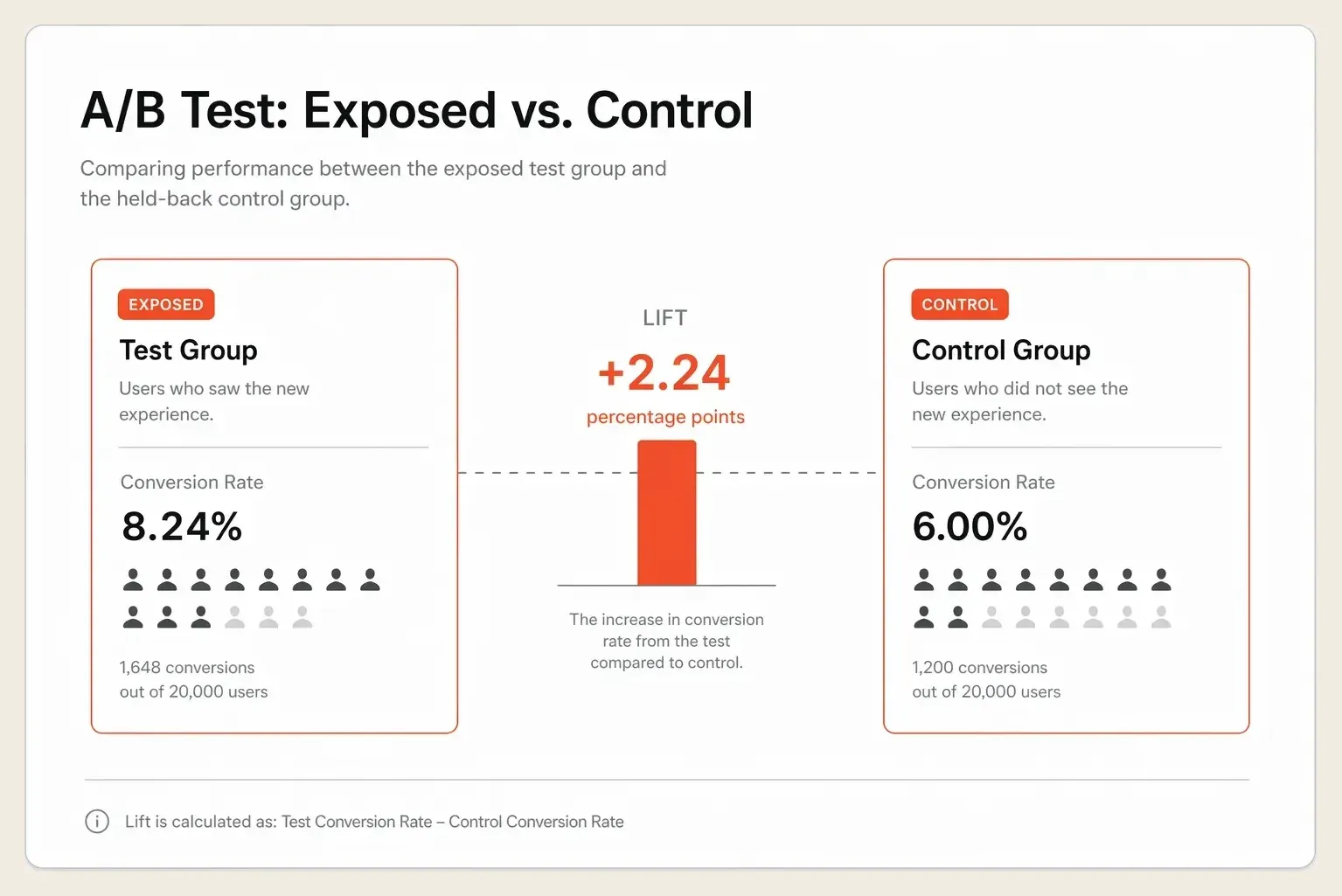
Incrementality Testing is a measurement method that isolates the true causal impact of advertising by comparing a group exposed to ads against a statistically matched group that was held back. It answers the one question attribution cannot: how many conversions happened because of the ad versus how many would have happened anyway. The result is a clean read on the real, incremental return of a campaign rather than the credit a tracking pixel happens to assign.
Why It Matters
Standard attribution gives every conversion a home, but it cannot tell you whether the ad caused that conversion or simply showed up on the path of a customer who was always going to buy. Retargeting is the classic trap: a retargeting campaign can post a glittering 8x return while contributing almost nothing incremental, because those users were already heading to checkout. Incrementality testing strips that illusion away and shows what spend actually moves.
The money at stake is enormous. Large advertisers running geo and holdout experiments routinely discover that 20 to 40 percent of "attributed" conversions are not incremental, meaning a meaningful slice of budget is paying for sales that would have closed for free. Brands that test incrementality reallocate that waste into channels with proven lift, which is why platforms now ship native lift tools and why measurement teams treat incrementality as the ground truth that an attribution model only estimates.
How It Works
Incrementality testing works by creating a control group that is deliberately not shown the ads, then measuring the difference in conversions between the exposed and held-back groups. That difference, the lift, is the incremental contribution of the advertising.
- Holdout Group: A randomly selected share of the audience that is suppressed from seeing the campaign, serving as the baseline. See holdout group.
- Geo Testing: Splitting matched regions into test and control markets when user-level holdouts are not possible.
- Lift Calculation: Conversions in the exposed group minus the control group's rate, scaled to the audience.
- Statistical Significance: Confirming the gap is real and not noise, which requires adequate sample size and test duration.
In practice, teams run a holdout for a fixed window, measure the conversion rate in both groups, and calculate lift along with a confidence interval. The cleaner the randomization and the larger the sample, the more trustworthy the result, which is why statistical significance is the gate before any budget decision.
A Real Example
A direct-to-consumer brand was spending $120,000 a month on a branded search and retargeting stack that reported a combined 6x return.
Suspicious that much of it was capturing demand it already owned, the team ran a 4-week geo incrementality test, suppressing the campaigns in 15 matched markets while keeping them live in 15 others. Conversions in the test (suppressed) markets dropped only 9 percent, far less than the 6x return implied. The incrementality math showed the true incremental return was closer to 1.4x, not 6x. The brand cut the retargeting budget by 60 percent, shifted it to a prospecting campaign that an earlier lift test had validated, and held total conversions flat while spending $50,000 less per month.
Common Mistakes
| The Mistake | ❌ Wrong Approach | ✅ Better Approach |
|---|---|---|
| Trusting attribution as truth | Treating last-click ROAS as causal impact | Validating with a holdout to measure real lift |
| Underpowered tests | Reading a result with too small a sample | Sizing the test for statistical significance first |
| Cutting tests too early | Calling a winner after a few days | Running the full pre-set test duration |
| Contaminated control | Letting the control group see the ads anyway | Enforcing clean suppression so the baseline stays valid |
How Hawky Helps
Spending against attribution alone means paying for conversions you may already own, and the only way to know the difference is to measure lift. Hawky's Performance Agent reads incrementality signals alongside cost and conversion data, so it optimizes budget toward the campaigns that produce proven, causal lift rather than the ones that simply collect last-click credit. It treats a holdout result as a direct instruction to reallocate, not a report to file.
Every lift finding, which channels drove real incremental conversions and which only harvested existing demand, is written to FeatherDB as living context the agents reuse on the next planning cycle. That memory means the account stops re-learning the same lesson and compounds toward spend that genuinely grows the business. The result is a system that buys incrementality, not vanity return.
Frequently Asked Questions
What is the difference between incrementality and attribution?
Attribution assigns credit for a conversion to the touchpoints a user interacted with, while incrementality measures whether the ad actually caused the conversion at all. Attribution can credit a sale that would have happened without any ad, which is why it often overstates impact. Incrementality testing uses a control group to isolate the conversions that exist only because of the advertising.
How do you run an incrementality test?
You run an incrementality test by holding back a randomly selected control group from seeing the campaign, then comparing its conversion rate against the exposed group over a fixed window. The difference between the two groups is the incremental lift. The test must be sized for statistical significance and run long enough to capture the full conversion cycle before you act on the result.
What is a holdout group in incrementality testing?
A holdout group is the share of the audience deliberately suppressed from seeing the ads, serving as the baseline for what would have happened without the campaign. By comparing conversions in the exposed audience against the holdout, you measure the true lift the advertising created. Clean randomization and no contamination are essential for the holdout to be valid.
Why does retargeting often show low incrementality?
Retargeting frequently shows low incrementality because it targets people who already visited your site and are often close to purchasing anyway. Attribution credits those conversions to the retargeting ad, but a holdout test usually reveals many would have converted without it. This is why retargeting can report a high return while contributing far less incremental revenue than it appears to.
Quick Takeaway
Incrementality Testing reveals which conversions your advertising actually caused versus which would have happened regardless, which is the only honest basis for allocating budget. Validate your biggest spend with a holdout before trusting its reported return, because attribution alone routinely overstates impact by a third or more.
Suspect your reported ROAS is crediting demand you already own? Ready to hire your first AI performance team? Book Demo