Market Share of Voice
Last updated
The percentage of total advertising presence in your category that belongs to your brand, measured by impressions, spend, or mentions. Because it tends to lead share of market, watching it tells you whether you are buying growth or conceding it.
Market Share of Voice
Market Share of Voice (SOV) is the percentage of total advertising presence in your category that belongs to your brand. It measures how loud your brand is relative to everyone competing for the same audience, whether that presence is paid impressions, ad spend, search visibility, or social conversation. If the whole category generates a million ad impressions and your brand accounts for two hundred thousand of them, your share of voice is 20 percent. SOV is the closest proxy for how much of the market's attention you actually own.
Why It Matters
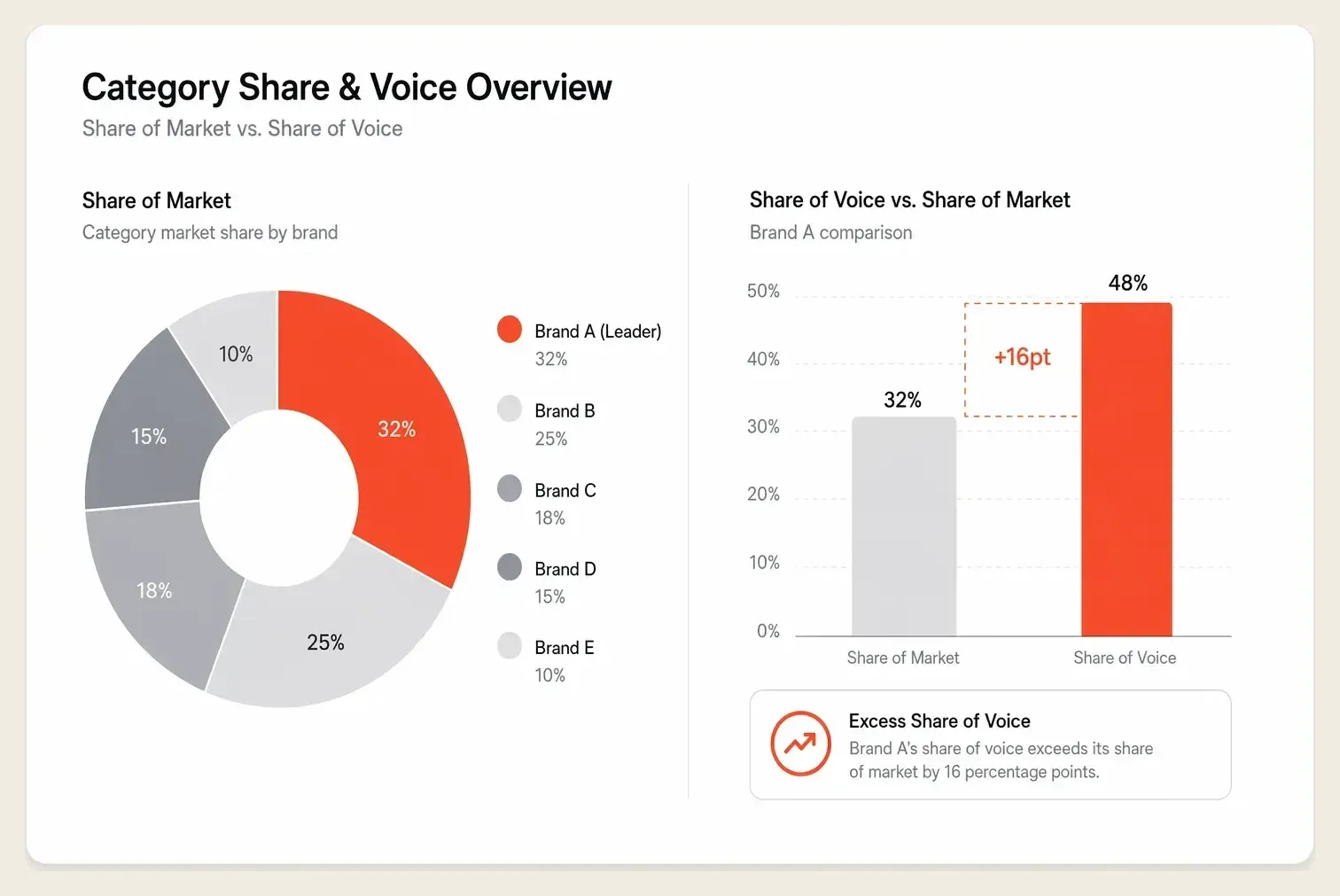
Share of voice matters because it predicts share of market. Decades of marketing research show that brands tend to grow when their share of voice exceeds their share of market and shrink when it falls below, a relationship strong enough that the gap between the two, often called excess share of voice, is treated as a leading indicator of future growth. When you outspend your share of attention, you are buying tomorrow's market share. When you underspend it, you are slowly giving it away.
The risk is that share of voice moves before your sales do. A competitor flooding the category with impressions raises the cost of attention, crowds you out of the feed, and erodes your position months before it shows up in revenue. Tracking SOV turns that slow erosion into something you can see and respond to while there is still room to act.
How It Works
Share of voice is calculated by comparing your brand's advertising presence to the total presence of the category, using whichever measure of presence fits the channel. The metric is only as good as the competitor set you define, so the first step is deciding who counts as the category.
- Choose the measure: paid impressions, ad spend, search impression share, or social mentions, depending on the channel you care about.
- Define the category: the specific set of competitors you compete with for the same audience, not the entire industry.
- Measure consistently: pull the same metric across the same window for every brand so the comparison is fair.
- Compare to share of market: hold SOV next to your revenue or unit share to see whether you are over or underinvesting.
Different channels use different presence measures. On search it often means impression share, on paid social it leans on impressions or estimated spend, and on organic social it is conversation volume. The principle holds across all of them: your slice divided by the category's whole.
Formula
The core formula is a simple ratio expressed as a percentage.
Share of Voice = (Your Brand's Advertising Presence / Total Category Advertising Presence) x 100
Where presence is measured by impressions, spend, or mentions depending on channel. Typical interpretation ranges:
- SOV roughly equal to share of market: a stable, defended position.
- SOV above share of market (positive excess SOV): a growth signal, you are investing ahead of your size.
- SOV below share of market (negative excess SOV): a warning, competitors are buying the attention you are conceding.
A common planning rule of thumb holds that each point of excess share of voice tends to correlate with future share-of-market gains, though the exact ratio varies by category, brand strength, and how cluttered the market is. Benchmarks are directional, and your own trend against named competitors matters more than any universal figure.
A Real Example
A regional coffee brand held a 14 percent share of market but discovered its share of voice on paid social had slipped to 9 percent as two competitors increased spend. The negative excess share of voice was a quiet alarm: the brand was being out-shouted in the exact channel its buyers used most, and history said its market share would follow downward if nothing changed.
Rather than match the spend blindly, the brand concentrated budget on the segments where it already led and competitors were weakest, lifting its SOV in those pockets to 19 percent. Within two quarters its blended share of market ticked up to 16 percent. Reading competitive intelligence alongside SOV let it buy attention where it converted instead of everywhere at once, protecting ROAS while gaining ground.
Common Mistakes
| ❌ Mistakes | ✅ Better Approach |
|---|---|
| Measure share of voice against the whole industry | Define a precise competitor set you actually compete with for the same audience |
| Treat SOV as a vanity number disconnected from sales | Compare SOV to share of market to see whether you are over or underinvesting |
| Chase total spend to raise SOV everywhere at once | Concentrate budget where excess SOV converts, guided by competitor ad analysis by segment |
How Hawky Helps
Hawky keeps share of voice in view with agents that read the category and act on it. Copilot tracks competitor presence as part of the competitive intelligence picture, answering where your share of voice is rising or slipping and which competitors are buying the attention, with sources attached. Instead of stitching together spend estimates by hand, you ask and get a grounded read.
When SOV points to an opening or a threat, the Performance Agent reallocates budget toward the segments where extra share of voice actually converts rather than spending to be loud everywhere. FeatherDB remembers how SOV and results have moved together over time, so the account learns which pockets of attention are worth owning.
Frequently Asked Questions
What is market share of voice?
Market share of voice is the percentage of total advertising presence in your category that belongs to your brand, measured by impressions, spend, search visibility, or social mentions. It captures how loud your brand is relative to competitors fighting for the same audience. Because it tends to predict share of market, SOV is widely used as a leading indicator of brand growth or decline.
How do you calculate share of voice?
Divide your brand's advertising presence by the total presence of the category and multiply by 100. Presence can be impressions, estimated spend, search impression share, or social mentions, depending on the channel. The result only means something when the category is defined as the specific competitors you compete with, measured over the same window with the same metric.
What is a good share of voice?
A good share of voice is one that meets or exceeds your share of market, because brands with positive excess share of voice tend to grow while those below it tend to decline. There is no universal target number, since it depends on category clutter and brand strength. The useful benchmark is your SOV relative to your own market share and to named competitors over time.
How is share of voice different from share of market?
Share of voice measures your slice of the category's advertising attention, while share of market measures your slice of its actual sales or units. SOV is the input and share of market is the outcome, with research showing SOV changes tend to lead market share changes. Comparing the two reveals whether you are investing ahead of your size or quietly underfunding your position.
Quick Takeaway
Market share of voice measures how much of your category's advertising attention your brand owns, and because it tends to lead share of market, watching the gap between the two tells you whether you are buying future growth or conceding it.
Knowing where your share of voice is slipping only pays off if you can move budget to defend it, which is exactly what agents on the account are built to do. Ready to hire your first AI performance team? Book Demo