Reach
Last updated
Reach is the number of unique people who saw your ad at least once during a campaign, the cleanest signal of how far your spend actually spread. Track it against impressions to catch frequency creep before saturation drives up your CPA.
Reach
Reach is the number of unique people who saw your ad at least once during a campaign, counted as individuals rather than views. If 10,000 different people each saw your ad, your reach is 10,000, no matter how many total times the ad appeared on their screens. Reach measures the size of the audience you actually touched, which makes it the cleanest signal of how far a campaign spread.
Why It Matters
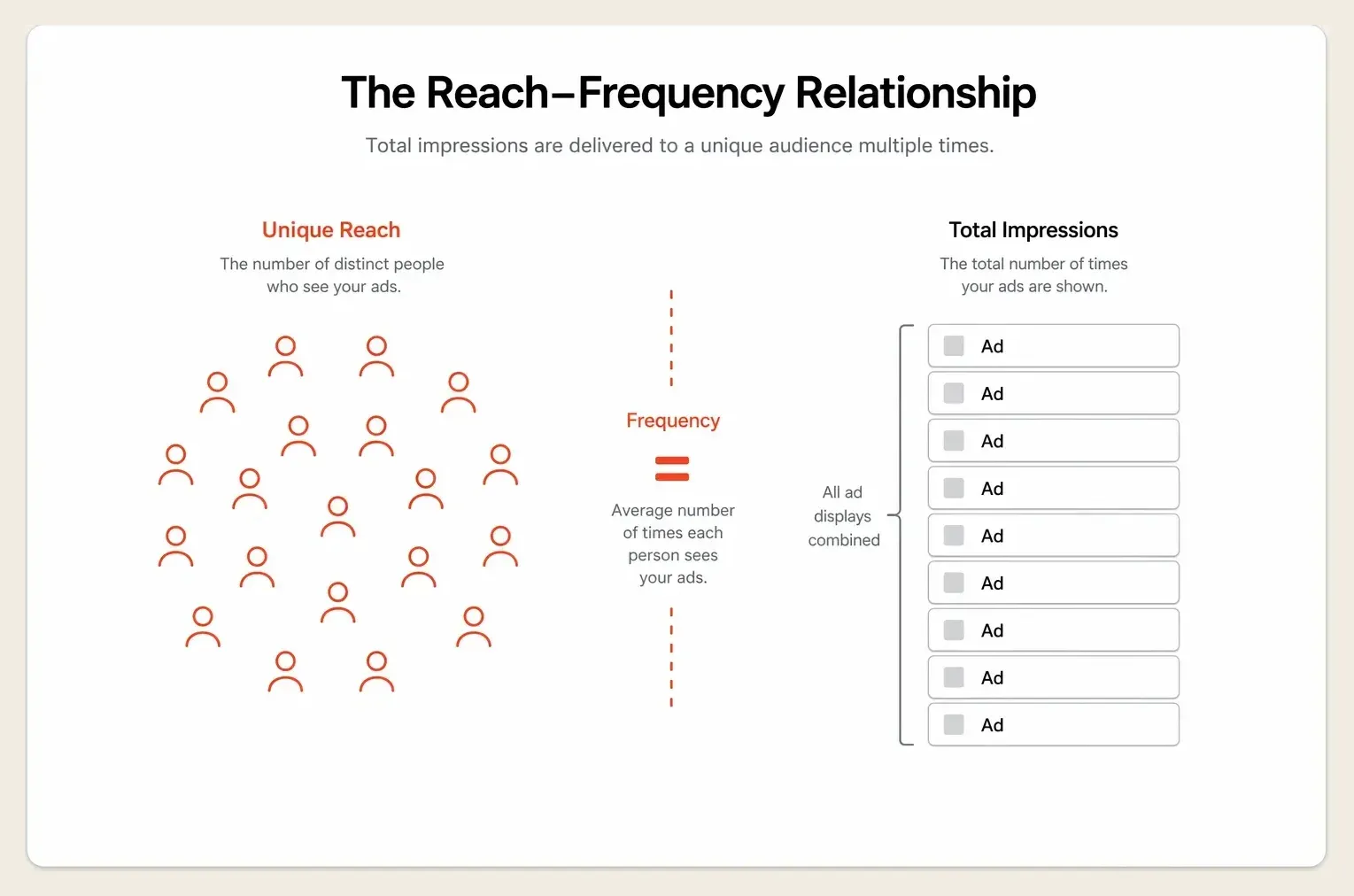
Reach is the denominator behind almost every efficiency decision you make. Pair it with impressions and you get frequency, the average number of times each person saw the ad, which is the single best early warning for creative fatigue. When reach stalls but impressions keep climbing, you are paying to show the same people the same ad again and again.
The business stakes are real. Meta's own reach and frequency guidance, along with years of media-mix research, points to a practical ceiling: once average frequency climbs past roughly 3 to 5 exposures in a short window, incremental conversions drop and cost per result rises. A brand that tracks reach catches this saturation early. A brand that watches only impressions and spend often discovers it weeks too late, after CPA has already crept up.
Reach also tells you whether a budget increase is buying growth or just repetition. Scaling spend should expand the unique audience, not simply hammer the existing one harder.
How It Works
Platforms calculate reach by de-duplicating the user IDs that were served your ad, so each person counts once regardless of devices, sessions, or placements. The same impression volume can produce wildly different reach depending on how the auction distributes your budget.
- Audience size sets the ceiling. A narrow custom audience of 5,000 people caps reach at 5,000, after which every extra dollar buys frequency, not new eyeballs.
- Budget and bid control the pace. More budget into a broad audience widens reach; more budget into a small audience inflates frequency.
- Objective shapes delivery. Reach and awareness objectives spread impressions across many people, while conversion objectives concentrate on the users most likely to act.
- Overlap erodes it. Running multiple ad sets against similar audiences fragments delivery and quietly shrinks true combined reach.
A Real Example
A skincare brand launches a new serum with a $20,000 monthly budget against a broad prospecting audience. In week one it reaches 400,000 unique people with 600,000 impressions, an average frequency of 1.5. Conversions are strong and CPA sits at $24.
By week four, reach has plateaued at 520,000 while impressions have climbed to 2.1 million. Average frequency is now above 4, and CPA has drifted up to $41. Nothing changed about the product or the landing page. The audience pool was simply tapped out, and the brand kept paying to re-serve the same people. Refreshing the creative and widening the audience pulls frequency back down and resets efficiency.
Common Mistakes
| ❌ The Wrong Way | ✅ The Better Way |
|---|---|
| Treating reach and impressions as the same number | Track both, then divide to monitor frequency as the real fatigue signal |
| Scaling budget on a tiny audience and calling it growth | Confirm reach is actually expanding, not just frequency climbing |
| Running overlapping ad sets against near-identical audiences | Consolidate to protect true combined reach and clean delivery |
| Chasing maximum reach with no frequency floor | Balance reach against the 1 to 2 minimum exposures needed to drive recall |
How Hawky Helps
Hawky runs the account with agents that act on reach instead of just charting it. The Performance Agent watches reach and frequency together in real time, and when reach plateaus while frequency climbs past your fatigue threshold, it widens the audience, rebalances budget, or pauses the saturated ad set before CPA inflates. It treats reach as a live constraint on spend, not a vanity number in a weekly report.
When the audience is genuinely exhausted and only new creative can reopen it, the Creative Agent ships fresh assets to reset frequency without abandoning the audience. Both agents read and write to FeatherDB, the account's living memory, so the system remembers the reach ceiling of each audience and the frequency point where performance historically broke down.
Frequently Asked Questions
What is the difference between reach and impressions?
Reach counts unique people who saw your ad, while impressions count the total number of times the ad was displayed, including repeat views to the same person. If one person sees your ad three times, that is one reach and three impressions. Reach measures audience size, impressions measure delivery volume, and dividing impressions by reach gives you frequency.
What is a good reach for a Facebook ad campaign?
There is no universal target, because good reach depends entirely on your audience size and objective. A useful rule is that healthy reach keeps average frequency between roughly 1 and 3 over a short window for prospecting, so you build recall without burning the audience. If reach stops growing while spend rises, the audience is saturated and needs to be widened.
How is reach calculated?
Reach is calculated by counting the unique user IDs served your ad and de-duplicating anyone who saw it more than once or across multiple devices and placements. This is why reach is always equal to or lower than impressions, and never higher. Platforms estimate cross-device identity to keep the count tied to people rather than sessions.
Why has my reach stopped growing even though I increased the budget?
When reach plateaus despite a budget increase, your audience pool is effectively maxed out and the extra spend is buying frequency instead of new people. The fix is to expand the audience with a lookalike audience or broader targeting, refresh the creative, or reduce overlap between ad sets. Pouring more budget into the same small audience only raises frequency and cost per result.
Quick Takeaway
Reach is the unique audience you actually touched, and its real power comes from pairing it with impressions to track frequency and catch saturation early. Watch reach to know whether your budget is buying growth or just repetition.
Watching costs climb while your audience stops growing? Ready to hire your first AI performance team? Book Demo