Impressions
Last updated
Impressions are the total number of times your ad was displayed, counting every repeat view, which makes them the unit you actually buy on a CPM basis. Read them against reach for frequency and against CPM for cost, never as a stand-in for how many people you reached.
Impressions
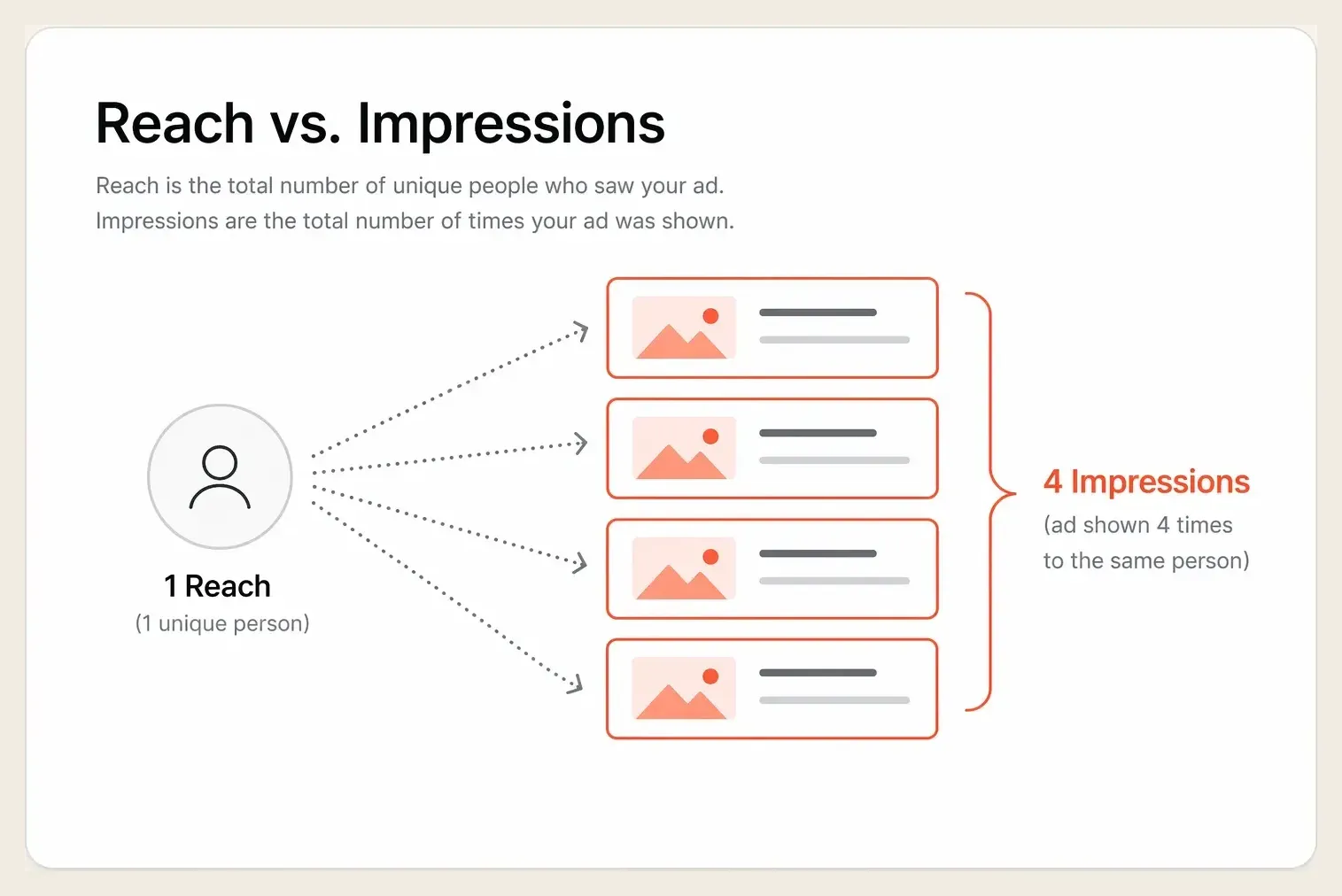
Impressions are the total number of times your ad was displayed on a screen, counted every single time it appears, even when the same person sees it more than once. If one user sees your ad four times, that is four impressions. Impressions measure raw delivery volume, which makes them the foundation for cost metrics like CPM and the input you divide by unique reach to get frequency.
Why It Matters
Impressions are the unit you actually buy. Every cost-per-thousand auction, every CPM benchmark, and every frequency calculation runs on impression volume, so misreading them distorts the whole account. The most common trap is treating impressions as an audience-size metric when they are really a delivery-count metric, which inflates a sense of how many people a campaign touched.
The pairing with reach is where impressions earn their keep. Impressions divided by reach equals frequency, and frequency is the clearest predictor of ad fatigue. Industry benchmarks and Meta's own delivery guidance suggest performance typically softens once average frequency pushes past roughly 3 to 5 in a tight window, so rising impressions against flat reach is a warning, not a win.
Impressions also anchor cost diagnosis. When CPA spikes, checking whether impressions surged at a higher CPM often reveals an auction-price problem rather than a creative or landing-page problem.
How It Works
An impression is logged when the platform serves your ad and it renders on a user's screen, subject to each platform's viewability rules. The same budget can produce very different impression counts depending on CPM, format, and competition.
- CPM sets the rate. Impressions equal spend divided by CPM, then multiplied by 1,000, so a rising CPM buys fewer impressions for the same budget.
- Format affects volume. Cheap, high-volume placements like feeds and Stories generate more impressions per dollar than premium in-stream video.
- Frequency inflates the count. Once an audience is saturated, impressions keep accumulating on the same people while reach barely moves.
- Viewability matters. Platforms count a served impression, but a viewable impression (actually seen) is the number that correlates with results.
A Real Example
A DTC coffee brand runs a $15,000 monthly Meta campaign. In a healthy month it serves 1.5 million impressions to 500,000 unique people, an average frequency of 3.0, at a $10 CPM, and holds a $30 CPA.
The next month, seasonal competition pushes CPM to $16. The same $15,000 now buys only 940,000 impressions. Reach falls to 360,000 and conversions drop with it. The brand assumes the creative broke, but the real story is in the impressions math: a higher auction price simply bought less delivery. Lowering CPM with stronger creative, or accepting a smaller efficient audience, restores the result. The diagnosis was only possible because the team read impressions against CPM and reach together.
Common Mistakes
| ❌ The Wrong Way | ✅ The Better Way |
|---|---|
| Reading impressions as the number of people reached | Use reach for audience size and keep impressions as delivery volume |
| Celebrating rising impressions while reach stays flat | Recognize that pattern as frequency creep and impending fatigue |
| Ignoring CPM when impression volume drops | Check CPM first, since a higher auction price buys fewer impressions |
| Optimizing to maximum impressions on an awareness buy | Optimize to viewable impressions and a sensible frequency cap |
How Hawky Helps
Hawky operates the account with agents that act on impression data rather than parking it in a dashboard. The Performance Agent reads impressions alongside CPM, reach, and conversion rate, so when impression volume falls it knows whether the cause is a budget shift, a CPM spike, or saturation, and it rebalances budget pacing and bids accordingly. It treats impressions as a live input to allocation, not a number to recap weekly.
When rising impressions against flat reach signal that the same people are being over-served, the Creative Agent ships fresh assets so new impressions land with renewed engagement instead of fatigue. All of it is grounded in FeatherDB, the account's living memory, which retains the CPM and frequency context the agents use to interpret every impression swing.
Frequently Asked Questions
What is the difference between impressions and reach?
Impressions count the total times your ad was displayed, including repeat views, while reach counts only the unique people who saw it. One person who sees an ad five times generates five impressions but one reach. Impressions measure delivery volume, reach measures audience size, and impressions divided by reach equals frequency.
What is a good number of impressions for an ad campaign?
Impression volume on its own is not a quality target, because what matters is how those impressions are distributed across people. A campaign is healthy when impressions translate into expanding reach at an acceptable frequency, usually keeping average frequency under about 3 to 5 in a short window. Millions of impressions concentrated on a tiny audience is a saturation problem, not a success.
Do impressions cost money?
Yes, impressions are what you pay for on a CPM basis, where you are charged per 1,000 impressions served. Your impression volume equals your spend divided by your CPM, then multiplied by 1,000, so a higher CPM buys fewer impressions for the same budget. Even on cost-per-click or cost-per-action bidding, impressions are the underlying delivery you are buying.
Why did my impressions drop suddenly?
A sudden impression drop is usually caused by a rising CPM, a reduced or exhausted budget, narrowed audience targeting, or an ad set leaving the learning phase and slowing delivery. Check CPM first, since seasonal competition can raise the auction price and cut impressions without any change on your end. A creative that lost engagement can also lower delivery because platforms serve high-performing ads more.
Quick Takeaway
Impressions are total ad displays and the unit you actually buy, so they only become meaningful when read against reach (for frequency) and CPM (for cost). Use impressions to diagnose delivery and price, never as a stand-in for how many people you reached.
Seeing impressions climb while results slip and unsure where the money is going? Ready to hire your first AI performance team? Book Demo