AI ad creative is advertising imagery, video, and copy produced or assembled by generative AI, using models trained on performance data to draft and vary ads faster than a human team can. It covers everything from a single AI-generated background to full statics, UGC-style video, and dozens of headline variations. Used well, it compresses creative production from weeks to minutes; used carelessly, it floods your account with on-brand-looking sameness that audiences learn to ignore.
This guide explains what AI ad creative is, how the models actually generate it, which formats are worth using, what the performance data really shows, and how to produce AI creative that performs instead of just piling up.
What is AI ad creative?
AI ad creative is any ad asset generated, adapted, or optimized by artificial intelligence rather than built by hand from scratch. The AI reads inputs (your product, brand kit, past winners, and audience signals) and produces finished or near-finished creative: images, video, and copy ready to test.
The category spans a wide range of autonomy. At one end, AI assists a designer by removing a background or resizing a static across placements. At the other, an AI agent reads your account, decides what to make, and renders complete on-brand ads bound to a specific ad set. The common thread is that a model, not a manual process, does the drafting.
This is distinct from creative analysis, which scores and explains creative you already have. Generation makes new ads; analysis tells you which ones work. The strongest programs run both: analysis surfaces the winning patterns, generation produces more creative built on them.
How does AI generate ad creative?
AI generates ad creative by combining a generative model (for images, video, or text) with your brand and performance data, then producing variations you can test. The process is less "type a prompt, get an ad" and more a pipeline that turns structured inputs into on-brand output.
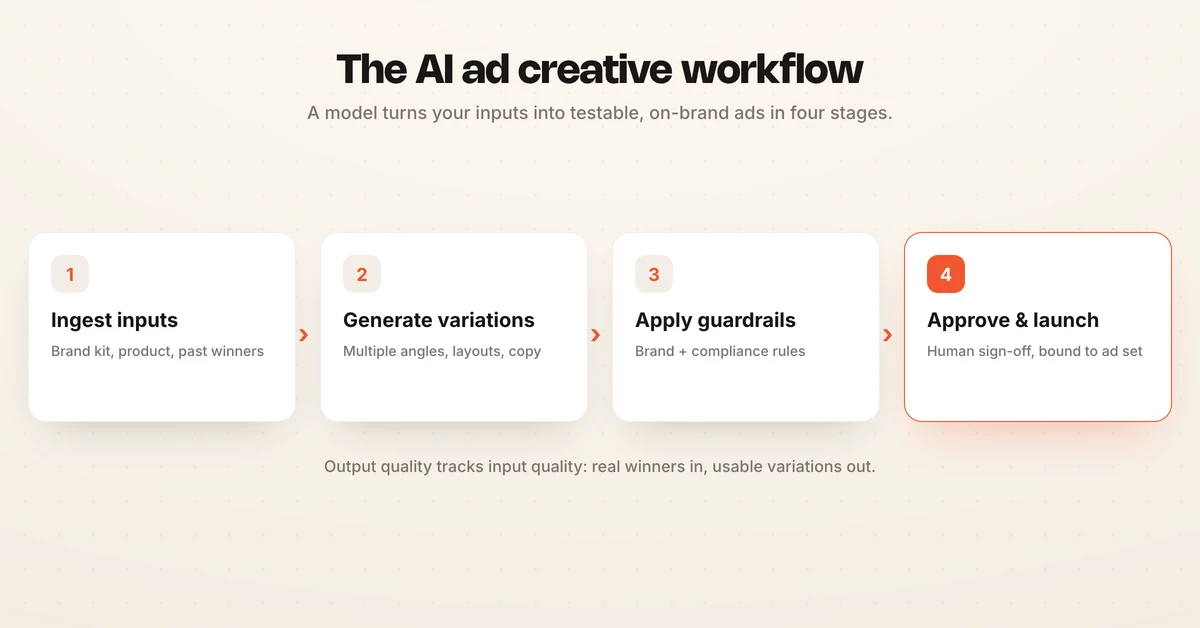
A typical AI creative workflow moves through four stages:
- Ingest inputs. The system reads your brand kit (logo, palette, fonts, tone), product details, and past ad performance. The richer this context, the more on-brand the output.
- Generate variations. The model drafts multiple angles, layouts, and messages, exploring hooks and visual styles a human might not try under time pressure.
- Apply brand and compliance rules. Guardrails keep output on-brand and inside platform policy, so the volume stays usable rather than off-message.
- Route for approval, then launch. A human reviews and approves, and the approved batch ships to a specific campaign or ad set for testing.
Under the hood, different model families handle different jobs. Diffusion models generate and edit imagery, large language models draft and vary copy, and a growing set of video models assemble short-form motion. Most production tools chain several together behind one interface, so you experience it as a single "make me ads" action. (StackAdapt on how AI is used in advertising)
The quality of AI ad creative tracks the quality of its inputs. Feed a model your actual winners and brand kit and it produces usable variations; feed it a generic prompt and it produces generic ads. That input dependency is why account-aware tools outperform standalone generators.
Types of AI ad creative
AI ad creative falls into four practical formats, and most campaigns use a mix. Each solves a different production bottleneck, from static volume to video cost.
| Format | What AI produces | Best for |
|---|---|---|
| Static image ads | Backgrounds, layouts, product scenes, full statics | High-volume testing, catalog and prospecting ads |
| Video and motion | Short-form cuts, animated statics, UGC-style clips | Reels, Stories, TikTok, cost-heavy video slots |
| Ad copy and headlines | Primary text, headlines, descriptions, variations | Message testing, localization, scale |
| Creative variations | Resizes, placement adaptations, angle swaps | Covering every placement without manual rework |
Static and copy generation are the most mature and lowest-risk, which is why most teams start there. AI video is improving fast but still needs the most human review. Across all four, the win is not a single perfect ad; it is enough on-brand variation to actually test what resonates.
Are AI-generated ads effective?
AI-generated ads are effective when they are tested and human-reviewed, and the platform data backs this up. Meta reports that advertisers earn an average of $4.52 for every dollar spent on its Advantage+ products, a 22% increase versus standard campaigns, and that AI background image generation lifts click-through rate by around 11% on average. (Social Media Today on Meta's AI ad results)
Adoption reflects that pull. More than one million advertisers used Meta's AI tools to create over 15 million ads in a single month in 2025. (Marketing Brew on Meta's AI ad push)
The bigger, more durable effect is on cost and speed. AI creative collapses production time from weeks to hours and makes it economical to test angles you would never have staffed manually, which is exactly why Meta pushes tools like Advantage+ creative so hard. More shots on goal, at lower cost per shot, is a real edge even before any per-ad quality lift.
Read platform numbers with a skeptic's eye, though. Independent analyses suggest the incremental ROAS of AI-driven campaigns can sit closer to parity with well-run manual campaigns, because the platform benefits from measuring itself. The honest takeaway: AI creative reliably wins on speed and volume, and it wins on performance when a human still decides what ships and reads the results against your own ROAS and CTR. Hybrid human-and-AI production, where the model drafts and a marketer edits, consistently beats both fully manual and fully automated approaches.
How to create AI ad creative that performs
Creating AI ad creative that performs comes down to feeding the model good inputs, testing at volume, and keeping a human in the loop. The tooling matters less than the discipline around it.
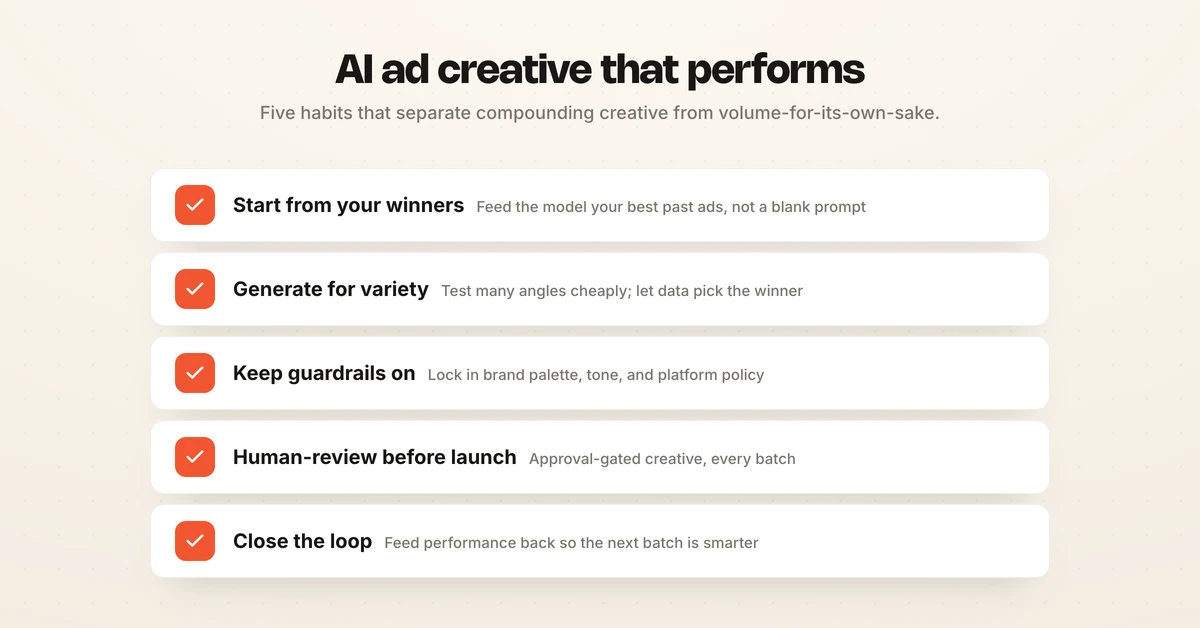
- Start from your winners, not a blank prompt. Give the model your best-performing past ads and brand kit so output inherits what already works.
- Generate for variety, not perfection. The point of AI is testing many angles cheaply. Ship a batch, let the data pick the winner, kill the rest.
- Keep brand and compliance guardrails on. Volume without guardrails is just faster off-brand output. Lock in palette, tone, and policy rules up front.
- Always human-review before launch. Approval-gated creative is the difference between AI that helps and AI that ships something embarrassing.
- Close the loop with analysis. Feed performance back in so the next batch is smarter. Memory is what makes AI creative compound instead of plateau.
The teams that get the most from AI creative treat it as an always-on testing engine with a human editor, not a vending machine for finished ads.
The limits of AI ad creative
AI ad creative has real limits, and ignoring them is how accounts end up with high volume and flat performance. Knowing the failure modes is part of using it well.
- Perceived-AI penalty. Ads that read as obviously AI-made can dent trust and premium perception, so polish and human review matter.
- Sameness at scale. When everyone prompts similar models, creative converges. Your brand kit and real winners are what keep output distinctive.
- Brand and legal risk. Unreviewed claims, faces, or logos can breach policy or brand standards. Guardrails and approval are not optional.
- Garbage in, garbage out. Weak inputs produce weak ads no matter how good the model is.
None of these kill the case for AI creative. They just confirm the rule: AI does the labor, humans keep the judgment. Explore the best AI ad creative tools once you know what you want the model to do.
How Hawky's Creative Agent produces AI ad creative
Most AI creative tools hand you a generator and leave the strategy to you. Hawky's Creative Agent works the other way: it reads your past winners, competitor patterns, and portfolio gaps from FeatherDB, then renders finished on-brand creatives with your brand kit baked in.
Every batch is bound to a specific Meta or Google ad set and routed through seat-level approval, so nothing ships without a human sign-off. The agent fires on schedule, on a performance signal like fatigue or a CPL spike, or on command, and every creative cites the evidence behind it. That is AI creative generation as an operator, not a prompt box.
Because it runs on shared context, results compound. The Man Company doubled creative performance and cut iteration cycles by 50% using Hawky. (case study) The pattern holds across the theme of this guide: AI produces the volume, memory makes it smarter, and a human stays in command.
Frequently asked questions
What is AI ad creative?
AI ad creative is advertising imagery, video, and copy produced or adapted by generative AI rather than built by hand. It ranges from a single AI-generated background to full statics, UGC-style video, and many headline variations. The AI uses your brand kit, product details, and past performance data to draft ads faster than a manual process can.
How does AI generate ad creative?
AI generates ad creative by pairing a generative model with your brand and performance data, then producing testable variations. It ingests your brand kit and past winners, drafts multiple angles and layouts, applies brand and compliance guardrails, and routes the batch for human approval before launch. Output quality depends heavily on input quality, which is why account-aware tools beat generic generators.
Are AI-generated ads effective?
Yes, when they are tested and human-reviewed. Meta reports advertisers earn an average of $4.52 per dollar on Advantage+ products (22% above standard campaigns) and that AI background generation lifts CTR around 11%. Independent analysis suggests incremental gains can be smaller, so the reliable wins are production speed and testing volume, with performance depending on human judgment and measurement against your own KPIs.
What is the difference between AI creative generation and creative analysis?
AI creative generation makes new ads, while creative analysis scores and explains ads you already have. Generation solves the production bottleneck; analysis tells you which creative works and why. The strongest programs run both, using analysis to find winning patterns and generation to produce more creative built on them.
Will AI-generated ads hurt my brand?
They can if you skip guardrails and human review. Ads perceived as obviously AI-made can reduce trust, and unreviewed creative risks off-brand or non-compliant output. Keeping brand rules, compliance checks, and seat-level approval in place lets you capture the speed of AI creative without the brand risk.
If producing enough on-brand ad creative to actually test, without drowning your team in manual design, is the bottleneck, Hawky's Creative Agent is built for that job: it renders finished on-brand creatives from your winners, bound to each ad set, with approval and a full audit trail keeping you in command.
Ready to hire your first AI performance team? Book Demo