Ad creative analysis is the practice of measuring how your own ad creatives perform, then breaking down why, so you can decide what to make more of and what to retire. It goes past reporting on spend and clicks to connect specific creative choices, the hook, the format, the message, the visual, to the results they drive. The output is a decision about your next ad, not just a chart of the last one.
This guide covers what ad creative analysis is, how it differs from reporting, the metrics that matter, a repeatable process for analyzing creative performance, and how creative analytics tools and AI change the work. It is about analyzing the creatives you run, not generating new ones and not spying on competitors, and it links out to deeper guides wherever you want more detail.
What is ad creative analysis?
Ad creative analysis is the process of evaluating the performance of your ad creatives to understand which elements drive results. It answers questions a spend report cannot: why did this video outperform that one, which hook holds attention, and what should the next batch look like.
A dashboard tells you a campaign spent 4,000 dollars and returned a 2.1 ROAS. That is reporting. Creative analysis tells you the top ad was the one that led with the problem in the first two seconds, that its variant with a customer face beat the product-only cut, and that performance dipped once frequency crossed a threshold. That is analysis, because it points to an action.
The distinction matters because most teams have plenty of reporting and very little analysis. Numbers pile up, but nobody can say which creative decision caused which result. Ad creative analysis closes that gap.
Ad creative analysis vs creative reporting
Reporting describes what happened. Analysis explains why and tells you what to do next. The two are often confused because they use the same metrics, but they serve different jobs.
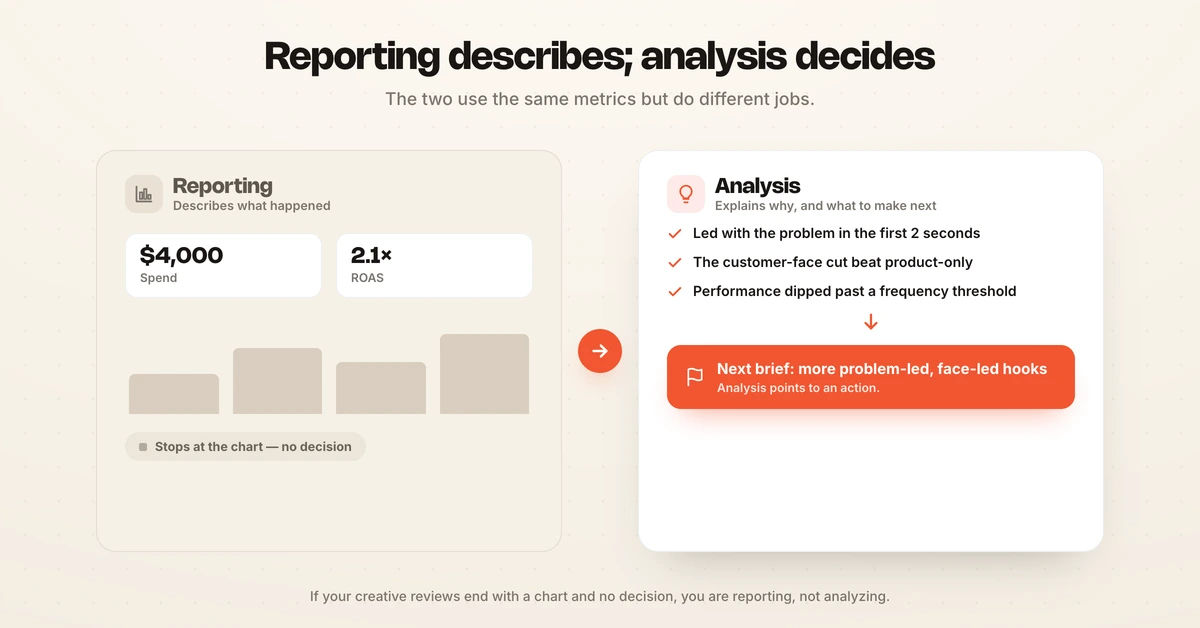
Reporting aggregates spend, impressions, clicks, and conversions into a view of the past. Analysis attributes those outcomes to creative elements, compares variants fairly, and produces a hypothesis for the next test. If your creative reviews end with a chart and no decision, you are reporting, not analyzing.
Why ad creative analysis matters
On modern ad platforms, targeting is largely automated. Broad, automated audience products like Meta Advantage+ mean the algorithm decides who sees your ad, so the creative is the main variable you still control, and the main thing that determines who the algorithm can find and how long a campaign keeps working.
That makes creative the highest-value input in performance marketing. Better analysis means you spot winners faster, kill losers before they waste budget, and understand the pattern behind a win well enough to repeat it deliberately instead of by luck.
It also compounds. Every ad you analyze teaches you something about your audience, and those insights should inform the next brief. Teams that analyze creative systematically build a durable advantage; teams that guess start from zero every launch.
Ad creative performance metrics
You cannot analyze what you do not measure. Creative analysis draws on a specific set of metrics that isolate how the ad itself, rather than the targeting or budget, is performing.
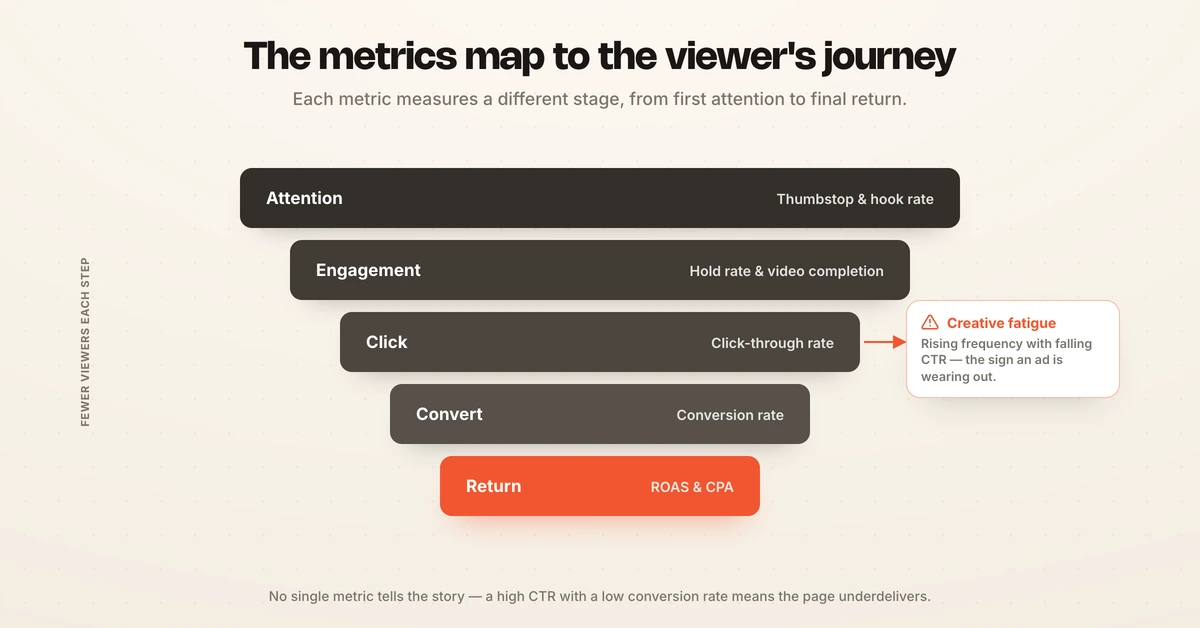
- Thumbstop and hook rate: the share of viewers who stop scrolling in the first seconds. A creative-level attention signal, and one Google's research on video attention treats as decisive in the opening moments.
- Hold rate and video completion: how far into the video people watch. Shows whether the ad sustains attention.
- Click-through rate: how compelling the ad is at driving action from the impression.
- Conversion rate: whether the click turns into the outcome you want.
- ROAS and CPA: the business result the creative ultimately drives.
- Creative fatigue signals: rising frequency with falling CTR, the sign an ad is wearing out.
No single metric tells the story. A high CTR with a low conversion rate means the ad promises something the landing experience does not deliver. Read them together. For a deeper breakdown, see the guide to creative performance metrics.
How to analyze ad creative performance
Analyzing creative performance is a repeatable process, not a one-off review. The goal at each step is to move from raw numbers toward a decision you can act on.
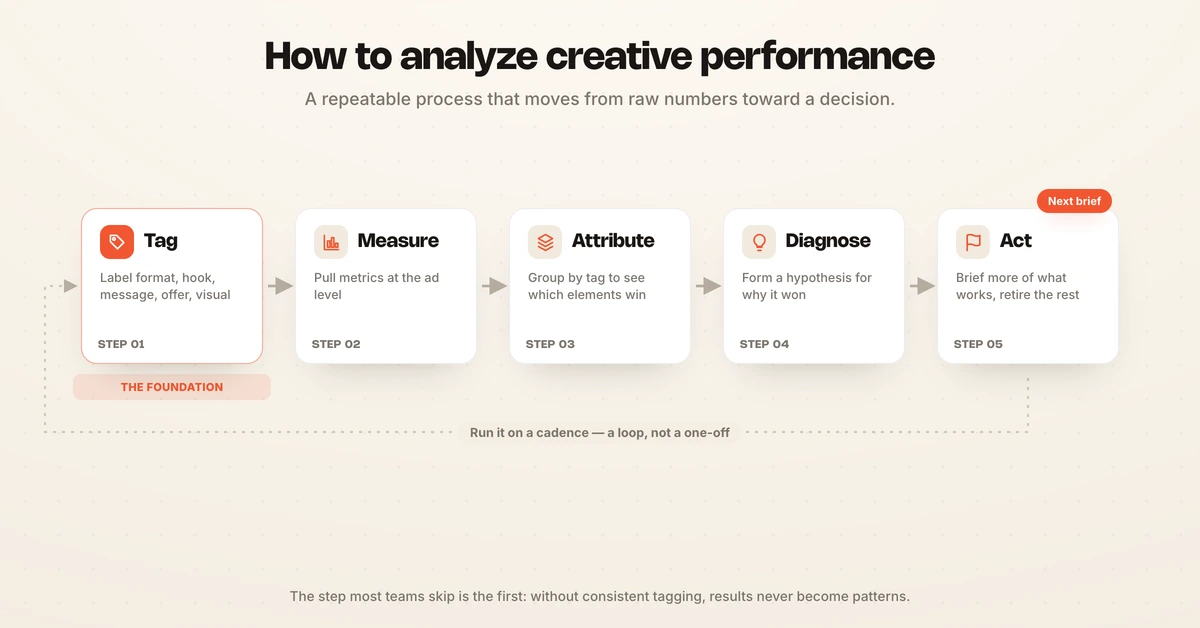
- Tag your creatives: label each ad by format, hook, message, offer, and visual style so you can compare like with like. This is the foundation everything else rests on.
- Measure performance: pull the metrics above for every creative, at the ad level, not just the campaign level.
- Attribute results to elements: group by tag to see which hooks, formats, and messages win, not just which individual ads.
- Diagnose why: form a hypothesis. Did the ad win because of the hook, the offer, the format, or the audience match.
- Act: brief more of what works, retire what does not, and set up the next test to prove your hypothesis.
The step most teams skip is the first one. Without consistent tagging, you can see that ad A beat ad B, but you cannot see that short-form testimonial hooks beat product demos across your whole account. Creative tagging is what turns individual results into patterns.
Element-level analysis
The deepest form of creative analysis breaks an ad into its parts and scores each one. Element-level analysis attributes performance to the hook, the first frame, the caption, the call to action, and the format, so you learn which components carry the result.
This is where analysis becomes genuinely predictive. Once you know that a specific hook style lifts hold rate across dozens of ads, you can brief it deliberately. A creative performance score rolls these signals into a single comparable number so you can rank a full library quickly.
For a step-by-step walkthrough, see how to analyze creative performance and the broader creative performance analysis guide.
What is creative analytics?
Creative analytics is the discipline and the tooling built around ad creative analysis at scale. Where a single analysis looks at one campaign, creative analytics systematizes it: automated tagging, standardized metrics, and dashboards that compare creative elements across your entire account over time.
The aim is to make creative decisions data-led rather than opinion-led. Instead of debating which ad "feels" stronger, a creative analytics workflow shows which elements consistently drive your KPI and feeds that back into every brief. Start with creative analytics 101 for the fundamentals.
Creative analytics has also split into two approaches. Traditional analysis relies on manual tagging and human review; AI-driven analysis reads the creatives automatically and surfaces patterns a person would miss. The tradeoffs are covered in AI vs traditional creative analysis.
Turning ad creative insights into action
Analysis only pays off when it changes what you make next. Ad creative insights, the patterns your analysis surfaces, are worth nothing if they stay in a slide deck. The goal is a loop: analyze, brief, launch, analyze again.
Feed every finding back into the creative brief. If testimonial hooks lift hold rate, the next brief should call for more testimonial hooks. If a format fades after a set frequency, schedule the refresh before decay, not after. Both Google's advertising guidance and platform best practices point the same way: iterate on what the data proves, not on opinion.
Set a cadence so analysis is routine rather than reactive. Weekly is enough for most accounts, tighter for high-spend ones. Watch creative refresh rate so you retire ads on evidence, and keep a live testing slate so there is always a new hypothesis in market. This is the difference between a team that guesses and one that compounds, the theme behind creative intelligence.
Creative analysis tools
Creative analysis tools automate the parts of the process that do not scale by hand: tagging every asset, pulling ad-level metrics from each platform, and grouping results by element. The right tool depends on your volume, your channels, and how much you want automated.
For a sourced comparison, see the guide to the best ad creative analysis tools. It covers platforms across price points and team sizes.
Where an agent fits
Most tools stop at surfacing insights and hand them back to you. Hawky reads your creative performance and acts on it. Its Creative Analysis capability tags and scores your existing creatives, attributes results to elements, and identifies which patterns drive your KPI, drawing on a living memory of your past winners.
Those insights do not sit in a dashboard. They feed the Creative Agent, which briefs the next batch from what actually worked, and the Performance Agent, which acts on fatigue signals before an ad decays. Each insight cites the evidence behind it, so you can see why a creative is flagged as a winner or a fade, not just that it is. Read how the outcome-based model works if you want the commercial detail.
The results are documented. The Man Company doubled creative performance and cut its iteration cycles by 50 percent using Hawky (case study).
Bringing it together
Ad creative analysis turns creative from a guessing game into a repeatable system: tag your ads, measure them at the element level, attribute results, diagnose why, and act. Reporting tells you what spend did; analysis tells you what to make next.
Because creative is the main lever left on automated platforms, the teams that analyze it well spot winners faster and repeat them on purpose. If you want your creative performance read, scored, and turned into the next brief automatically, with the evidence behind every call, Hawky's Creative Analysis is built for that job.
Ready to hire your first AI performance team? Book Demo