Creative Iterations: How to Systematically Scale Winning Ads
Creative iteration is the system of treating a winning ad as a launchpad, not a finish line: you isolate why it won, spin variations on that signal, and rotate and scale them before the winner fatigues. Done systematically, one winner becomes 5 to 10 profitable iterations instead of a single ad you ride until it dies.
Most teams celebrate a winner, scale its budget, and watch it fatigue a week later with nothing to replace it. The operators who compound do the opposite: every winner triggers a wave of structured iterations that keep performance alive and feed the next round. This guide shows how to build that system, step by step, with the iteration types, cadence, and fatigue triggers that work in 2026.
What creative iteration actually is
Creative iteration is the practice of systematically producing new versions of a proven ad to extend its lifespan and scale its results, rather than starting from a blank page each time. A winning ad is a signal that a concept works, and iteration extracts every bit of value from that signal before moving on.
Iteration is not the same as net-new creative. Net-new swings at fresh concepts and is slower and riskier; iteration builds on a known winner and is faster and safer. The strongest accounts run both, but iteration is what turns a single hit into sustained, scalable performance. (The ultimate guide to creative testing)
This matters because creative frequency, the speed at which you produce, test, and refresh ads, is the single biggest lever for scaling ROAS. Iteration is how you pull that lever without burning out your team or your audience.
The iteration ladder: cosmetic to structural
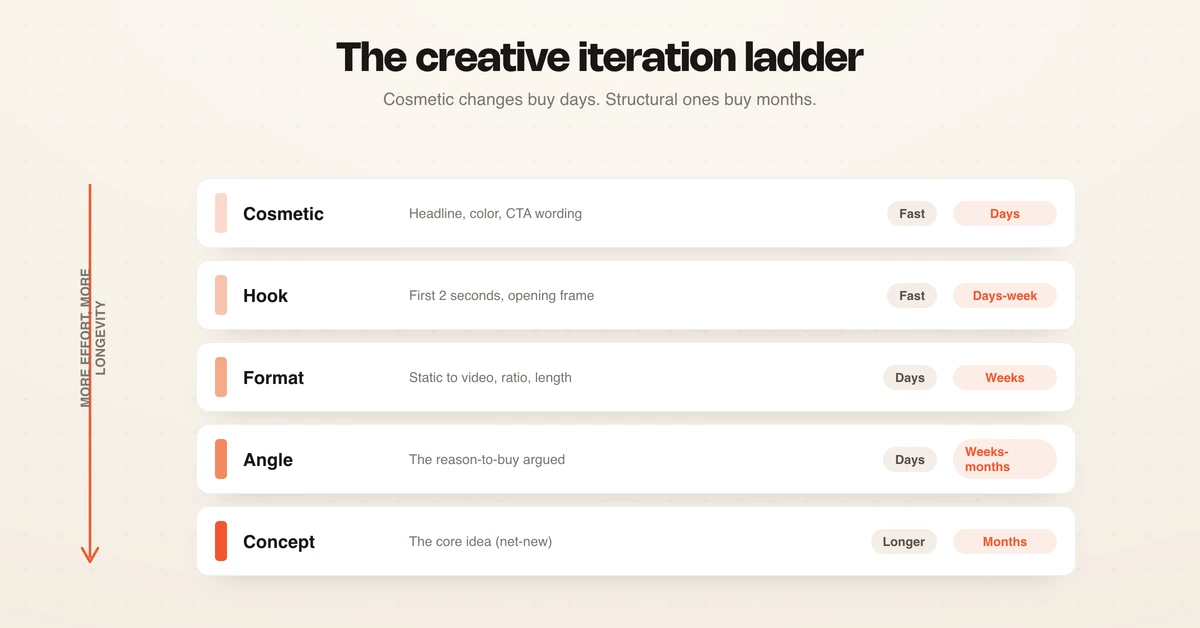
Creative iterations sit on a ladder from cosmetic to structural, and each rung trades speed for durability. Cosmetic changes are fast and extend a winner by days; structural changes take longer but open months of fresh performance.
Knowing which rung to use is the core skill. Start at the top of the ladder for quick wins, then move down as a concept matures.
| Iteration type | What changes | Speed | Lifespan added |
|---|---|---|---|
| Cosmetic | Headline, colors, captions, CTA wording | Hours | Days |
| Hook | First 2 seconds, opening frame | Hours | Days to a week |
| Format | Static to video, aspect ratio, length | Days | Weeks |
| Angle | The reason-to-buy argued | Days | Weeks to months |
| Concept | The core idea (net-new territory) | Longer | Months |
Step 1: Confirm the winner and isolate why it won
Before you iterate, confirm the ad is a real winner and pin down the specific reason it works. Iterating a fluke wastes the whole wave, so wait for a defensible sample and a clear signal.
Read it at the element level, not just the ad level. Was it the hook, the visual, the offer, the proof, or the format that drove the result? Score each component against a creative performance score and read metrics in funnel order: hook rate for attention, CTR for intent, CPA or ROAS for the decision. (How to analyze creative performance)
What "done" looks like: a one-line hypothesis about why it won ("the problem-first hook drove a 32% hook rate") that every iteration will preserve and probe.
Step 2: Iterate the hook first
The hook is the highest-impact iteration because it fatigues first and carries the most weight, so a fresh opener on a proven body often restores performance fast. Swap the first two seconds or the opening line while keeping the winning body intact.
Produce several hook variants on the same concept: a new pain framing, a bold-claim version, a question opener, a pattern interrupt. Keep everything downstream constant so the hook is the only variable and the test stays readable. Pull from a tested swipe file of hooks and adapt them to your winner.
What "done" looks like: four to six hook variants live on the winning body, each isolated so you learn which opener extends the concept.
Step 3: Spin cosmetic variants at volume
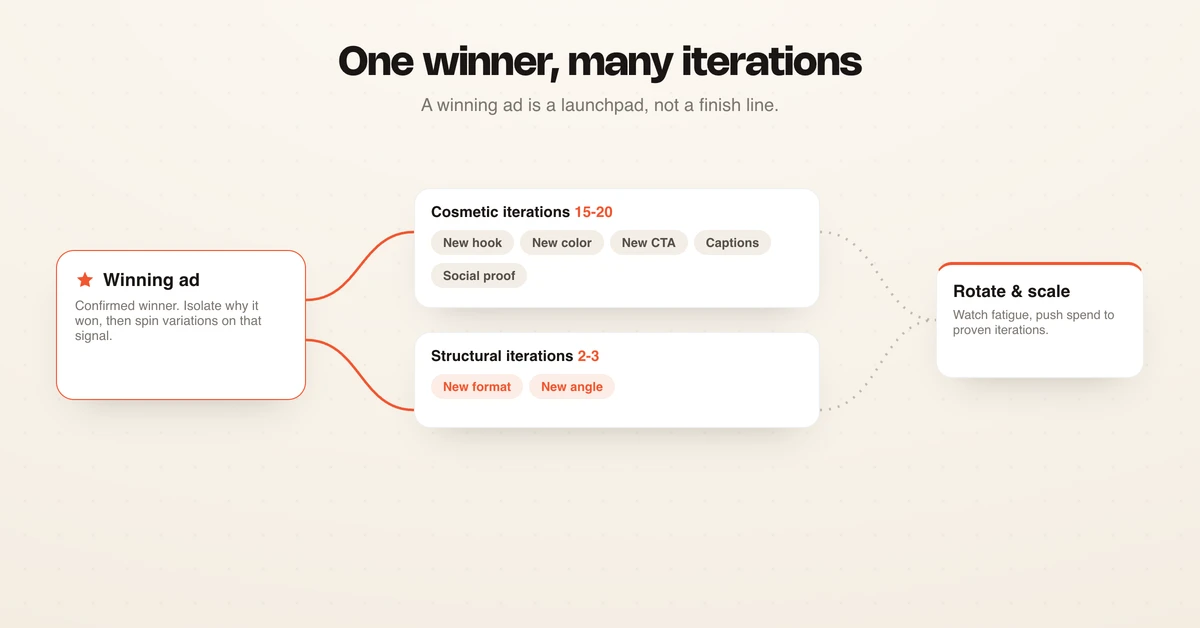
Once the hook is working, produce cosmetic variants at volume to maximize the winner's reach across placements and audiences. This is where speed compounds: a strong concept can support 15 to 20 variants without a full rebuild.
Change one element per variant: background color, on-screen text, social-proof placement, CTA wording, or thumbnail. These small changes give the algorithm fresh assets to serve and keep frequency in check without diluting the winning idea. The same modular approach powers high-volume static ads that convert.
What "done" looks like: a batch of cosmetic variants live, each a single controlled change off the proven creative.
Step 4: Build structural iterations for longevity
Cosmetic variants buy days; structural iterations buy months, so develop new formats and angles off the winning concept while it is still strong. This is what keeps a proven idea alive long after the cosmetic well runs dry.
Take the winning angle into a new format (a static winner becomes a UGC video, a talking-head becomes a demo), or take the winning format into a new angle (the same creator pitches a different benefit). Each structural iteration is a bigger bet than a cosmetic one, so test fewer at a time and give them room to read. This is where iteration shades into creative strategy frameworks like angle mapping.
What "done" looks like: two or three structural iterations in test, each extending the concept into new territory.
Step 5: Rotate winners, watch fatigue, and scale
Close the loop by rotating multiple iterations on a schedule, watching for fatigue, and pushing spend to the strongest. Running one iteration until it dies is what causes the ROAS crashes that iteration is supposed to prevent.
Set fatigue triggers and act on them fast. A common rule: any ad with frequency above 2.5 and a declining CTR gets a fresh iteration pushed within 48 hours, and a hook-rate drop of 10% for three straight days is an early warning to queue the next variant. Watch for creative fatigue at the iteration level, not just the account level, and keep a bench warming so a replacement is always ready. (How to detect and beat ad fatigue)
What "done" looks like: a rotating set of iterations, fatigue triggers live, and budget consolidating on the proven winners.
How to read iteration results
Read each iteration against the right metric, because cosmetic and structural changes prove themselves differently. A cosmetic variant is judged on whether it holds the winner's efficiency at fresh impressions; a structural iteration is judged on whether it opens a new pocket of performance the original could not reach.
Compare every iteration to the original winner's baseline, not the account average, so a small but real lift is not lost in the noise. Watch the metric that matches the change: hook iterations on hook rate, format and angle iterations on CTR and CPA or ROAS. Keep the wins, kill the rest fast, and feed the pattern behind each winning iteration back into the next round so the system compounds instead of resetting. (Creative performance metrics)
How many iterations, and how often
The right iteration volume scales with spend, but the 2026 baseline is faster than most teams run. The more you spend behind a winner, the faster it saturates and the more iterations it needs to stay alive.
| Spend level | Iterations per winner | Refresh cadence |
|---|---|---|
| High spend | 15-20 variants | New iterations weekly |
| Mid spend | 8-12 variants | Every 1-2 weeks |
| Low spend | 4-6 variants | Every 2-3 weeks |
Treat these as starting points and let each winner's own fatigue curve, not the calendar alone, decide the exact timing.
Common mistakes to avoid
Most iteration systems break for the same handful of reasons. Avoid these and the loop keeps compounding.
- Scaling spend without iterating. Pouring budget on one winner just saturates it faster. Scale the iterations, not only the dollars.
- Changing too much per variant. A variant that changes hook, color, and CTA at once teaches you nothing. One change per test.
- Only doing cosmetic iterations. Cosmetic tweaks run dry in days. Build structural iterations before the concept fatigues.
- No fatigue triggers. Waiting for CPA to crash means you iterate too late. Act on frequency and hook-rate signals.
- Letting the winning pattern evaporate. A winner nobody documents is relearned next quarter. File why it won so the next wave starts smarter.
How to scale creative iteration with AI agents
You can run this system by hand, but the math is brutal: 15 to 20 variants per winner, every week, across every winning concept, is more production than most teams can staff. Iteration is where creative bottlenecks turn into lost ROAS.
This is where agents change the equation. An agentic platform like Hawky treats every winner as a launchpad: its Creative Agent reads the winning pattern and competitor data from FeatherDB, generates on-brand cosmetic and structural iterations bound to a specific ad set, and routes them through approval, while the Performance Agent rotates them, watches fatigue, and scales spend on the proven ones against your KPI. Configurable autonomy keeps you in command, from approval-gated to fully autonomous with a full audit trail. The Man Company doubled creative performance and cut iteration cycles by 50% running this loop.
Whether you iterate by hand or with agents, the principle holds: a winner is a beginning, and the team that iterates fastest scales furthest.
Frequently asked questions
What is creative iteration in advertising?
Creative iteration is the practice of systematically producing new versions of a proven ad to extend its lifespan and scale its results. Instead of treating a winning ad as a finish line, you isolate why it won and spin cosmetic and structural variations on that signal. Done well, one winner becomes 5 to 10 profitable iterations rather than a single ad you ride until it fatigues.
How is iteration different from making new creative?
Iteration builds on a known winner, so it is faster and lower-risk, while net-new creative swings at fresh concepts and is slower and riskier. Iteration extracts maximum value from a proven signal; net-new finds the next signal. Strong accounts run both, but iteration is what turns a single hit into sustained, scalable performance.
How many iterations should I make from a winning ad?
The volume scales with spend, but a strong concept on a high-spend account can support 15 to 20 variants. Mid-spend accounts typically run 8 to 12 and low-spend accounts 4 to 6, refreshing more often as budget rises. Quality and controlled, one-variable changes matter more than raw volume.
When should I iterate versus kill an ad?
Iterate while the concept still shows a winning signal but the specific execution is fatiguing, indicated by rising frequency and a declining hook rate or CTR. A common trigger is frequency above 2.5 with a falling CTR, which calls for a fresh iteration within 48 hours. Kill the concept entirely only when new angles and formats off it also fail to perform.
What is the difference between cosmetic and structural iteration?
Cosmetic iteration changes surface elements like headline, colors, captions, or CTA wording, and it extends a winner by days. Structural iteration changes the format or the angle, takes longer to produce, and can open weeks to months of fresh performance. Use cosmetic iterations for quick wins and structural iterations to keep a proven concept alive long term.
Can AI generate ad iterations automatically?
Yes. AI agents can read a winning ad's pattern and generate on-brand cosmetic and structural iterations at volume, then test and rotate them automatically. The trustworthy approach keeps humans in command: people set the brand rules, KPI, and guardrails, while the agent generates and tests within those limits, with every action logged and reversible.
If producing enough iterations from every winner to scale it before it fatigues is your bottleneck, Hawky's Creative Agent and Performance Agent are built for that job: they turn each winner into on-brand variants and rotate and scale them against your KPI, with guardrails and a full audit trail keeping you in command.
Ready to hire your first AI performance team? Book Demo