Static Ads That Convert: A Creative Strategy Playbook
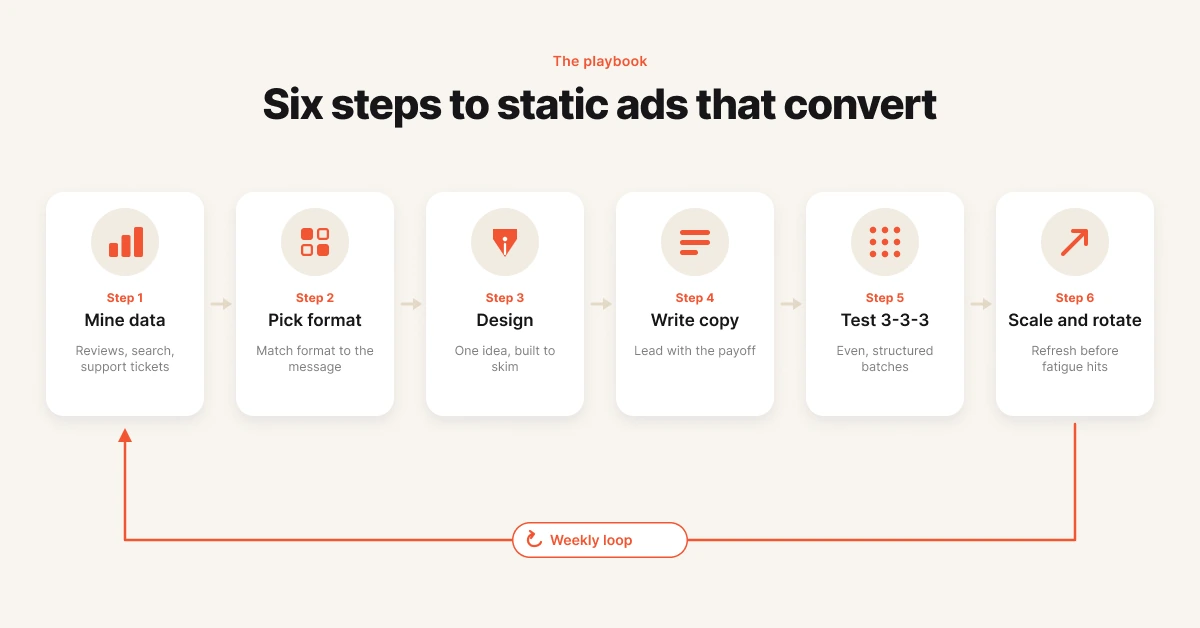
By the end of this playbook, you will have a repeatable system for producing static ads that convert: researched angles, proven formats, design and copy rules, and a testing framework that finds winners fast.
Static images still drive roughly 60 to 70% of conversions on Meta. Yet most teams treat statics as filler between video shoots, recycling the same layout until performance collapses. The teams that win treat static ads as their highest-velocity testing format and build an operating system around them.
What you need before you start
A static ad strategy needs three inputs: performance data, customer language, and production capacity. Without all three, you are guessing.
Before running this playbook, make sure you have:
- An ad account with at least 30 days of conversion data and accurate pixel or conversion API tracking
- A brand kit (logo, fonts, colors) so output stays consistent across batches
- Access to the Meta Ad Library for competitor research
- A design resource: an in-house designer, a freelancer, or an AI creative generation tool
- A testing budget, typically 10 to 20% of total spend, reserved for new creative
If your tracking is broken, fix that first. Every step below depends on trusting your ROAS and CPA numbers.
Step 1: Mine your data for angles that already convert
A converting static ad starts with a proven angle, not a blank canvas. Your account history, your customers, and your competitors have already paid for the lessons. Extract them before you brief a single creative.
Pull your top 10 ads by spend-weighted ROAS or CPA over the last 90 days. Tag each one by hook type, primary benefit, format, and visual style. Patterns emerge fast: maybe price-anchored hooks beat lifestyle imagery, or problem-led headlines beat product shots. Tools like Hawky's Creative Analysis automate this tagging at the element level, scoring hooks, visuals, and CTAs separately.
Next, mine customer language. Read 50 reviews, support tickets, or survey responses and copy exact phrases customers use to describe the problem and the result. Headlines written in customer language outperform headlines written in marketing language.
Finally, study competitors. In the Meta Ad Library, any static ad that has been running for 60 or more days is very likely converting. Note the angle, not the design. Competitor analysis tools track these long-running ads automatically and flag when rivals shift hooks or offers.
What done looks like: a one-page angle map listing your 3 to 5 proven angles, each backed by account data, customer quotes, or competitor evidence.
Pro tip: weight your analysis by spend, not by ad count. One ad with $40k behind it tells you more than ten ads with $200 each.
Step 2: Choose static ads that convert: 7 proven formats
Format selection matters more than design polish. The same angle can double or halve its performance depending on the format carrying it.
These seven static formats consistently convert across D2C and lead generation accounts:
| Format | What it is | Best funnel stage | Why it works |
|---|---|---|---|
| Big number lead | One large stat or price dominates the frame | Cold and warm | Numbers stop the scroll; dark backgrounds make them pop |
| Highlighted testimonial | Customer quote with key phrase highlighted | Warm and hot | Borrowed trust beats brand claims |
| Before and after | Side-by-side transformation | Cold and warm | The visual tells the story in under a second |
| Us vs. them table | Comparison chart against alternatives | Hot | Wins crowded markets; pre-empts objections |
| UGC-style photo | Phone-shot product photo with casual caption | Cold | Native look blends into feed and earns attention |
| Feature callout | Product image with annotated benefits | Warm | Communicates 3 benefits without reading body copy |
| Founder note | Plain text on simple background, letter style | Warm and hot | Pattern interrupt; reads as content, not ad |
Match format to funnel stage. Static ads frequently outperform video for retargeting and brand-aware audiences, where clear benefit-driven copy and a strong CTA minimize distraction. Meta feed benchmarks put static images at 0.90% CTR on a $12.50 CPM against $18.00 CPM for 15-second video, which makes statics the cheaper read on any new message, according to Stackmatix benchmark data.
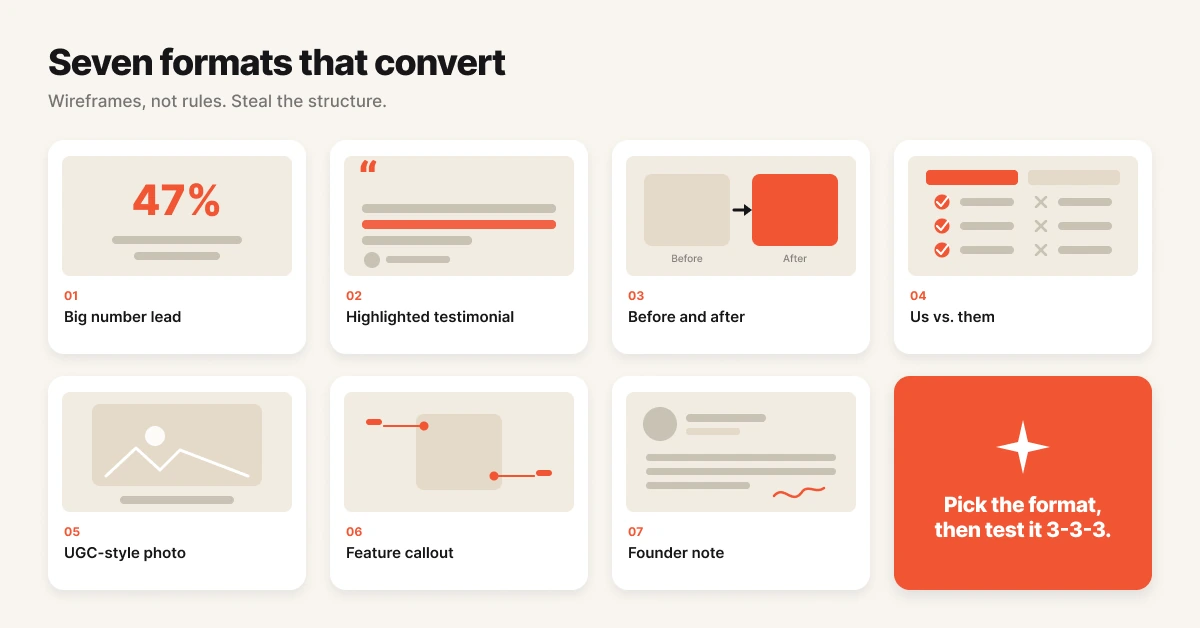
What done looks like: each angle from Step 1 mapped to 2 formats, giving you a concept grid before any design work starts.
Step 3: Design for the 0.3-second scroll
You get roughly 0.3 seconds of attention in feed. A static ad either communicates one idea instantly or it loses the impression. Design every element around that constraint.
The craft rules that survive testing:
- One idea per ad. A single benefit, a single visual focus, a single CTA. Clutter kills performance.
- Headline of 2 to 5 words, set large enough to read on a phone held at arm's length. Use a highlight color to force the eye there first.
- Maximum 3 supporting benefits. More than three and none get read.
- Native beats polished. Ads that look like organic content consistently outperform corporate design. Imperfect, phone-shot imagery is a feature, not a bug.
- Use contrast deliberately. Light figures on dark backgrounds consistently outperform light layouts when the hero element is a number or price.
Run the squint test before launch. Blur your eyes at the creative: if you cannot identify the headline and the product in one beat, neither can a scroller.
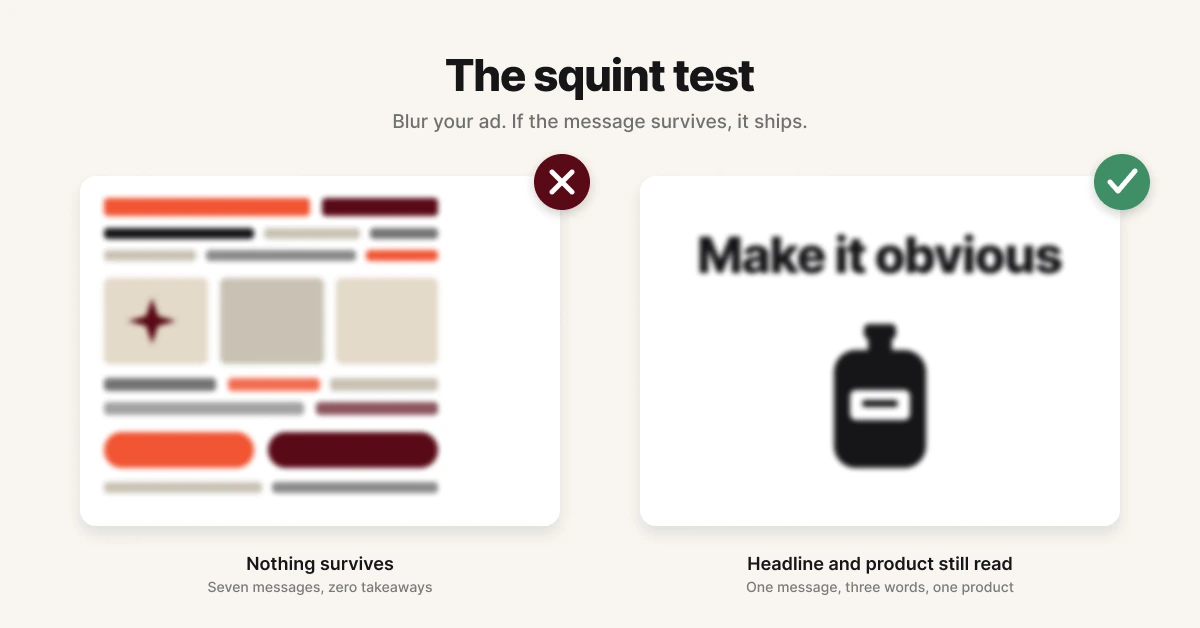
What done looks like: every creative in the batch passes the squint test and follows Meta's image ad specs for each placement, with 1:1 and 4:5 ratios covered.
Step 4: Write copy that sells in seven words
Strong static ad copy makes the benefit unmistakable in seven words or fewer. The image earns the stop; the headline earns the click. For product-aware audiences, short punchy copy beats long-form almost every time.
Write the headline as an outcome, not a feature. "Sleep cooler tonight" beats "Advanced cooling gel foam technology." Specificity multiplies believability: "Cut CPL 27%" beats "Improve your results."
Keep primary text short for retargeting and hot audiences. For colder traffic, a longer problem-agitate-solve caption can support the static, but the creative itself must still stand alone, since most viewers never expand the caption.
Match the CTA to intent. "Shop now" suits hot audiences, "Learn more" suits cold ones. A mismatched CTA quietly raises CPA even when the creative is strong.
What done looks like: every creative has a headline under seven words, written in customer language from Step 1, with a CTA matched to the audience temperature.
Step 5: Test with the 3-3-3 framework
Structured testing finds winners; random testing finds noise. The 3-3-3 framework, popularized by Pilothouse, structures each round as 3 concepts, 3 variations per concept, and 3 hooks per variation. Brands running it reported roughly 30% improvement in outbound CTR year over year.
Statics are the cheapest validation layer in this system. If a message fails as a $50 static test, a $5,000 video built on the same message will fail too. Validate the angle cheap, then fund production for proven messages only.
Run each test with discipline:
- Form one hypothesis per round, such as "problem-led hooks beat product-feature hooks for cold traffic."
- Isolate the variable. Change the hook, keep format and offer constant.
- Give each ad enough budget to clear roughly 2,000 impressions or your account's typical learning threshold before judging.
- Read metrics in order: CTR tells you the hook works, CPC tells you the audience matches, CPA and ROAS tell you the offer converts.
- Kill losers fast and log why they lost. The losses are the library that makes the next round smarter.
What done looks like: a testing log where every creative carries a hypothesis, a result, and a tagged reason for winning or losing.
Step 6: Scale winners and rotate before fatigue hits
Creative fatigue is the tax on every winning static. Most accounts need fresh creative every 3 to 6 weeks, and the algorithm needs 5 to 10 active variations per campaign to keep delivery efficient.
Watch three fatigue signals: frequency climbing past 2.5 to 3, CPM rising while CTR falls, and CPA drifting up with no audience or offer change. Any two together mean the creative is dying. Catching this early matters: teams using automated detection catch fatigue 4 to 7 days earlier than manual weekly reviews.
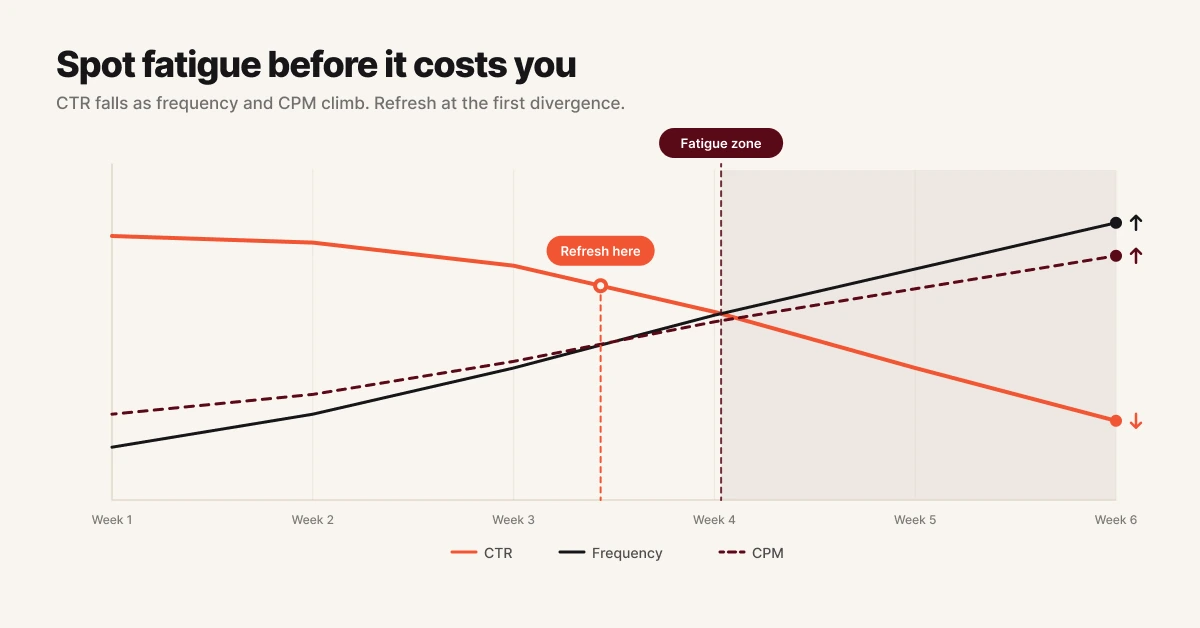
Do not replace winners; iterate them. Keep the proven angle and swap one element at a time: a new headline on the same visual, a new background on the same headline, or the same concept adapted into a different format from the Step 2 table. A single winning static should spawn a family of 5 to 10 descendants before it retires.
This is where production speed becomes the bottleneck. Design cycles of 1 to 2 weeks cannot keep up with fatigue cycles of days. An autonomous creative pipeline closes that gap: Hawky's Creative Agent reads your winning patterns, renders on-brand static variations when a fatigue signal fires, and routes every batch through seat-level approval with a full audit trail, so autonomy never means losing control.
What done looks like: no winning ad set ever runs out of fresh variations, and every refresh is built from a documented winning pattern.
Common mistakes that kill static ad performance
These five mistakes show up in almost every underperforming account:
- Testing layouts instead of angles. Swapping colors and fonts produces no learning. Test the message first; polish the design after the message wins.
- Letting one winner carry the account. A single static at high frequency creates a fatigue cliff. When it dies, performance drops overnight with nothing validated to replace it.
- Over-polishing. Studio-perfect brand ads scream "advertisement" and get scrolled past. Native, slightly imperfect creative wins the feed.
- Shipping one size everywhere. A 1:1 feed creative cropped into Stories placement loses its headline. Adapt every winner to 1:1, 4:5, and 9:16.
- Killing tests too early, or on the wrong metric. Judging an ad on CTR alone promotes clickbait. Judging it before statistical signal promotes noise. Set spend thresholds and read CTR, CPC, and CPA in sequence.
Tools that make this easier
You can run this playbook manually. These tools remove the slowest steps. For a deeper evaluation of the analysis layer, see the 9 best ad creative analysis tools.
Hawky covers the most steps in one platform. Creative Analysis handles the element-level tagging in Step 1, Competitor Analysis tracks long-running rival statics, and the Creative Agent automates Step 6 entirely: it renders on-brand static variations from your winning patterns, fires on fatigue signals, and holds every batch for approval. Hiveminds cut CPL 27% and saved 160+ hours per brand monthly running this system (Hiveminds case study).
Meta Ad Library is the free baseline for competitor research. Filter by platform and active date to find the long-running statics worth studying.
Foreplay organizes swipe files and ad inspiration into searchable boards, useful for the concept stage when briefing designers.
Canva remains the fastest manual production tool for static variations when a human designer owns the pipeline.
Frequently asked questions about static ads that convert
Do static ads still work in 2026?
Yes. Static images still drive roughly 60 to 70% of conversions on Meta, and they remain the cheapest format for testing new messages. Video gets the attention headlines, but statics carry most direct-response budgets.
Are static ads better than video ads?
Neither format is universally better. Statics typically win for retargeting, direct response, and brand-aware audiences because they deliver the offer with zero distraction at lower CPMs. Video wins for cold-audience storytelling and platforms built around motion, like Reels and TikTok.
How many static ad variations should I run?
Keep 5 to 10 active variations per campaign. Fewer than five starves the algorithm of options and accelerates fatigue; the variations should span different angles and formats, not cosmetic tweaks of one design.
How often should I refresh static ads?
Refresh every 3 to 6 weeks for most accounts, or immediately when frequency passes 3 and CTR declines. High-spend accounts fatigue faster and may need weekly refreshes.
What makes a static ad convert?
A converting static ad communicates one specific benefit in under a second, in the customer's own language, with a format matched to the funnel stage. Design supports the message; it never substitutes for it.
How much budget should creative testing get?
Reserve 10 to 20% of total ad spend for testing new static concepts. The testing budget is what keeps the scaling budget supplied with proven winners.
Static ads reward systems, not one-off inspiration. Research the angle, pick the format, design for the scroll, test with structure, and rotate before fatigue. Run the loop weekly and your creative library compounds.
If your team cannot produce fresh statics fast enough to outrun creative fatigue, Hawky's Creative Agent is built for that job. Ready to hire your first AI performance team? Book a demo.