Creative Strategy for Performance Marketing: The Definitive 2026 Guide
After reading this guide, you will be able to build a complete creative strategy for performance marketing: a closed loop that turns performance data into angles, angles into tested creatives, and tested creatives into compounding account knowledge.
Creative strategy for performance marketing, sometimes called performance creative, is the systematic process of using performance data to decide what ads to make, test, and scale. Most teams get this backwards. They produce assets first, then check the data, and treat every new ad as a fresh guess. The teams winning in 2026 run the loop in the other direction: data defines the angle, the angle defines the creative, and every test feeds the next brief.
The stakes are higher than they were even two years ago. Industry analyses consistently attribute 70-80% of paid social performance to the creative itself, with targeting and budget settings accounting for the rest. Meta and Google have automated most of the levers marketers used to pull. Creative is the lever that's left.
What you need before you start
You need three things before building a creative strategy: access to your ad account data, a baseline of past creative performance, and a production pipeline that can ship new creatives weekly.
Specifically, gather:
- Ad account access with at least 90 days of history on Meta, Google, or YouTube
- Element-level performance data: which hooks, visuals, and CTAs drove results, not just which campaigns
- A brand kit: logo, fonts, colors, tone, and compliance rules in one place
- Competitor visibility: a way to see what ads competitors are running and how their messaging shifts
- A production path: in-house designer, agency, or AI creative generation that can turn a brief into finished assets within days, not weeks
If you run $50k+/month, you also need a measurement agreement with finance or leadership on the KPI that matters: ROAS, CAC, LTV, or contribution margin. Every creative decision in this guide traces back to that number.
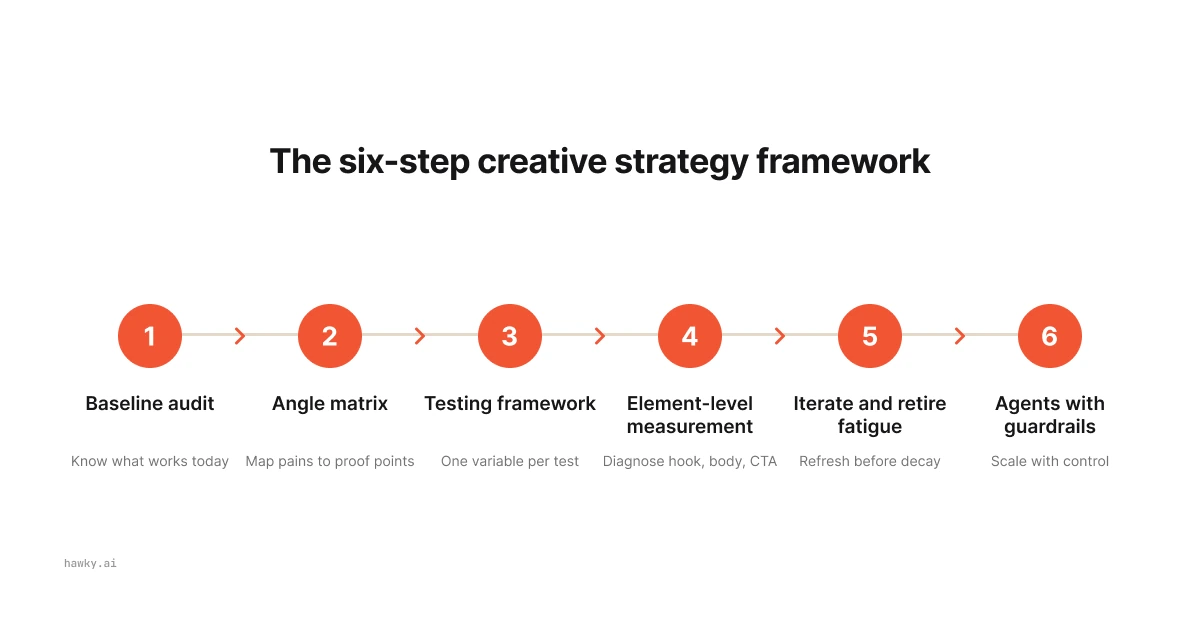
Step 1: Build your creative intelligence baseline
A creative intelligence baseline is an audit of every ad you've run, broken down by element: hook, visual, body copy, CTA, and format. This is the foundation of performance creative. Without it, your briefs are guesses dressed up as strategy.
Start with your top 20 ads by spend over the past 90 days. For each, record the hook style (question, claim, statistic, problem callout), the visual approach (product shot, UGC, lifestyle, comparison), the CTA, and the result against your KPI. Then do the same for your bottom 20. Patterns appear fast: maybe statistic-led hooks beat question hooks by 2x, or UGC outperforms studio shots only on cold audiences.
Do the same exercise for competitors. Their ad libraries are public in the Meta Ad Library and the Google Ads Transparency Center, and their longest-running ads are usually their winners. You're not copying. You're mapping which angles are already saturated in your category and which are open.
What "done" looks like: a single document or dashboard listing your winning patterns, your losing patterns, and the angles competitors own. Teams using element-level creative analysis tools compress this from a week of manual work to hours.
Pro tip: Weight your baseline by recency. A winning hook from six months ago may already be fatigued across your category. Patterns decay, and your baseline should too.
Step 2: Define angles before assets
An angle is the strategic claim that connects your product to a customer's desire or pain. A hook is the first 1-3 seconds that earns attention. One angle can generate 20 or more hook variations, which is why angle selection, not asset production, is the decision with the most upside in your creative strategy.
Build an angle matrix. List your audience's top pains and desires down one axis and your product's proof points across the other. Each intersection is a candidate angle. A sleep supplement brand might find "falls asleep faster" x "clinically tested ingredient" as one angle and "no morning grogginess" x "customer testimonials" as another.
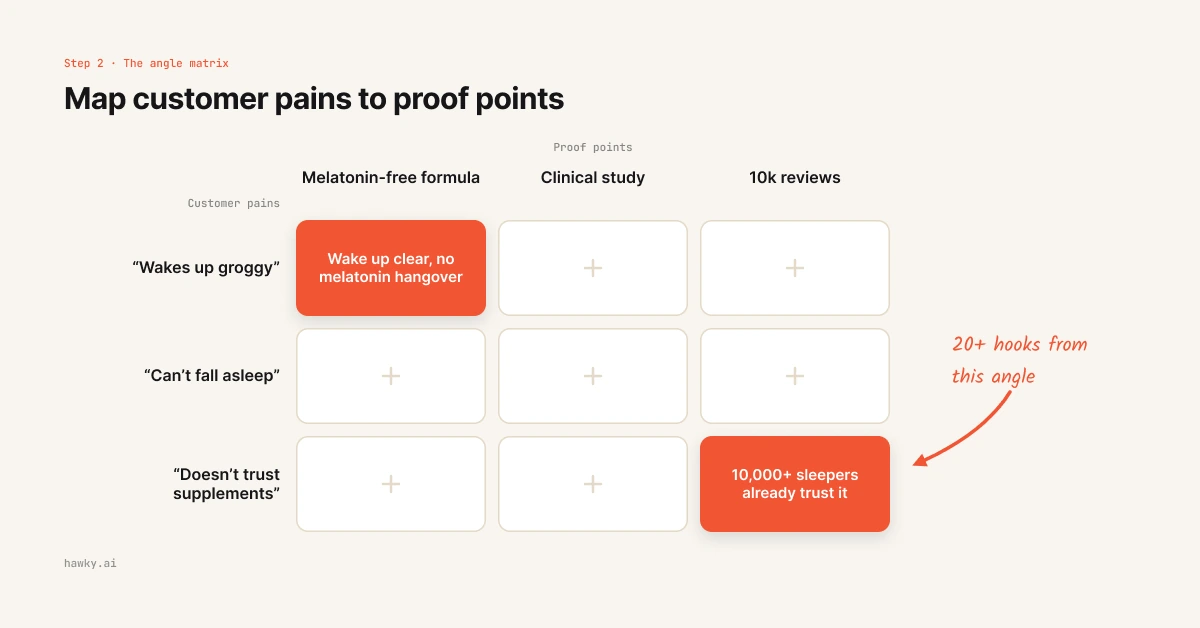
Score each angle on three criteria: evidence (does your baseline data or customer research support it?), saturation (are competitors already running it?), and proof (can you back the claim?). Prioritize high-evidence, low-saturation angles. This is where the competitor mapping from Step 1 pays off.
| Angle matrix component | What it is | Example |
|---|---|---|
| Pain or desire | The customer problem the ad speaks to | "I wake up groggy" |
| Proof point | The product fact that answers it | Melatonin-free formula |
| Angle | The repeatable strategic claim | "Sleep deep without the morning fog" |
| Hooks | 1-3 second openers derived from the angle | 20+ variations per angle |
What "done" looks like: a ranked list of 5-10 angles, each with evidence attached, ready to brief.
Step 3: Build a structured creative testing framework
A creative testing framework is a fixed weekly system that defines how many new concepts you launch, how much budget each gets, and what threshold a creative must clear to win. Without structure, testing produces noise instead of learnings.
The 2026 baseline for accounts at meaningful spend is 2-4 genuinely different concepts per week. The word "different" carries the weight. Meta's algorithm now rewards true creative diversity: distinct angles, formats, and tones. Thirty variations of the same concept fragment your budget and teach you nothing.
Structure each test cycle the same way:
- Brief from the angle matrix. Every concept tests one angle. Write the hypothesis down: "Statistic-led hooks on the grogginess angle will beat the control on hook rate."
- Launch with equal conditions. Same budget, same duration, same audience settings. Unequal tests produce unusable data.
- Let the test run. Most creatives need 3-7 days or a minimum spend threshold (commonly 1-2x your target CPA) before the data means anything.
- Apply decision rules in advance. Define what "winner," "iterate," and "kill" look like before launch, not after.
What "done" looks like: a documented testing calendar, naming conventions that encode angle and hook in every ad name, and decision rules your whole team follows.
Pro tip: Name your ads so the learnings survive. A name like grogginess-angle_stat-hook_ugc_v3 turns your ad account into a searchable research library.
Step 4: Measure creative at the element level
Campaign-level ROAS tells you whether you made money. It does not tell you why. Creative strategy requires element-level measurement: separating the performance of the hook from the message from the conversion path.
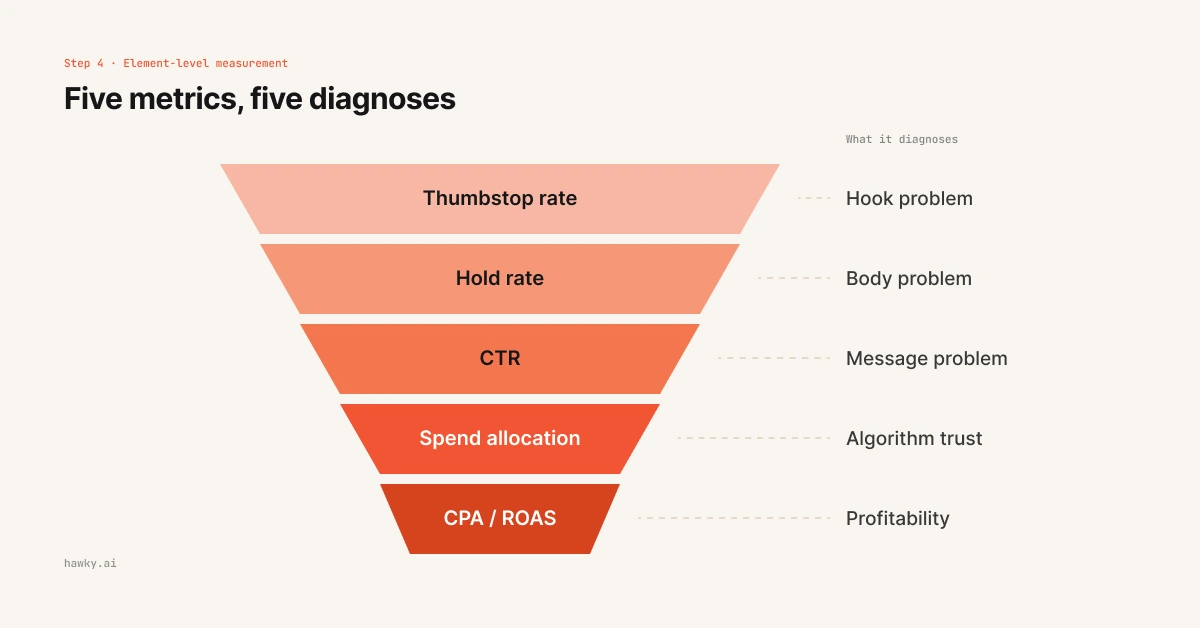
Use this metric stack, in order:
| Metric | What it diagnoses | Healthy signal (Meta, typical) |
|---|---|---|
| Thumbstop / hook rate | Is the first 3 seconds earning attention? | 25%+ of impressions watch past 3s |
| Hold rate | Does the body sustain interest? | 10%+ watch to 50% |
| CTR | Does the message drive action? | 1%+ outbound |
| Spend allocation | Does the algorithm trust the creative? | Rising share within the ad set |
| CPA / ROAS | Is it profitable? | At or below your KPI target |
Read the stack top to bottom like a funnel. A creative with a strong hook rate but weak CTR has a message problem, not an attention problem. Iterate the body and CTA, keep the hook. A creative with weak hook rate dies in the first 3 seconds; no amount of CTA optimization saves it.
Watch spend allocation closely. Meta's delivery system votes with budget, shifting spend toward creatives it predicts will convert. When a new creative starts pulling spend share within days of launch, the algorithm is telling you something your dashboard hasn't confirmed yet.
What "done" looks like: a weekly creative report that scores every live ad on this stack and tags the failing element, so the next brief targets the actual problem.
Step 5: Iterate winners and retire fatigue early
Creative fatigue is the measurable decline in a creative's performance as the audience sees it repeatedly. It shows up as rising frequency, falling CTR, and climbing CPA, usually in that order. In competitive categories, fatigue can set in within 2-3 weeks of scaling a winner.
The standard playbook catches fatigue late: CPA spikes, someone notices in a weekly report, and the team scrambles for a replacement while spend burns. The better playbook watches leading indicators (frequency, CTR trend, hook rate decay) and preps successors before the cliff. Teams running automated fatigue detection catch it 4-7 days earlier than manual review cycles.
When a winner fatigues, don't start from zero. Iterate along one axis at a time:
- Same angle, new hook: cheapest iteration, fastest to produce
- Same hook, new format: static to video, UGC to studio, single image to carousel
- Same angle, new proof: swap the testimonial, statistic, or demonstration
- New angle: only when the angle itself, not the execution, has saturated
This is also where playbooks earn their keep. Document every winning pattern (the angle, hook style, format, and audience it won with) in a shared system. Institutional creative knowledge is the asset that compounds; without documentation, it walks out the door with your media buyer.
What "done" looks like: no winner scales without a successor already in testing, and no learning lives only in someone's head.
Step 6: Scale the loop with agents and guardrails
Everything in Steps 1-5 can run manually. At scale, it shouldn't. The loop (analyze, brief, produce, test, measure, iterate) is exactly the kind of repetitive, data-heavy work that AI agents now handle end to end, which is why autonomous performance marketing has moved from pitch deck to production in 2026.
The shift is from tools that recommend to agents that execute. A recommendation engine tells you a creative is fatiguing; an agent generates the replacement from your winning patterns, routes it through your approval flow, and binds it to the right ad set. A dashboard reports that spend allocation shifted; an agent rebalances budget against your KPI and logs the trigger data for every move.
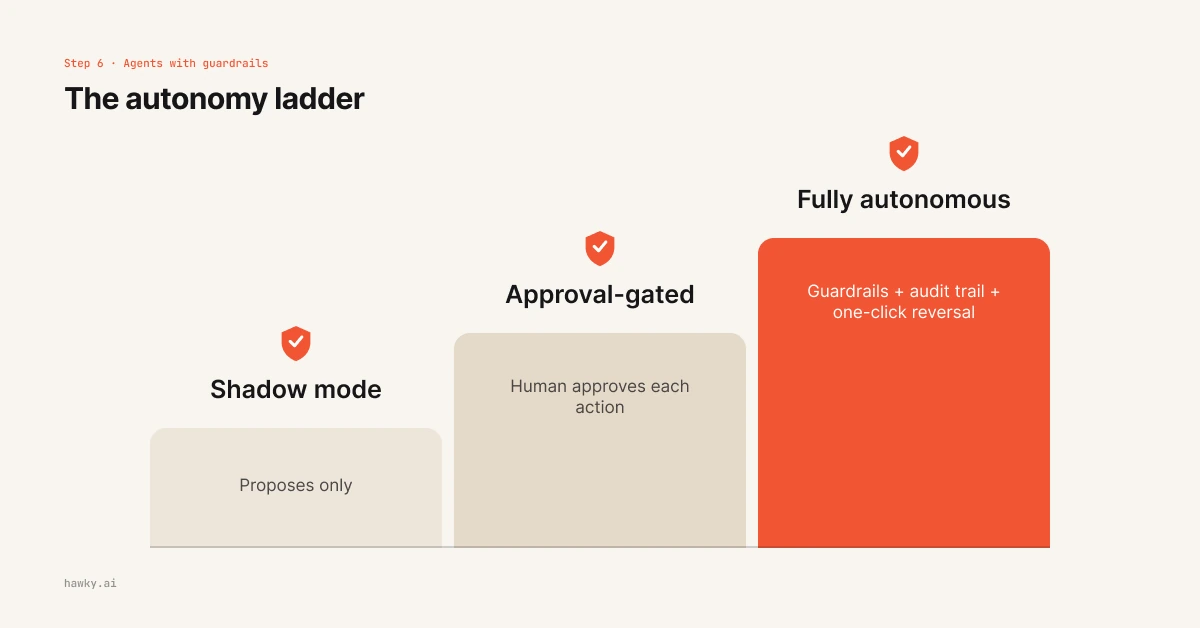
Autonomy without control is a liability, so configure the gate to match your trust level:
- Shadow mode: the agent proposes every action but executes nothing. You grade its judgment risk-free.
- Approval-gated: the agent executes only what a human approves, at the batch, campaign, or brand level.
- Fully autonomous: the agent operates within guardrails (spend caps, KPI floors, brand rules) with every action logged and one-click reversible.
Loosen the gate as trust builds. The audit trail stays constant throughout, so you can always answer "why did the system do that?" with the actual trigger data and confidence score behind the decision.
What "done" looks like: your team spends its hours on judgment (which angles to pursue, which claims to make, what the brand stands for) while agents handle the labor of production, monitoring, and optimization.
Common creative strategy mistakes to avoid
1. Testing variations instead of concepts. Ten crops of the same ad is one test, not ten. Meta's algorithm clusters similar creatives, and your "testing program" becomes an expensive way to learn nothing. Test genuinely different angles and formats.
2. Killing creatives too early. Judging a creative on day one is reading tea leaves. Set a minimum spend or conversion threshold before any kill decision, and hold to it even when early numbers look ugly.
3. Measuring only at the campaign level. Campaign ROAS can look healthy while every new creative fails, because one old winner carries the account. Element-level measurement catches the rot before the winner fatigues.
4. Briefing without evidence. "Let's try something fun" is not a brief. Every concept should trace to an angle, and every angle to data: your baseline, customer research, or a competitor gap.
5. Losing learnings between cycles. If your creative insights live in a media buyer's memory or a dead Slack thread, you rebuild your strategy from scratch every quarter. Document winning patterns in a system the whole team reads.
Tools that make creative strategy easier
Hawky runs most of this loop in one platform. Its Performance Agent plans, launches, and optimizes Meta, Google, and YouTube campaigns against your KPI around the clock, with every action logged, reversible, and gated by configurable guardrails. Its Creative Agent reads your winning patterns and renders finished on-brand creatives, triggered by schedule, fatigue signal, or command. Both agents work from a living memory layer, a centralized store that compounds knowledge of your brand, which is how customers reach results like 27% lower CPL and 160+ hours saved per brand monthly.
Motion focuses on creative analytics and reporting for Meta-heavy teams. Strong visual reporting that helps creative strategists communicate with designers, though production and execution stay manual.
Foreplay handles creative research and swipe files. Good for building competitor ad libraries and briefing, less for measurement or automation.
Superads offers AI-powered creative reporting with a focus on creative diversity scoring. Useful for diagnosing whether your testing program has genuine variety.
Canva or Figma plus a clear playbook remains the budget path for production. Pair with manual analysis if you're under $20k/month in spend and the economics of automation don't pencil yet.
For a deeper evaluation of this category, see the 9 best ad creative analysis tools.
Frequently asked questions
What is creative strategy in performance marketing?
Creative strategy in performance marketing is the systematic process of using performance data to decide which ad concepts to produce, test, and scale. It connects account data, customer research, and competitor intelligence to creative production, replacing guesswork with a measurable loop: data informs angles, angles become creatives, and test results feed the next round of briefs.
What percentage of ad performance comes from creative?
Industry analyses in 2025-2026 consistently attribute 70-80% of paid social performance to the creative itself, with targeting, budget, and bid settings driving the remainder. As Meta and Google have automated audience targeting and bidding, creative quality and diversity have become the primary levers marketers still control directly.
How many ad creatives should you test per week?
Most accounts at meaningful spend ($50k+/month) should test 2-4 genuinely different creative concepts per week. The emphasis is on concept diversity, not volume: distinct angles, formats, and hooks. Smaller accounts should test fewer concepts but hold each to a minimum spend threshold (typically 1-2x target CPA) before making decisions.
What is creative fatigue and how do you prevent it?
Creative fatigue is the decline in an ad's performance as the target audience sees it repeatedly, visible as rising frequency, falling CTR, and climbing CPA. You prevent its damage by monitoring leading indicators (frequency, CTR trend, hook rate decay) and keeping successor creatives in testing before winners hit the cliff. Automated fatigue detection typically catches decline 4-7 days earlier than manual weekly reviews.
What does a creative strategist do?
A creative strategist owns the connection between performance data and creative production. They analyze which ads work and why, translate those findings into evidence-backed briefs and angles, and manage the testing pipeline that turns briefs into validated winners. In 2026, the role increasingly involves supervising AI agents that handle analysis and production, shifting the human's job toward judgment and brand stewardship.
Can AI agents really run creative strategy autonomously?
AI agents can now execute most of the creative strategy loop: detecting fatigue, generating on-brand creatives from winning patterns, launching tests, and rebalancing budgets against a KPI. Autonomy works when paired with control: shadow modes, approval gates, spend caps, and full audit trails with reversible actions. The strategic decisions (which angles to pursue, what the brand claims) remain human judgment calls.
Creative strategy in 2026 is a loop, not a deliverable. Data defines angles, angles define creatives, tests define winners, and winners feed memory that makes the next cycle smarter. Run the loop manually and you'll beat teams that guess. Run it with agents under guardrails and you'll beat teams that run it manually.
If your creative testing runs on gut feel and your winners fatigue before replacements ship, Hawky's Creative Agent and Performance Agent are built for that job.
Ready to hire your first AI performance team? Book a demo