Creative Strategy Frameworks: 7 Mental Models for Modern Operators in 2026
Creative strategy frameworks are the mental models operators use to decide what to make and why, so creative becomes a system of bets instead of a guessing game. The seven below are the ones modern performance teams actually reach for in 2026, and together they turn a blank brief into a clear, testable plan.
A process tells you how to run the loop; a framework tells you what to put into it. If you already run a creative strategy loop, these are the models you plug into each cycle to brief sharper, test smarter, and scale what works. Here are seven, with when to use each and how to apply it.
What a creative strategy framework actually is
A creative strategy framework is a repeatable mental model that turns performance data and audience insight into specific creative decisions. It is not a template for the ad itself; it is the thinking that decides which angle, message, or format to bet on next.
Frameworks matter because creative is now the biggest lever in paid media, and a blank page is the slowest way to use it. A good framework narrows infinite options to a short list of high-probability bets, which is what lets a small team out-produce a bigger one. Use them as lenses, not laws: pick the one that fits the decision in front of you.
The point of a framework is speed and repeatability, not rigidity. It removes the part of the work where teams stall (staring at a blank brief, debating opinions) and replaces it with a structured way to choose. The seven that follow cover the decisions an operator faces every week, from who to talk to, to what to say, to how much to bet.
The 7 creative strategy frameworks modern operators use
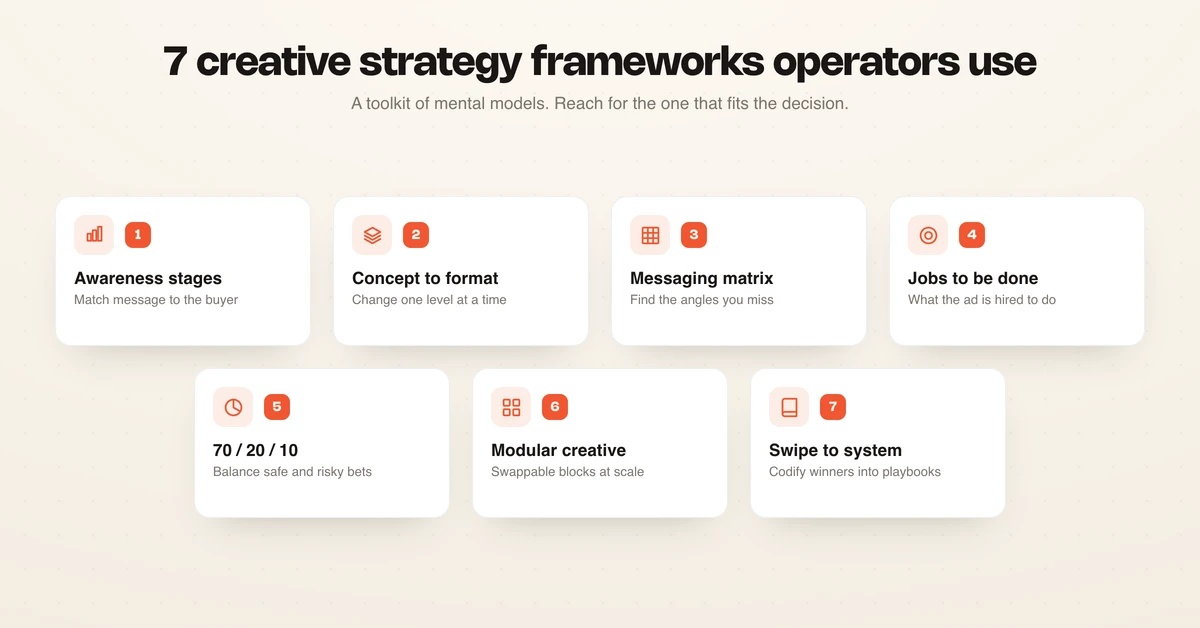
1. The awareness stages: match the message to the buyer
The awareness-stages model, drawn from Eugene Schwartz's Breakthrough Advertising, says a prospect sits at one of five stages, and your message has to meet them there. Pitch a product-aware buyer like they are unaware and the ad falls flat.
The five stages run from unaware to most-aware, and each calls for a different creative job. Cold, unaware audiences need a problem named before any product talk, while most-aware audiences just need the offer and a reason to act now. (Customer awareness stages)
| Stage | What they know | Creative job |
|---|---|---|
| Unaware | Not aware of the problem | Name the problem |
| Problem-aware | Feel the pain, not the fix | Agitate, then hint at a path |
| Solution-aware | Know solutions exist | Show your category is best |
| Product-aware | Know your product | Prove it, handle objections |
| Most-aware | Ready to buy | Offer, urgency, CTA |
When to use it: any time you are briefing for a new audience or a full-funnel rollout.
2. Concept, angle, hook, format: keep the levels straight
This framework separates a creative into four levels so you change one at a time and learn what actually moved the result. Teams that blur these levels test chaos and learn nothing.
The concept is the big idea, the angle is the specific reason-to-buy it argues, the hook is the first two seconds that earn attention, and the format is the container (UGC, static, motion). A new hook on the same concept is a fast iteration; a new concept is a real swing. Naming the level you are changing is what makes a test readable.
When to use it: every brief and every test, so each variant isolates one level.
3. The messaging matrix: cover the angles you are missing
A messaging matrix maps customer pains and desires against proof types, so you can see which angles you have tested and which you have ignored. Most accounts over-index on one or two angles and leave winning ones undiscovered.
Build a simple grid: rows are the core pains and desires your product addresses, columns are proof types (demo, before-and-after, social proof, expert, comparison). Each cell is a potential creative bet, and the empty cells are your roadmap. The matrix turns "we need more ads" into "we need a social-proof angle on the time-saving benefit."
When to use it: quarterly planning, or any time the pipeline feels repetitive.
4. Jobs to be done: ask what the ad is hired to do
The jobs-to-be-done lens, adapted from Clayton Christensen's framework, asks what job a specific creative is hired to do in the funnel, not just what it says. An ad that should be earning a click is judged differently from one meant to build belief.
Define the job before you brief: stop the scroll, reframe the problem, prove the claim, or close the sale. The job sets the success metric, so a top-funnel hook is read on hook rate, not on immediate ROAS. Judging every ad by the same number is how good creative gets killed early.
When to use it: when deciding what to test next and which metric to judge it on.
5. The 70/20/10 portfolio: balance safe and risky bets
The 70/20/10 model splits creative effort across safe iterations, new angles, and wild experiments, so you scale winners without going stale. Pour everything into safe iterations and the account fatigues; pour it all into wild bets and performance whipsaws.
Allocate roughly 70% of effort to iterating proven winners, 20% to new angles adjacent to what works, and 10% to genuinely different swings. The 10% is where your next breakthrough hides, and the 70% keeps the account stable while you look for it. (The ultimate guide to creative testing)
| Tier | Share of effort | Purpose |
|---|---|---|
| Iterate | ~70% | Extend proven winners |
| Expand | ~20% | New angles near what works |
| Experiment | ~10% | Wild, different bets |
When to use it: planning your weekly or monthly creative slate.
6. Modular creative: build for swappable parts
Modular creative treats every ad as a stack of swappable blocks (hook, body, proof, CTA) so you can produce many variants without rebuilding from scratch. It is the framework that makes high-volume testing affordable.
Design the winner once, then systematically swap one block at a time: five hooks on one body, or three CTAs on one demo. This multiplies your test surface while keeping production cheap, and it pairs perfectly with the concept-angle-hook-format levels. The result is more readable tests and a faster path to the next winner. (Static ads that convert)
When to use it: whenever you need volume, which in 2026 is most of the time.
7. Swipe to system: turn winners into playbooks
The swipe-to-system framework captures why a winning creative worked and codifies it into a repeatable pattern, so a one-off success becomes an institutional asset. Without it, every quarter starts cold and the same lessons get relearned.
When an ad wins, document the pattern: the angle, the hook structure, the proof, the audience. File it where the next brief writer will see it, and the library compounds instead of evaporating. This is the difference between a team that gets luckier and a team that gets smarter. (Creative performance metrics)
When to use it: after every clear winner, as a standing ritual.
How the frameworks fit together
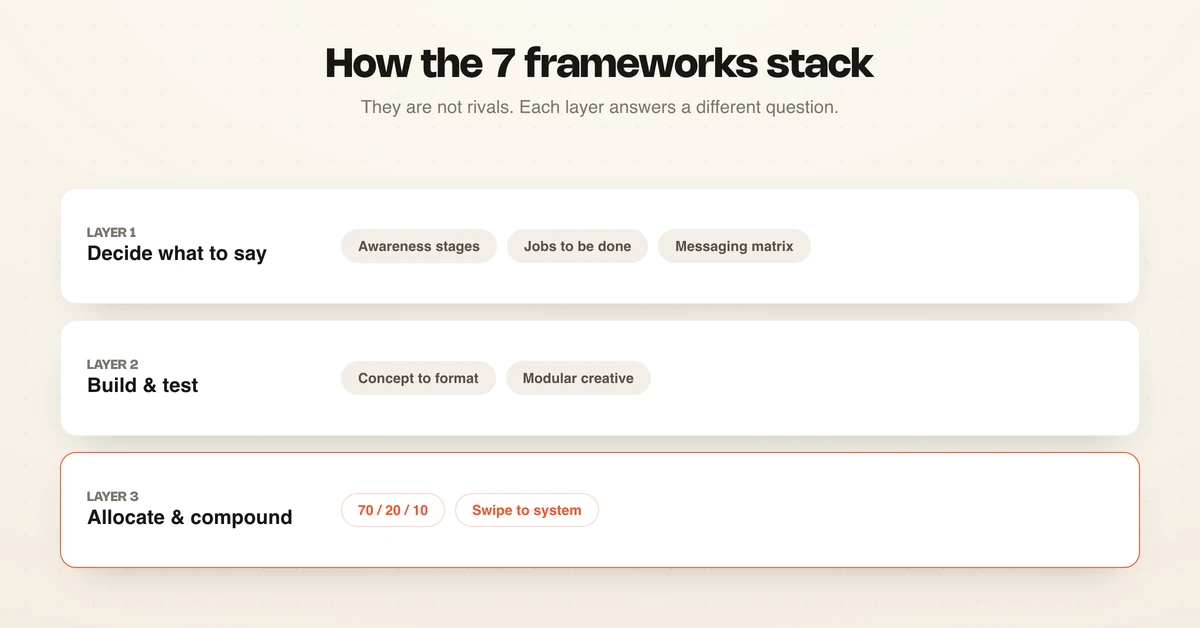
These frameworks are not competitors; they stack. Awareness stages and jobs-to-be-done decide what a creative should say and do, the messaging matrix finds the gaps, concept-angle-hook-format and modular creative shape how you build and test, and 70/20/10 plus swipe-to-system govern how you allocate and compound over time.
In practice you do not use all seven on one ad. You reach for the one that fits the decision: planning a slate (70/20/10), briefing a cold audience (awareness stages), or filing a winner (swipe to system). The skill is matching the model to the moment.
Common mistakes when using creative strategy frameworks
Frameworks fail in practice for predictable reasons, and knowing them keeps the models useful instead of decorative.
- Treating a framework as a checklist. Forcing all seven onto one brief produces a muddled ad. Pick the model that fits the decision and ignore the rest.
- Letting the matrix go stale. A messaging matrix built once and never updated stops surfacing gaps. Revisit it as new winners and angles appear.
- Cutting the 10% first. When budgets tighten, the experimental tier is the easiest to kill and the most expensive to lose, because that is where breakthroughs hide.
- Skipping the awareness stage. Briefing every audience the same way wastes cold traffic on product-aware messaging. Map the stage before you write the hook.
- Never filing winners. A win that is not documented is a lesson you pay to learn again. Make swipe-to-system a standing ritual, not an afterthought.
How to apply these frameworks at scale
Frameworks are only as good as how consistently you run them, and that is where most teams break down: the matrix goes stale, winners never get filed, and the 10% experiments get cut first. The discipline, not the idea, is the hard part.
This is where agents help. An agentic platform like Hawky operationalizes the frameworks: its Creative Agent reads your winners and competitor patterns from FeatherDB (swipe to system in practice), generates modular variants mapped to angles and awareness stages, and routes them through approval, while the Performance Agent holds the 70/20/10 balance and tests against your KPI. Configurable autonomy keeps you in command, from approval-gated to fully autonomous with a full audit trail. The Man Company doubled creative performance and cut iteration cycles by 50% running this way.
Whether you run the frameworks by hand or with agents, the principle holds: pick the right model for the decision, and let your winners compound into a system.
Frequently asked questions
What is a creative strategy framework?
A creative strategy framework is a repeatable mental model that turns audience insight and performance data into specific creative decisions, like which angle, message, or format to test next. It is not the ad template itself; it is the thinking that narrows infinite options to a short list of high-probability bets. Operators use frameworks as lenses, choosing the one that fits the decision in front of them.
Which creative strategy framework should I use?
Match the framework to the decision. Use the awareness stages when briefing a new or cold audience, the messaging matrix when planning a quarter, the 70/20/10 portfolio when building your slate, and swipe-to-system after every winner. Most teams combine several across a single cycle rather than relying on one.
What is the 70/20/10 rule in creative strategy?
The 70/20/10 rule allocates creative effort across three tiers: about 70% to iterating proven winners, 20% to new angles adjacent to what works, and 10% to genuinely different experiments. It keeps the account stable while still hunting for breakthroughs. The 10% tier is where most step-change winners are found, so it should be protected, not cut first.
How do awareness stages change ad creative?
Awareness stages change the job of the creative based on what the prospect already knows. Unaware audiences need the problem named before any product talk, solution-aware audiences need proof that your category and brand are the best choice, and most-aware audiences just need the offer and a reason to act now. Matching the message to the stage is one of the biggest levers in creative strategy.
Do creative strategy frameworks still matter with AI?
Yes, more than ever. AI agents can generate and test creative at scale, but they need direction on what to make and why, which is exactly what frameworks provide. The frameworks become the instructions you give the system, so the strategist sets the angles and awareness mapping while agents handle the production and testing labor.
If keeping these frameworks running consistently is the hard part, Hawky's Creative Agent and Performance Agent are built for that job: they turn your winners into modular variants mapped to the right angle and stage, and balance the testing portfolio against your KPI, with guardrails and a full audit trail keeping you in command.
Ready to hire your first AI performance team? Book Demo