The 5 Stages of Awareness: A Marketer's Guide (Eugene Schwartz)
The 5 stages of awareness are Unaware, Problem Aware, Solution Aware, Product Aware, and Most Aware. Copywriter Eugene M. Schwartz defined them in Breakthrough Advertising in 1966, and they describe how much a buyer knows about their problem, the solutions available, and your product. Hawky's Creative Agent uses the same 5 awareness stages to generate stage-matched ad creative from a brand's proven winners.
Schwartz wrote Breakthrough Advertising while selling direct-response products by mail, and the model has outlived every media channel it was written for. The awareness stages matter because ad performance depends on matching your message to what the buyer already knows. Show a discount code to someone who has never heard of you and they scroll past. Show an educational explainer to someone ready to buy and you delay the sale.
Who created the 5 stages of awareness?
Eugene M. Schwartz, an American direct-response copywriter, introduced the five stages of awareness in Breakthrough Advertising, published by Prentice-Hall in 1966. The book argues that a copywriter cannot create desire, only channel existing desire toward a product, and that the buyer's awareness level decides which headline can do that work.
Schwartz's own term was levels, not stages. The Eugene Schwartz levels of awareness, the Eugene Schwartz 5 levels of awareness, and the 5 stages of awareness all name the same model, and awareness levels and awareness stages are used interchangeably today.
Schwartz paired the awareness stages with a second idea called market sophistication, which tracks how many competing claims a buyer has already heard in a category. Awareness tells you what the buyer knows. Sophistication tells you how tired they are of hearing it. Together they describe market awareness: what your category already understands, and how much of it they have already been told. Most marketers use the 5 stages of awareness and ignore sophistication, which is why so many ads sound identical inside a crowded category.
What are the 5 stages of awareness?
The 5 awareness stages segment buyers by how much they know, not by who they are. Demographics tell you a buyer is a 34-year-old marketing manager. The stages of awareness tell you whether she knows she has a problem worth solving.
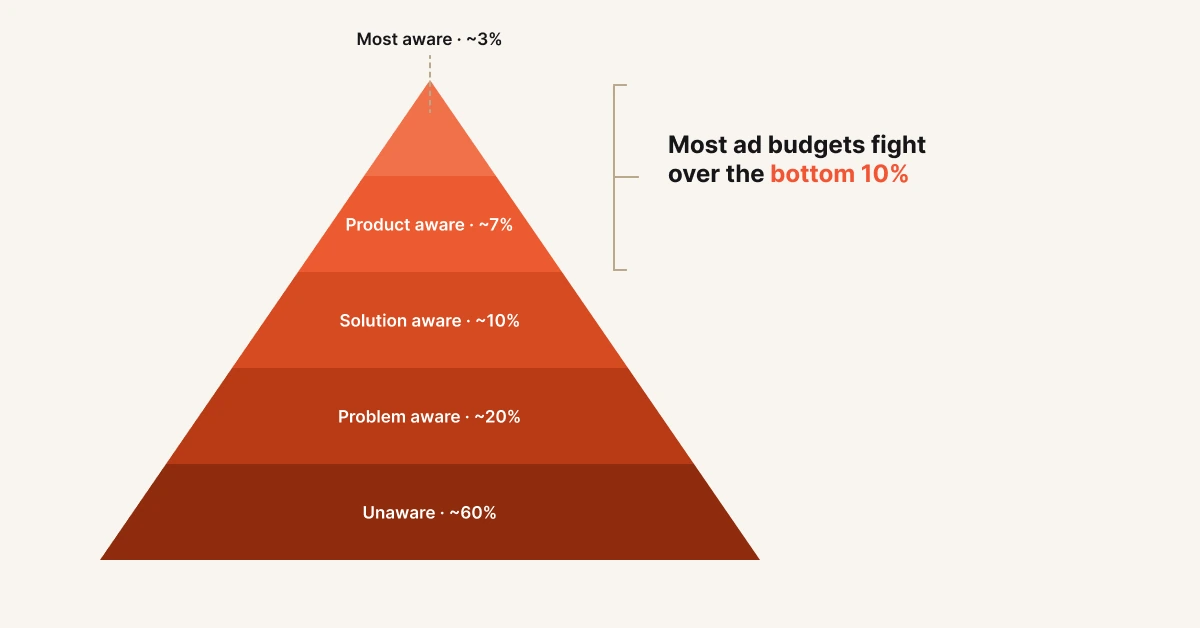
In order, the 5 levels of awareness are unaware, problem aware, solution aware, product aware, and most aware. Every buyer sits at one of those five points on a knowledge spectrum, from no felt problem at all to fully informed and waiting for the right offer.
| Stage | What the buyer knows | Share of market (typical) |
|---|---|---|
| 1. Unaware | Nothing. No felt problem, no search activity | ~60% |
| 2. Problem Aware | The pain, but not that solutions exist | ~20% |
| 3. Solution Aware | Solutions exist, but not your product | ~10% |
| 4. Product Aware | Your product, but not why it beats alternatives | ~7% |
| 5. Most Aware | Everything. They are waiting for the right offer | ~3% |
The percentages vary by category and brand maturity, but the shape holds: the further down the list, the smaller and more valuable the audience. Most ad budgets fight over the bottom 10 percent while the top 80 percent goes unaddressed.
Why the awareness stages decide ad performance
The awareness stage you write for determines which ad message converts and which one gets ignored. This is the whole premise of awareness marketing, and building marketing awareness of where your buyers actually sit is the cheapest performance fix most accounts have available. The most common failure pattern looks like this: a brand runs product-focused ads with discount CTAs to broad cold audiences, clicks come in, conversions do not. The team concludes the creative is weak and tests new colors and layouts. Performance stays flat because product-aware messaging is hitting problem-aware people.
This matters more now than it did in Schwartz's era for one structural reason. Meta's advertising objectives and Google's Performance Max have absorbed most audience targeting decisions, and both platforms now find the audience from the assets you supply. When the algorithm picks who sees the ad, your creative is the targeting. Writing for a stage is how you tell the algorithm which buyer to look for.
Unaware
Unaware buyers do not know they have a problem your product solves. They feel symptoms, a bloated CAC, a cluttered skincare shelf, afternoon energy crashes, but they have not named the cause. This is the largest and cheapest audience in every category, and the one most accounts have zero creative for.
Message job: name a problem the viewer has not yet named.
Creative angle: story-led and curiosity-led. Pattern interrupts, relatable scenarios, "the moment you realize" narratives. Nothing about your product, because the buyer has no frame to evaluate it.
Example ad approach: a 20-second first-person video opening on "Why your current skincare routine might be aging you faster," with the brand appearing only in the final frame. Judge it on hook rate and hold rate, never on ROAS. See the best DTC Meta ad hooks for opening lines that survive cold traffic.
Problem Aware
Problem aware buyers can name their pain but do not know solutions exist. They search symptoms, read threads, and consume educational content at high rates. They are receptive and openly skeptical of being sold to.
Message job: validate the pain precisely enough that the buyer assumes you know the cure.
Creative angle: education. Pain-point hooks, mini explainers, founder-story video, UGC that mirrors their frustration.
Example ad approach: a carousel titled "Struggling with creative fatigue every three weeks? Here is what is actually happening in your ad account," ending on a link to a guide rather than a product page. Measure CTR and content consumption.
Solution Aware
Solution aware buyers know solution categories exist but have not picked one, and they may not know your product at all. They compare approaches: hire an agency or buy software, diet or exercise, manual media buying or an AI agent.
Message job: sell the approach before the brand, then attach your product to it.
Creative angle: comparison content and "three ways to solve this" frameworks that position your category as the smart default.
Example ad approach: a split-screen static reading "The three ways to fix rising CAC, and why most teams pick the wrong one," with the product introduced as the third option plus one number of proof. The creative strategy frameworks guide covers how to structure these angles at scale.
Product Aware
Product aware buyers know your product exists but are not convinced it is the best choice. They are reading reviews, comparing you against named alternatives, and looking for a reason to believe or walk away.
Message job: replace opinion with evidence.
Creative angle: social proof, case studies with specific numbers, comparison statics, objection-handling creative. Retargeting pools are built for this stage.
Example ad approach: a testimonial video cut around one verifiable result, such as "Hiveminds cut CPL 27% and saved 160+ hours per brand each month." Specific customer, specific metric, no vague brand language.
Most Aware
Most aware buyers know your product, want it, and are waiting for the right moment or offer. The job is removing the last piece of friction, and every extra sentence between desire and checkout costs conversions.
Message job: make the offer and get out of the way.
Creative angle: offers, deadlines, guarantees, abandoned-cart sequences, free trials and pilots. One CTA, no education.
Example ad approach: a dynamic product ad or a single-frame static reading "Your 30-day free pilot is waiting. Start today, cancel anytime." Measure conversion rate, ROAS, and AOV.
What should your ads do at each awareness stage?
Each awareness stage has one job, and the ad fails when it tries to do the next stage's job too early. Unaware ads name the problem. Problem aware ads validate the pain and prove a fix exists. Solution aware ads compare approaches and introduce the product. Product aware ads prove superiority with evidence. Most aware ads present the offer.
| Stage | Ad message | Best formats | CTA | Primary KPIs |
|---|---|---|---|---|
| Unaware | Name the hidden problem | Story video, native-style content | "Learn more" | Reach, hook rate, engagement |
| Problem Aware | Validate pain, educate | Explainer video, carousel, UGC | "See how" | CTR, content consumption |
| Solution Aware | Compare approaches, introduce product | Comparison carousel, demo snippets | "Compare options" | Email signups, retargeting pool growth |
| Product Aware | Prove superiority | Case study video, testimonial, comparison static | "See results" | Product page visits, demo requests, add-to-cart |
| Most Aware | Remove friction, make the offer | Offer static, dynamic product ads | "Buy now" or "Start trial" | Conversion rate, ROAS, AOV |
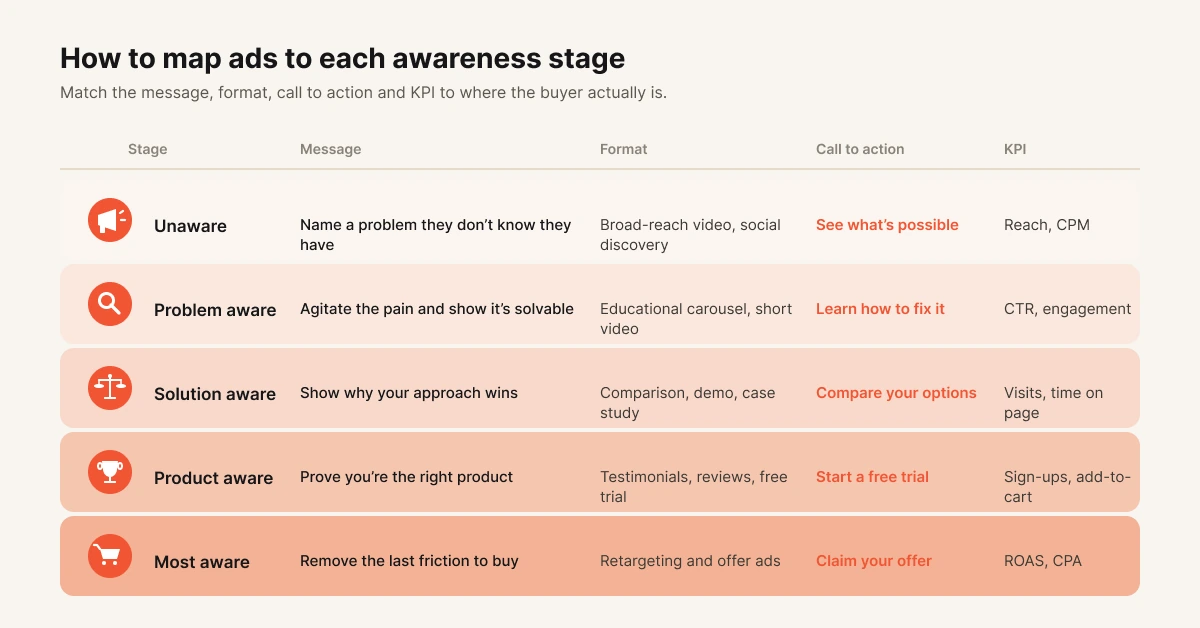
Three rules make the mapping hold up in a live account:
- Audit before you create. Tag every live ad with the stage its message targets. Most accounts discover 80 percent of creative speaks to stages 4 and 5 while the media plan buys cold traffic.
- Budget across the spectrum. A common starting split is 20 to 30 percent on stages 1 and 2, 20 to 30 percent on stage 3, and 40 to 50 percent on stages 4 and 5. Newer brands need more top-stage spend to fill the pool.
- Sequence the journey. Retarget stage-2 engagers with stage-3 creative and stage-3 engagers with stage-4 proof. Each stage's audience is built from the previous stage's engagement.
In a category where the decision takes months, the stages stop being a diagram and become a content schedule.
Velocity podcast
“At every stage our goal is not to push the sale, but to stay relevant. I think in real estate marketing, if content disappears, your buyer will disappear.”
Awareness stages vs. the marketing funnel
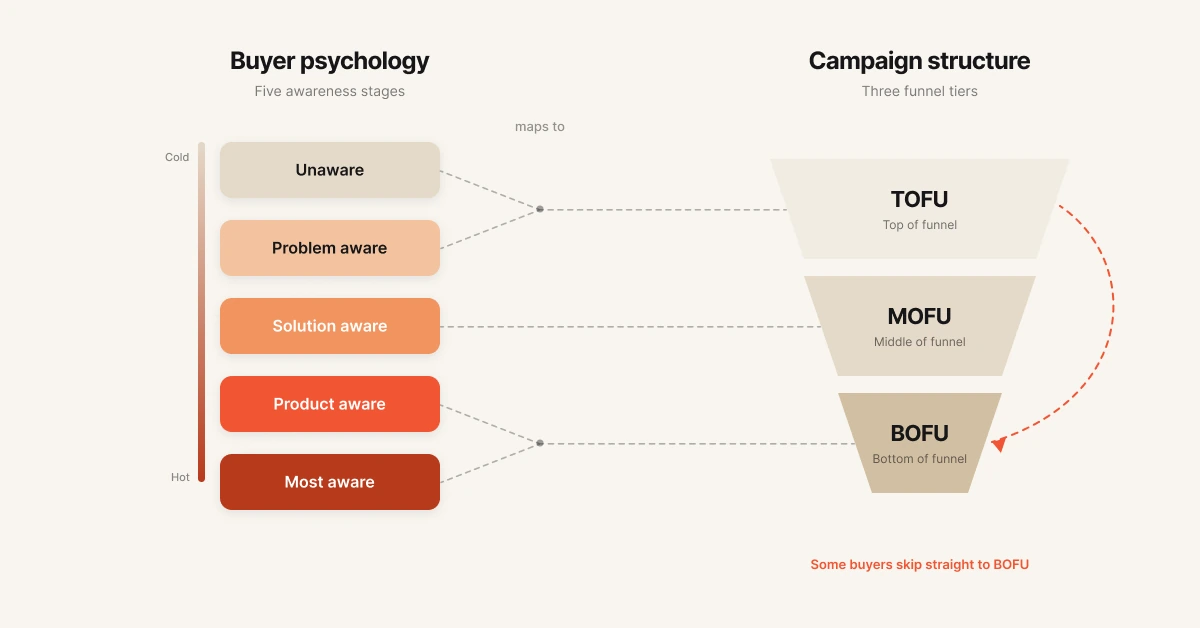
Awareness stages and the marketing funnel are related but not interchangeable. The funnel (TOFU, MOFU, BOFU) describes your campaign architecture. The 5 stages of awareness describe the buyer's state of knowledge. One is your structure, the other is their psychology.
| Framework | Describes | Unit of analysis |
|---|---|---|
| Awareness stages | What the buyer knows | The buyer's mind |
| Marketing funnel | How you organize campaigns | Your media plan |
If your team labels campaigns awareness consideration conversion rather than TOFU, MOFU, and BOFU, the mapping is the same: awareness covers stages 1 and 2, consideration covers stage 3, and conversion covers stages 4 and 5.
The rough mapping: unaware and problem aware align with TOFU, solution aware with MOFU, and product aware and most aware with BOFU. The distinction matters because buyers skip around. Someone can land on your pricing page fully solution aware from a Reddit thread you never paid for, and platform data will misread where they started.
How to measure awareness in marketing
Awareness metrics are the part most teams skip, which is why unaware-stage creative gets killed on the wrong number. Judging a stage-1 ad on ROAS is like judging a billboard on click-through rate: the mechanism does not produce that outcome.
Use awareness metrics that match what each stage is actually doing:
| Awareness metric | What it tells you | Best stage |
|---|---|---|
| Reach and unique impressions | How much of the market you touched | Unaware |
| Hook rate (3-second views / impressions) | Whether the opening earns attention | Unaware, Problem Aware |
| Branded search volume | Whether ads are creating name recall | Problem Aware, Solution Aware |
| Ad awareness / brand lift | Whether people remember seeing you | All stages |
| Engaged view rate | Whether the message held past the hook | Problem Aware, Solution Aware |
| Assisted conversions | Whether upper-stage ads support later sales | Unaware through Product Aware |
Ad awareness is the one most accounts never measure. Meta and Google both run brand lift studies that survey exposed against unexposed users, and those are the cleanest read on whether stage-1 and stage-2 spend is doing anything at all. Below the spend threshold for a lift study, branded search volume is the practical proxy: if unaware-stage creative is working, people start typing your name into Google a few weeks later.
Set the measurement window longer than your click window. Awareness in marketing compounds, and a 7-day attribution window will always make top-stage creative look like waste.
How to run the 5 awareness stages in one account
You can implement the framework in a week.
- Tag your live ads by stage. Read each ad's message and assign it a stage from 1 to 5. The gaps become obvious in an hour.
- Map your audiences to stages. Broad cold audiences are stages 1 and 2. Engaged-but-not-purchased pools are stages 3 and 4. Cart abandoners and past buyers are stage 5.
- Fill the missing stages. Most accounts have no stage 1 to 3 creative at all. Write one creative brief per missing stage using the table above.
- Set stage-appropriate KPIs. Judging an unaware-stage ad on ROAS kills it before it can work.
- Test inside the stage, not across it. Compare two unaware hooks against each other, never an unaware hook against a most-aware offer. The ad creative testing guide covers the read rules.
For the planning layer around this, see how to build a creative strategy.
How agents keep every awareness stage fed
Awareness mapping used to be manual labor: audit creative, tag stages, rebuild audiences, rotate ads before fatigue sets in. Five stages across three platforms is more creative than most teams can brief in a month, which is why the top two stages quietly go unfilled.
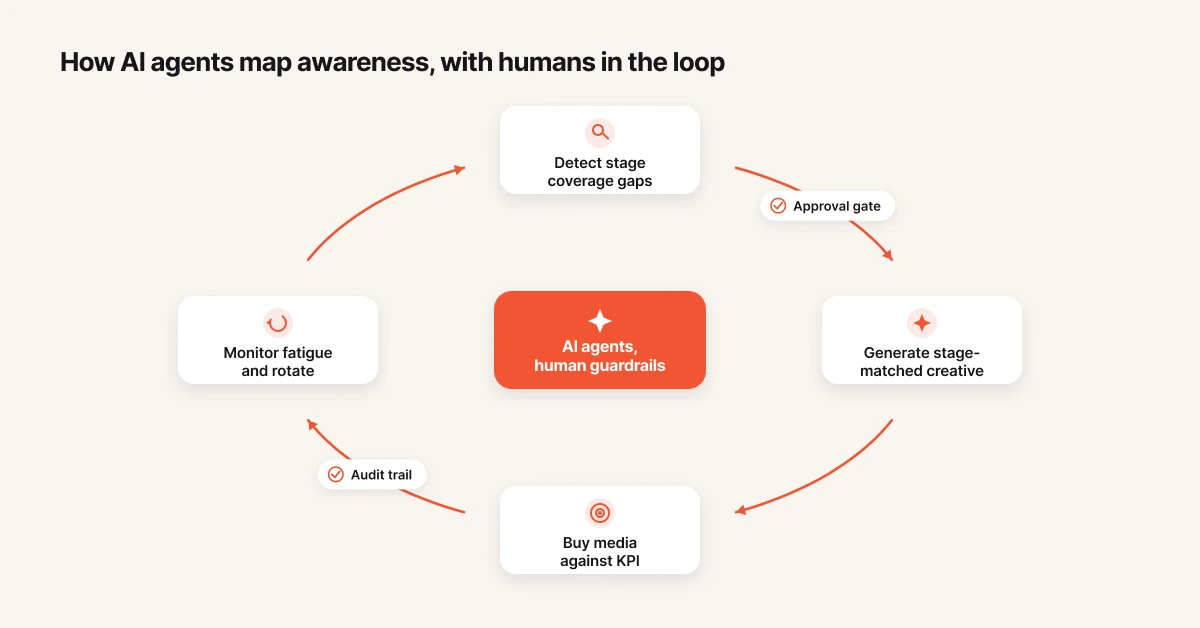
Hawky is an agentic performance marketing platform, and two of its agents cover this work. The Creative Agent renders on-brand creative from a brand's proven winners, so a stage-3 comparison angle or a stage-5 offer static comes back in the same visual language, with every batch approval-gated and bound to a specific ad set. The Performance Agent then runs those ads across Meta, Google, YouTube, and TikTok against your KPI, autonomously and inside guardrails you set, with every action logged and reversible.
Both agents read from FeatherDB, the living-context memory that holds what has already worked in your account. That is what keeps a stage-2 education angle from being rewritten as a stage-5 discount ad three weeks later.
Awareness stage examples
D2C skincare brand: unaware ads name an unrecognized problem ("your cleanser is stripping your skin barrier"). Solution aware ads compare ingredient approaches. Most aware ads serve a first-order discount to cart abandoners. Three messages, three audiences, one product.
B2B SaaS at $100k per month spend: problem aware ads validate the pain of manual reporting hours. Product aware ads run named case studies with CPL numbers against retargeting pools. The team measures problem aware on CTR and product aware on demo requests, not one blended ROAS.
Performance marketing platform: Univest increased CTR by 20% within one week by moving buyers from product aware to most aware with proof-led creative. Evidence is the stage-4 unlock.
Frequently asked questions
What are the 5 stages of awareness?
The 5 stages of awareness are unaware, problem aware, solution aware, product aware, and most aware. They describe how much a buyer knows about their problem, the solutions available, and your specific product, and each stage needs a different ad message to convert.
Who created the 5 stages of awareness?
Eugene M. Schwartz, an American direct-response copywriter, created the framework in his 1966 book Breakthrough Advertising. It remains the standard model for matching ad messaging to buyer knowledge, and most modern funnel frameworks are derived from it.
What should your ads do at each awareness stage?
Unaware ads name a problem the buyer has not recognized. Problem aware ads validate that pain and show a fix exists. Solution aware ads compare approaches and introduce the product. Product aware ads prove superiority with evidence. Most aware ads present the offer and remove friction.
What is the difference between problem aware and solution aware?
A problem aware buyer knows their pain but does not know solutions exist. A solution aware buyer knows solution categories exist but has not chosen one and may not know your product. Problem aware buyers need education about solutions, solution aware buyers need comparison content.
How do awareness stages relate to the marketing funnel?
Awareness stages describe the buyer's knowledge, the funnel describes your campaign structure. Roughly, unaware and problem aware map to TOFU, solution aware to MOFU, and product aware and most aware to BOFU. Buyers skip stages, so treat the mapping as a guide rather than a rule.
Map every ad to the buyer's mind
The 5 stages of awareness are 60 years old and more useful now than when Schwartz wrote them, because creative has become the targeting. Brands that match message to buyer knowledge hand the algorithm five distinct signals instead of one blended guess.
If you need creative matched to each awareness stage, Hawky's Creative Agent is built for that job.
Ready to hire your first AI performance team? Book Demo